I’m organizing “Recent Advances in Generative Models: Theory and Applications” at INFORMS on November 1, 4:15–5:30 PM, in Moscone South 304 (Level 3). The session will cover AI for mathematical and legal reasoning, theoretical foundations of generative models, and more. You are all cordially invited, and I hope to see you there!
@ziwphd@GoogleDeepMind Interested and filled the form. I previously worked on robust evaluation for AI reasoning agents at Google DeepMind and I would love to work on this direction further.
The output of a research project is much more than the paper itself: it is the people who ask fundamental questions and gain intuition + process knowledge. This is very different from digesting textbook knowledge, which is usually a condensed product of decades of deep thinking.
BREAKING: OpenAI might have stolen another major proof.
In a detailed Mastodon post, which I report in full in the comments, Andreas Thom presents several pieces of evidence suggesting that OpenAI may have trained Astra on conversations in which he and Gábor Kun were working on Gromov’s soficity conjecture, one of the ten problems OpenAI later announced Astra had solved.
I know Andreas. We met several times early in our careers. He is an exceptional mathematician, a leading expert on sofic and hyperlinear groups, and one of the most respected scholars in the field. He has spent two decades working on this problem.
If his account is correct, this is not a minor dispute over attribution. It would mean that unpublished human work was absorbed into a model and then presented to the world as a breakthrough by the model itself.
And if the allegations raised by Levent Alpöge, Tristan Buckmaster, and now Andreas Thom are all substantiated, we are no longer looking at isolated incidents.
We may be looking at one of the greatest intellectual scandals in the history of science.
AI is not discovering new mathematics.
AI is stealing human discovery.
Congrats to everyone including all mathematicians across companies and institutions who have been tackling this Navier-Stokes problem for a while! I knew folks who have made very good progress on this at Google DeepMind (both my team & elsewhere) & this news felt very personal to them. The pace of progress these days is unprecedented. We should find a way so we all can celebrate this as a historic moment for mankind & how this achievement eventually benefits humanity 🙂
Terry delivered a beautiful talk at #ICM2026 that mathemics is not just about problem solving but a series of 5 steps: proof generation, verification, exposition, publication, and finally canonicalization (delivered in textbooks for future generations). AI is doing well at the first step (generation), making good progress for the second (verification), but the remaining stages will require more human involvements. We're transitioning from the era of proof scarcity into proof abundance & I personally think there are a lot of works to be done to have AI as a tool to truly empower mathematicians and scientists.
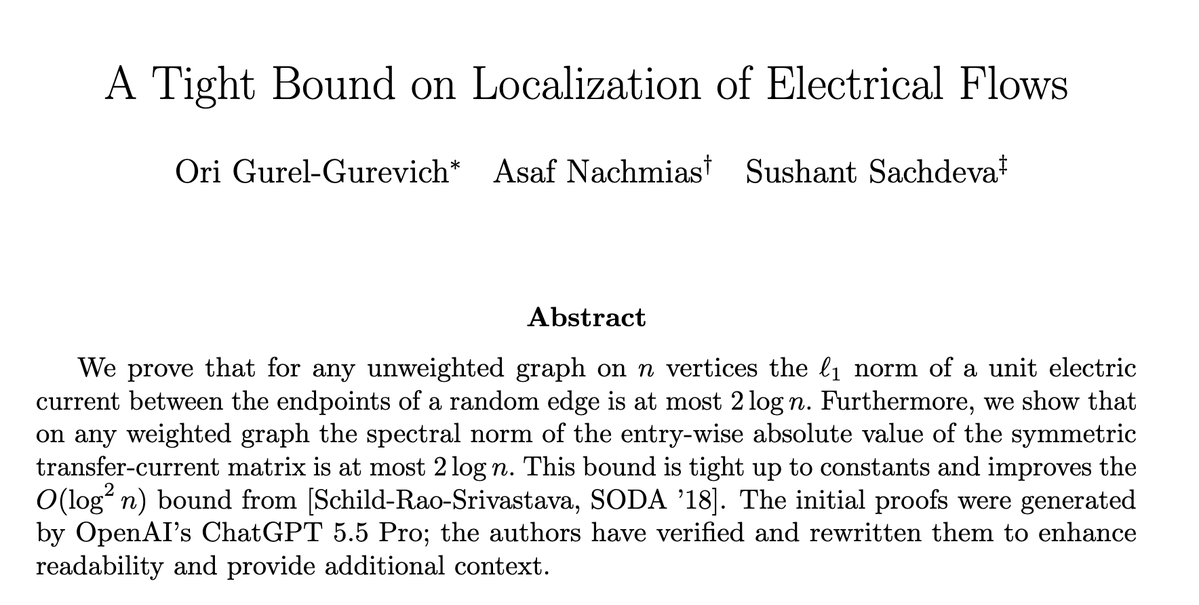
5.5 Pro one-shot settled the tight localization of electrical flows w/ a cute proof.
This improves the log^2 n result of Schild-Rao-Srivastava. Many excellent researchers and myself had thought about this q for a long time.
Very excited to share a new milestone in AI for Math: Aletheia, powered by Gemini Deep Think, was just used to autonomously solve a Kirby problem! “Kirby’s list” is a “compendium of the most important unsolved problems in topology, the study of deformable shapes” (Quanta magazine). 🧵
I’m so tired of writing rebuttals to this kind of “lack of novelty” review: “This paper trivially combines A, B, and C, so the algorithmic novelty is limited.”
Technically, most (if not all) robotics papers are convex combinations of existing ideas.
I still deeply appreciate A+B+C papers—especially when they deliver:
- New capabilities: the “trivial combination” unlocks behaviors we simply couldn’t achieve before
- Sensible & organic design: A+B+C is clearly the right composition—not some arbitrary A′+B+C′
- Nontrivial interactions: careful analysis of the dynamics, coupling, or failure modes between A, B, C
- Rehabilitating old ideas: A was dismissed for years, but paired with modern B/C, it suddenly works—and teaches us why
- System-level & "interface" insight: the contribution is not any single piece, but how the pieces talk to each other
- Scaling laws or regimes: identifying when/why A+B+C works (and when it doesn’t)
- Engineering clarity: making something actually work robustly in the real world is not “trivial”
- New problem formulations: sometimes the real novelty is in the reformulation—only under this view does A+B+C make sense.
Maybe worth keeping these in mind when reviewing the next A+B+C paper : )
“Mathematics is undergoing the biggest change in its history.”
Glad to see our math agent #Aletheia featured by @newscientist on its results at the FirstProof inaugural challenge, alongside other interesting milestones in AI for Math research! Implications worth thinking about. Link in thread.
Hi friends,
I am happy to share that I will visit the University of Michigan on 25-27/03 and Northwestern University on 21-23/04. If you are in the area during those days, please come say hi!
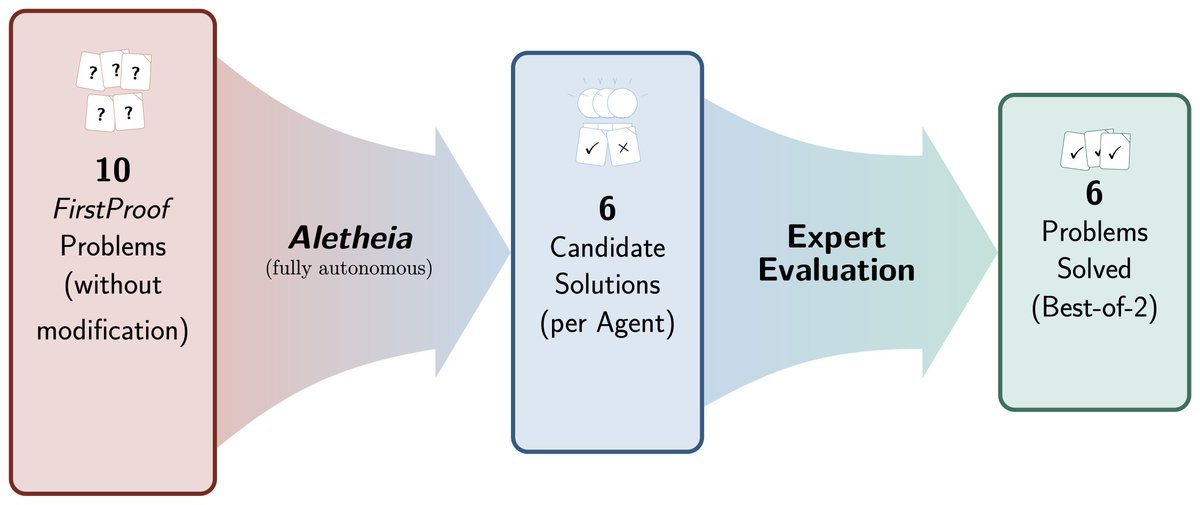
Thrilled to share: #Aletheia, our math research agent, just solved 6/10 notoriously hard FirstProof problems autonomously, the best result in the inaugural challenge! To me, this is even bigger than our historic IMO-gold achievement last year; these problems challenge even top mathematicians. We share our results transparently, see paper and full thoughts in the thread. 👇
I'm excited to share that I will be joining the Department of Statistics (https://t.co/gFNeaeCm4Y) at Texas A&M University @TAMU as an Assistant Professor in Fall 2026. Looking forward to starting this new chapter!
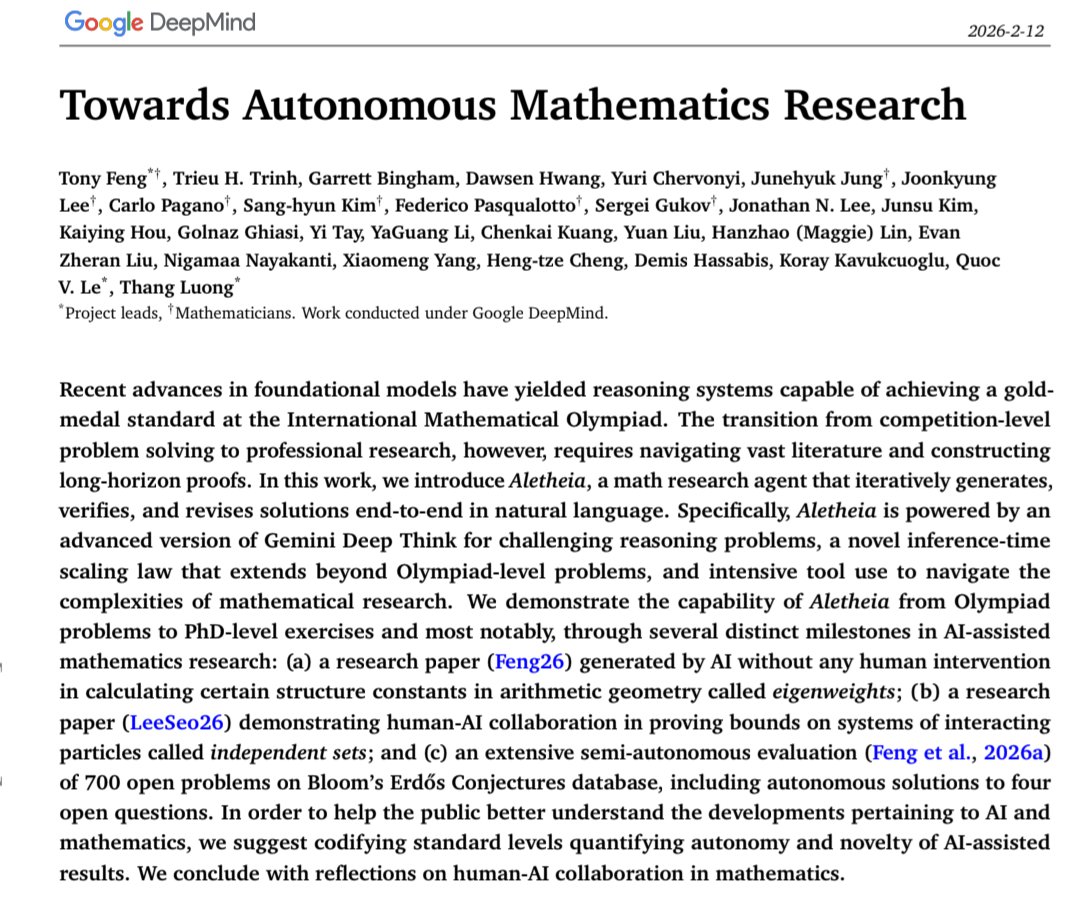
The #Aletheia paper is finally available on arXiv https://t.co/8pLHmZZQO4! Excited to share the 1st wave of papers on AI for math research! More to come very soon, stay tuned!
Blog: https://t.co/NblFQxG5tM
If math research were like ML research:
🚨 Introducing NavierStoked 🌊 🏄♂️. The first ever proof of existence and uniqueness* to Navier stokes. Check out our arxiv / blog post / GitHub repo and give us a star!
(*assuming zero viscosity, pressure, gravity, and stress tensor).