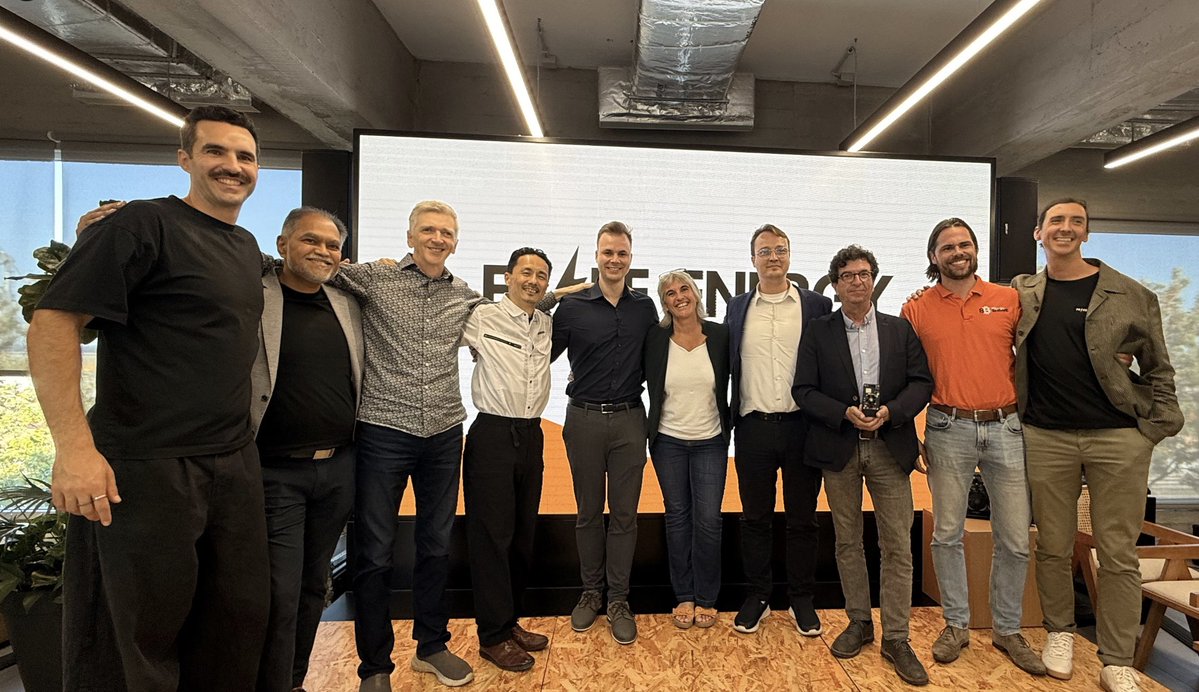
I just got back from the Bitcoin Energy Summit in Lisbon and I have a question that won't leave me alone.
First some context: Bitcoin mining is now stabilizing the grids of 7 nations, 4 agencies (including the Spanish Govt and the World's largest energy policy association) just called for more flexible demand being critical to the resilience of the grids of the future - and Bitcoin mining is the world's most flexible load resource by an order of magnitude.
So in light of this my question is this: why is 95% of the Bitcoin adoption conversation about Bitcoin-as-money when Bitcoin-as-energy is already deployed on grids across 3 continents?
Is it possible that energy is the Bitcoin usecase that paves the road for mainstream acceptance of Bitcoin in the West?
I've been in this space for four years now. When I started, the conversation was "bitcoin mining wastes energy." A group of Bitcoiners including @thetrocro, @jyn_urso and others changed that. Then it became "ok maybe it doesn't waste energy, but it's not useful." @gladstein, @jack and others changed that too.
But here's what I noticed in Lisbon. Three separate European organisations - the European Bitcoin Energy Association, Free Madeira, and the Institut National de Bitcoin in France - are all independently converging on the same conclusion.
@geyer_rachel, Chair of EBEA said energy is what will move the needle for Bitcoin in Europe. @andreloja at @FREEMadeiraOrg said energy is the most topical issue in Europe right now. Bastien Desteuque (@Proxy18387764), directeur général at @BitcoinPolicyFr said they're focusing on mining because France has spare nuclear capacity and that's where the biggest opportunity is.
Three organisations. Same conclusion.
And that's before you get to what's actually being built. In Sweden, a man I coach runs ASIC hardware that earns almost two-thirds of its revenue from frequency regulation - keeping the lights on, responding in seconds to the need of the grid operator, and helping to stabilize the grid an incredible 11,247 times last year alone. (Yes, you read that sentence right).
In Lisbon, I watched Kenji Tateiwa present a circular economy where bitcoin mining heat grows tropical fish and the CO2 gets converted to charcoal and micro diamonds. Bastian outlined how France's surplus nuclear energy could be absorbed by bitcoin mining by 2027.
And outside the West, from stabilizing the economy of Bhutan post-covid to helping save Virunga National Park in Africa - Bitcoin mining was behind both events and many more. This phenomenon is a global one.
The conversation has quietly moved from "does bitcoin mining help grids?" to "how many services can one machine provide?"
We've been thinking about this like monoculture - one machine, one function.
What I saw in Lisbon is permaculture. The same hardware doing frequency regulation, heat capture, Sats-minting ... and potentially in the near future - voltage regulation (something that would have prevented the 28 April 2025 Iberian Peninsular Blackout).
I talked to Bitcoin founders after the keynote who told me the energy thesis had opened their eyes. These are people who worked to advance Bitcoin payment infrastructure, and they hadn't fully grasped this.
Bitcoin solves a monetary problem the world is only beginning to understand. I'm more convinced of that than ever.
And ... as we wait for that revolution to be fully grasped, the energy revolution is already here - deployed, generating revenue, stabilizing grids. It might just be the thing that opens the door for everything else. What other Bitcoin use case is this far along ... at least in the West?
AI moves fast, and the grid must keep pace. Today, at @Reuters Global Energy Transition 2025, we announced a new partnership with @TAE Power Solutions to deliver a first-of-its-kind grid efficiency platform. Learn more:
To reassure people about the digital euro, Lagarde cites China as a "success story" and says explicitly that the EUSSR is following China's lead on Centralized Digital Currency.
China's Central Bank Digital Currency (CBDC), the e-CNY, gives the People's Bank of China for the first time the surveillance powers to track all citizens' financial transactions in real-time.
🤡🤡🤡
@PocketBitcoin The fact that it is a digital asset but not virtual (FIAT money). Energy that, through mathematical consensus, becomes scarce and limited digital information, uncensorable and accessible by anyone and anywhere.
🚀 Excited to introduce #ShadowyCreators🚀
🧭 Mission
🔸Consultancy in #Web3, fostering relationships with game-changing companies
🔸 Collaborations: Tech-cofounders & "CTO-as-a-Service" for high-potential ventures
🔸 Entrepreneurship: Fueling innovation in Web3 and beyond.
@AleBit23@BlockChainCaffe@We_Are_YouChain On Feb. 25, 2023, the Solana (SOL) blockchain faced "network issues": it stopped validating user transactions at about 6 a.m. UTC. Public block explorers registered 99% network degradation: Solana's transactional bandwidth dropped from 4,300 to 42 transactions per second (TPS).
Proposal for SAT symbol.
A mirrored Z with the typical dashes of the currency. Summon the S and the lightning of Lightning Network.
Quick to write even by hand.
#Bitcoin#SatSymbol