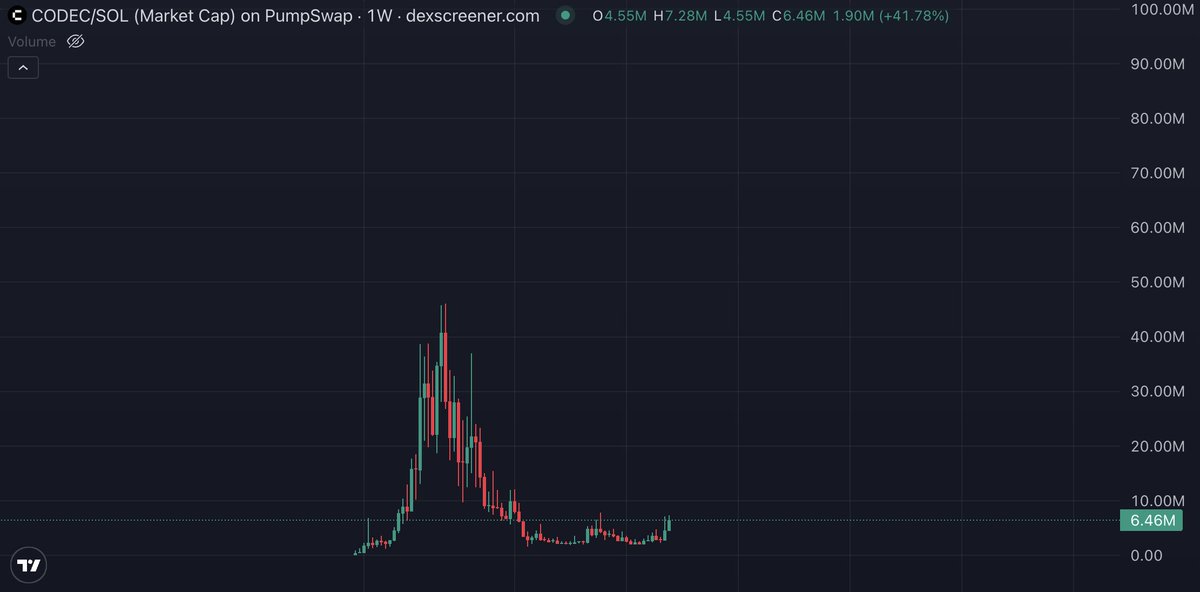
I never left, have been adding to my bag and conviction for more than a year but I can understand how everything is different wen you are on the inside, having said this WE ARE SO BACK. I think @Cryptotrissy is one of the best tek KOLs in the game, if he has developed a new conviction over the past 2 months on solana:69LjZUUzxj3Cb3Fxeo1X4QpYEQTboApkhXTysPpbpump then basically moon falls short from where we are going. Congrats to @unmoyai@0xdetweiler and the team for treating this as a real startup project rather than your classic 99.9% vaporware web3 BS. Excited to see where we go next
After many months of research and consideration, $CODEC is once again my highest conviction trade.
My bullishness for robotics never left, however the environment clearly wasn’t favourable and products were still too immature to have a real impact on development.
So why the sudden change of mind? What’s so interesting that’s brought me back?
Firstly, this wasn’t an overnight decision. Around 3 months ago I was coming back from a trading hiatus, since my read on the market wasn’t great, a protocol I have to better my edge is reading as much non crypto related material as possible. This is my favourite tool in the arsenal to respark my curiosity, which is one of, if not the most valuable trait when becoming interested in your craft again.
By reading about non crypto related sectors, it helps open my mind on potential possibilities through breaking a close minded state. You realise how much opportunity, innovation and capital flows through society as a whole. As you can probably guess, one of these topics was related to robotics.
In my telegram channel, I spoke about the introduction of World Action Models (WAM) and Egoscale + Scaling Laws. Very quickly I realized how much the space had progressed over just a 6-9 month period. A complete step change had been made across nearly every vertical, many of the theses I had a year ago have arrived and are showing rapid improvement. Since then, it’s been the core narrative sitting in the back of my mind that I haven’t been able to shake.
I’ll try to keep the key points short as each of them deserves their own article, which I’ll hopefully write in the near future.
1. World Action Models (WAM) - a new architecture which builds on VLA’s/VLM’s by adding prediction. Instead of only choosing an action, they try to predict how the scene will change after that action. Data collection through teleoperation is largely inefficient, humanized sensors are massively growing and companies adjacent to them. Nvidia defines them as models that predict future world states and actions. DreamZero see’s WAMs as a way to learn physical dynamics and generalize to unseen motions where standard VLAs can struggle. Robotics is moving from task specific policies toward general purpose physical intelligence.
2. EgoScale and Scaling Laws - trained a VLA on 20k hours of action labeled egocentric human video, found a log linear scaling law between human data scale and validation loss, showed that validation loss strongly tracks downstream robot performance and reported a 54% average robot success improvement over no pretraining on a 22 DoF dexterous hand. This has been proof that dexterity can improve with better and more data.
3. In context learning - In context learning lets models learn new tasks from examples instead of by changing weights. This is not the same as permanently learning a skill. The robot changes its behavior while the demonstration is in context, but its model weights are not updated. So in the next session, that skill is gone. Generalist AI’s GEN 1.5 shows that a robot can take a short demo video as a “prompt” and immediately perform the task. In trials on simple tasks, it learned from just one demonstration with no extra training. This proof of concept suggests robot skills can be transferred by demonstration much as GPT learns from text prompts, although this is only for short horizon context, not long tasks. Prompted skills aren’t as good as fine tuned ones. Nevertheless it’s a massive progression.
4. Simulations - They’ll never capture everything that happens in the real world, but what they do give us is access to information that is difficult to get from videos alone such as the exact position of objects, contact points, forces, and robot movements. That makes simulation a useful complement to real world data. Codec (SimArena) can help by providing realistic, calibrated simulations and task setups that match the robot being used. This gives the model more examples to learn from and helps it make better predictions
5. Systems - As tooling, benchmarking, authoring layer, system ID etc become more advanced, robotics slowly becomes a compute problem. Different physical robots and even two nominally identical copies do not behave identically. Simulation tooling can’t accurately correlate between foundation models. System ID is the missing layer and where simulation tooling like Codec will be able to abstract calibrations, giving more confidence for deploying in reality.
So what specific tasks am I focused on?
- Publicising robotics research and being in the weeds for every new innovation that’s coming out on a daily basis
- Positioning Codec’s marketing so it fully captures how the architecture is aligned with industry standards and future bottlenecks
- Help @unmoyai put his big brain thoughts onto this app as there’s very few people with his technical knowledge + experience
- Simplify and point readers of my page in the right direction, the entire sector has multiplied. There’s so many new sub fields and interesting experiments happening that are often complex and hard to keep track of
- Bullposting
I’ll address the elephant in the room and explain why I left unannounced previously, which I want to apologise for.
With start ups and especially in crypto, small decisions make a massive difference. Everything is about attention to detail and rapid execution. I was extremely hands on with product positioning, marketing, business analysis etc alongside my own bullposting and trading, which was a position I was comfortable to be in, since I’ve scaled multiple companies before.
Due to being so hands on, I was very passionate and strong minded on certain decisions, I treated the product like it was my own and even wrote a 30 page product and business analysis on every vertical. At some stage myself and the team had weak communication while trying to move at a high growth start up pace. This eventually led to myself being frustrated as there was too many chefs in the kitchen and conflict from multiple marketing heads.
So with this conflict, I silently stepped away as I had too much respect for the @codecopenflow team, @0xdetweiler and everyone else involved behind the scenes who put so much effort in. Looking back, did I handle the situation well? Probably not, but when I become passionate on my work I treat it like life or death. With my departure I gave a list of items which needed to be improved from my perspective regarding processes, operations, positioning and overall structure. I can confidently say these have greatly improved and with my inputs I should be able to help put the icing on the cake.
Due to past experiences, I know there will be some people uncertain of my commitment. To help with my transparency towards being dedicated for the long term, you’ll be able to watch my Fomo account.
I wished I could have made this post when the price was ranging at 2-3 mil. However this wasn’t a decision I took lightly and I wasn’t risking my reputation, I’ve spent over 2 months going back and forth with the team making sure I understand every vertical to a tea. This wasn’t a decision I was going to make without seeing a clear long term roadmap that matches how I see the robotics industry evolving.
As the terminator once said: “I’m back”
Codec coded.
Data is one of the biggest bottlenecks in robotics today.
LLMs were trained on data that was already widely available across the internet. Collecting it came at virtually no cost, and when a model gets something wrong, you can simply run it again.
Robotics faces a very different challenge.
Training data has to be collected in the physical world, with people performing tasks one at a time. This can cost anywhere from $15 to $1,200 per hour. And unlike an LLM generating an incorrect response, when a robot makes a mistake, the consequences are physical: damaged equipment, disrupted operations, and real safety risks.
Simulation addresses part of this. In a virtual environment, a robot can repeat the same task thousands of times, and failure costs nothing.
This is the role SimArena by @CodecOpenFlow plays on Machinefun. Builders can put their robots through real tasks in the browser before building any hardware.
Robots learn through repeated failure. On physical hardware, each failure takes time, costs money, and risks damaging the equipment.
SimArena moves this process into browser, where a robot can run millions of attempts overnight at no cost.
@Hushelapp@Galaanadiimaa since you all are looking like a long term project and market is so slow rn, you should make a statement by getting dex... you need more eyes, so you need to bond, and bond prolly wont come without dex
Robots are getting their own coding agents.
They can write a behavior, test it in simulation, learn from failure and try again before touching real hardware.
This is the loop we are building CodecFlow and SimArena for.
https://t.co/x26P37xjNH
Anthropic ($ANT) debuts on Nasdaq today after raising roughly $79 billion, the largest IPO pricing on record. All of that money backs intelligence that exists only in the digital world.
Robotics is a few years behind on the same path.
As capital at this scale moves into the physical world, the most valuable piece will be the layer that connects that intelligence to real machines.