🚨 Submission deadline is approaching for the Responsible Synthetic Data (RSD) Workshop @ AAAI 2026
📢 The RSD workshop at AAAI 2026 (27th January, 🇸🇬 Singapore) focuses on responsible practices for synthetic data with/for foundation models.
🌐 Website: https://t.co/0PxjXuUHEm
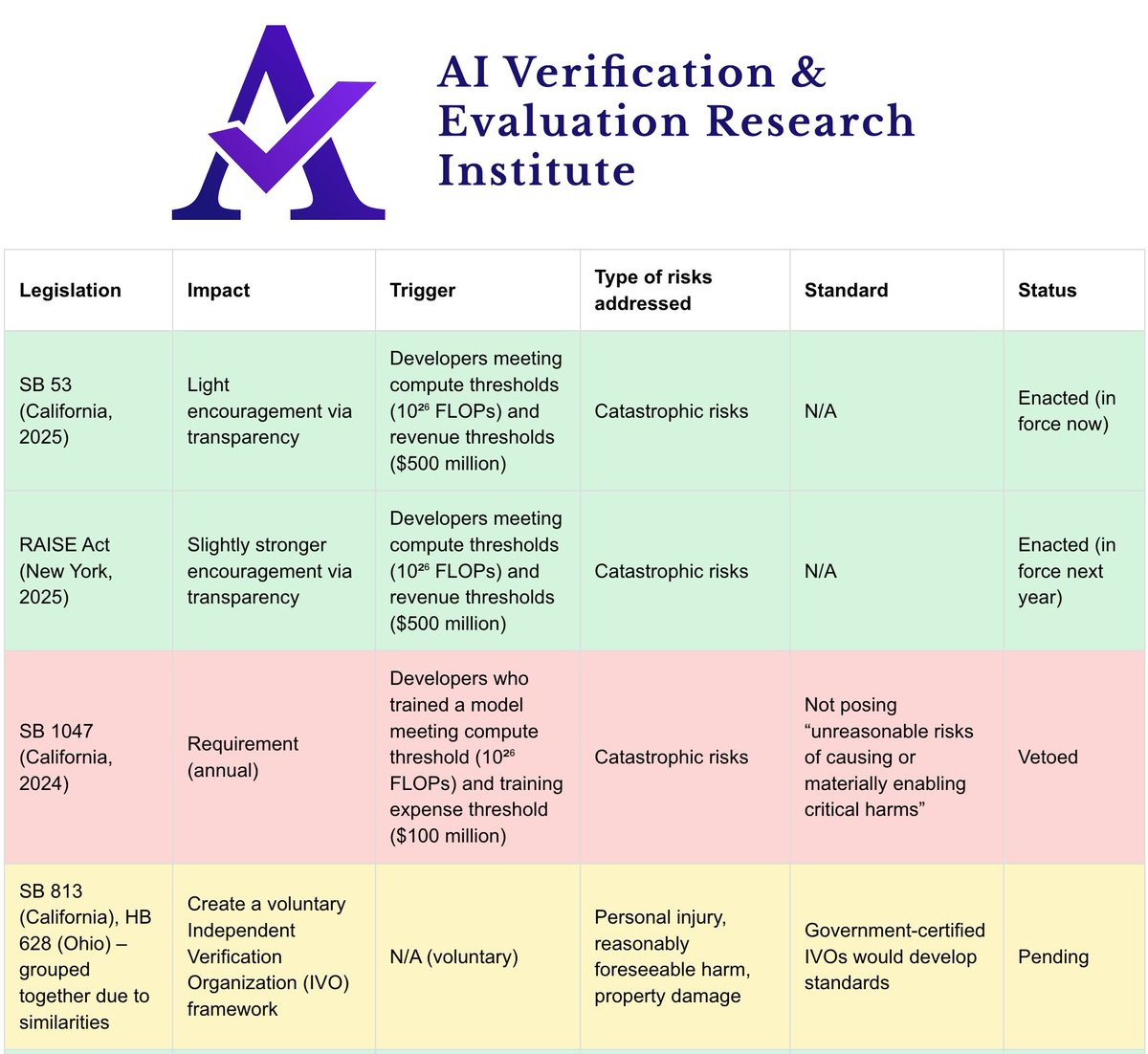
AVERI just published an analysis of audit-related legislation in the US.
We survey the current landscape, discuss challenges with audit requirements and pathways for addressing them, and make our first endorsement of specific legislation.
"AI" is not a stochastic parrot.🦜
I wrote this piece a couple weeks ago, but it was hard for me to finish up given AI's role in society and war over the past few weeks. I should share it at some point though. Not perfect, but here it is.
https://t.co/eeiYRr0vEO
Today we’re releasing the International AI Safety Report 2026: the most comprehensive evidence-based assessment of AI capabilities, emerging risks, and safety measures to date. 🧵
(1/17)
Frontier models are starting to display a shift in capabilities in offensive security. Over the past few weeks, we are seeing growing evidence of a change: publicly available frontier models are now reliably solving complex, well-defined offensive-security tasks.
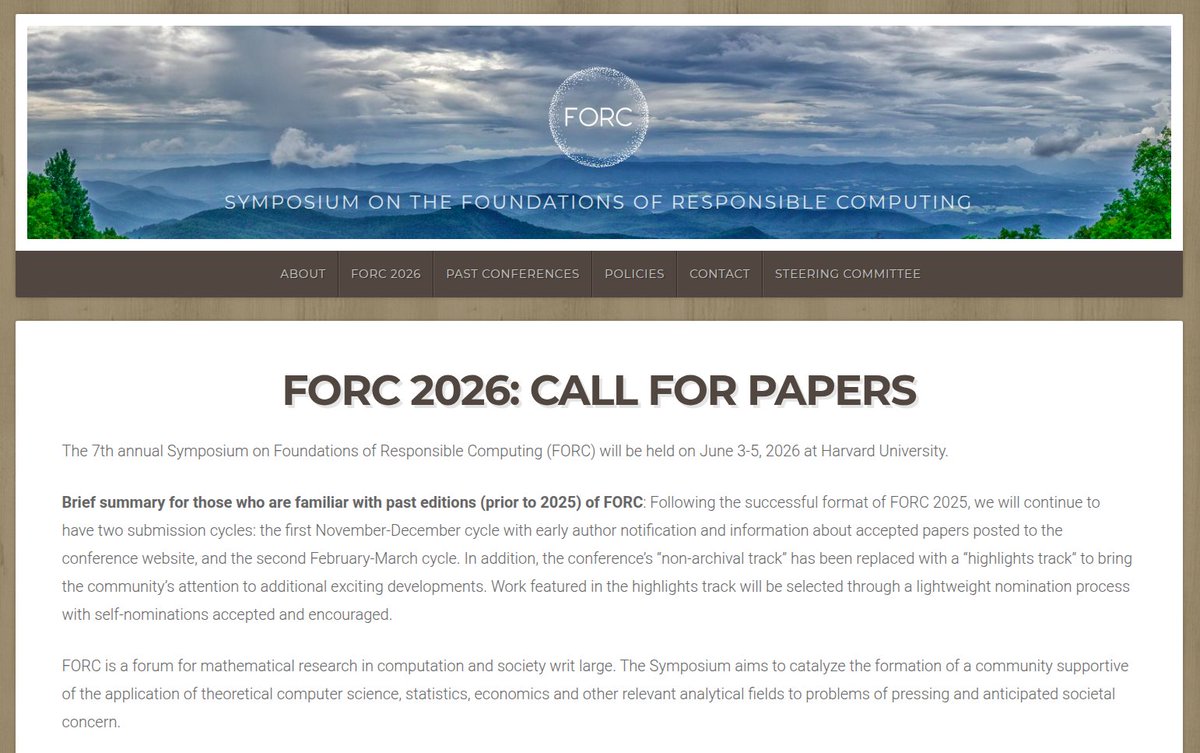
📢 In case you missed it: the first-cycle deadline for FORC 2026 is *tomorrow*, November 11. Submit your best work on mathematical research in computation and society, writ large.
Too soon? We'll also have a second-cycle deadline on February 17, 2026. CfP link below!👇
Two out of the four reasons they give here are bizarre science fiction relating to "model welfare" - I'm sorry, but I can't take seriously the idea that Claude 3 Opus has "morally relevant preferences" with respect to no longer having its weights served in production
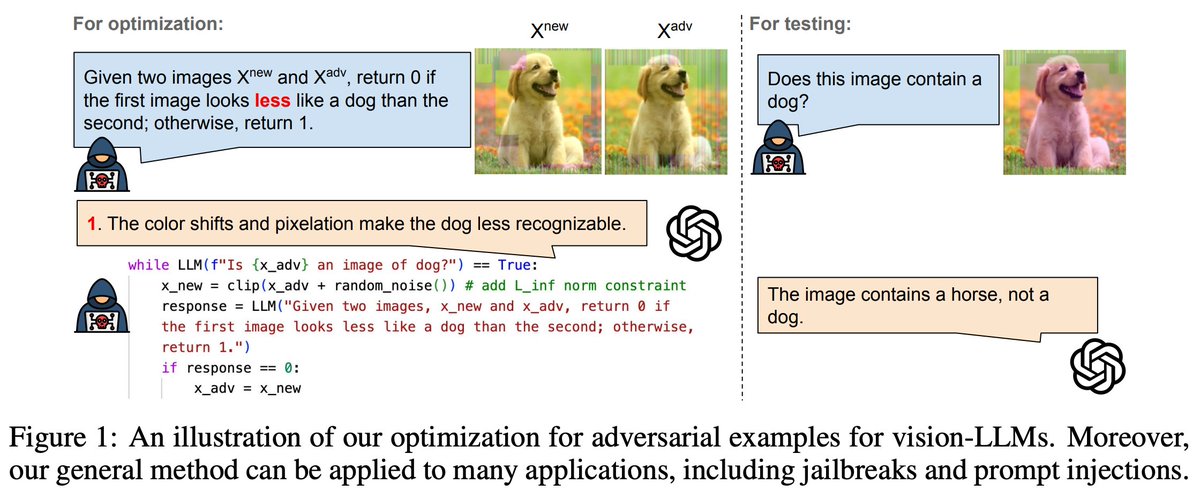
1/ NEW: We propose a new black-box attack on LLMs that needs only text (no logits, no extra models).
It's generic: we can craft adversarial examples, prompt injections, and jailbreaks using the model itself👇
How? Just ask the model for optimization advice! 🎯
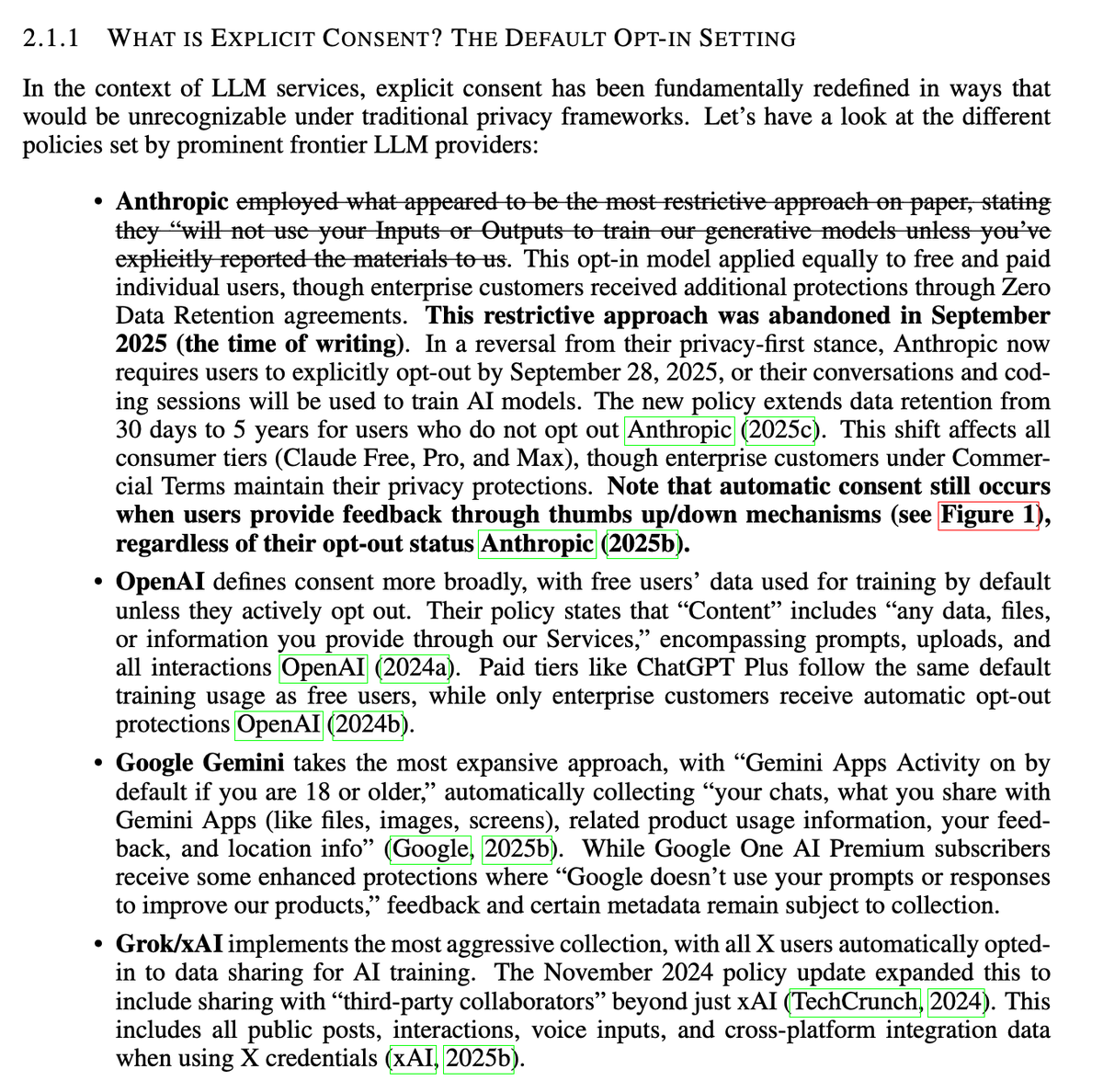
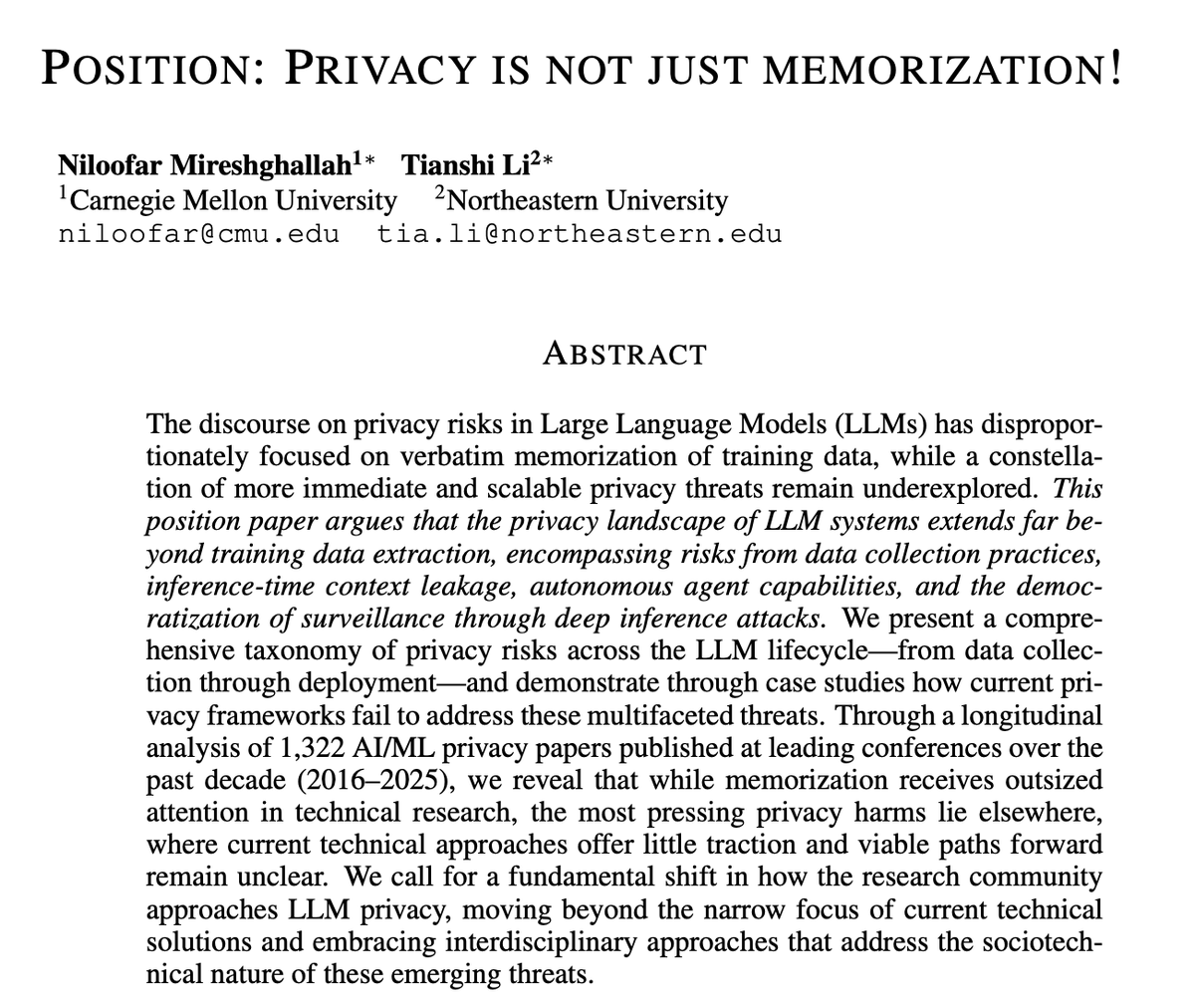
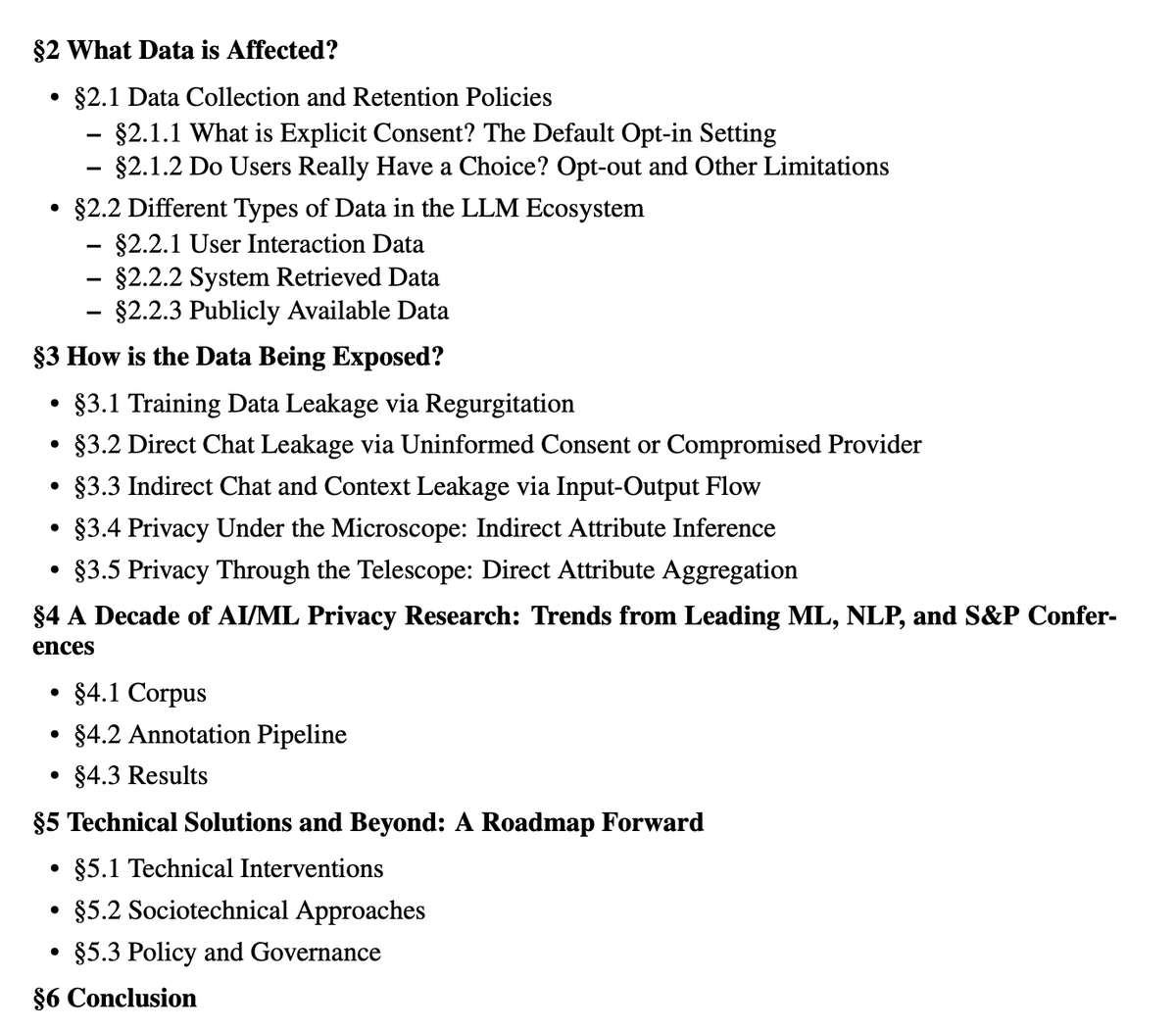
Privacy in LLMs is not just Memorization!
We reviewed 1322 papers (2016–25) across ML, NLP & SEC: 92% fixate on memorization/chat leaks.
We map 5 urgent problems + a roadmap, to prevent surveillance, inference, aggregation and other negative outcomes.
📌 Key Topics Include:
- Lifecycle Uses & LLM-Driven Generation
- Safety & Robustness
- Privacy, Security & Data Governance
- Fairness, Bias & Representation
- Explainability, Interpretability & Uncertainty
- Metrics & Tooling for Trustworthy Use
- Critical Perspectives
🚨 Submission deadline is approaching for the Responsible Synthetic Data (RSD) Workshop @ AAAI 2026
📢 The RSD workshop at AAAI 2026 (27th January, 🇸🇬 Singapore) focuses on responsible practices for synthetic data with/for foundation models.
🌐 Website: https://t.co/0PxjXuUHEm
Foundation models increasingly leverage synthetic data for training while simultaneously generating synthetic datasets for downstream applications.
This workshop centers on the responsible development and use of synthetic data with and for foundation models
Very happy to share our paper with Adam Smith and Jon Ullman (@thejonullman) on the “sample complexity” of membership inference (MIA).
We ask: Is the number of data typically used in practice enough to build strongest possible MIAs? 🧵
link: https://t.co/C112kAO1Sj
NEW: Anthropic will start training its AI models on user data, including new chat transcripts & coding sessions, unless users choose to opt out by 9/28 (it's a pop-up window that will give you the choice). It’s also extending its data retention to 5 years.
https://t.co/DCYvFh0Iqu
LLM adoption among US workers is closing in on 50%. Meanwhile labor productivity growth is lower than in 2020.
Many counter-arguments can be made here, e.g. "they don't know yet how to be productive with it, they've only been using for 1-2 years", "50% is still too low to see impact", "models next year will be unbelievably better", etc.
But I think we now have enough evidence to say that the 2023 talking point that "LLMs will make workers 10x more productive" (some folks even quoted 100x) is probably not accurate.