It’s officially time to start America-maxing. For the next two months, you should be walking around every day with the “Free Bird” guitar solo playing in your head while envisioning every American Chad, large and small, in their element, doing their thing, flag waving behind them
Here are a three reasons to apply to UATX right now.
Admitted students get:
1. An invite to a full day with Palantir on campus April 25, including a hands-on session with their team.
2. An invite to hear Ben Shapiro speak on April 26.
3. Up to $500 reimbursed to visit Austin.
No commitment to enroll is required. And if you do enroll -- tuition is free, for all four years.
Great paper by @BryanPCutsinger and Alex Salter.
Many supposed criticisms of "economics" are actually criticizing the *misapplication* of economic ideas.
There’s no greater sign that you’re winning than these sort of attacks. I’ve spoken at UATX. The faculty and students were great. The attacks on the institution are not only lame and silly, but they’re coming from the exact people you’d expect. @JTLonsdale
"The authors provide only the shallowest consideration of monetary theory, relying instead on a set of ad hoc examples to explain away inflation and prop up their preferred policies."
-- My review of "Inflation: A Guide for Users and Losers" by Blyth and Fraccaroli.
When I say "crypto," many people think meme coins.
But it's more than that.
Bitcoin, stablecoins, and utility tokens are very different and serve different purposes.
To understand crypto, you have to know the difference.
https://t.co/BlqbqbP7IT
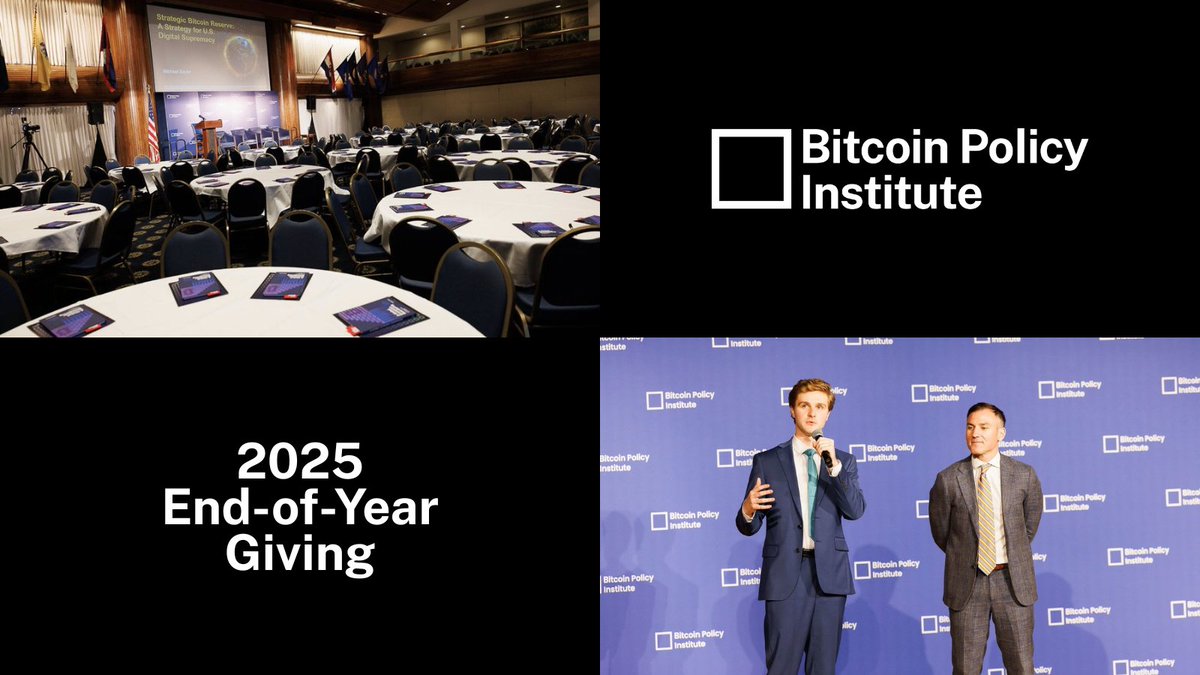
In 2025, Bitcoin fully entered the policy conversation.
BPI was there to provide context, clarity, and credible analysis.
Your support sustains independent, evidence-based research and advocacy at the intersection of Bitcoin and public policy.
Donate: https://t.co/RQDELagEBc
UATX will never charge tuition. And we will never take government money.
Here's why.
Graduates spend decades shouldering debt for hollow credentials. This debt influences every decision they make: What job to take. Where to live. When to marry. When to have children. Some will never start that company. Never take that risk. Never build what they were meant to build.
Meanwhile, universities take billions of subsidies from Washington while hoarding billions in endowments. And every year, they raise tuition.
Universities get richer. Students get poorer. America gets weaker.
Every breakthrough — every invention, every industry, every new frontier — began with a handful of extraordinary individuals free to take extraordinary risks. Washington led men into battle at 22. Carnegie was building his steel empire by 30. Meriwether Lewis charted the American West in his twenties. Sam Colt patented the revolver at 22. Palmer Luckey sold Oculus at 21. Patrick Collison founded Stripe at 22. Michael Dell began his computer business at 19. Fred Smith launched FedEx at 29. None of them spent his twenties paying off student loans.
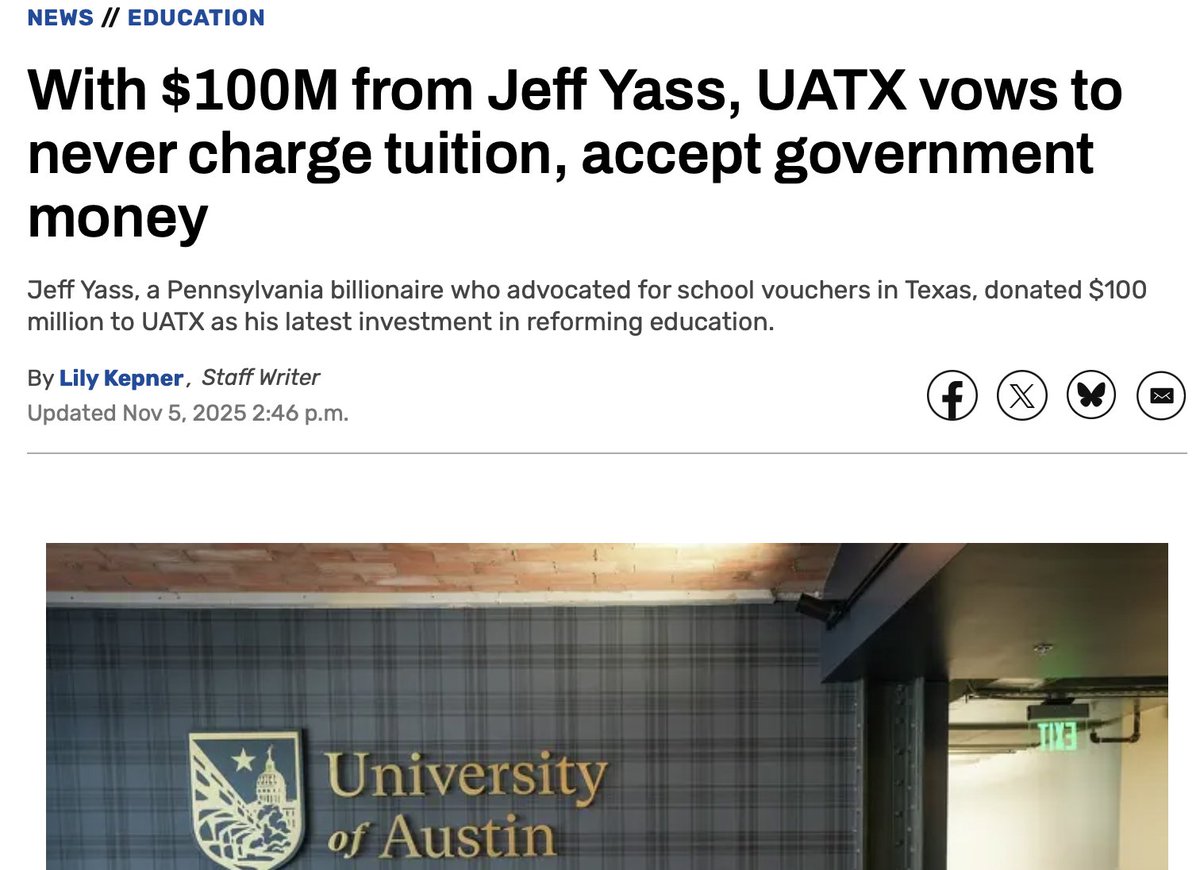
Thanks to a $100 million gift from Jeff Yass — the largest donation since UATX was founded in 2021 — we're breaking the chains. His gift marks the launch of a $300 million campaign to build a university that sets students free.
Our bet: Create graduates so exceptional they'll pay it forward when they succeed, financing the tuition of the next generation. When our students build important companies, defend our nation, advance scientific frontiers, build families, and create works that elicit awe, they'll remember who made their excellence possible. And they’ll give back.
Other Americans will take notice. Those who believe in unleashing American talent will invest in creating more of it.
Every other college gets paid whether students succeed or fail. At UATX, if our graduates don't become essential to American excellence — and if their work doesn't inspire others to fund this mission — we're done.
Every dollar raised, every professor hired, every course taught must produce extraordinary graduates — or we fail. We've designed our own constraints: no room for bloated bureaucracies, no frivolous departments, no administrative empire-building. Our survival depends on one thing only: graduating leaders free to pursue American greatness.
The University of Austin rejects the credentialing cartel. We admit purely on test scores, rank every student, and fail those who can't cut it. The nation's brightest are coming to Austin — transferring from Carnegie Mellon, turning down UChicago, leaving Columbia — to wrestle with great books, master AI and data science, and start real companies on campus. They're choosing a university dedicated to excellence instead of collecting hollow credentials elsewhere.
Jeff Yass has shown us what betting on America’s future looks like. Now we invite you to join him.