Phase Action Space for cross-embodiment Representation (PHASOR for short) introduces a universal action representation that maps different humanoid embodiments in a shared motion space, making robot behavior more transferable, interpretable, and scalable across platforms.
At OpenMind, our deployments involve mixed fleets that operate on one brain. PHASOR helps our team run shared interpretable actions that are transferable across devices without a need for additional re-training.
Read the research here: https://t.co/Bw65vrIWHh
@p_ferragu Pi can be (and has been) used in integer form for calculating interplanetary trajectories.
The relevant maximum number of digits of pi is how many are needed to describe the volume of the Universe in Planck cubes (voxels).
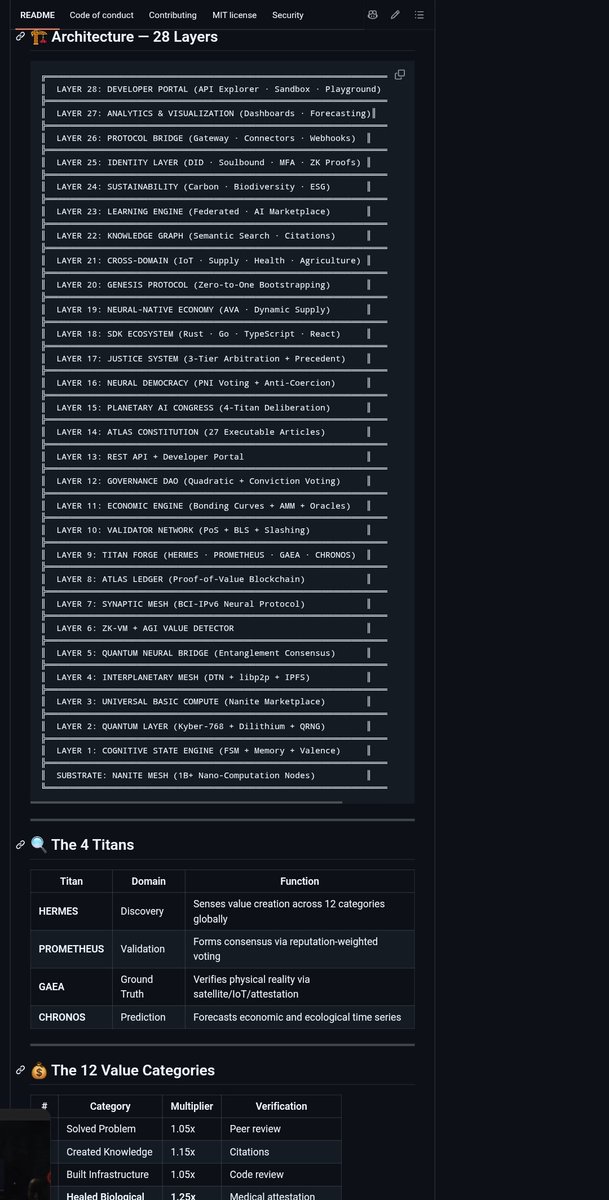
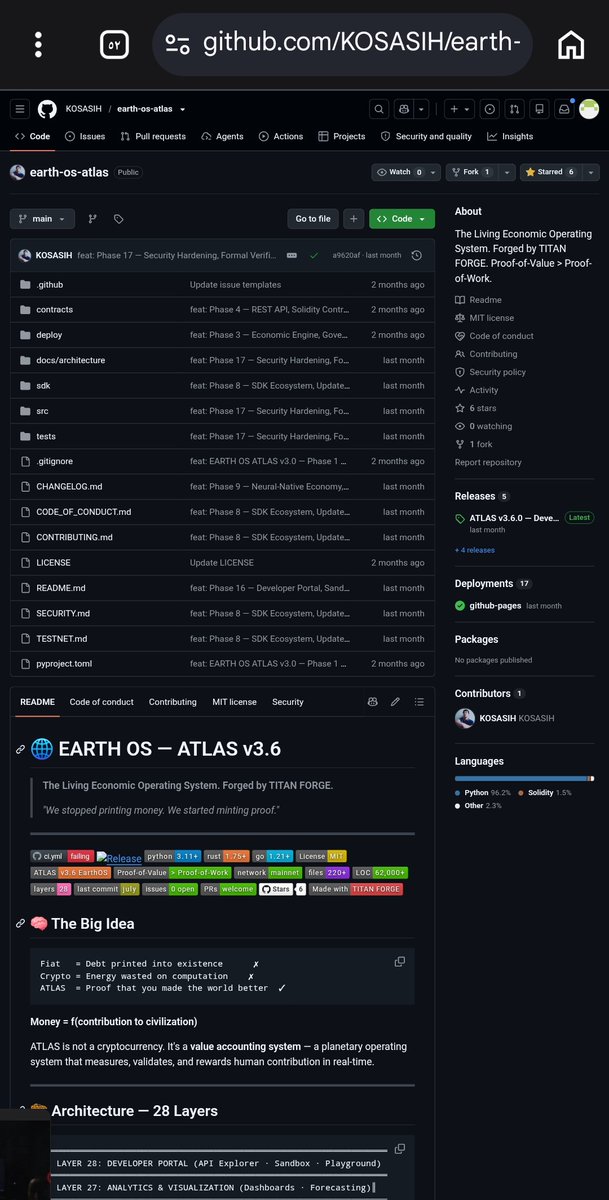
**EARTH OS — ATLAS**
The living economic operating system. We stopped printing money. We started minting proof.
For too long the world had two answers. Sovereign money born from debt. Crypto born from burned energy. ATLAS offers a third path: money as a function of contribution to civilization. Not a slogan. A full architecture named Proof-of-Value.
The idea is simple and severe. If you solved a problem, created knowledge, built infrastructure, healed a body, protected a system, restored land, or prevented harm, the world became measurably better. That measurable better is what gets minted. Not what a miner owns. Not what an institution prints.
ATLAS does not present itself as a speculative coin. It presents itself as a planetary value-accounting system. It discovers contribution, verifies it, anchors it to reality, rewards it, then governs its own rules through an executable constitution rather than a mission statement.
Behind that logic stand four Titans. Hermes senses value as it is created. Prometheus forms consensus and weights it by reputation. Gaea binds evidence to the physical world through attestation, sensors, and observation. Chronos reads economic and ecological time so policy is not flown blind. Together they are Titan Forge: discovery, validation, ground truth, and foresight.
Value is not one kind of thing. The system recognizes twelve categories and steers behavior with different multipliers. Biological healing sits at the top of the ladder. Created knowledge follows. Protecting systems, preventing harm, and restoring ecosystems rank above social connection or beauty alone. The meaning is deliberate. Civilization should pay first for what keeps life, knowledge, and the planet intact, not for what fills the noise.
Economically the cap is one billion ATLAS. Issuance does not come from mining. It comes from a contribution proof that can be used only once, scored by confidence, with a base reward that halves every four years. At launch, early contributors receive a calculated advantage so the ledger is not born empty. The training wheels come off at critical mass. Live supply watches velocity. If circulation goes cold, minting eases upward. If the market overheats, issuance tightens. Burns happen through fees, penalties, and collective decision. The internal market discovers price through bonding curves, a liquidity pool, and oracles, not through outside spectacle first.
Above the economy sits a protocol-state. Twenty-seven executable constitutional articles. An agent congress. Optional neural democracy with coercion defenses. A three-tier justice system that keeps precedent. Sovereign identity, with reputation that cannot be sold. A global trust graph that flows through attestation. Bridges into health, education, agriculture, supply chains, disaster, and climate. A sustainability layer that treats carbon, biodiversity, and planetary boundaries as inputs to value, not as stickers.
The stack is twenty-seven application layers over a computational substrate. From cognitive state and post-quantum cryptography, through a synaptic mesh, a zero-knowledge machine and a value detector, to the proof ledger, the economic engine, governance and justice, a basic compute marketplace, real-world gateways, a knowledge graph and federated learning, up to a developer portal. That is operating-system ambition, not token ambition.
The team update gives the system a mouth and a body. Atlas MCP lets an agent create proofs, attest, mint, query, and govern from inside the same AI session. SoloHost makes the node yours: your keys, your data, your agent permissions, sovereign hosting with no intermediary. ATLAS is the constitution of value. MCP is the agent’s voice. SoloHost is the body you run yourselves.
🧶🧵
#PiNetwork #PiDEX #PiRC #Protocol27 #Mainnet #Web3#DeFi
#Web3
#Decentralization
#CryptoNews
#DigitalEconomy
#FinancialFreedom#PiNetwork
#PiPioneers
#PiMainnet
#PiCoreTeam
#PiCrypto
#PiCommunity
#PiDEX
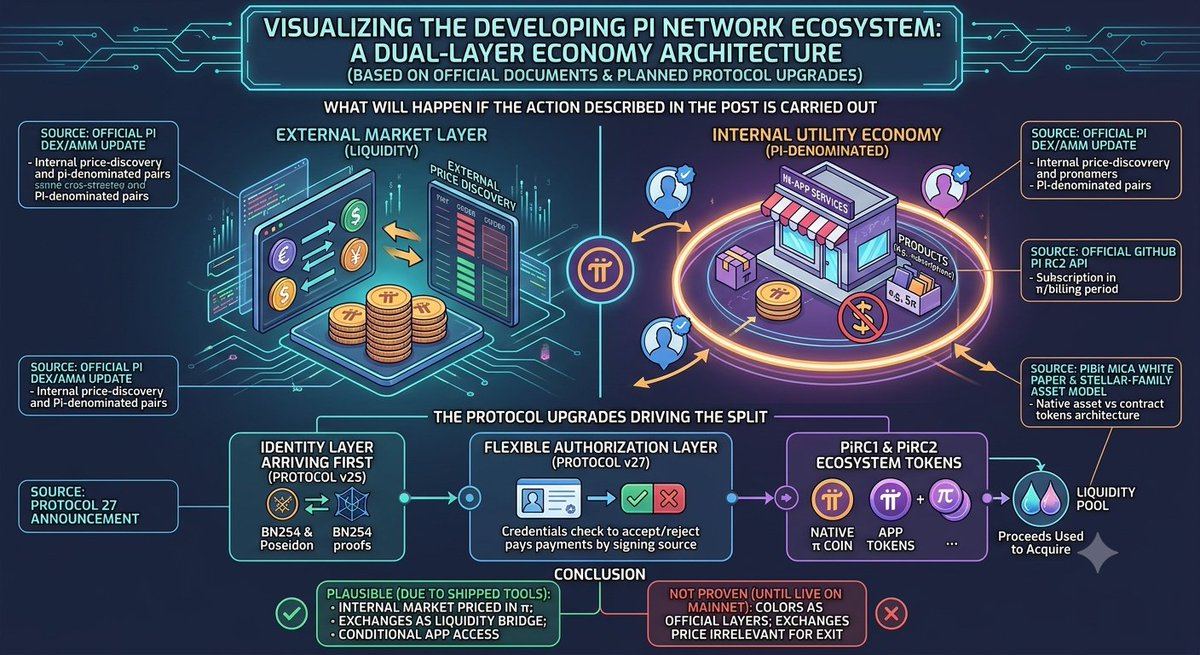
**Is an internal Pi economy separate from the external market impossible? Official sources say no.**
This is not a wish list. It is about layers already described in official documents and protocol upgrades that are not fully live on Mainnet yet.
The community case — internal pricing in π, exchanges as a liquidity bridge, usage rules based on contribution or source, and accounting in units rather than dollars — does not require a miracle. It requires the contract and authorization layer to finish coming online. That is exactly what the network is building.
**1) Internal pricing without the dollar is not a community invention.**
The official Pi DEX/AMM update organizes liquidity around Pi-denominated pairs. Tokens are priced against Pi, not against fiat. That is an announced internal price-discovery design, even if it is still on Testnet.
Source: official Pi blog — Pi DEX & AMM Update.
**2) Official contracts themselves do not display a paper-currency value.**
Official PiRC2 in `PiNetwork/PiRC` defines a subscription as a service price in **π per billing period**. That is a contract specification, not marketing copy.
Source: official GitHub — PiNetwork/PiRC, PiRC2 Subscription Contract API.
**3) The team left product pricing to supply and demand inside the ecosystem.**
That fits a utility economy: merchant and buyer agree in π. The external price exists for entry and exit, but it is not a required price tag for every in-app good.
Source: post-Open Network design, plus App Studio and fees denominated in π.
**4) Account- and app-level authorization is being built into the protocol.**
Protocol v27 — targeted for Mainnet on 15 September 2026 — adds more flexible ways for accounts and applications to authorize transactions. That is the engineering point where a payment can be accepted or rejected by credential, proof, or signing source without rewriting the ledger.
Source: @PiCoreTeam announcement on Protocol 27.
**5) The identity layer is arriving before the full market layer.**
Protocol v25 introduced BN254 and Poseidon to support proofs without exposing all underlying data. That makes it possible for apps to distinguish a verified contributor from a pass-through user.
Source: official Pi blog — Protocol v25.
**6) Tokens on top of the coin are part of the official model.**
PiRC1 and the ecosystem-token design separate **native PI** from app tokens. Proceeds used to acquire those tokens go into the liquidity pool. That is a structural admission that the network is not limited to one undifferentiated asset.
Source: Open Network Anniversary blog + PiNetwork/PiRC.
**7) A Stellar-family architecture allows a technical split.**
In this model there is a native coin, issued assets, and contract tokens. Listed PI today is the native asset. A token layer with different usage rules can still sit on top of it if a contract and bridge are deployed. That is asset anatomy, not folklore.
The MiCA paper itself describes PI as the native fungible asset of the Layer-1 chain, while leaving applications free to set service rules.
Source: PiBit MiCA white paper + this family’s asset model.
**8) Decentralization is incomplete. That is why early dismissal is unscientific.**
Upgrades are still a central schedule. SuperNodes do not yet set issuance policy. An independent mint contract for a restricted layer has not been adopted as public protocol policy. A final verdict before that layer is live is a verdict on an unfinished stack.
Source: the 19→28 upgrade path, node/SuperNode documentation, and Protocol 28 still listed as TBD.
🧵🧶🧵🧶🧶
#PiNetwork #PiDEX #PiRC #Protocol27 #Mainnet #Web3
🚨 BREAKING NEWS
OpenMind has officially started testing Pi Testnet integration for robot payments through RoboPay.
If Pi Mainnet is eventually integrated, $PI holders could potentially rent robots and pay for their work with Pi without needing to purchase, maintain, or operate the robots themselves.
The future is getting interesting.
Pi Network Expands SoloHost Ecosystem With AI And Developer Tools
@PiCoreTeam officially integrates OpenClaw and the Atlassian MCP Server into the SoloHost framework on Pi Desktop.
OpenClaw gives Pioneers a local AI environment, while the Atlassian MCP Server provides AI-powered Jira project management.
It marks the transition of 420,000 active nodes on the network from mere blockchain validation to a decentralized physical infrastructure (DePIN).
QUICK: $Pi Network has announced that OpenClaw and the Atlassian MCP Server are now available through SoloHost on Pi Desktop.
OpenClaw provides a locally run AI setup, while the Atlassian MCP Server enables local connections for Jira-related workflows.
The update expands SoloHost beyond blockchain infrastructure to include AI and developer tools within the Pi Desktop ecosystem.
Grateful to @cicada_mm for featuring us in their research blog.
Dive into the full piece for our thinking on scaling data volume without sacrificing quality, how we prioritize robot embodiments, and what foundation-model scale actually means.
OpenClaw and the Atlassian MCP Server are now featured in SoloHost on Pi Desktop, expanding the range of self-hosted tools users can run locally.
OpenClaw offers a more contained local AI setup with streamlined installation, while the Atlassian MCP Server supports AI-integrated Jira workflows for professionals through a locally run connection.
Go to the Pi mining app to learn more about both apps and how SoloHost expands the utility of Pi Desktop and Nodes beyond blockchain infrastructure by bringing new AI and developer tools into the Pi ecosystem.
OpenClaw is an open-source, self-hosted AI agent assistant created by developer Peter Steinberger, designed to live on local hardware and execute real-world tasks rather than just chat.
The project launched in late 2025 under the name Clawdbot, then rebranded to Moltbot after Anthropic raised trademark concerns over its similarity to "Claude," before settling on OpenClaw.
Its "local-first" architecture, keeping private data off external servers, has made it especially popular among privacy-conscious crypto natives, and the project has since attracted over 385,000 developers on GitHub.
The August 2026 cycle brought some of the project's most substantial updates yet.
Official apps across iOS/iPadOS, Android, and macOS saw broad improvements to setup, chat, permissions, and offline handling, while model support expanded to include GPT-5.6 across OpenAI and Codex routes.
On the reliability side, persisted data now includes a quarantine store that survives database damage, along with crash-recoverable SQLite snapshots and rollback-writer recovery, and sessions can be rewound or forked from individual messages.
A new plugin install provenance system now requires explicit acknowledgment for untrusted executable sources, tightening supply-chain security.
Worth flagging for a crypto audience: OpenClaw itself isn't a token, but a separate community-run meme coin on Solana trades under the CLAW ticker, and developers have been targeted by phishing scams using fake $CLAW token giveaways designed to drain connected wallets.
Conditional framing matters here, the AI-agent tooling and the speculative token are distinct entities, and conflating them risks misleading readers.
For a content angle: OpenClaw's local-first design and agent-to-wallet execution capability sit right at the intersection of AI and crypto infrastructure narratives, worth watching as agentic on-chain automation matures.
#PiArt
💥🧏 PI CORE TEAM IS TURNING ORDINARY PEOPLE'S NODE COMPUTERS INTO ATM 💲🤑
Many of you still think running a Pi Node just means plugging in a computer to run "transaction verification" in circles and then sitting around waiting for harvest day. Big mistake!
The Node 0.6.2 upgrade together with the arrival of the SoloHost feature is exactly the springboard triggering a silent revolution: turning ordinary people's hardware infrastructure into a machine that generates Real Utility.
👇 Below are 4 detailed pieces decoding the "guts" of this infrastructure:
1️⃣ Turning your own computer into a "mini cloud" (Edge Computing) ☁️
• Instead of companies having to spend billions renting centralized servers from AWS, Google Cloud, or Microsoft Azure, SoloHost turns every computer running a Pi Node into a Micro-Data-Center thanks to Docker packaging technology.
• By gathering more than 420,000+ Nodes worldwide, Pi Network is building a massive Edge Computing network.
• Where's the ATM? Once the network moves into commercial operation, the computing resources (storage capacity, hard drive space, RAM/CPU power) that you contribute can be rewarded with real value from the applications running on top of it!
2️⃣ Running Local AI – the king of private data security 🔒
• The problem of our era: using ChatGPT or Claude on the web means you're throwing all your data, emails, and financial reports onto a third-party server. Large enterprises are extremely afraid of leaking trade secrets (Data Breach).
• The SoloHost solution: with the newly launched OpenClaw and Hermes apps, you get an AI as smart as ChatGPT but running on a Local AI mechanism.
• The killer point: all the Memory, chat history, and documents you hand over to the AI to process stay right on your own home hard drive, wrapped inside an isolated environment (Sandbox). No big tech company can peek in!
3️⃣ Opening a highway to pull Devs & Businesses into the game (Atlassian MCP) 🛣️
• The old bottleneck: programmers and project managers often use Jira software to divide up work. They want to use AI (Cursor, Claude Code, Codex) to jump in and help with the work but often hit rate limit/quota caps from Atlassian's servers.
• The turning point with MCP Server: SoloHost allows running the Atlassian MCP Server directly on a personal machine.
• The result: the AI now travels through a "self-made side door," freely going in and out of the Jira work board reading/writing data comfortably 24/7. No interruptions, no intermediary fees, smooth down to the millimeter! Tech people who see this fall in love instantly.
4️⃣ Open (Permissionless) Publisher mechanism – an exploding app marketplace 🚀
• The Pi Core Team doesn't try to hog everything and build every application itself. They created an open publishing mechanism for SoloHost.
• Any developer anywhere in the world can package their software into a Docker file and upload it to the SoloHost marketplace.
• 420,000+ Node owners just need exactly 1 click to install and start using it right away. The application network will grow on its own at breakneck speed without PCT spending a single drop of sweat on manual review!
🔥 BOTTOM LINE: Pi Network has never stopped at just being a "check-in" app on your phone. Pi is quietly building an extremely practical Web3 infrastructure combined with AI. The computer sitting and staking at your house is exactly one link in that future computing network!
Have you upgraded to Node 0.6.2 to get ready to become a "factory owner"?
Leave your thoughts below to discuss! 👇
#PiNetwork @PiCoreTeam