Orban concedes defeat. The support of Trump, Vance, Putin, Lavrov, Weidel, Milei, Le Pen, Fico, Babis and many others could not overcome Hungarian anger at a stagnant, corrupt regime
https://t.co/yfMCWUFk34
Just a thought:
Ukraine’s President is Jewish.
Our Defense Minister is a Muslim, a Crimean Tatar.
The Commander-in-Chief of the Armed Forces is an ethnic Russian.
Our top drone ace — recently awarded the title Hero of Ukraine — is an ethnic Hungarian.
Over 70,000 women serve in the military now.
Almost all of the most renowned combat medics are women.
The revolution that changed this country forever began with a Facebook post by an ethnic Afghan Pashtun, a prominent Ukrainian journalist.
And in our parliament, we have a Black MP — an Afro-Ukrainian and universally admired Olympic champion.
All of this — in a country that is still, for the most part, Slavic.
On the streets of Kyiv today, you’ll see halal restaurants for Muslim tourists standing peacefully next to Jewish eateries. Nearby are a museum and a monument to Sholem Aleichem, and a plaque bearing the face of Golda Meir, who once lived here.
Among our main landmarks: 19th-century synagogues. Just a short walk away — a large mosque and Muslim cultural center. And above all, of course — the ancient Christian churches and monasteries that are the oldest and most significant in the East Slavic world.
I still can’t get over the fact that Ukraine’s chief Muslim mufti (an ethnic Tatar from Donetsk) stepped down to serve as a frontline paramedic in the army. That our chief rabbi works tirelessly every day to help Ukraine across the globe — and that his adopted son died fighting for Ukraine, weapon in hand.
For many years now, a giant glowing menorah has stood each Hanukkah in the heart of Kyiv’s main square. And on Independence Day, every religious denomination gathers in Saint Sophia Cathedral to offer prayers for Ukraine, each in their own rite.
Just as they all come together for remembrance at Babyn Yar and the Holodomor monument.
The more you look at the world, the more often you realize how much healthier Ukrainian society has become when it comes to coexistence between nationalities and faiths.
We weren’t always like this. We are becoming this now — as the country is being radically transformed by revolution and by the defense against imperial Russia.
We are shedding the weight of so many remnants of the past — really fast.
Just recently in May, Ukraine held its WWII commemorations — with poppies and the slogan “Never again!”
What a stark contrast to the satanic frenzy of Russia’s “Victory Day,” with its death cult, its “We can do it again!” bravado, and its glorification of dying for the Tsar.
Against the backdrop of war, Ukraine is living through a real national and cultural renaissance. We are rediscovering the Ukrainian language, Ukrainian books, music, cinema — as something precious.
And for how many decades were we taught to look down on everything Ukrainian — as “third-rate,” “peasant,” “inferior”?...
I walk the streets of Kyiv on Christmas (December 25th, not January 7th as demanded by Moscow priests) and see bands of children in traditional embroidered clothes carrying colorful Bethlehem stars and singing carols. “Ukrainian Christmas” is returning to these lands as a vibrant cultural tradition.
On Easter, crowds gather near Saint Sophia Cathedral for picnics and spring dances. In the old city above Podil, I often hear youth pounding out Cossack songs on drums. I always see many people at our nation’s sacred places — the Kyiv Pechersk Lavra, the cathedrals of Lviv, the Motherland Monument, the old castles.
We haven’t suddenly become devout believers. We’ve simply come to take pride, like never before, in being Ukrainian — in treasuring our traditions, our culture, our history, and our way of life, in our own country.
New traditions keep being born in wartime, against all odds.
Today, we honor war veterans by inviting them to make the symbolic first kick at football matches — and then we give them a standing ovation from the stands, for their service.
I could go on like this for hours.
What I’m trying to say is — I love what Ukraine is becoming.
This hope — breaking through unspeakable pain and hardship — feels like a light piercing the tunnel.
Ukraine now, and Ukraine 12 years ago, are two completely different countries.
The road ahead is brutally hard, but if only — if only our Ukraine can survive this war for its very existence.
In honor of Vance's visit to Hungary, where he will campaign for Viktor Orban, I am reposting this article: Orban's Hungary is one of the poorest countries, and certainly the most corrupt and least free country, in the EU. Vance wants this for America?
https://t.co/Qx1CaKNL2E
New: We obtained phone calls between Russian Foreign Minister Sergei Lavrov and Hungarian Foreign Minister Péter Szijjártó showing them conspiring to lift EU sanctions on Russia -- from oligarchs to banks to the shadow fleet. Full story with consortium partners at @InsiderEng: https://t.co/uour6hcjbr
Ukraina ei ole häviämässä sotaa. Mutta jos Eurooppa ei ryhdistäydy on vaara olemassa.
Eurooppa ei ole turvassa ennenkuin Ukraina on turvassa. Ja Ukraina ei ole turvassa ennenkuin se on EUn ja Naton jäsen.
Nyt vaan pitää tehdä töitä sen eteen.
https://t.co/zzyaS95a4H
😄Viktor Orbán responded to protesters who booed him at a rally in Győr
He accused them of serving Ukrainian interests and wanting to send “Hungarians’ money to Ukraine,” as his campaign continues to frame domestic issues through the Ukraine narrative.
💥Not how one wants to be featured in the @nytimes, but I’m glad a US audience sees what’s happening in this small country’s wild election campaign. As with other Orbán-related news, here's my warning to US colleagues: Orbán's actions still serve as a blueprint for Trump/MAGA...
Congress intends to divert about $750 million in funding provided by NATO countries through the PURL program to restock the U.S. military’s own inventories, rather than to send additional assistance to Ukraine
Trump’s admin wants to keep weapons that allies PAID for, for Ukraine
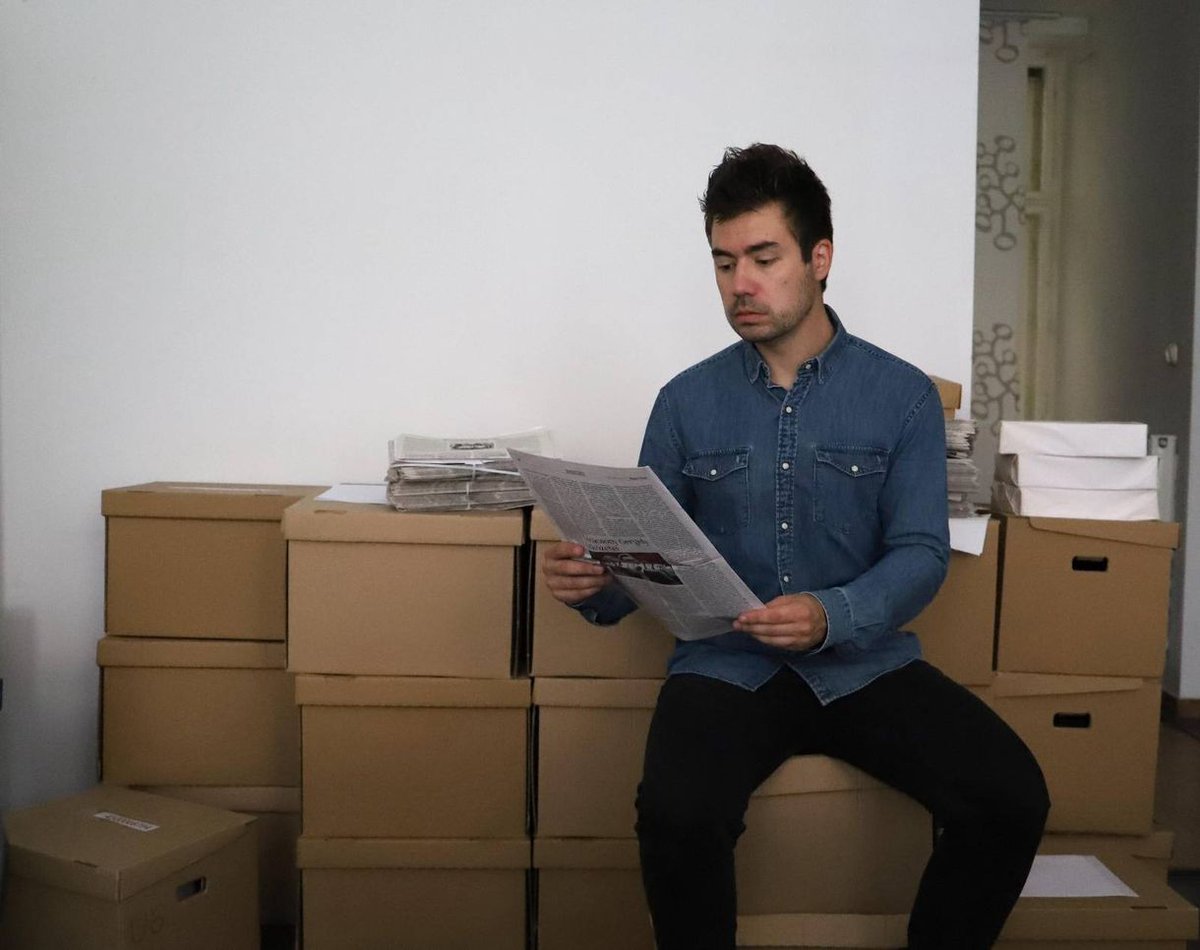
‼️Statement on the Orbán Government Accusing Me, an Investigative Journalist, of Espionage‼️
Today, the Hungarian government has filed a complaint against me for espionage. Accusing investigative journalists of espionage is virtually unprecedented in the 21st century for an EU member state. This is typical of Putin’s Russia, Belarus, and similar regimes.
I have spent over a decade documenting how Russian spies and interests have penetrated Hungarian politics, so I am probably the least surprised by this.
Despite growing signs that the Hungarian government acts as a Kremlin ally and copies the Russian model, I still trust that parts of the Hungarian state—and the judiciary—follow the Hungarian constitution, not that of the Russian Federation.
I have never engaged in espionage. I see my work as journalistic counterintelligence—from exposing the hacking of the Hungarian Foreign Ministry by Russian actors to revealing the activities of Hungarian pro-Kremlin propagandists.
Defending myself publicly would be easier if I were not bound by source protection. But that remains my top priority. I cannot reveal who provides me information or what I receive, including from within Hungarian state structures.
If I were not a journalist, I could list many facts proving it is impossible for the Hungarian state to genuinely believe I am spying. Certain meetings, contacts, and information gathering could never have happened otherwise.
This baseless accusation now forces me to share details of a specific investigation, including a conversation with a confidential source that appears to have been wiretapped. Normally, this would appear in a finished article or my upcoming book—not here. (It will appear there as well.)
Since 2023, I have investigated whether the relationship between Péter Szijjártó and Russian officials exceeds legal limits. The published audio, where I’m heard talking to a source, mentions that communication between Szijjártó and Sergey Lavrov is recorded by EU intelligence services. Less attention has gone to my point that this relationship raises strong suspicion of political intelligence activity and influence operations in Russia’s interest.
These are serious claims and hard to prove. As a journalist, I cannot force anyone to speak or hand over documents. That is why gathering this information has taken so long—and why I spoke to that sensitive source (while the conversation was secretly recorded).
Serious claims require serious evidence, and I believe I have gathered some. I have not engaged in espionage.
I have not cooperated with any foreign intelligence service in surveilling Szijjártó. Instead, I tried to verify earlier fragments of information about Szijjártó–Lavrov communication.
I sought to identify the channels and phone numbers used, and whether a secret channel—possibly used by Russian intelligence—exists. In other words, whether Szijjártó uses a hidden device or number unknown even within the Hungarian Foreign Ministry.
This was only one part of my research. The other, more serious topic is this:
Since at least 2016–2017, EU and NATO intelligence services have had indications that large amounts of cash and precious stones may have been transported from Russia on Hungarian government aircraft or private jets used by government figures. Officials from at least six countries made such claims to me.
These signals did not come from monitoring Hungarian targets, but, for example, from intercepting Russian officials discussing or preparing such shipments.
Alongside Szijjártó–Lavrov communication, I examined how baggage screening and handling works on such flights, which officials travel with what luggage, whether more packages arrive from Moscow than depart, and how such shipments could be handled discreetly.
I know how serious this is, and I would not have written even this much—but since I do not know what else may be taken from the edited recording, or what fabricated accusations (like, for example, that I was seeking such details to commit terrorism) may follow, I believe I must share this now.
Why do I investigate all this?
According to many sources familiar with the Hungarian state and counterintelligence, there is no independent body in the Orbán system able to investigate or act if a senior official is suspected of espionage.
Government members direct intelligence services and set expectations. The services lack both tools and authority to investigate a government member.
I knew this would be difficult when I chose to pursue it. But few people in Hungary can or dare to do this, so I felt it was my duty.
We have now reached the point where the Orbán government—of which Szijjártó is still a member—aware of my reporting plans and the risk they pose, has preemptively accused me of espionage.
I am a Hungarian patriot. I serve the public. As an investigative journalist, my job is to hold power accountable. Neither political theater nor legal threats will deter me.