Imagine a historian in 2035 writing a political history of the 2020s, and he points out that every election, the out-of-power party won a cost-of-living election and then used their mandate to ignore or exacerbate affordability only to be destroyed in the next election, where voters again said “to be clear, I don’t want whatever bullshit you’re up to, I just want life to feel more affordable,” and then, once again, the winning politicians prioritized everything except affordability, and this story repeated itself over and over again.
One of my strongest held political opinions right now is: Democrats should do everything they can to avoid that history being written.
“Claude can help US kill more people more quickly ?”
Host: “With the help of LLMs, the US military has gone from hitting 1,000 targets a day to 5,000. That means Claude can help kill more people more quickly. Are you comfortable with that?”
Dario Amodei: “I am supportive of the US being more effective militarily. Having that ability be stronger doesn’t cause wars. It deters wars.”
“Do you want this country to be a more powerful actor on the world stage? I do. I’m a patriot.”
The Rosstat data leaks confirm that Russia's KIA stands around 500,000.
This has been the emerging consensus number across different methods, and denied only by Z propagandists who prattle on about body exchange ratios, so this isn't super interesting per se.
The problem is that it is not Russia's absolute losses, but the relative loss ratios against Ukraine, and its dynamics, are what will decide the war. Consequently, the Rosstat leaks don't update us on the war's expected outcome.
Our ideas about Ukraine's KIA and casualties are much vaguer because we haven't had substantive leaks beyond Tusk's and Budanov's (accidental?) public statements. There are Western intelligence agency estimates but their methodology is unverifiable.
The question of why there have been no Ukrainian leaks is an interesting and important one. Probably Ukraine just collects and digitizes less data - at any rate using Ukrstat was always much more of a hassle prewar than using Rosstat. However, more importantly, most ideologically invested hackers - such as the Belarusian Cyber Partisans responsible for this Rosstat leak - are overwhelmingly pro-Ukrainian. They would probably not spill data that undermines mobilization in Ukraine.
Rightists have trouble understanding why Charlie Kirk jokes are funny.
Maybe I can explain it in a way you can understand.
People make jokes when a situation is absurd, and more specifically, when others demand you say something untrue about a person and treat them with more respect than they deserved.
George Floyd died. You conservatives thought jokes about St Floyd were funny. In your mind, he was a criminal and a drug addict, and leftists had treated him like the Second Coming of Jesus. Or think about how you'll see a trans person playing basketball with biological women, which leftists tell you is fine and normal, and how funny it is to laugh at this.
Similarly, most Americans do not share your personal admiration for Charlie Kirk. They think he was a bigot and a conspiracy theorist. He was also not in any way a thinker or someone who contributed positively to the discourse, but a political hack who formed his opinions based on tribal considerations and owning the libs.
When Charlie Kirk died, you went around cancelling people for being insufficiently sad. Even if someone said they were sad about his death and they just thought he didn't deserve to be admired, in those cases rightists still tried to destroy people's lives. Republicans in Congress started calling for a statue of Charlie Kirk in the US Capitol, and others introduced legislation to put his face on coins.
As of April 2026, an AP article identified more than 60 Kirk-themed bills introduced across over 20 states. Among these was one in Florida that threatened to take away funding from universities if they didn't rename a road after Charlie Kirk.
Outside of your bubble in which Charlie Kirk was a great thinker and leader, this is all ridiculous.
So when people at a Chappelle show hear the name "Charlie Kirk," they're not thinking about the human being and father. They're associating the name with rightists trying to create a cult of personality, and are employing humor, which is common when people are facing a movement that is trying to tell them what to do.
Fukuyama on waking up to the truth about postmodernism: "A lot of people in that postmodernist tradition deliberately wrote in this very obscure style where you really couldn't quite understand the argument that they were making. And I think that, as a student in their early 20s, you know, it sounded very profound.
I guess I'm just not smart enough to understand what this guy is saying. But, with more self-confidence and a few more years, you kind of realize it is bullshit."
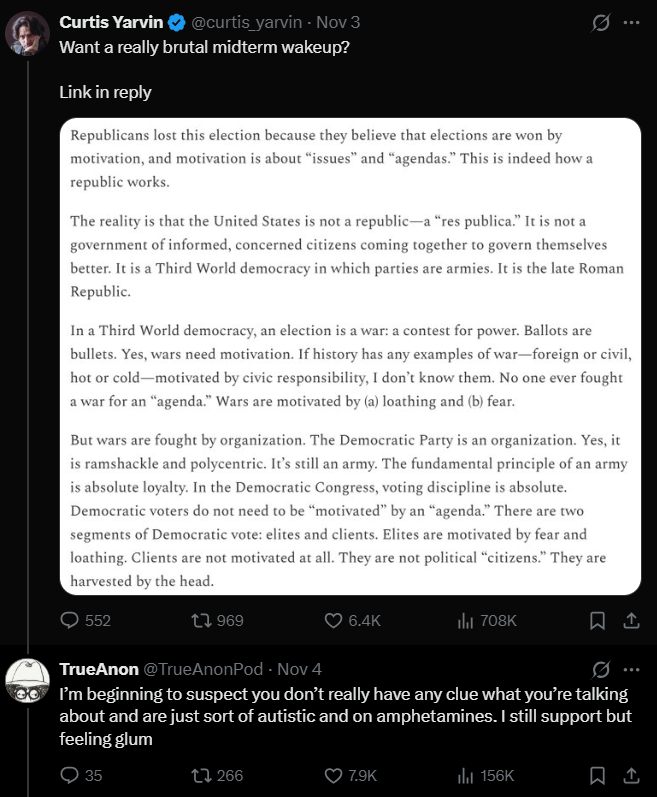
Your revolution is over, Mr. Yarvin! Condolences. The chuds lost. My advice is to do what your classmates did; start an AI startup, sir. The chuds will always lose. Do you hear me, Yarvin? THE CHUDS WILL ALWAYS LOSE!!
This has been very obvious to anyone with a brain for a while now.
Yarvin larps as a 180 IQ dark wizard political genius but all he does is make bad predictions and vague esoteric references to old obscure thinkers and books to make you think he’s smart.
For a certain type of lonely, depressed, angsty autistic type it’s easy to get one-shotted by guys like him but he’s just a total pseud and a fraud, like the “Intellectual Dark Web” guys from 2010s.
Avoid.
Im hopeful for America because of Democrats like Ossoff and Talarico or Republicans like Rubio and DeSantis.
Articulate statesmen who although opposed have a vision for America and approach public office with dignity.
America needs to abandon low IQ resentment politics now.
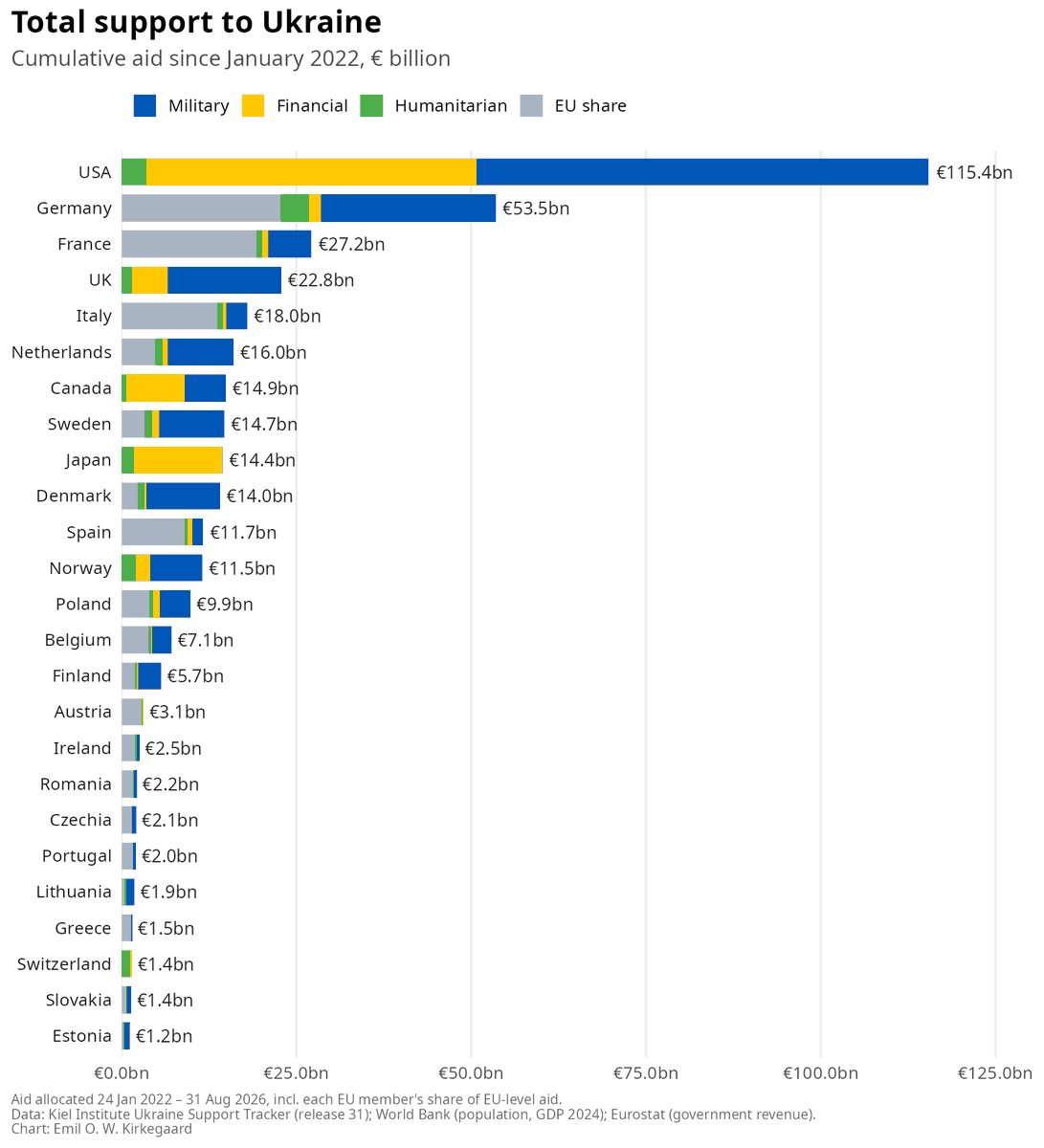
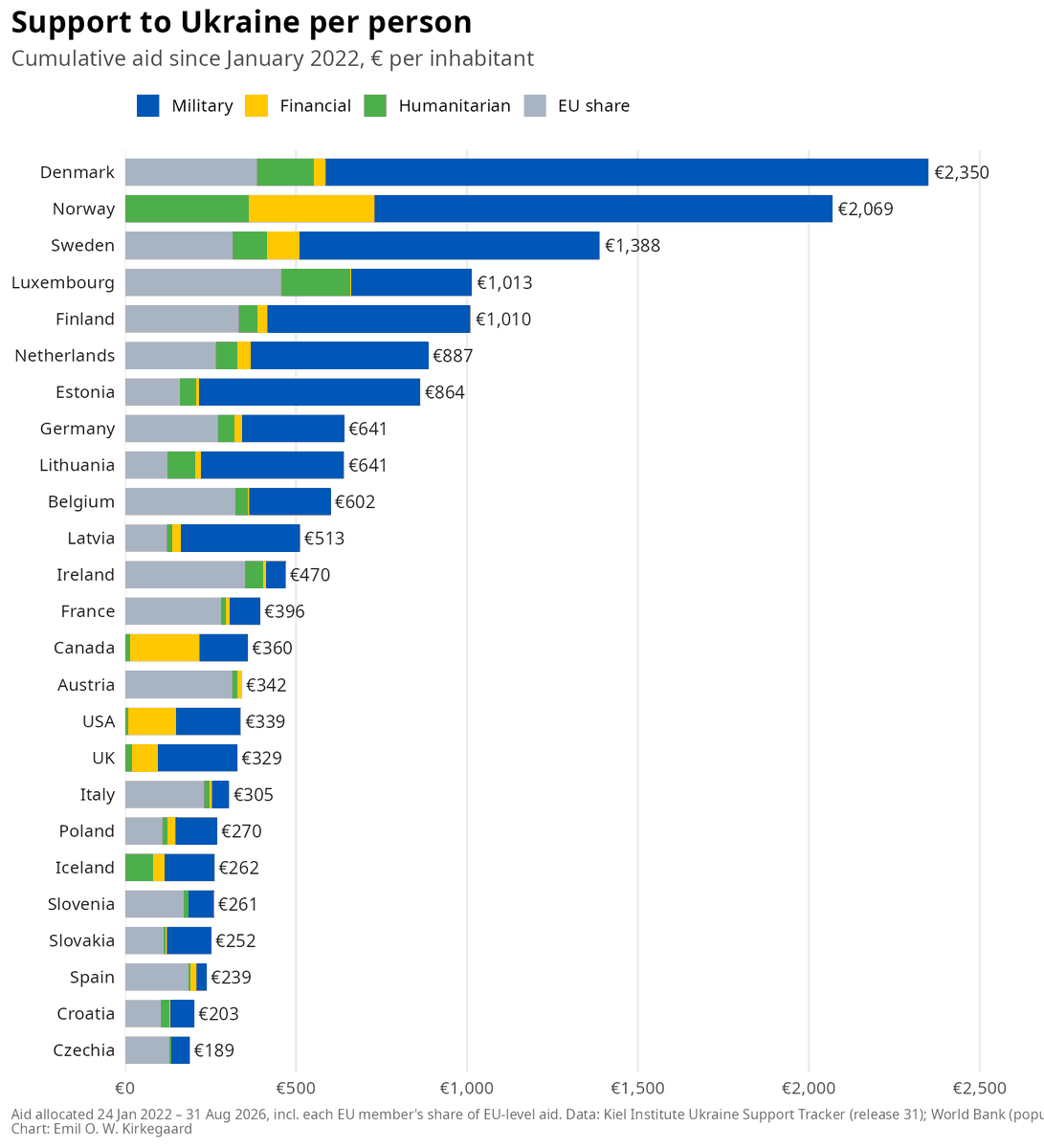
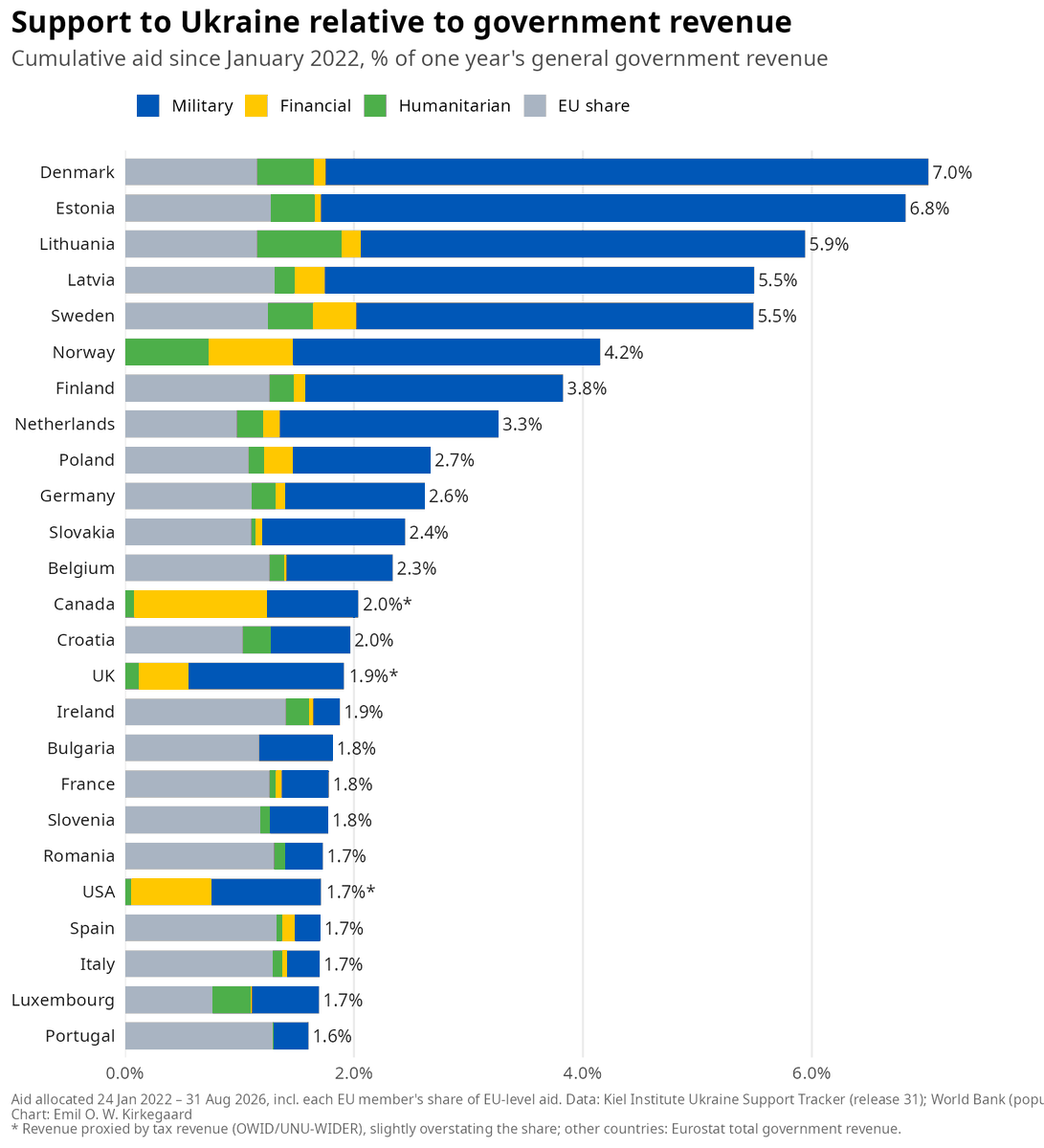
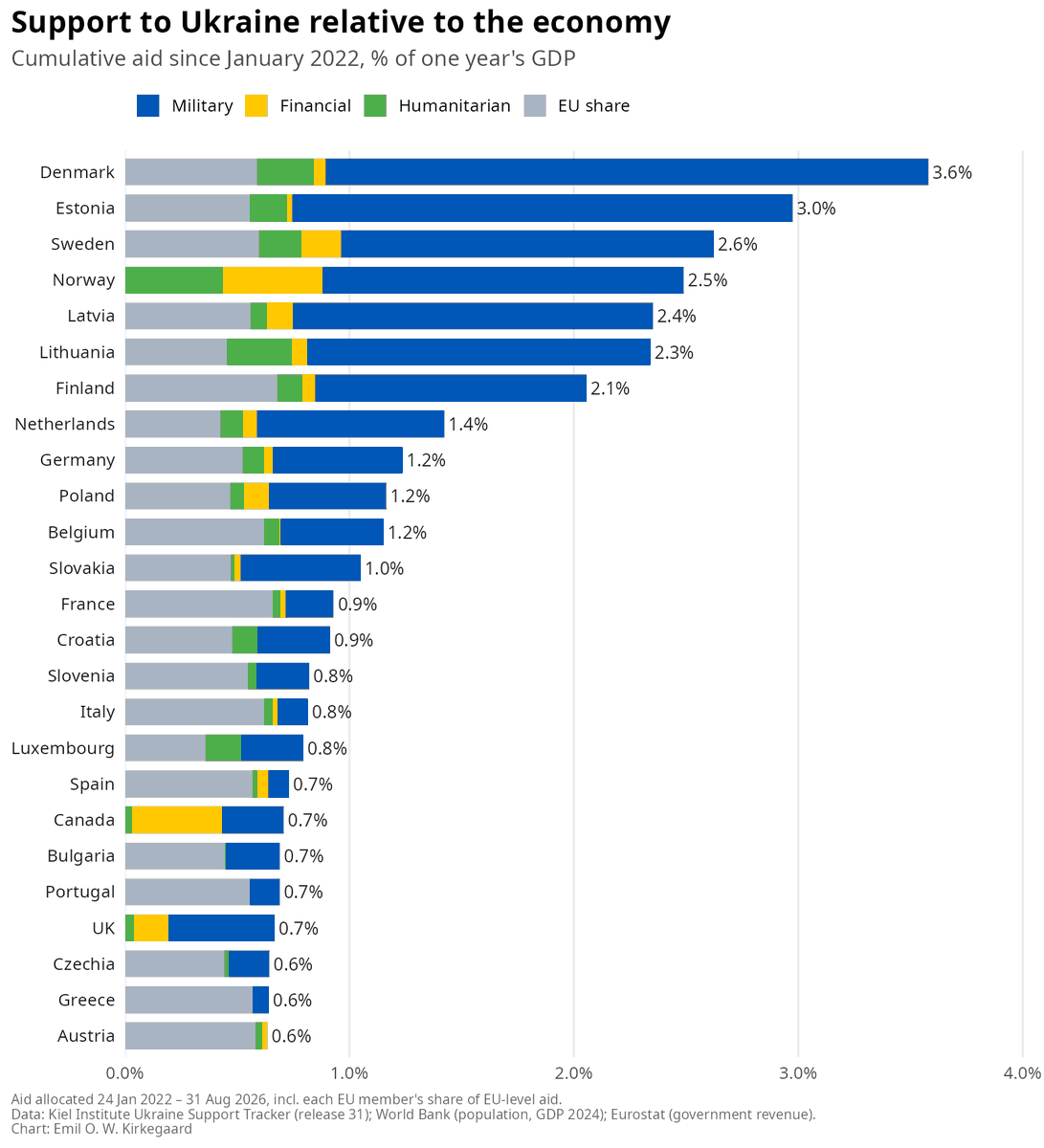
The war in Ukraine is very expensive. Here's what things look like from the pro-Ukraine side:
1) On absolute scale, USA dominates any particular country, but it's a silly comparison because of scale.
2) On per person basis, Denmark is #1, Norway #2
3) On economy basis (GDP), Denmark #1, Estonia #2
4) On government revenue basis, Denmark #1, Estonia close #2
Thus, in relative terms, the main countries funding the war aside from Russia and Ukraine itself, are the Baltics and Nordics. Exactly the same countries who arguably have the most to fear. Small countries are easy prey in theory, several have borders to Russia (as do a few others not in the top like Poland).
Yes, that’s Yarvin’s actual view. That Republicans are all sincere policy wonks with deep principles and respect for their enemies, and that’s why they lose to the Democrats, who combine all the traits of every genocidal and authoritarian movement in history.
I swear to you, this is what passes for right-wing thought in the Trump era.
Takes on the election
1. To a first approximation, Republicans lost this hard because voters lost confidence in the Trump administration, not because of a positive agenda from the Democrats. Favorability of the Democratic Party was negative (-5). But Trump told voters to “vote like he was on the ballot”, and they did. The NBC exit poll found that 37% of voters approved of Trump, and 63% disapproved (-26). There’s just no winning the national environment with these margins.
2. There were essentially two major issues that voters cared about: 1) cost of living and 2) government corruption, both of which ~90% of voters said were “crucial or a major factor”. AI was not *that* big of a deal in this election - 56% said it was “crucial or a major factor”, but it’s really hard to disambiguate what voters feel about AGI and catastrophic risks (if anything) from ordinary median-voter NIMBYism around data centers. (It will, however, likely be a huge deal in the 2028 election when the impacts of AI become much more visible). Immigration was also not that big of a deal. Voters actually slightly favored Rs on immigration (+2), probably thanks to lasting backlash from the Biden administration’s laxity on border enforcement. It's unclear to what extent the war with Iran contributed aside from it raising the price of gas.
3. Data centers are probably not over. In fact data center ETF $DTCR was up nearly 2.5% today! It’s hard to understand why this is the case, but one hypothesis is that markets think ultimately, elites’ recognition of the immense economic and national security importance of data centers will override voters’ desire not to build them.
4. On cost of living in particular: one of the most important questions now is to what extent Dems will embrace economic slopulism (think rent control, broad asset taxes, and subsidizing demand) vs. “abundance liberal” policies like building more housing, cutting regulations, and embracing economic growth.
5. Thermostatic backlash is real. Voters hate incumbents. Political majorities shift constantly. The blue wave of 2008 was immediately followed by the red wave of 2010. Anyone predicting a durable multi-decade supermajority for Democrats will likely end up being wrong.
6. “Woke is back” is exactly the wrong lesson for Democrats to take from this, and Ro Khanna posting “DEI is back” doesn’t help. Using transgender issues as a proxy for “woke”, 52% of voters said trans rights have gone too far, compared to just 26% who said they haven’t gone far enough. Deep-blue Washington voted to ban trans athletes in girls’ sports, and Colorado voted to ban trans surgery for minors. Successful Democrats mostly avoided culture war issues.
7. Similarly, a lot of moderate or even right-leaning downballot measures passed, even in blue states. Eight states voted to require voter ID. North Carolina voted to cap state income taxes. California’s billionaire tax is on track to fail by nearly 11 points. Wisconsin voted to ban DEI in state government. Voters largely do not like left-wing ideas.
8. On the other side, “Demographics is destiny” (i.e. America needs to be a white nationalist/nativist country and heavily restrict immigration) is the wrong lesson for Republicans. White voters shifted 13 points to the left. Whites under 30 shifted 30 points to the left. Hispanics and other non-white groups shifted massively towards the right in 2024, and can be encouraged to do so again.
9. Moderates outperformed; radicals underperformed. Dems won by 13 points nationwide. Roy Cooper won by 19.6 in North Carolina (where Trump won by 3.2 in 2024). Jon Ossoff won by 18 in Georgia, where Trump won by 2.2. Abdul El-Sayed in Michigan and Troy Jackson in Maine, both Bernie-backed supporters of Medicare for All, abolishing ICE, and wealth taxes, both underperformed the national margin. In fact, Maine shifted slightly rightward. Dems were able to win deep red states like Iowa, Kansas, and Mississippi by running moderate, Republican-presenting, pro-border-security candidates. I suspect this is the main reason markets are up today. (For some intuition on how insane it is for a Dem candidate to win in Mississippi, Trump won Mississippi in 2024 by a larger margin than Harris won California!)
10. One of last night’s biggest winners was Florida’s Republican governor, Ron DeSantis. Under his tenure, Florida has gone from slightly red-leaning to reliably red. Republicans swept every statewide office, kept every House seat, and kept their majority in the State House and supermajority in the State Senate. In January, Florida will be the only one of America’s ten most populous states to have a Republican governor. DeSantis is genuinely smart and nuanced, lacks the baggage of figures like Vance and Rubio who are associated with the Trump administration, and did a great job as an administrator running Florida (see its high rate of domestic migration, zero state income tax, very low debt per capita, high education rankings, state budget surplus, etc). I would be unsurprised if he decided to run for President in 2028.
11. The other biggest winner was Jon Ossoff. Ossoff is a young, handsome, charismatic, moderate white male who won by 18 points in a state that went +2.2 for Trump in 2024. He achieved this in large part by focusing relentlessly on the two issues that mattered: the Trump admin’s corruption and the cost of living. He may very well be the Democratic frontrunner in 2028 (although, of course, it's far too early to make confident predictions about these things).
12. The biggest loser of all last night was Israel and the US-Israel relationship. Israel’s popularity in the United States has been in a steep, secular decline for years. Just 13% of Democrats and 54% of Republicans have positive views on Israel, and this is heavily skewed by age - younger voters are much more likely to oppose Israel. With Democrats taking both houses, it’s unlikely America’s level of political and military support for Israel will last for very long.
13. Gerrymandering doesn’t work under sufficiently strong margins for the opposing party. In political science, this is known as “dummymandering”. Dems are on track to flip 7 of North Carolina’s 14 House seats, shifting the balance of power from 10-4 Republican to 11-3 Democratic.
14. Trump quickly conceded that his party lost and he would be open to working with the Democrats. This was a positive update on Trump’s tendency toward authoritarianism. Many mainstream Republican figures, like JD Vance and Ted Cruz, quickly posted somewhat genuine mea culpas. There was a lot less coping than I expected. It’s possible that the loss had to be very painful for them to learn from it, and we wouldn’t have seen the same if Dems had won only 51 Senate seats.
15. Elections are truly a ton of fun to monitor live. There’s nothing like it. And prediction markets beat mainstream media in terms of timeliness and accuracy by FAR.
16. There’s a good chance none of this matters that much. Trump is still the president and still has veto power. Voters might turn on the incumbent Democrats in 2028. And historically, real GDP growth isn’t that different during eras where Ds controlled Congress vs Rs. Much of your probability mass should go towards “nothing ever happens”.
@Leonov_mr@eye_ii_eye Абсолютное большинство конгрессменов-республиканцев не вписываются в мага-культ в том смысле, в каком вписаваются в него ярые сторонники Трампа. Они голосуют по партийной линии, потому что они республиканцы, ну да, они не могут голосовать за правки демократов. Система такая
@Leonov_mr@eye_ii_eye Электоральная система и последствия популярности Трампа у избирателей, внутри партии и вне ее, так сработали, не республиканцы в Конгрессе его поставили президентом личными решениями. Маккейна не выпиздили, Маккейн умер. Бейкон спокойно переизбрался, куда выпиздили-то его?
@Leonov_mr@eye_ii_eye И это часть их взглядов, конечно, никуда не денется, потому что она является привычной частью республиканской платформы десятилетиями, я с ней тоже не во всем согласен, но она не отбитая в том смысле, в котором отбитые МАГАвцы. И уход от МАГА республиканизма и будет нормальностью
@Leonov_mr@eye_ii_eye Ну и не очень ясно, что под "нормальными" ты имеешь в виду. В смысле ну да, у республиканцев есть часть дефолтных взглядов (оружие, аборты, так далее), которые тебе не кажутся нормальными, но они нормальны для партии в целом и для многих избирателей, они не связаны с МАГА