The final evolution for technology with AI will be when pre-fab user GUIs become obsolete. Your phone will run an LLM, and that LLM will build what you're asking for in real-time. Information on a search, messaging interfaces, video calls--everything will be built on-demand.
My favorite use of @claudeai's skills has been creating a /commit skill that updates the repo's docs, if needed, and puts a [rag:n] score in the comment. My @n8n_io flow triggers nightly and re-indexes my RAG based on the total score for the day. Never out of date!
Ok, ok, last one. I made a skill to give @claudeai a bit more structure when it comes to making beats. Here's its first go at Trance/House/Progressive. Not bad for a first pass?
I made a fairly large skill for everyone to make music with @claudeai and Strudel REPL! Just have claude install the skill, then /dj-setup to install the deps/app, and /dj "make me a mellow lo-fi song so I can sleep" or whatever. HF <3
https://t.co/z0rODUVDBp
So, I edited Strudel REPL's code a bit, letting @claudeai push live music straight into the session. They say beauty is in the eye of the beholder... I guess music is in the ear of the compiler? LOL
I made a simple frontend wrapper script that enables beautiful and functional voice-to-text dictation on Linux (specifically, with @hyprwm's ecosystem, tested in Arch). It leverages whisper, pipewire, wtype, gtk4, and has many style config options.
https://t.co/gkoQRGhgXX
So, @Google / @GeminiApp released an update for Stitch, which is nearly exactly what my app does :facepalm: well, at least mine works local and with any frontier model. It's still useful, I swear!
This image is a real-life example of how I created simple module in CoUX for game dev skill-icon image training.
It hooks in with my Gemini API key and generates 3 images, live-reload, and then I can literally use the UI to select keep/discard, which will then be put into a training folder or deleted.
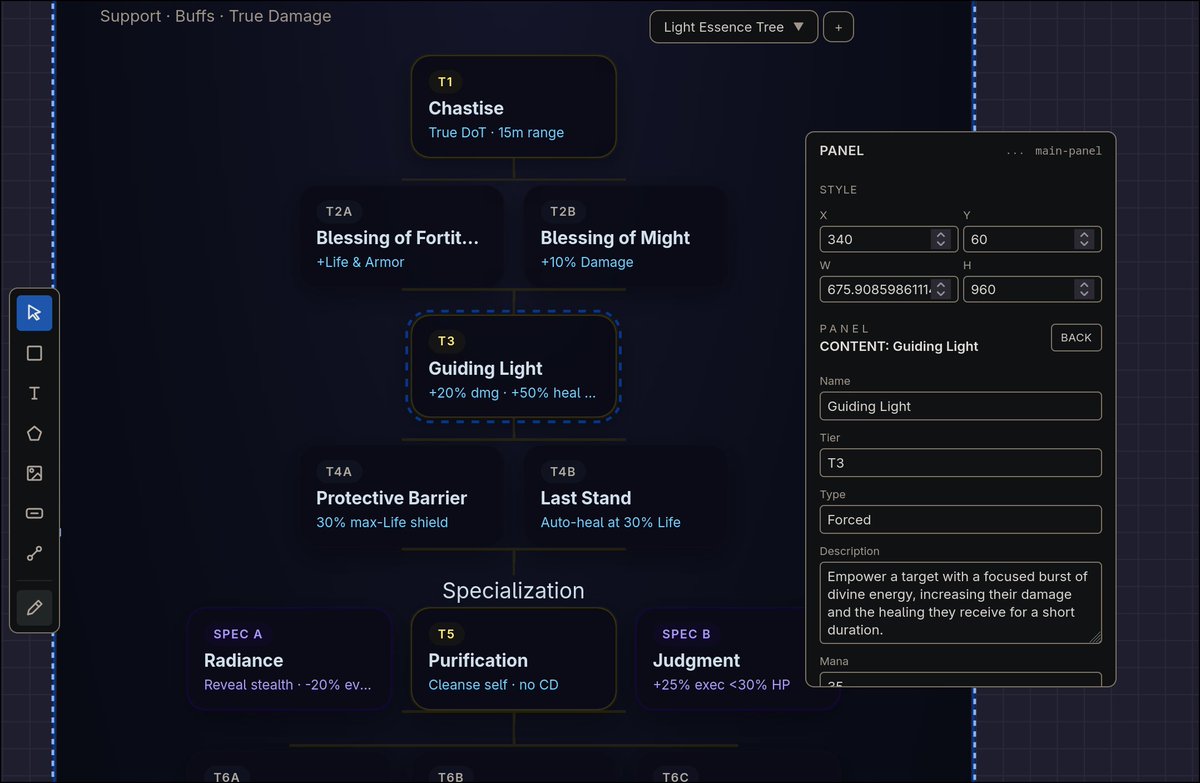
The other image shows a basic skill tree generated in CoUX and the ability to double-click and edit UI elements.
Honestly, I still think mine has a big use-case for game development, but Stitch probably outshines me on the webdev part.
hey all, I'm hiring Product Engineers, Product Designers, and AI Specialists at a stealth startup.
We're in the hardware space.
Well funded by top-tier VCs.
Working with world-class manufacturers.
Follow and DM me what you've built. If it's good, we'll talk.
This is CoUX, a LLM cooperative UX/UI designer built in Y.js
It solves the intrinsic problem of: I want to design an UI/UX with my LLM, but my LLM doesn't understand what I want.
With CoUX, you are only exposed what you need:
- Editable text boxes, colors, custom edit panel, zero-code (unless you want it).
- UX/UI elements are created from prompts with built-in skills for formatting.
- Editor is live, changes auto-save, and the LLM can see a full history of changes: full pass-through.
- Full DOM for elements, with real polish. The LLM can generate images or take provided assets, and use them in the Module creation/updates. User can click-through to a specific element (see screenshot) and edit just that element, not the container.
And exporting it is modular and code-agnostic, ensuring each module can be recreated in your language/platform of choice with your LLM.
Design it all here, get it right, then export it, and have the LLM redesign in the language of your choice.
I have tested it with both Godot and React for gamedev and I'll be open-sourcing it once I finish testing it with a few more game UI/UX modules. Happy building!
@yiliush I disagree with some people saying this is the wrong direction. I just want to tweak it a bit:
This should be an Operating System, not an IDE orchestrator. Let me swap workspaces with hotkeys, have music/browser integrated, etc!
This is 100% "Next-gen OS".