Monroe County Community School Corporation (MCCSC) has 10 year enrollment decreases while they simultaneously lobbied 2 referendums increasing property taxes. @Indy_reporter_ and @GovBraun we need property tax reform!
@hossadarian@Jared_Kelly7 Oh. High school games start at 8 pm. I guess that makes it’s A-OK.
BTW. Three time graduate of IU with decades of IU football support here.
@qschneid14@Jared_Kelly7 Maybe. But no football game should have a scheduled 8 pm start time. Ever. By anyone. Anywhere. Schools should push back on this.
Today we remember the lives lost, honor the first responders & members of our military who served & the countless families and communities impacted.
#NeverForget
A new Nature geoscience study shows a thick ice cap in northwestern Greenland was completely ice-free just 7,000 years ago.
The cap is Prudhoe Dome, which today is 1,600 feet thick.
The researchers drilled through the ice and dated the sediments below it. It turns out those sediments were once exposed to sunlight, meaning there was no ice.
7,000 years ago, summer temperatures were 3 to 5 C warmer than today.
This study shows, once again, that large ice losses have occurred in the recent past, caused entirely by natural climate variability, no CO2 forcing required.
There is already a bloody Josh Hoover shirt at the NIL Store, because you knew there would be. Use code TDH15 to save 15%. #iufb
https://t.co/YfZbJgBho5
When Al Gore released his documentary, An Inconvenient Truth, 20 years ago, he said that there would be no snows on Mt. Kilimanjaro by 2016.
But below is a live shot I grabbed of what Kilimanjaro looks like today.
Still snow-capped. 🏔️
Belle Glade, FL was the first NOAA ghost station that I discovered. Tomorrow I will post the 230th ghost station in the U.S. -- where NOAA's data factory continues to fabricate imaginary global warming data.
Earth has emerged from multiple recurring ice-age cycles that have followed the exact same pattern for a million years—warming roughly 5–6°C every 100,000 years.
These warm interglacials did not once trigger a global environmental crisis. Indeed, civilisation itself arose within the 11,700 years of today's warm Holocene interglacial. Reducing a planetary-scale biosphere to a sudden climate crisis within a few decades ignores the entire geological record.
Earth’s living biosphere is dynamic and resilient. This is demonstrated in real time as plants and farm production increase, supported by marginal rises in CO₂ levels at around 1 to 3 ppm a year. The moderate warmth and available carbon are driving a visible expansion of the green leaf plants and cereal crops—as recorded by NASA satellites.
Atmospheric CO₂ is not a threat to on-going life on Earth. The world warms or cools almost entirely from natural cycles and nature's variability. CO₂ is the building block for life—the essential driver of photosynthesis and primary plant productivity on land and in the oceans. There is no evidence CO₂ variations trigger ice age glaciations or drive interglacial recoveries.
These are by and large a the predictable consequences of the Milankovitch orbital cycles, followed by ice-sheet retreat, falling surface albedo, and subsequent shifts in ocean circulation.
The paleoclimate record shows that CO₂ 'follows' the rising temperatures on multi-millennial scales. The net-zero agenda rests on the claim that CO₂ 'leads' temperatures on decades long time scales. Yet the Antarctic ice-core record (EPICA Dome C, Vostok) is specific: temperatures consistently rise several hundred to a thousand years before CO₂ increases.
This lead–lag relationship has been settled science for over two decades (Caillon, 2003; Pedro, 2012; Parrenin, 2013).
Only after the oceans—especially the Southern Ocean—have warmed for centuries does dissolved CO₂ outgas from the deep, slowly raising atmospheric levels.
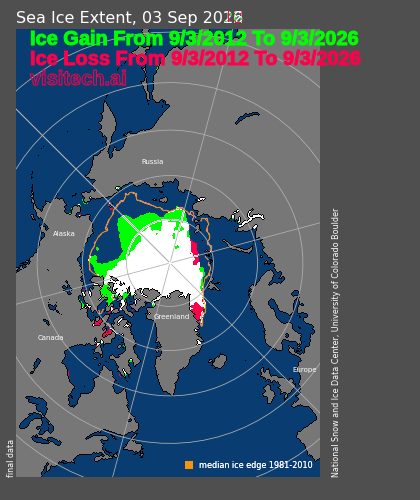
Arctic sea ice extent has increased 30% since 2012, when leading government scientists predicted an ice-free Arctic.
https://t.co/24Xy71Vaao
https://t.co/JvSnUCgAJg
https://t.co/eLJHSxqxgQ
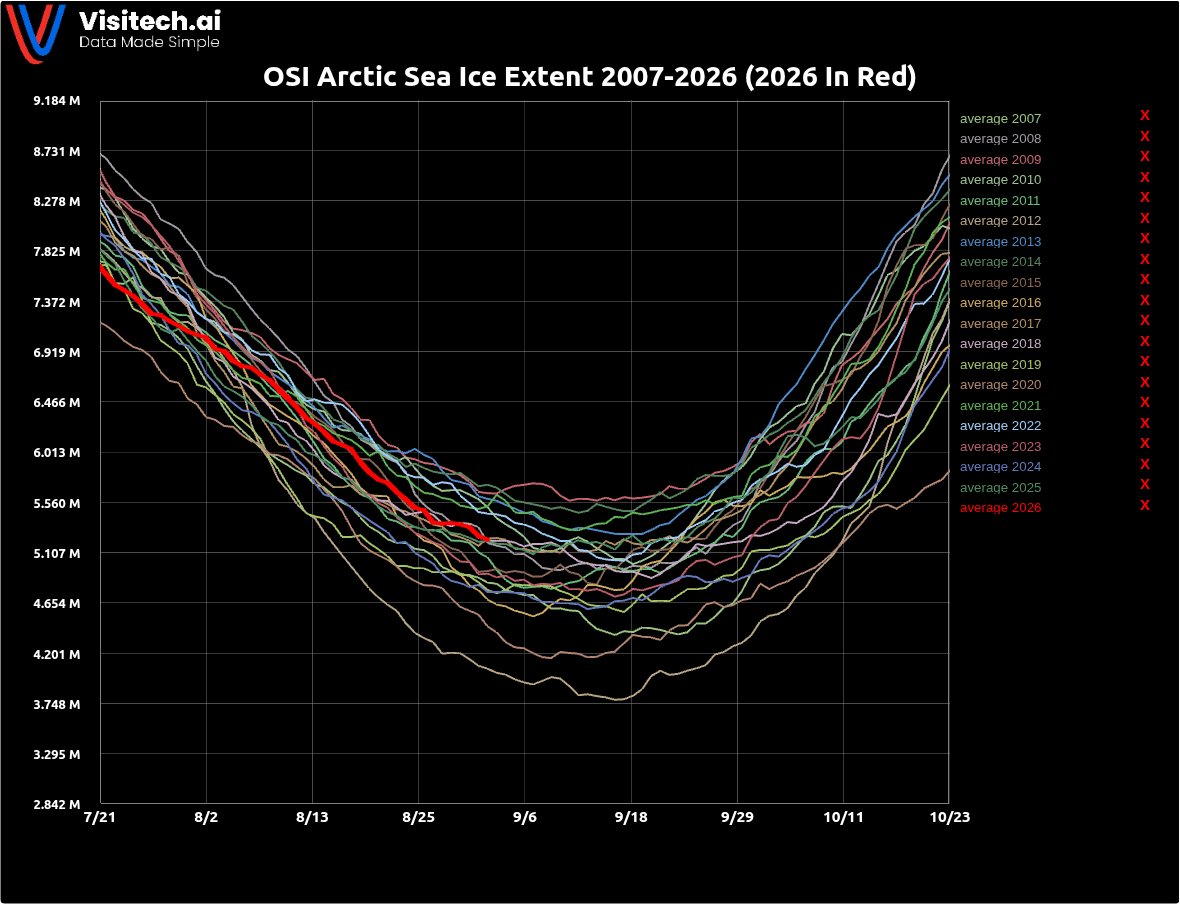
Arctic sea ice extent is above the average since 2007, when @algore won the @NobelPrize and predicted the ice would be gone by 2014.
https://t.co/bpNO5BsWf1