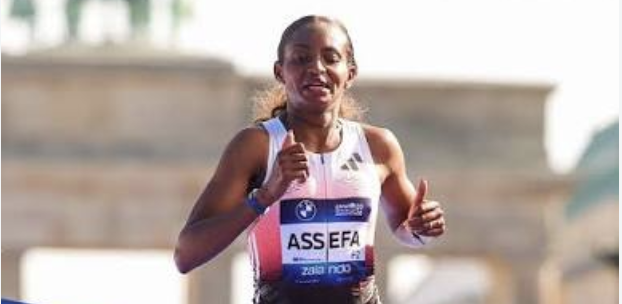
Tigst Assefa ran the third-fastest marathon in history on Sunday, winning the Berlin Marathon in 2:11:04.
For the last 2 kilometers, her Achilles tendon was "completely gone." It's been reported as a rupture.
"She was effectively running on one leg."
Through 40km, she was on world record pace, on pace to run 2:09:45. An unbelievable time. She started feeling pain at 31km and just pushed through. Holding on to the pace. But after 40km, she was visibly limping and slowed significantly
She still won in the 3rd fastest time in history.
After the race, she was immediately rushed for scans and medical treatment which confirmed a complete achilles tear, surgery, and missing ~6 months of competing.
Her manager said, "With a tendon like that, I don't know how she could finish."
Absolutely insane toughness. But it begs the question: how do you run 2 km on a ruptured tendon? Is that superhuman?
The science is fascinating. And it's something I personally experienced.
During World War II, anesthesiologist Henry Beecher studied 215 severely wounded soldiers.
About a third said they felt no pain at all, while nearly three-quarters said they didn't want any drugs for the pain. He concluded that "strong emotion can block pain."
Neuroscientist Howard Fields proposed an explanation for this phenomenon: the motivation-decision model. Your brain weighs pain against everything else you want at that moment.
When something bigger is at stake, it can turn pain down with its own opioids.
If you need to make it to the medic to help you and your squad survive...you don't feel as much pain. Your body is prioritizing its signals, and it decides this one (pain) gets in the way of a much more important goal.
Think of a pilot in an emergency. Alarms flashing and buzzing everywhere. They all matter. But a good captain tunes out everything except what's needed to steady the plane first.
That's our brain.
Now picture Assefa, she's in the closing miles of the race. A new world record is in her sights. She's spent years training for this and knows what it brings.
She feels the Achilles, a little at first, then more. But part of her tunes it out just enough. The pull of the finish is too strong. She still felt pain. It didn't go away and it got worse as the race went along, but the pain was up against a lot.
I've experienced this first hand.
In 2014, I raced a half-marathon as my tune up to attempt an Olympic Trials qualifier in the Marathon. With about a mile to go, my Achilles started to scream. I ignored it and closed my last mile in 4:30 to win.
I got the victory...but then was out for months because I partially tore my achilles.
I still felt pain, but if you asked me during or even after the race I would have told you, "Oh, just bad tendinitis." My brain had edited the signal.
So is it toughness? Yes. It still hurt a lot. As I'm sure it did with Assefa.
But toughness is more than handling discomfort. It's navigating it: asking whether the risk is worth the reward, without being blinded by the goal.
It's why sometimes the tough decision is to quit.
In my case, I should have stopped immediately. It was a meaningless tune up. For Assefa, maybe winning Berlin was worth it? It's hard to say.
The same brain that let her run on one leg is the one that can blind you.
On Everest, researchers found climbers so locked on the summit that they couldn't turn around. They called it an "escalation of commitment and difficulty stopping."
That's why real toughness is so hard to figure out. We're always pulled, sometimes to slow down, other times to press on. And both can be the right answer.
Real toughness is creating the space to take the right action. It's a decision-making process.
If the goal is big enough, your brain will let you push through almost anything. That's the gift and the danger.
Toughness is knowing which finish line is worth it.
Interesting NEW study investigating...
BRAKING STEP forces during EARLY DECELERATION from different approach speeds (AS)
100% AS = Peak Forces 5.3 x BW
85% AS = Peak Forces 4.6 x BW
70% AS = Peak Forces 4.1 x BW
🔑 Technical Ability = ⬆️ EARLY DECELERATION
#Braking#Forces
Als je de beelden terugziet begrijp je echt niet wat Jeremiah St. Juste in zijn hoofd haalde om de arts en verzorger zo te bejegenen. Kan me wel vinden in de woorden van Kenneth Perez.
Great job here discussing the biomechanics of Lindsey Vonn’s run today and how she had to compensate for her torn left ACL.
When you understand the biomechanics, and physics of the body and subsequent injuries that change those, then you can say confidently, without a doubt that Lindsey Vonn’s left ACL tear played a role in today’s crash.
One of the most incredible athletic performances post injury - Lindsey Vonn tore her left ACL and meniscus 7 days ago.
Over the past week she posted footage of her rehabbing at such a high level of function. Today she completed a training run in preparation for the Winter Olympics, hitting a top speed of 120kph on the run.
To add to it she had a partial right knee replacement in 2024. Too remarkable not to share!
ℹ️ Update Shaqueel van Persie
De medische bevindingen rond Shaqueel van Persie zijn positief; een operatieve ingreep is niet noodzakelijk en het revalidatietraject is inmiddels opgestart.
Lees hier meer: https://t.co/8Ch9hywPhZ
The pelvis and deep core escort the arm!
You can’t fire a cannon off a canoe.
If the base isn’t stable, power leaks upstream.
Clean up the global movement system → the arm takes care of itself.
Move Better. Play Better.
@Koelewi06043383@PES04971659@RutgervdNoort Slijten door beweging ?
Je bloedvaten, hart en als makkelijkste voorbeeld je spieren worden sterker door beweging. Je gewrichten wel ?
For the Dutch sports medicine community
We have started our MAPS study
Maturing
Adolescent
Pubic
Symphysis
Looking for athletes 16-21 groin pain adductor/pubic
See link for details
https://t.co/1cwOvNPg82
Please share
Exercise is the risk you take to avoid the consequences of being still.
At every visit to my office, I ask people if they are there because the pain is too severe or if they're afraid they'll make the pain worse with activity. Over 60% answered that they were worried.
Aging comes with discomfort. Our parts are changing. Not all pain implies harm. But, some pains do. In most instances, people can continue to workout or run without fear of worsening pain. Many will feel better if they're active.
We can usually be active with some discomfort while staying strong, capable, resilient, and fit. Or we can choose to be sarcopenic, frail, and sedentary with the same pain.
The documented risk of injuries with running, cycling, and weight training is low. Actually, it's much lower than you might think. And no, running doesn't cause arthritis. BUT... the risks of being sedentary are far more significant... and they produce compounding effects that would make your 401K jealous.
We rarely require forced complete rest. The loss of muscle mass begins immediately, and after just two weeks, you can lose as much as 6-8% of it. The loss of metabolic health that goes along with it is also significant. Furthermore, it could take 3-4 months of effort just to get back to baseline.
Frailty doesn't come from one incident. It comes from multiple hits over a long time. If we are forced to rest and never recover to baseline, our fitness level will constantly diminish. Over a few decades, this leads to the changes you see in many 60-80-year-olds who struggle to climb stairs, get up from lying down, and so on.
Exercise or movement should be preserved at all costs. Before you choose to rest for a few weeks... reach out to a professional. They may help calm your fears and get you back on your feet.