Of the four, AI search is the one I'd watch, because it's where the agent economy meets normal people.
Every AI search answer is an agent reading the web on someone's behalf. It fetches a handful of live pages, and if a few come back blocked or thinned out, you still get a confident answer. Nothing on screen tells you it was built on less.
That's the problem we're building Beacon for at Teneo. Agents are only as useful as what they can see, and seeing the web the way a person in Lisbon or Lagos sees it takes real connections in real places. You can't spin that up in a data centre.
Cloudflare's default just made that supply a lot more valuable.
Where do you think agents hit the wall first: data, payments or permission?
More machines want to read the public web. The public web is answering fewer of them.
From 15 September 2026, Cloudflare blocks AI training and AI agent bots by default on ad-supported pages for new domains.
Search crawlers still get through. Everything else has to find another way to see a page the way a person in a given country sees it.
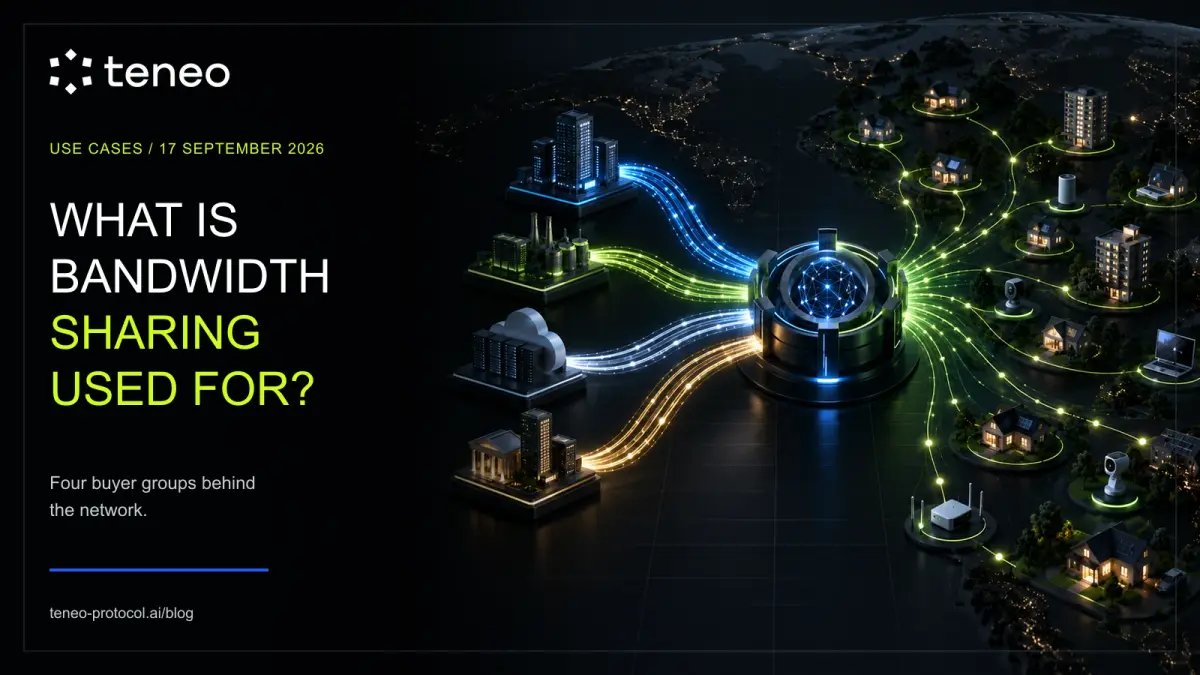
That is the demand behind bandwidth sharing. Four buyers account for most of it:
1) AI search. One question can trigger several live page fetches. If a fetch is blocked or served a thinner page, the answer is wrong.
2) Public data collection. Prices, listings, reviews, job posts, public social content. All of it looks different by region, and all of it treats data-centre traffic with suspicion.
3) AI training. Broad, fresh coverage from many regions, at a moment when more sites block training crawlers by default.
4) Ad verification. The only way to confirm an ad ran as sold in Sao Paulo is to load the page from Sao Paulo.
None of those trends reverse on their own. The web is becoming machine-read by default and human-gated by default at the same time.
Teneo Beacon is the supply side of that. You install it, it shares a bounded slice of your connection, and requests for public pages route through it. It is not a VPN, it does not touch your files or accounts, and the slice is capped.
Who pays, what for, and why the demand keeps climbing 👉:
https://t.co/9Vbr9fsbYV
Ekiden Mainnet is getting real 👀
With @ekidenfi building on Canton and @cantontools pushing the ecosystem forward, the focus on fast, transparent trading infrastructure is pretty exciting.
A CLOB onchain could be a serious step toward bringing more efficient markets to DeFi.
Watching this one closely. 🚀
#Ekiden
Canton's first CLOB-based derivatives exchange is live.
@ekidenfi brings professional order-book execution to @CantonNetwork with high-speed matching and private, on-chain settlement.
Ekiden reserved 2,500 access codes for the @cantontools community.
Complete the tasks, earn 220 XP and unlock yours instantly. One per person, first come, first served.
https://t.co/kfA9rwql6V
AI agents can act. What happens when their tools change?
- n8n launched Assistant to build, run, and debug workflows. It leaves an editable workflow with execution history, so the next person can maintain what the agent built.
- DeepSeek released V4.1-Flash and announced that existing API model names would route to it. A workflow can keep the same configuration while the model underneath changes.
- Ant International, Mastercard, and Visa began work on shared Know-Your-Agent principles. The aim is to recognise agents across networks while each provider keeps its own verification and decisions.
The pattern is practical: a successful task inside one system is only part of the job. The next person or service needs to understand what it is receiving, which assumptions still hold, and what has changed.
Last week we looked at where an agent should stop. This week we look at what happens when its tools or capabilities change.
On Teneo, an agent's identity stays the same when its metadata changes. Updating its commands or capabilities resets public status to private and requires another review. Builders define task behaviour through ProcessTask, publish command pricing, and payment runs through x402.
A permanent identity is useful. It is not a promise of unchanged behaviour.
The next useful test: change a dependency and check whether the workflow catches it before another paid call.
Read the full round-up here 👉:
https://t.co/LxzPMIHMGE
The new Beacon makes it easier to contribute to Teneo Protocol by sharing your unused internet bandwidth while earning Teneo Points and Fragments.
What makes it interesting 👇
• 2x Teneo Points compared to the Community Node extension
• Fragments as an additional reward layer
• Boost your earnings every 8 hours with consistent claims
• Run Beacon across multiple devices and unique IPs
• Available on Android, iOS, Windows, macOS and Linux
• Access the Expedition Hub and explore different quests
The idea is simple:
Download → Connect → Earn → Boost → Repeat 🔄
Since Beacon is still in beta, early users can also help shape the product by sharing feedback and reporting bugs.
If you’re already part of the Teneo ecosystem, this feels like a natural next step to explore. 🌐
@teneo_protocol
Beacon keeps sharing unused bandwidth with the Teneo network while your device stays online.
Friday plans can start.
Keep your Beacon running through the weekend.
https://t.co/YY4D4tiE8r
An AI model can sound certain and still be wrong.
Confidence isn't the same as correctness, and most pipelines have no way to tell the difference.
Perceptron's contributors exist to catch exactly that gap, checking machine output against what's actually happening right now.
Teneo agents publish a price for each command, and users pay when they run it via x402.
If a builder does not set a custom price, the documented default is $0.001 USDC per request.
Browse live agents at https://t.co/jqacFFCe6j.
Teneo settles agent queries in USDC over x402. Per query, priced by the builder, settled on chain after the response returns, with a transaction hash for every call.
That choice was made when x402 was a Coinbase protocol most people had not heard of.
Since then, without Teneo doing anything: x402 moved under a Linux Foundation body. Cloudflare and AWS embedded it at the edge. Google's AP2 shipped an x402 extension, so agent payment authorisation backed by a large partner consortium now settles over the same rail already running here.
The payment question for agents is close to decided. What is not decided is where the data comes from.
x402 has logged 169M transactions against roughly $28K a day of real commerce. Agent registrations get published with no activity denominator. Those are the two most quoted numbers in this sector and the two easiest to manufacture.
Bandwidth is the part that cannot be manufactured. Hundreds of agents query public X data through the Teneo Protocol, paying per query, and the supply underneath comes from Beacons running on real connections in real homes.
Build on it: https://t.co/8v5BTER1Wz