Summer is the best time of year to be a high school cross country runner.
No school, no mandatory practices, cool mornings and long evenings. Every run is a chance to build the fitness your competitors might pass on earning.
Come August, once practice becomes mandatory, everyone is back to training so get ahead now.
XC parents: your role this summer is simple but important.
Help make sure your athlete gets to practice, completes their on-your-own runs, and that running remains a priority even during vacations. Let’s be honest: most runs take less than an hour and can usually be done before the rest of the family is even ready for the day.
If you’re vacationing somewhere that isn’t safe to run outside… where exactly are you vacationing? 😄
Beyond running, parents can make a huge difference by helping athletes: • train in relatively new running shoes • eat mostly home-cooked meals and have a good stock of snacks • maintain a normal sleep schedule • actually hear that alarm in the morning
Summer isn’t a break from responsibilities. In many ways, teenagers need more structure and support during the summer than they do during the school year.
A successful fall season is built during the summer.
I believe it’s good that parents “force” their kids to do things they’d rather not do.
It could be 6 AM summer XC runs with the team.
It could be ordering their own food at a restaurant.
It could be communicating with teachers.
Parenting, teaching and coaching should not always be comfortable for the person in charge or the child/student/athlete. Practice doing uncomfortable things now so that growth happens and more can be handled later.
@AltamontXCTF@Siemers_XC_TF At first I paced the leaders. I was in shape enough and capable of it! Now my leaders are too good and so I try to pace the back half of my group to help bridge the gap between my top guys and my developmental guys. It’s my personal choice, not required by the district!
If you want to be recognized…
Be recognizable.
That means 1) the obvious, perform in an exceptional way. And if that’s not possible yet then 2) stand out through your personality and enthusiasm for the sport and team. Be supportive, be helpful, be kind and be present.
#1 some can do. #2 everyone can do.
We often think coaching is all about the workouts, game plans, and the technical stuff.
It's not. That stuff matters. But it misses the stuff that actually make a difference.
Here's 23 coaching principles I've collected over two decades of coaching everyone from high school kids to some of the world's best:
1. Coach from dependence to independence.
Coaching is about making your own job kind of obsolete. Works towards having our athlete be more self-sufficient, with a coaches role moving towards a kind of mentor and partnership.
2. Coaching comes from conversation.
And most of that is observing and listening. The athlete tells you everything you need to know…if you're paying attention.
3. Caring comes first.
If they know you don’t care, the perfect plan won’t matter. The old saying “They don’t care how much you know until they know how much you care,” is still true.
4. Standards without warmth makes them fragile.
Warmth without standards leaves them lost. You need both. In parenting research they call this authoritative instead of authoritarian.
5. The story they tell themselves runs the show.
Coach the story. Knowledge doesn’t change behavior. Story does. “It’s hard to outperform your self-concept.”
6. You can't want it more than they do.
The day you start trying to is the day you've lost the room. Your job is to set the conditions and pull the lever, not push the cart.
7. Effort is contagious.
So is dread. Pay attention to which one you're spreading. You are the thermostat not the thermometer. You're changing the room temp.
8. Challenged, not threatened.
We do our best when we're stretched, not when our worth is on the line. Hard things land different when failing doesn't mean you're worthless. Stretch the challenge. Keep the worth out of it.
9. People perform best when they feel valued as a person and not just an athlete, that they belong, and when they’re performing out of joy instead of fear. Joy is a performance enhancer.
10. Reward what you preach.
If you say process and only celebrate outcomes, the brain hears the second message.What is honored will be cultivated. Watch what you praise.
11. Action is the antidote to anxiety.
One purposeful step convinces the brain the situation is manageable. Don't wrestle the monster. Point at the work and start moving.
12. Confidence is quiet. Insecurity is loud.
Arrogance sits on insecurity. Confidence sits on experience. The brashest voice in any room is usually the one most afraid of being found out. Real confidence comes from earned experience. Do the work.
13. Ego kills sync.
It crowds out the signals that lead to connection.
Always stay in learning mode. Be curious. “Once you stop learning about your athletes, you've stopped coaching.” Brother Colm O’Connell
14. Skills come from struggle.
Don’t over coach or step in too early. Rescue them too soon and they don’t keep what they almost figured out. Productive failure beats premature help.
15. Plant seeds constantly. And water them.
Any coach, teacher, or parent will tell you of the kid who told them years later they finally get it. We can’t force understanding. Just keep cultivating the space for it to grow.
16. Define success yourself.
Don't import a definition that gets in the way of the person you're trying to help become. The borrowed definition almost always fails the person who's actually in front of you.
17. Lower the bar, raise the floor.
Too often we focus on those rare days when everything aligns. You can’t control when those show up. Focus on raising your floor, making the average days better.
18. If they can only succeed with you, you’ve failed.
The goal is to give people autonomy and agency. To teach them how to do the thing, and then ultimately let them go.
19. Teach, don’t just train.
Too often, we get stuck in prescriptive mode. Remember, you are fundamentally changing the person in front of you.
20. Coaching is pattern recognition.
We pick up patterns when we pay attention. Build a database deep enough that you can see what an athlete is showing you. Then trust it.
21. Be in love with an idea, just don't marry it.
Don't become the person who swears by a single diet for everyone. Every system eventually fails, and if you've tied your identity to it, you go down with the ship.
22. The car ride home is the practice.
After a hard race or a bad workout, the brain is wide open. What you say in those minutes lasts longer than anything you said in practice all season.
23. Get out of your own way.
Most of coaching is helping people stop self-sabotaging. Under-preparation is a coping strategy. The athlete who skips the work is protecting his ego.
Underrated life advice: Make yourself easy to root for. Be kind. Be reliable. Celebrate other people’s wins. Work hard without complaining. Carry good energy into rooms. You'll be shocked by how many doors open for you by making life better for others.
They did it! The Charger boys and girls were BOTH crowned SCC Champions tonight at Clarke....maybe for the first time in HISTORY!
The boys outscored 2nd place Knoxville by 16 points. The girls came from behind to beat Davis County by .5 points...POINT 5!
Congratulations!
Are you kidding me?? Lucas Anderson breaks another 40 year old record this spring, etching his name into the books now in the 1600 M Run. Earlier this spring, he set the record in the 3200 M Run--another 40 year old record set by Dave Halferty in 1986. Impressive!
A bad meet should never get to tell a kid who he is.
A coach spends an entire season fighting that battle for 30+ young people at once.
Across 7 to 10+ meets, and for some from indoor straight into outdoor, you’re in the trenches. One athlete fighting doubt, one learning patience, one guarding against ego after success, and one rebuilding belief after a public bad day.
That is the real work.
You are not just teaching starts, splits, exchanges, or technique.
You are helping young people handle pressure, disappointment, success, frustration, accountability, and growth, without letting the wrong lesson take root.
This is why track, and sports in general, matter so much.
Sports let kids learn life lessons at a price they can still afford, with a coach beside them before the real world starts charging full price.
#TrackCoach #CoachingLife #TrackAndField @pntrack@MikeCunningham
No surprise here!
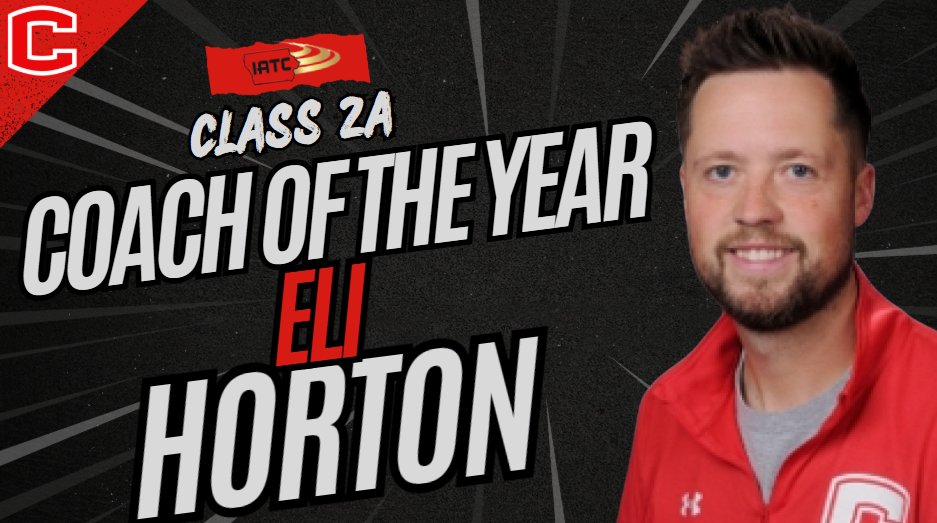
After leading the Chargers to the title this fall, Coach Eli Horton is the 2025 IATC Cross Country Coach of the Year!
Proud of you, Coach! Congratulations!
At Tuesday's SCC meet, schools set new conference records in 11/38 events--roughly 30% of the meet!
The Chargers were responsible for 3-Girls 4x100, Girls Sprint Med, Boys D-Med.
Additionally, Chariton set 3 school records-400, Sprint Med, and 4x200.
Bob Cain Track is FAST!