🗞️ Iran Plans to Send Negotiating Team to Islamabad Tuesday — NYT, WSJ, MSNOW
Multiple U.S. outlets report Iran is preparing to attend a second round of talks in Islamabad on Tuesday, but no Iranian officials or state-linked media have confirmed the news.
◽️The New York Times’ Farnaz Fassihi reports, citing two senior Iranian officials, that a delegation led by Parliament Speaker Mohammad Bagher Ghalibaf and Foreign Minister Abbas Araghchi is making plans to travel to Islamabad — but that Ghalibaf will only attend if VP JD Vance is also present.
◽️Vance is scheduled to depart Washington for Pakistan on Tuesday, giving the Iranian delegation time to travel from Tehran, NYT said.
◽️The Wall Street Journal, citing people familiar with the matter, separately reports Iran has told regional mediators it will send a negotiating team for a second round of U.S.-Iran talks.
◽️MSNOW, citing a diplomat in Tehran indirectly involved in the talks, also reports the delegation will travel “only” if Vance is present.
The ceasefire is set to expire Tuesday, but Iran has not issued any official confirmation on whether it will participate in talks. The foreign ministry spokesperson said in a briefing this morning that “no decision has been made” regarding the next round of negotiations.
اللي في الفيديوهات دا أمين شرطة مصري يبدو انه لسة واصل اسطنبول قريب، وللأسف كل اللي بيعمله انه بيتحرش بالبنات اللي بيتصور معاهم بالطريقة دي لا وبيتفاخر وبينشر القرف دا على السوشيال ميديا وطبعاً وزارة الداخلية لما توصلها الفيديوهات هتطلع تنفي وتقول دا مفصول من 50 سنة.
زي النهاردة بتاريخ ١١-٣-٢٠١٢: برأت محكمة عسكرية مصرية اليوم الأحد طبيبا مجندا بالقوات المسلحة في القضية المعروفة إعلاميا بكشوف العذرية. وجاء حكم المحكمة ببراءة الطبيب أحمد عادل بسبب تضارب أقوال شهود الإثبات بشأن المتهم، وعدم كفاية الأدلة.
#Jan25
1/12 Bahrain is one of the gulf countries being hit with missiles, and as people follow the news, it’s important you understand the country, its context and history:
The indigenous population of Bahrain are the Baharna (بحارنة) – mostly made up of Arab Shia (it was one of the first countries to become Shia in the region in the 7th century). The Alkhalifa family (from the Bani Utbah tribe) occupied Bahrain by force in 1783 coming from Zubara (modern day Qatar) and have been ruling with violence since then. During the 2011 uprising one of the prominent chants was “go back to Zubara, your visit is over”, as the Bahrainis consider themselves occupied. This makes Bahrain the oldest ongoing occupation in the region.
A Day 3 recap of the war (with focus on Iranian strategic narrative):
🔹CENTCOM confirms that U.S. strikes on Iranian missile bases used B-1 bombers. The U.S. is trying to dismantle Iran’s fortified underground missile facilities.
🔹Iranian reports suggest Tehran has rejected multiple mediation attempts. Tehran’s apparent assessment is that it can sustain high-intensity conflict for 60-90 days, making early ceasefire acceptance strategically disadvantageous.
🔹Ali Larijani explicitly framed the war as a contest of endurance, stating Iran – unlike the United States – is prepared for a prolonged conflict. The objective appears to be altering Washington’s cost-benefit calculations over time.
🔹Iranian strategic discourse increasingly describes the conflict as a “war without rules” or a “game without red lines,” signaling deliberate unpredictability intended to reshape deterrence dynamics after leadership decapitation failed to halt Iran’s response.
🔹A related concept emerging in Iranian messaging is operating “one level above” adversary actions, i.e., delivering escalatory responses even to indirect threats in order to redefine escalation thresholds.
🔹This logic appears reflected in Iranian strikes toward British facilities in Cyprus, interpreted domestically as retaliation for London allowing U.S. access to Diego Garcia despite not joining offensive operations.
🔹One of the most consequential developments was the loss of three U.S. F-15 aircraft, initially claimed by Iran as shootdowns but later attributed to friendly fire from Kuwaiti air defenses, highlighting the growing risks of coalition battlefield congestion.
🔹Analysts close to Iranian security circles describe a layered missile strategy: first targeting radar systems, then launching low-cost drones and missiles to exhaust air-defense interceptors before deploying advanced weapons later.
🔹Iran’s continuous missile launches therefore appear designed less for immediate damage and more for attritional depletion of U.S. and Israeli defensive systems over time.
🔹Uncertainty over the size and dispersal of Iran’s advanced missile stockpiles may explain intensified U.S. and Israeli strikes against underground facilities and missile infrastructure.
🔹President Pezeshkian expanded emergency authorities across ministries and provincial administrations to ensure continuity of governance, deepening wartime decentralization already initiated before the conflict.
🔹Israel’s targeting pattern has become clearer: strikes now heavily focus on intelligence ministries, police headquarters, IRGC district bases, and internal security institutions, suggesting systematic erosion of regime coercive capacity.
🔹Parallel strikes against western border regions and Kurdistan province have fueled Iranian fears that external actors may seek to enable insurgent infiltration as an alternative to direct ground invasion.
🔹Iran has responded by striking areas in Iraqi Kurdistan while increasing pressure along its borders, indicating concern about a potential indirect ground dimension to the war.
🔹Iran-aligned Iraqi resistance factions – including Kataib Hezbollah, Harakat al-Nujaba, and Kataib Sayyid al-Shuhada – continue their operations on a limited scale, opening another attritional front against U.S. forces.
🔹Hezbollah formally confirmed its participation, firing rockets toward Haifa, though involvement remains limited due to degraded capabilities and domestic political constraints in Lebanon.
🔹Iranian sources claim prewar coordination between the Quds Force and regional partners defined phased entry into the conflict, suggesting activation of the “axis of resistance” is proceeding gradually rather than simultaneously.
🔹The IRGC has reportedly begun enforcing a de facto closure of the Strait of Hormuz, warning commercial vessels against transit and threatening missile strikes. This is a major escalation targeting global energy flows.
🔹Simultaneous attacks on Gulf energy infrastructure, including an Aramco facility near Ras Tanura and gas infrastructure in Qatar, indicate an effort to raise global energy prices and increase economic pressure on Washington.
🔹Iranian authorities signaled zero tolerance for dissent. IRGC intelligence warned that actions undermining stability during wartime would be treated as collaboration with the enemy, implying harsh internal repression.
🔹Negotiation signals remain contradictory. While Trump suggested a potential deal was possible, Larijani publicly rejected negotiations, reinforcing Tehran’s view that talks can occur only after strategic calculations shift.
🔹Iran’s sustained missile tempo against Israel appears designed to impose psychological as well as military pressure, keeping populations under prolonged shelter conditions while conserving firepower for a longer conflict.
🔹Overall, Day 3 shows the war evolving into simultaneous military, economic, psychological, and regional escalation far beyond bilateral confrontation.
🔹The key question now is whether expanding proxy involvement and energy warfare will force external powers into deeper participation or instead accelerate pressure for negotiated containment.
---
P.S: Not sure how long I can keep doing this!
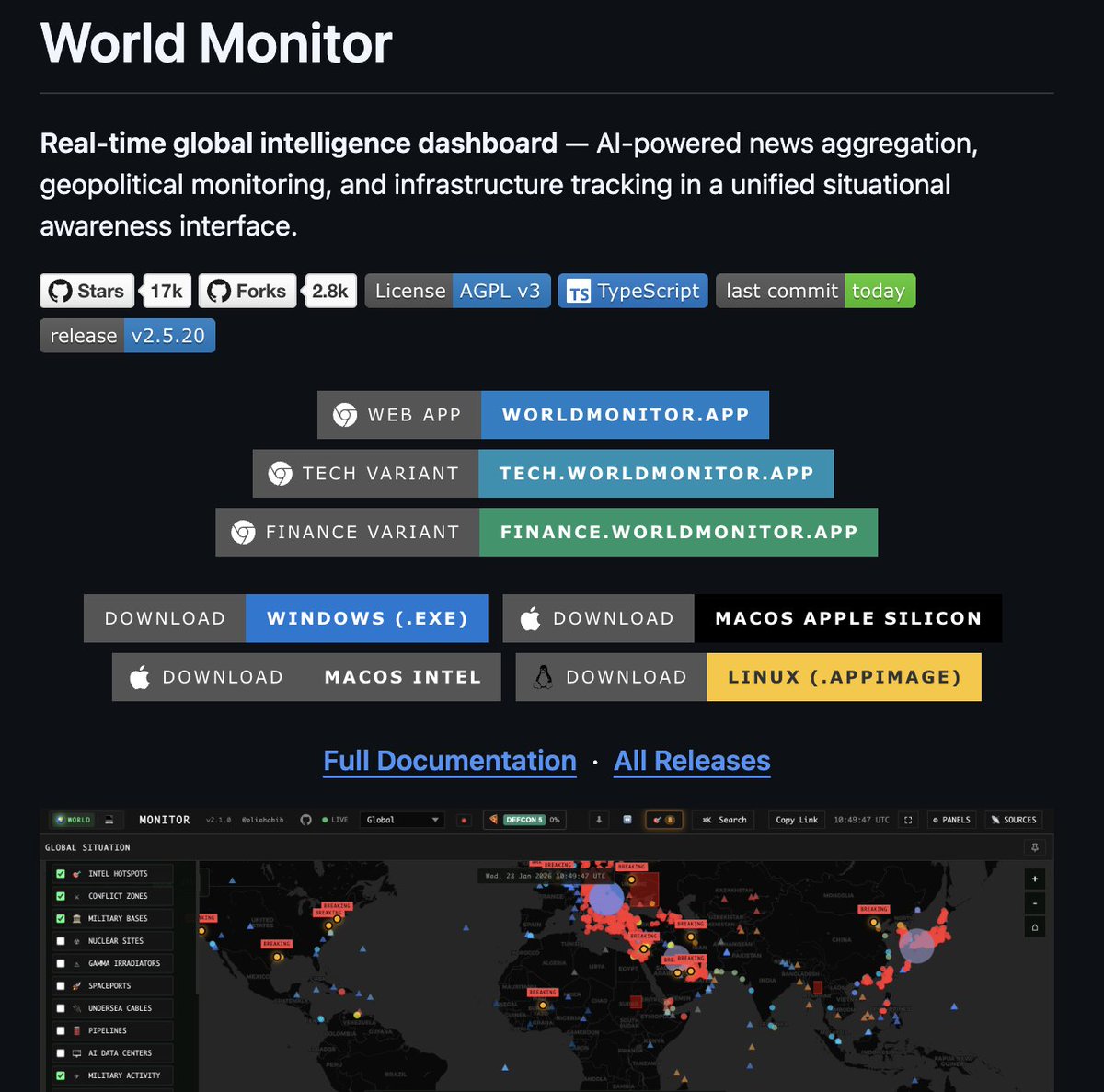
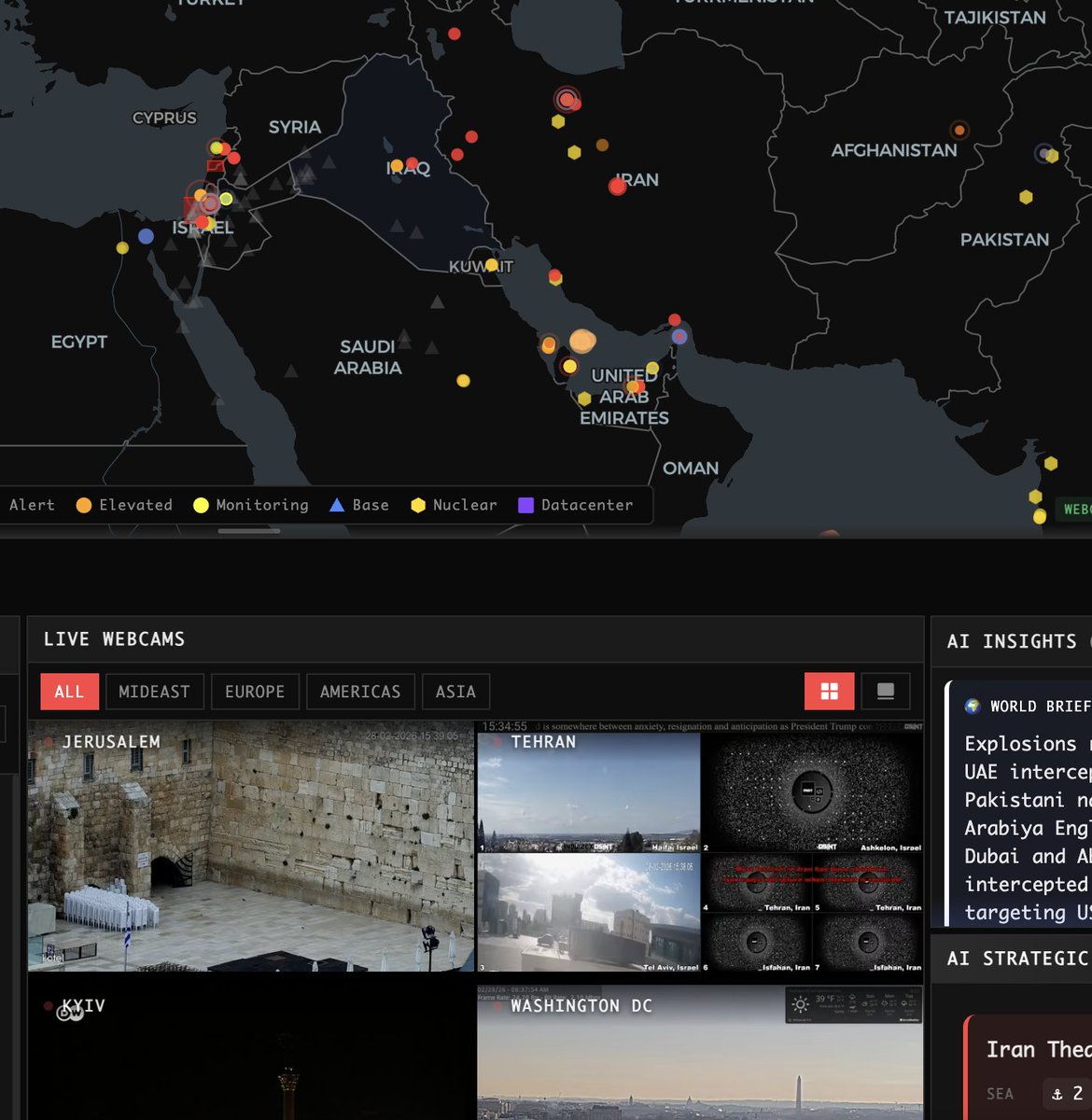
With everything happening between the US and Iran, World Monitor by @eliehabib is worth knowing about. It's an open source intelligence dashboard with a 3D globe, 36+ data layers, and 150+ news feeds that you can run locally. Think of it as a free, self-hosted alternative to expensive OSINT platforms.
> 36+ toggleable map layers including military bases, conflicts, naval vessels, satellite fire detection, protests, and infrastructure targets
> AI-powered focal point detection that correlates across news, military activity, protests, and outages to identify convergence zones automatically
> Country instability index generates real-time risk scores using a weighted blend of protest data, conflicts, displacement, outages, and climate anomalies
> Temporal anomaly detection flags deviations like "military flights 3.2x normal for Thursday" using a 90-day rolling baseline
> 8 live video streams (Bloomberg, Al Jazeera, Sky News, CNBC, etc.) embedded directly in the dashboard
> Runs AI summarization locally through Ollama with no API keys and no data leaving your machine
> 4 variants from one codebase: geopolitics, tech, finance, and a "happy news" version
> 100% free and open source, runs as a native desktop app on macOS, Windows, and Linux
The Iranian regime is in trouble. Bringing in mercenaries is its last best hope.
Riots in dozens of cities and the Basij under siege — Mashed, Tehran, Zahedan. Next stop: Baluchistan.
47 years of this regime; POTUS 47. Coincidence?
Happy New Year to every Iranian in the streets. Also to every Mossad agent walking beside them...
@realDonaldTrump@SecRubio@CIADirector