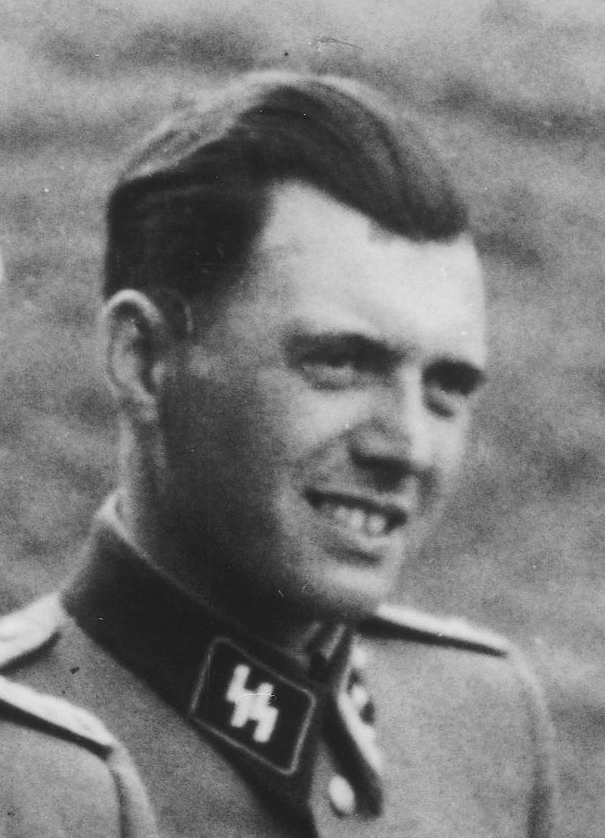
Josef Mengele, the Auschwitz "Angel of Death," is the most famous Nazi who never once saw a courtroom, and the way his life actually ended is far stranger than any trial could have been.
He was not some brute. He held two doctorates and saw himself as a serious scientist, which is what makes him so chilling. At Auschwitz he would stand on the arrival ramp in a spotless uniform, sometimes whistling opera, and decide with a small flick of his hand who went to the barracks and who went straight to the gas. He was obsessed with twins and with eye color, and he ran experiments on prisoners that are too grotesque to fully describe here.
When the Soviets closed in on Auschwitz in January 1945, he simply packed up his research files and walked away. American troops actually captured him that spring and let him go, because unlike most SS men he never got the blood-type tattoo under his arm, so nobody realized who they were holding.
He then vanished for years as a farmhand in Bavaria, sorting potatoes under a fake name while the world's most wanted lists carried his real one. In 1949 he slipped down a "ratline" to Argentina and did something almost unbelievable for a hunted man. He lived in Buenos Aires under his own name. He was listed in the phone book. He moved in circles friendly with the Perón government and helped run a business.
The wall finally cracked in 1960, when Mossad agents snatched Adolf Eichmann off a street in Buenos Aires and spirited him to Israel for trial. Mengele understood he could be next. He panicked and ran, bouncing from Argentina to Paraguay to Brazil, always one rumor and one border ahead of the people looking for him. Israel really did hunt him, and more than once quietly shelved the search to chase more urgent threats.
The world pictured a shadowy criminal mastermind protected by a secret Nazi network. The reality was much smaller and sadder. He spent his last years as a bitter, lonely, sickly man rotting in a modest house near São Paulo, sheltered by a couple of Nazi-sympathizer families who half regretted taking him in. He argued with everyone, wrote self-pitying diaries about his own suffering, and chewed the ends of his mustache from anxiety.
In 1977 his son Rolf finally traveled to Brazil to meet the father he barely knew, hoping for some flicker of remorse about Auschwitz. He got the opposite. Mengele defended everything he had done and blamed the victims for their own deaths. Rolf went home disgusted and still kept his father's secret.
The end came on February 7, 1979. Mengele went into the ocean at Bertioga, suffered a stroke while swimming, and drowned in the surf. No manhunt, no capture, no justice, no reckoning. The people hiding him buried the body quietly under a dead man's borrowed name, Wolfgang Gerhard, and told no one.
For six years the world still believed he might be alive and closing in. Then in 1985 investigators raided the home of Hans Sedlmeier, Mengele's lifelong friend and secret contact back in Germany, and found an address book that led them straight to the family in Brazil. The family cracked and pointed to a grave in the town of Embu.
They dug up the bones. A forensic team that included the legendary Clyde Snow examined the skeleton, matched old X-rays and measurements, and concluded it was him. Any lingering doubt was erased in 1992, when DNA testing confirmed beyond question that the bones in that grave belonged to Josef Mengele.
Then comes the strangest part of all, the detail almost nobody knows. Nobody claimed the body. His family wanted nothing to do with it. So the skeleton stayed in an institute in São Paulo, and today the man who performed monstrous experiments on living human beings is used to teach forensic medicine to Brazilian medical students.
The very doctor who led the identification now uses those bones in the classroom, showing students how to read a skeleton and give a name back to the dead. Think about that. Mengele escaped every court on earth, died a free old man in the water, and ended up as a teaching tool for the exact science that finally caught him. The experimenter became the specimen.
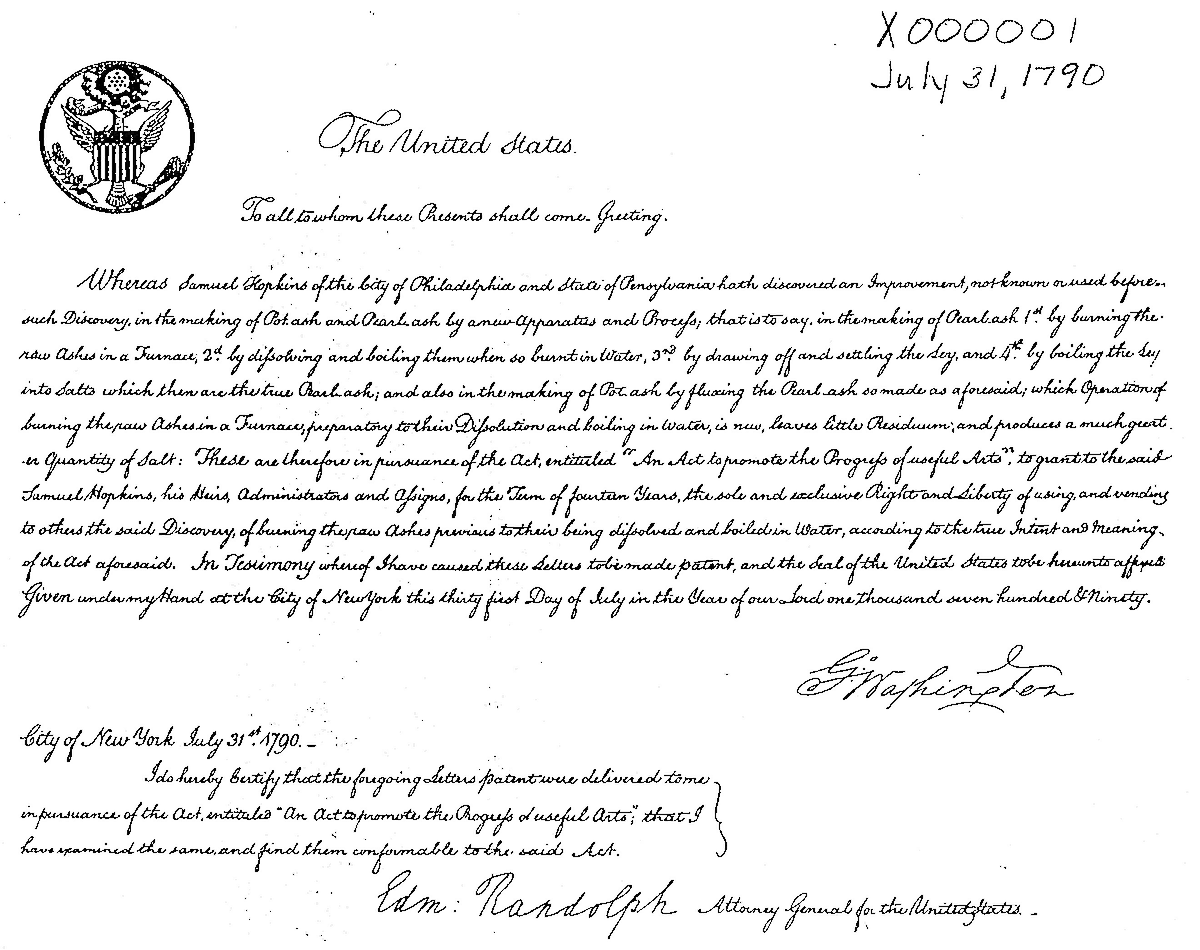
July 31, 1790. The United States issued its very first patent, and George Washington himself signed it, kicking off the system that would help make America an engine of invention.
The founders were surprisingly forward thinking about this. They wrote protection for inventors right into the Constitution, believing that if you gave people the exclusive right to profit from their ideas for a while, they would be motivated to invent useful new things and share them with the world. So one of the young government's early acts was to set up a patent system.
The first patent ever granted went to an inventor named Samuel Hopkins for a better method of making potash, a chemical used in fertilizer, soap, and glassmaking. It sounds humble, but it was genuinely useful stuff for a farming and manufacturing nation.
What makes it remarkable is who signed off on it. The document was personally signed by President George Washington. The government was so small and new that the president was literally approving individual patents by hand. That first grant launched a system that would go on to protect the light bulb, the airplane, the telephone, and millions of other inventions. American ingenuity got its official start on this day.
On this day in 1718, a British admiral destroyed an entire Spanish fleet in a war that had not actually been declared yet. He basically ambushed them, wiped them out, and started the war by winning it.
Here is the tangled setup. Spain wanted to grab back territory in Italy, and had landed an army on Sicily to seize the island. Britain was not officially at war with Spain, but Britain had committed to stopping exactly this kind of Spanish expansion, so it sent a powerful fleet to the Mediterranean under Admiral Sir George Byng, with orders to prevent the Spanish takeover. That put a British fleet and a Spanish fleet in the same waters off the southern tip of Sicily, near Cape Passaro, with no state of war between their two countries. A very awkward, very dangerous situation.
Byng did not wait around for the diplomats to sort it out. He shadowed the Spanish fleet closely, and when the Spanish ships fired on his leading vessels, that was all the excuse he needed. He fell on them hard.
It was less a battle than a rout. The British fleet chased down and smashed the Spanish one, and by the end Byng had destroyed or captured around seventeen Spanish warships, with the total Spanish losses running even higher when you count the smaller vessels. The Spanish navy in those waters was essentially annihilated in a single day, and with its fleet gone, Spain's whole plan to hold Sicily was crippled.
The remarkable thing is the sequence of events. The battle came first, the formal declaration of war came afterward. Cape Passaro was the opening blow of the War of the Quadruple Alliance, a war that in a real sense started because Byng chose to strike a devastating blow before anyone had officially said the fighting had begun.
It is a sharp little lesson in how naval power actually worked in that era. A fleet in the right place, commanded by someone willing to act decisively, could settle a war before the politicians had even finished arguing about whether there was one.
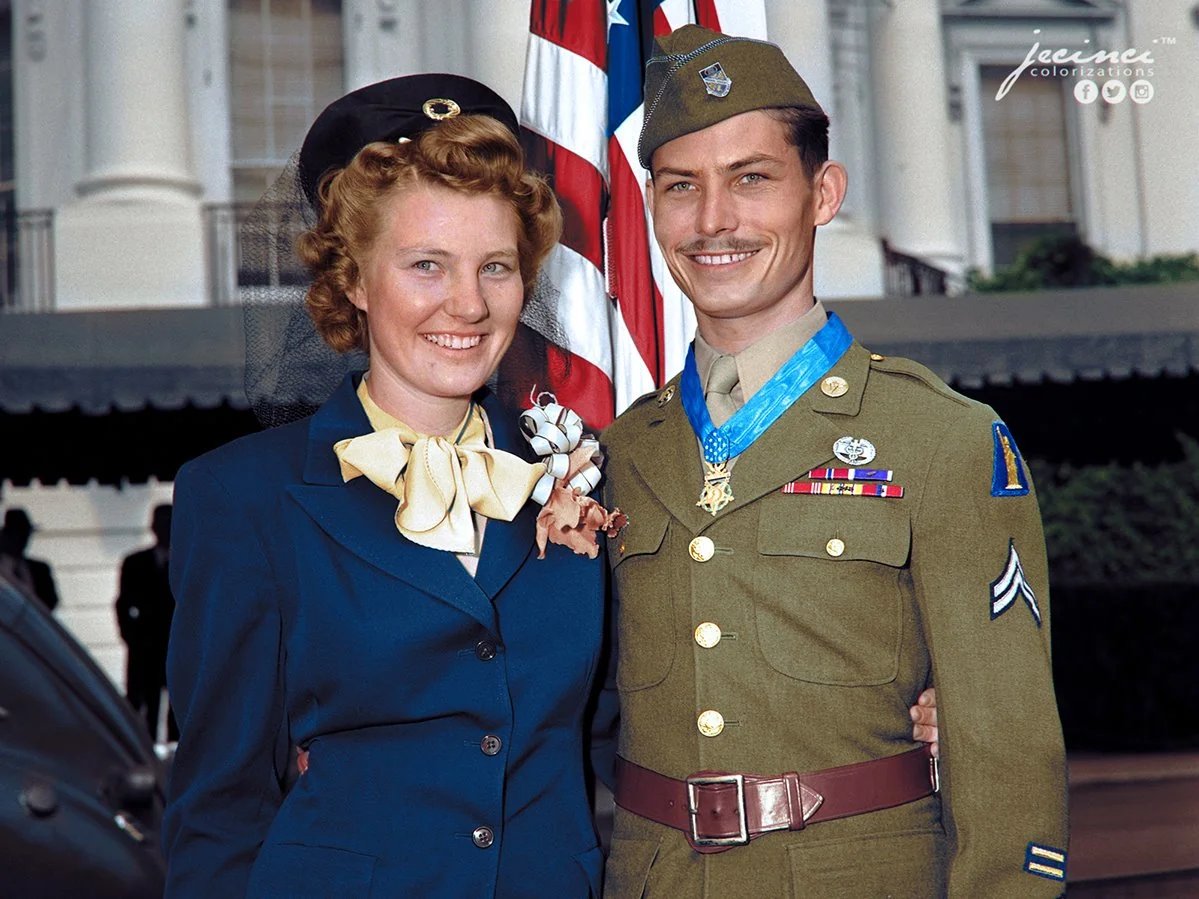
Desmond Doss went to war and refused, on principle, to carry a weapon or fire a shot, and he came home with the Medal of Honor. He is the only conscientious objector in American history to earn it, and the way he did it should shame anyone who ever called him a coward for his beliefs.
Doss was a Seventh-day Adventist from Virginia who took the commandment against killing literally and completely. He wanted to serve, but he would not carry a rifle. The Army did not know what to do with him. His fellow soldiers despised him at first, called him a coward, threw boots at him while he prayed, tried to get him discharged as unfit. He took all of it and would not budge. He trained as a combat medic, unarmed, and shipped out to the Pacific.
Then came Okinawa, and a place called Hacksaw Ridge, a sheer escarpment the Americans had to climb into a meat grinder of Japanese fire. In the fighting on top, Doss's unit was cut to pieces and ordered to pull back off the cliff. Doss would not leave the wounded. Alone, under fire, he went from man to man across that exposed ridge, dragging each one to the edge, and lowered them down the cliff face one at a time with a rope sling he rigged himself, praying the whole time, Lord, help me get one more. One more. One more.
He lowered an estimated 75 men to safety that way, the men who had mocked him, saved one after another by the man who would not carry a gun. Later, still on Okinawa, he was badly wounded, took a grenade blast to the legs and then a bullet that shattered his arm, and rather than pull a bearer off another casualty he splinted his own broken arm to a rifle stock and crawled 300 yards to the aid station.
President Truman gave him the Medal of Honor and reportedly told him he considered it a greater honor to shake his hand than to be president. The unarmed objector the Army tried to throw out ended the war as one of its greatest heroes.
Millard Fillmore, the 13th President of the United States, grew up so poor he was basically illiterate as a teenager, taught himself to read using a borrowed dictionary, and then fell in love with and married his own teacher. His passion in life was books. He came from nothing on the New York frontier, was sent off to apprentice making cloth, and clawed his way to literacy almost entirely on his own. When he finally enrolled at a little local academy, his teacher was a sharp young woman named Abigail Powers. He married her.
Books stayed the center of his world. Abigail was stunned to find that the White House, the home of the President, did not own a real collection of books. So the two of them created the first permanent White House Library, turning a room upstairs into a proper library that still exists in spirit today. For a couple who had bonded over reading, building the nation's home a library was the ultimate move.
Fillmore's love of learning also produced one of the most humble moments in presidential history. Oxford University offered to give him an honorary degree. The diploma was written in Latin. Fillmore turned it down, reportedly saying that no man should accept a degree he could not read. He refused to be handed an honor he couldn't personally understand.
And here is the twist that makes him famous for the wrong reason. The single most repeated "fact" about Fillmore, that he installed the first bathtub in the White House, is a total lie. It was invented from scratch in 1917 by the writer H.L. Mencken as a joke, purely to prove how easily people believe nonsense. Mencken later confessed he made the whole thing up, but the story was so catchy it got printed as real history for decades and still gets repeated today.
So the real Millard Fillmore: a dirt-poor kid who taught himself to read, married his teacher, built the White House its first library, turned down an Oxford degree because he couldn't read the Latin, and is best known for a bathtub story that a comedian completely fabricated.
That's a President.
@RodDMartin I get excited thinking about it, but I fear it would be **too** high a high-value target. How would we protect it from one stray hypersonic ship killer? Have you watched "The Next World War" series on Youtube? It's amazing -- and the past few episodes have been horrifying
July 28, 1944. Three days ago Operation Cobra tore a hole in the German front. Today that hole becomes a trap, and around a Norman crossroads called Roncey the retreating Germans are caught in the open and torn apart from the air in a preview of the catastrophe that is about to swallow their whole army in France.
Once Cobra broke through, the American armor did not stop to fight, it poured south and west, deep and fast, the way a breakout is supposed to work. That left the German units in the path with a terrible choice. Stand and be surrounded, or pull back along roads that American tanks were already cutting. Thousands of them, a mix of SS panzer troops, paratroopers, and the wreckage of shattered divisions, jammed onto the narrow lanes around Roncey trying to escape east before the noose closed.
They did not make it. The roads clogged. Tanks, half tracks, trucks, and guns backed up bumper to bumper in the sunken Norman lanes, hemmed in by the same thick hedgerows that had protected them for weeks and now penned them in like cattle. And overhead the sky belonged completely to the Allies. American and British fighter bombers found the stalled columns and worked them over for hours, up and down the packed roads, cannon and bombs and rockets into vehicles that could not scatter and could not hide.
When it was finally over and the pocket was cleared by the 30th, they counted the results. More than a hundred German tanks and hundreds of other vehicles destroyed or abandoned in and around Roncey, thousands of men killed, captured, or scattered into the fields. One of the best equipped forces the Germans had left in the sector simply ceased to exist on those roads.
Roncey is a small name, but it is the shape of things to come. It showed what happened to a German army trying to retreat under total Allied air supremacy. A couple of weeks later, on a much larger scale, the same thing happens at Falaise, where the bulk of the German army in Normandy is trapped and annihilated in a pocket so full of dead men and horses and machines that generals said you could walk across it stepping only on corpses. Roncey, today, was the rehearsal for that destruction.
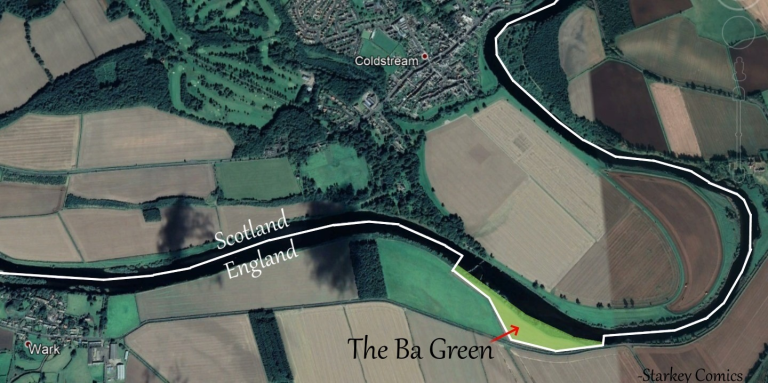
One of the many stretches of the Scotland-England border is the River Tweed, which marks the boundary for many miles. It follows the course of the river without deviation, except for one very curious field.
This is how a small piece of England came to be part of Scotland.
1/3