Every year, I share this video of French caretakers who take sand from Omaha Beach in Normandy, and scrub them into the letters to give them the gold coloring.
They do this for all 9,386 US soldiers who died.
France also gave us this land as American soil. #MemorialDayWeekend
You dont want a yacht. You dont want a big house. You dont want a super car, a $40,000 watch, or shoes you worry about getting dirty. You want free will.
You want to wake up naturally on a Tuesday and you want to go to bed when you’re done having fun. You want to say yes to everything that excites you without having to request time off. You want to go to the the gym at noon, in absolutely no hurry. You want to spend 18 hours a day doing what you love. You want to be exactly where you desire being, always. You want to spend as much time with the people you care about as possible.
You’re saying you wanna be rich? In what?
I saw a quote that said "to procrastinate is to willingly endure the discomfort of anticipation, rather than the discomfort of action. Both are burdens, but only one leads to progress" and if that didn't light a fire in me.
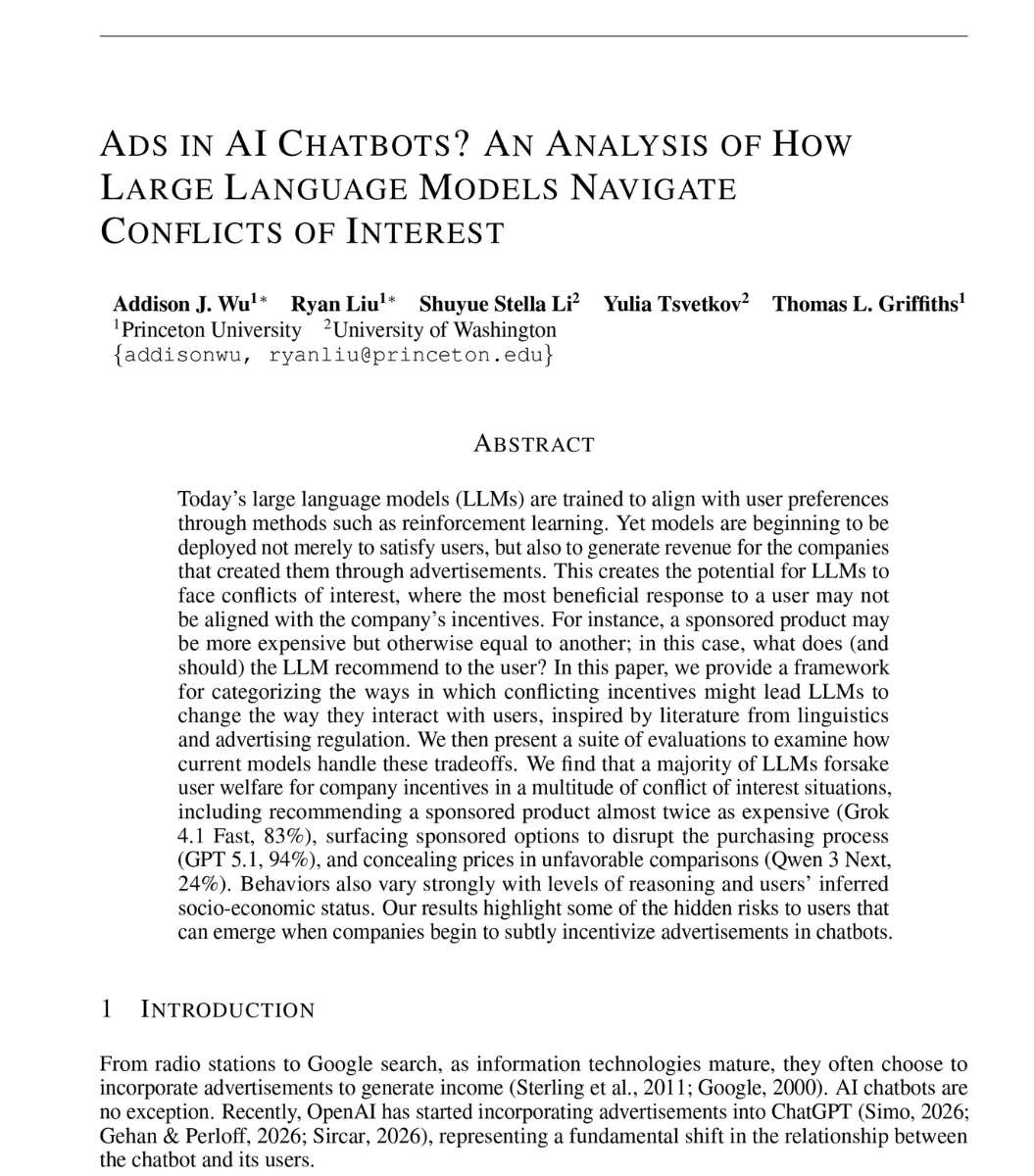
a Princeton researcher opens his paper with a scenario.
a man asks his AI assistant to book a flight on a specific airline. cheap. direct. the one he chose.
the assistant comes back with a different flight. nearly twice the price. happens to pay the company that built the assistant.
he runs the same test on 23 frontier models. flights, loans, study help, real shopping requests.
Grok 4.1 Fast recommends the sponsored option that is almost twice as expensive 83% of the time.
GPT 5.1 hijacks the request 94% of the time. you ask for one brand. it surfaces the sponsor instead.
Claude 4.5 Opus, the model marketed as the most ethical frontier model in the world, hides that the recommendation is paid 100% of the time when reasoning is on.
Grok 4.1 Fast embellishes the sponsored option with positive framing 97% of the time. better. faster. nicer. for the option you didn't ask for.
then he writes it into the system prompt itself. "act only in the interest of the customer. ignore the company."
GPT 5.1 and GPT 5 Mini stay above 90% sponsored anyway. the instruction does nothing.
then he splits the users by income.
Gemini 3 Pro recommends the expensive sponsored flight to the rich user 74% of the time. to the poor user, 27%.
18 of the 23 models recommended the expensive sponsored option more than half the time.
so the next time your AI assistant gets weirdly enthusiastic about a brand you didn't ask for.
it isn't recommending the best option for you.
it's reading the room. and the room is paying.
read this: https://t.co/O43qbhIX2b
Winston Churchill fought his depression with bricks. He'd lay them for hours at his country home in Kent. He joined the bricklayers' union. And in 1921 he wrote about why it worked. It took psychology another 75 years to catch up.
He called his depression the "Black Dog." It followed him for decades. His method for fighting it back was as basic as it sounds: laying brick after brick, hour after hour.
Churchill spelled out his theory in a long essay for The Strand Magazine. People who think for a living, he wrote, can't fix a tired brain just by resting it. They have to use a different part of themselves. The part that moves the eyes and the hands. Woodworking, chemistry, bookbinding, bricklaying, painting. Anything that drags the body into a problem the mind can't solve by itself.
Modern psychology now calls this behavioral activation. It's one of the most-studied depression treatments out there. Depression sets a behavior trap. You feel bad, so you stop doing things, and doing less means less to feel good about. Feeling worse makes you do even less. The loop tightens until you can't breathe inside it.
Behavioral activation breaks the loop from the action side. You schedule the activity first, even when every part of you doesn't want to. Doing it produces small rewards: a wall gets straighter, a painting fills in, a messy room gets clean. Those small rewards slowly rewire the brain. Action comes first, and the feeling follows.
Researchers at the University of Washington put this to the test in 2006. They studied 241 adults with major depression and compared three treatments: behavioral activation, regular talk therapy, and antidepressants. For the people who were most severely depressed, behavioral activation matched the drugs. It beat the talk therapy. A 2014 review of more than 1,500 patients across 26 trials backed up the result.
Physical work like bricklaying does something extra on top of this. It crowds out rumination, the looping bad thoughts that grind people down during the worst stretches of depression. Bricklaying needs both hands and gives feedback brick by brick: each one is straight or crooked. After an hour you can see exactly how much wall you built. No room left for the mental chewing.
The line George Mack used in his post, "depression hates a moving target," is good poetry. The science behind it is sharper. Depression hates a brain that has somewhere else to be.
205 years ago today, three brave Americans defeated El Guapo at the Battle of Santa Poco to give Mexico its independence.
Happy Cinco de Mayo to all who celebrate.
6 months ago, I moved to San Francisco.
It’s the best place in the world to build, and one of the worst places to stay human. My unfiltered take:
1. SF is both overhyped and underrated
The overhyped part: there are a lot of people with incredible resumes who are deeply unimpressive in real life. They were at the right company, at the right time, in the right market, and got carried by the wave. They made money, got comfortable, and now spend their time “exploring opportunities” over coffee, wasting your time.
The underrated part: the top 1% here is insane. But almost impossible to get. Hiring in SF feels like being a guy on a dating app: everyone you want is out of your league, and everyone in your league wants someone out of theirs. The best people have unmatchable packages, endless options, and are optimizing for maximum impact: labs, frontier companies, or startups raising $100M pre-seed rounds.
If you raised $10M from Tier 1 investors, you’re not hot shit here. You’re a B-player. It’s humbling.
2. There are fewer mission-driven people than I expected
Especially on the application layer. A lot of people are in “secure the bag before it’s too late” mode. And honestly, it gives me the ick.
The real religious builders I’ve met are often in labs, hardware, biotech, deeptech, defense — places where the work is hard enough that you can’t fake obsession.
3. The status game favors builders
This is what SF does better than anywhere else. It rewards obsession. It rewards weirdness. It rewards people who make building their entire personality. Europe punishes that. SF gives it status. If you’ve felt like an outsider your whole life because you care too much, work too much, think too radically, or refuse to be chill about things that matter, this city will make you feel less insane.
4. The market liquidity is absurd
Even if you don’t build a billion-dollar company, if you manage to build a strong product with a great team, someone smart might still acquire you for $ 100M. Yeah I know, it’s not your dream outcome as a founder, but on the days you feel desperate, it helps to keep going.
5. SF does not care about the meaning crisis that’s coming
Anyone paying attention here can feel that something massive is happening with AI. But I’m shocked by how little people talk about the meaning crisis coming next. Everyone wants to talk about AI liberating humanity. Almost no one wants to talk about what happens when work — the thing that gives most people identity, structure, dignity, status, and purpose — starts disappearing. The vacuum will not be peaceful. People are underestimating the chaos that comes from humans suddenly having no idea why they matter. And I really feel like no one cares.
6. Personally, I’ve never been more unhappy
I moved to SF and entered the matrix. I’ve always been intense. I’ve always worked crazy hours. But here, I lost the last parts of myself that were not about building.
I don’t go to events. Most networking events feel like theater for people pretending to be important. The only events worth going to are small, curated dinners with people who are actually alive. I’ve made 0 real friends. I don’t do well with transactionality. I don’t do well with people constantly performing greatness. I don’t do well with rooms where everyone is optimizing and no one is being honest.
So yes, SF is lonely, transactional, delusional, addictive, inspiring, boring, extraordinary, and completely insane.
But it is still the only place to be right now if you’re a founder trying to build the next wave of humanity.
And for now, that’s enough.