We are at #PCST2023! Our editor @hp_peters and managing editor Susan Howard will be in the exhibition area of the conference center (3rd floor, Willem Burger Foyer) during lunch and coffee breaks. They will be happy to answer any questions about our journal. Look for our poster!
Our editor @hp_peters and managing editor Susan Howard will also be at #PCST2023!
If you have any questions about our journal, you can meet them in the exhibition area of the conference center (3rd floor, Willem Burger Foyer) during lunch and coffee breaks.
“Substance over showmanship, improving one-way communication, respecting the audience.” Three theses about Sharon Dunwoody’s legacy in my commentary published by Science Communication: https://t.co/nktzUaTGsC.
#sciencecommunication#sciencejournalism
In an invited essay, @hp_peters not only discusses the papers collected in this Thematic Section but also sheds light on developments since the 1980s, emphasizing that the public comm. efforts of many universities have moved toward a corporate model
👉https://t.co/Zq6qqUbrqD
Less than 3 weeks until the call for proposals to PCST 2023 (11-14 April, Rotterdam, NL) closes. Check out at https://t.co/iAnHbzDXvw. Deadline 7 September for submitting an abstract. Great city, great conference center. @PCSTNetwork
Neue Publikation @SciPublic: ExpertInnen in der Coronaberichterstattung
Mit der Frage, wie es um die fachliche Expertise der in der Coronaberichterstattung präsenten WissenschaftlerInnen bestellt ist, haben sich @MLSandmann & M. Lehmkuhl zus. mit WMK-Studierenden beschäftigt.
We had an important conversation about the difference between providing information that publics need to make decisions and using deficit-model #scicomm
Is it possible to inform without treating your audience as "deficient"? @hp_peters thinks so
#PCST23
Just over 2 weeks away now from our 1st Science@Culture Talk brought to you with The @IrishTimes. The 1st annual talk will be delivered by @b_trench and is sure to be fascinating. Registration is free but spaces are limited. #science
Dont miss out⬇️ ⬇️
https://t.co/doRsgcrys9
Special Issue Interview with @hp_peters on 'how the editorial team has processed COVID-19-related submissions, what he has learned about the research community relevant to PUS, his position towards Open Science', and more.
By @MejlgaardNiels
#scicomm
https://t.co/DkjTiNb9vm
Special Issue Interview with @2JohnDurant about Public Understanding of Science, the deficit model, the divide between #scicomm researchers and practitioners, and more.
By @ayelet_bt
https://t.co/PCiuG6Uxz1
Special Issue Interview: @BLewenstein looks back at his tenure, highlighting the debate he prompted early on in our journal about science centers, and regretting not devoting more space to creating bridges between #scicomm & #scied
By Jean-Baptiste Gouyon
https://t.co/SG8nE2UV8a
Special Issue Interview: Martin W. Bauer offers us his keen insight into various aspects that have challenged – and still challenge – studies on public communication of science
By Pablo Kreimer
#scicomm
https://t.co/S9CodF8VyB
Special Issue Interview with Edna Einsiedel: ‘What the journal has done best is to illustrate the richness and diversity of the relationships between science and its many publics’. Still, many worlds remain to be explored.
By Sally Stares
#SciComm
https://t.co/5qCZS8wgiR
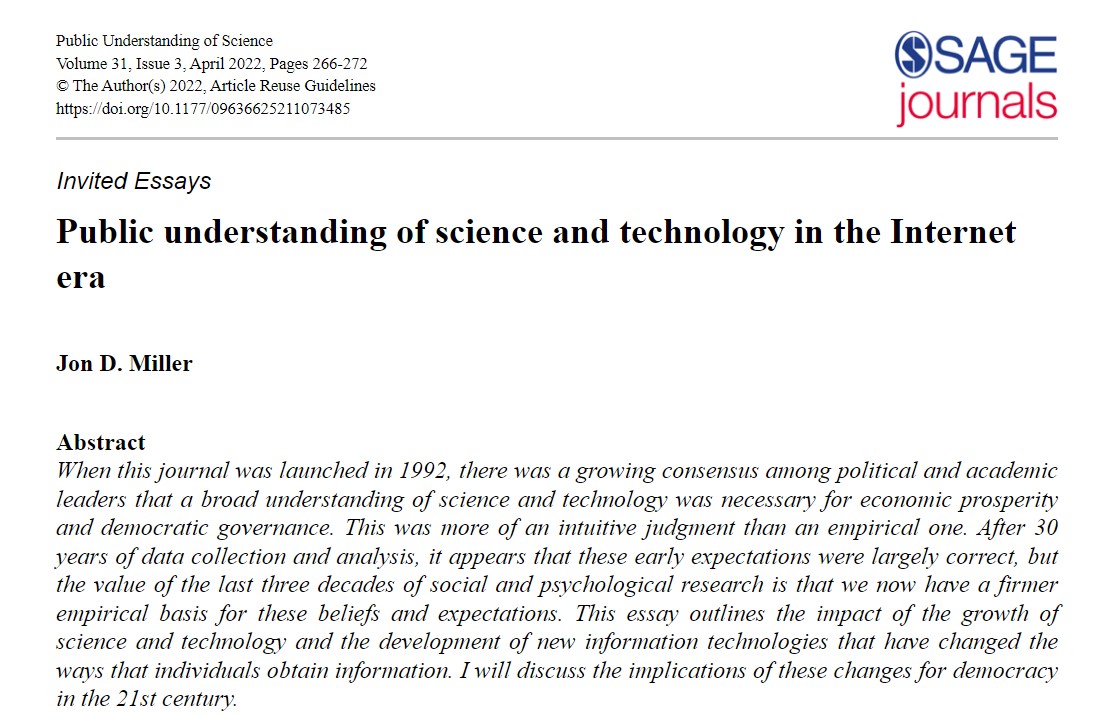
In his essay for @SciPublic Jon D. Miller argues that while "more information is now available to citizens than in any time in human history" making use of it still requires a "core set of constructs about science". He outlines paths to re-conceptualize scientific literacy.
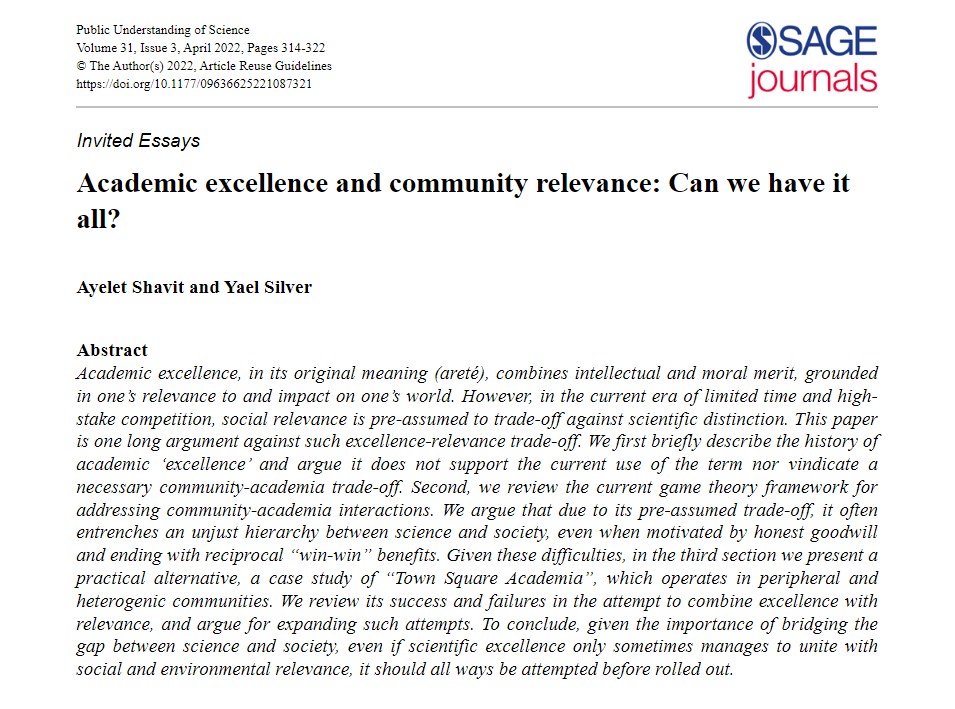
Back to the roots? Ayelet Shavit's and Yael Silver's plea for a vision of science that combines community relevance and academic excellence in their essay for @SciPublic.
Special issue essay on 'Academic excellence and community relevance: Can we have it all?'
By Ayelet Shavit & Yael Silver
#scicomm
https://t.co/toaPkP4a30
Peter Weingart warns that the competition for media attention may damage trust: "As for now, it can only be warned that universities are ill advised to sell themselves in the same way and with the same means commercial companies do."
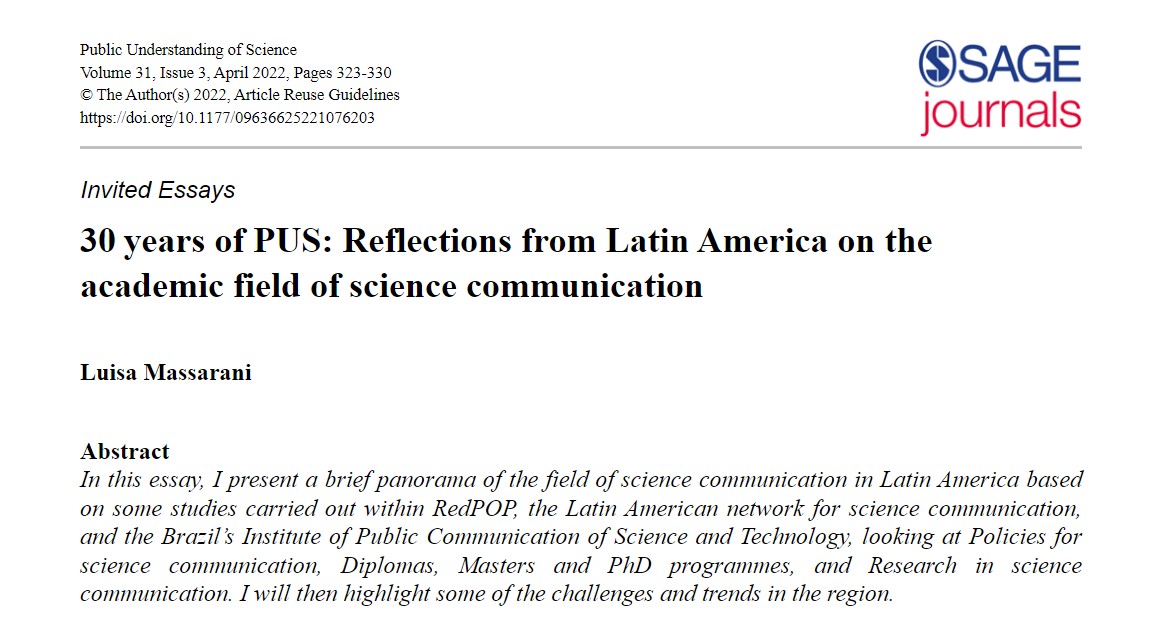
A challenging question for @SciPublic from @LuisaMassarani about the "low presence of Latin American studies in international journals": "Are papers from the so-called developing world evaluated in a more cautious way than manuscripts from the so-called developed world?"
Special issue essay on '30 years of PUS: Reflections from Latin America on the academic field of science communication'
By Luisa Massarani
#scicomm
https://t.co/XNKHMhMjCn