Fenbendazole is the future of cancer treatment.
It's helped terminal cancer patients achieve complete remission when chemo failed.
Big Pharma can't patent it, so they ignore it.
Here's everything you need to know: 🧵
I was an unprofitable trader for 4 years
Now I make $15-40k/month consistently from trading
Here are the mistakes that were holding me back from becoming profitable (avoid them):
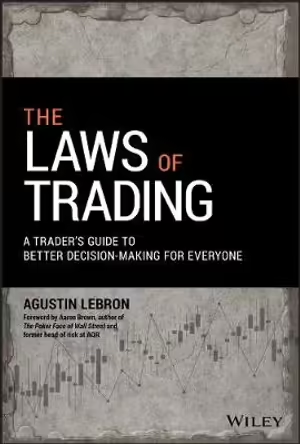
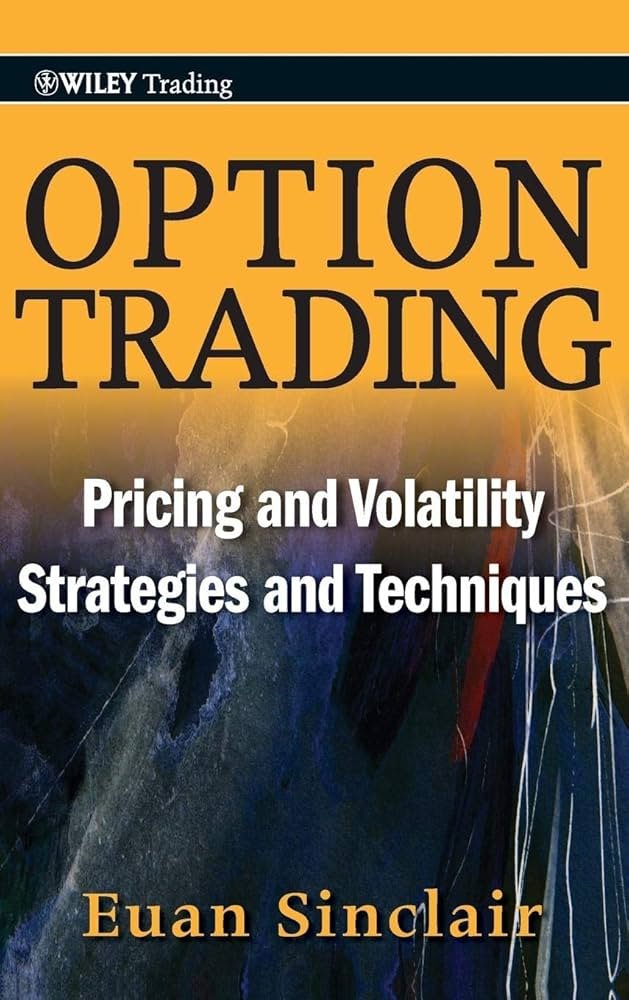
I had the opportunity to guest lecture to a university class yesterday and got some questions about resources for students interested working toward a trading seat. The good news is that there are massively more and better resources available now than ever before. The bad news is, for every useful book/class/podcast there are seemingly 999 more that are worthless at best, massive value destructors at worst.
A few hints to help sort the wheat from the chaff:
1. Anything that tells you trading is easy is lying to you. Trading is a brutally hard game played against literally the smartest, most disciplined, most aggressive people in the world. People that survive and thrive tend to welcome that specific challenge, even though most would not describe their time on the desk as fun.
2. Anything that purports to have a risk-free or can’t lose strategy is garbage. Most of the time, professional traders are hoping to be right 50-55% of the time and relying on highly evolved discipline and risk-management skills to be profitable with that winning percentage. They also have to manage capital to survive during periods of worse than normal performance, which invariably happen.
3. Anything that is selling you trading as a means to achieving a lifestyle with the emphasis on material possessions is almost certainly a scam. Pretty much every successful trader does not focus on the material consequences of their trading in real time, it’s too distracting and leads poor decision making. There’s even a famous passage from Reminiscences of a Stock Operator about a group of traders who try to earn enough money to buy a fine fur coat, all of whom fail because they were focused on the prize, not on winning the game.
4. Anything that tells you anyone can do it is ignoring the fact that most markets are a zero sum game. People have to lose for other people to win, that’s how it works. The other interpretation that any individual can be a trader is also, unfortunately, incorrect. Any individual who possesses higher than average levels of discipline, curiosity, intellectual honesty, and competitiveness could potentially learn to be a professional trader, but that is a subset of the total population. Fortunately, there are lots of trading-adjacent roles that allow people with interests in the market but not the exact skill-set necessary to thrive as a trader to have interesting, productive careers.
5. Anyone claiming to offer something “just like the pros” or “better than the professionals” is unaware of what the pros actually have. Elite hedge funds, banks and merchant traders spend huge sums of money to develop proprietary tools, techniques, and infrastructure to compete in the intellectual arms race that is a modern financial market. Professional traders can easily consume hundreds of thousands to millions of dollars of information & technology resources, which is one of the reasons their profit targets are so high. That level of support is simply not available to individuals for $29.99 a month or whatever.
6. Anything that claims outperformance and the answer is just “AI” is probably not going to outperform anything. As discussed above, trading firms have the very best technology they can identify and afford, and all will be racing to find ways to productively deploy AI tools in their workflow. And they will, for specific tasks. It is important to note that AI is currently good at some things and not terribly good at others, so any product/service that is serving a stock model with a wrapper over it is almost certainly not going to be very productive and, even if it does achieve success, unlikely to out-compete more specialized tooling produced in-house at a bank or hedge fund.
I discovered a prescription medication that helped hundreds of my clients heal 10x faster from chronic illness.
It's non-toxic, non-addictive, with zero long-term side effects.
Most doctors don't know what it is or how to prescribe it.
Introducing KETOTIFEN:
I've tested hundreds of supplements over 30 years to heal myself.
Most are worthless, but these 15 transformed my health.
At 50, my bloodwork is better than when I was 20.
The evidence-based supplement list that actually works: 🧵
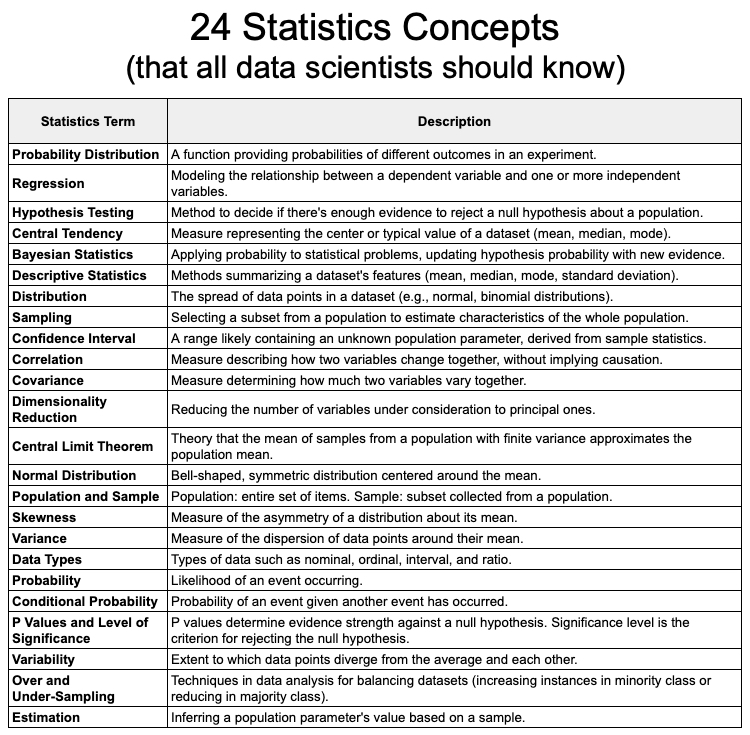
It took me 10 years to master all 24 of these statistics concepts. In the next 24 days, I'll teach them to you one by one (with examples of how I've used them in business contexts). Here's what's coming:
1. Probability Distribution
2. Regression
3. Hypothesis Testing
4. Central Tendency
5. Bayesian Statistics
6. Descriptive Statistics
7. Distribution
8. Sampling
9. Confidence Interval
10. Correlation
11. Covariance
12. Dimensionality Reduction
13. Central Limit Theorem
14. Normal Distribution
15. Population and Sample
16. Skewness
17. Variance
18. Data Types
19. Probability
20. Conditional Probability
21. P Values and Level of Significance
22. Variability
23. Over and Under-Sampling
24. Estimation
===
Ready to learn Data Science for Business?
I put together a free on-demand workshop that covers the 10 skills that helped me make the transition to Data Scientist: https://t.co/LR39RJ5XKB
And if you'd like to speed it up, I have a live workshop where I'll share how to use ChatGPT for Data Science: https://t.co/EaMpKrJiqX
If you like this post, please reshare ♻️ it so others can get value.
❌ Today, I'm going to talk about my mistakes as a bettor.
When decisions are made by your mind rather than an algorithm, correcting certain biases can be complicated.
Here, I'll outline 3 mistakes I've identified in my approach as a bettor:
1. Betting against fatigued players.
• I think I've lost more money than I've won by betting against players who have had a tight schedule of matches and tournaments.
• While it's true that a player who has been playing for many weeks with little rest, in different cities or even continents, eventually feels it, it's also true that often this decline takes longer than we think.
• The reason is quite evident: in tennis, mental strength and confidence are so crucial that they often override physical fatigue.
• How many times have we seen players with a physically exhausted appearance but riding a wave of confidence win the crucial points and eventually the match?
• In summary, mentality > physical condition in tennis, especially for players of a certain level, and that anticipated decline sometimes takes longer than expected.
2. Betting against injured players.
• In my previous point, I talked about players who might be tired. Here, I'm referring to players who have or might have some physical issue, either because they've retired from a recent match or have taken a medical timeout (MTO), or have publicly mentioned an injury.
• Injured players already have the "injured" tag attached to their odds. That is, this information is public, and the betting market already adjusts the odds accordingly.
• Many times, it's challenging to resist betting against an injured player, but one must consider the odds. I don't have data, but my intuition tells me that even betting in favour of these players could be profitable in the long run because the market tends to overreact.
3. Reducing my number of bets, or "doing underbetting" -in contrast to "overbetting"- when I'm on a losing streak.
• While it can be advisable to pause and rethink things when you're in a pronounced losing streak, I believe that, in my case, I have been overly and excesively cautious and conservative in the past.
• This has led me to reduce the number of bets significantly in bad years like 2021 or 2022, causing me to miss out on many opportunities.
• It has also made me lose the spontaneity and freshness of my activity as a tipster and bettor.
• Moreover, I believe it's good to reflect during a losing streak, but it's also important to be aware that the majority of the reasons for a losing streak are due to variance and randmoness and not your selections.
In summary, these are the significant flaws I see in myself as a bettor, which I have tried to correct, although sometimes it's not easy to detach from these biases.
💬 What about you? What are your flaws and errors as a bettor?
Want to find the best-performing home teams?
Most people waste precious time navigating through tedious spreadsheets or getting lost in outdated websites.
No need. I'm about to show you how to instantly discover top-performing home teams at any given moment:






![Kanojiyaaakash1's tweet photo. Google Chrome has 100,000+ extensions.
Here are 12 free extensions that will save you hundreds of hours:
[🔖 Bookmark for later] https://t.co/zJfCdp6HWd](https://pbs.twimg.com/media/F_nft1PakAAhOly.jpg)


