Paper out @NatureComms 🎉🎊 A huge thanks to the reviewers and editors who helped us substantially improve our article. @mohajerani77
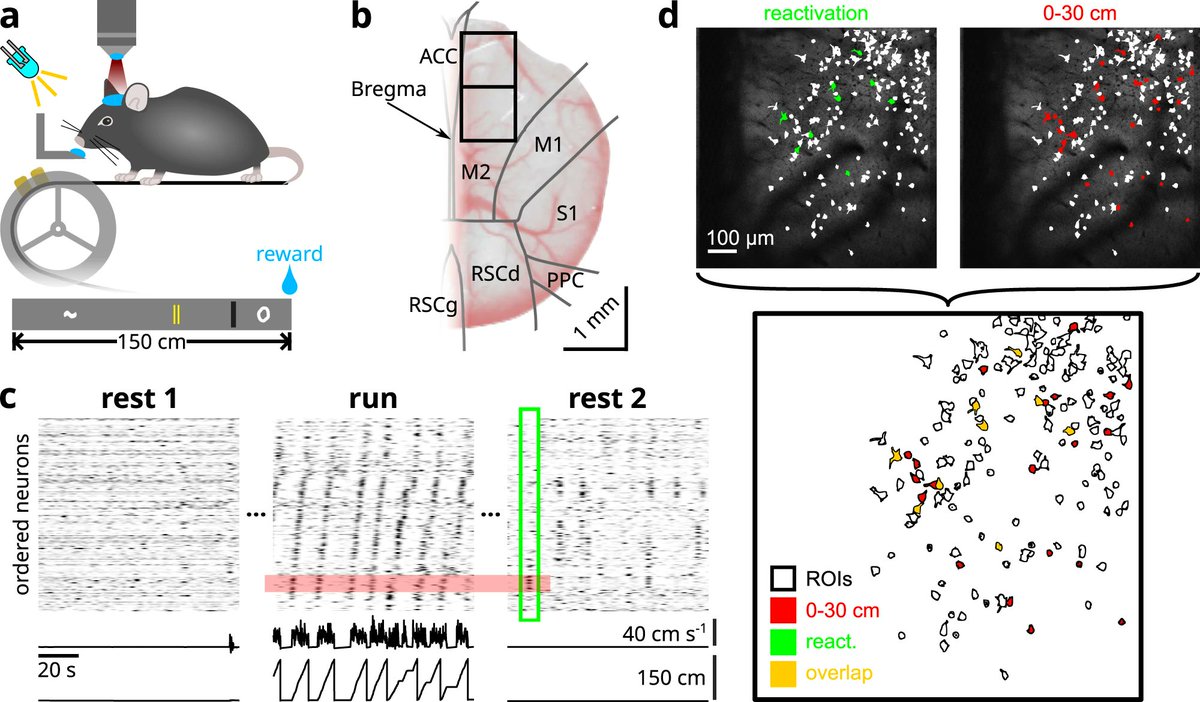
"Cortical reactivation of spatial and non-spatial features coordinates with hippocampus to form a memory dialogue"
👉👉 https://t.co/BSV314PTPM
Happy to share my first postdoc paper from the group of @attila_losonczy! Big team effort with @StephHerrlinger , @Margaret_Conde_, @Cliodhna, @yoojuyoun and the rest of the team!
Preprint : https://t.co/NEoImfpVwG
Video: https://t.co/HeFAKpZbcv
Website: https://t.co/V5E4H1TLa6
Stable maps from drifting neurons: CA1 solves the "representational drift paradox" through coordinated population dynamics.
New preprint w/@AntjeKilias@bartos_marlene@JF_Sauer showing that representational drift isn’t random
https://t.co/ESfIQwAIGt
View our new study on persistently active ensembles of neurons in the medial prefrontal cortex of mice that reliably maintain trajectory-specific tuning over week’s while animals perform an olfaction guided spatial memory task. Published in Nature Com.
https://t.co/lngJdFcTP8
I am happy to share our recent study published in Nature Comm on hippocampal interneuron circuits governing the representation of novelty in mice. doi: 10.1038s41467-024-44882-3
#ResearchHighlight| Non-spatial cues precede spatial attributes in memory retrieval! Using two-photon imaging in mice, @hr_chang@mohajerani77 and colleagues shed light on neocortex-hippocampus dynamics. 🧠🐭#Memory
Highlight👇:
https://t.co/wW0zwgJIlN
Checkout our latest mouse string-pulling manuscript
1. String thickness variation increases task difficulty and influence mouse mouth/hand use during string-pulling.
2. Total pull time changes as a function of string thickness and follows Fitts’s law.(1/2)
https://t.co/YakSRVJexz
1/ New paper from the lab; Weak-hyperactive hippocampal CA1 neurons in the prodromal stage of Alzheimer's disease .... https://t.co/Bc7nA1Q2GK
Codos to @SamsoonInayat@BB_McAllister@hr_chang @robsutherland1 and twitter-less Ian Whishaw
# Chinese scholar # Old Montreal fire
A large fire broke out in a historical building in Old Port District of Montreal, Canada at 5:45 am on Thursday. 6 people remain missing, among which is a promising young Chinese scholar, Dr. An Wu, who came to Montreal for a conference.
Huge #Congrats to @AjabiZaki & @markpaulbrandon on their latest publication in @Nature! Their hard work and dedication have truly paid off. Excited to see such groundbreaking research making an impact.
Now published @Nature, we used miniscopes to study the thalamic head direction system during drift and reorientation.
Paper: https://t.co/DVWQEgFQ7I
Summary: https://t.co/uDOUYP1wsp
There’s a lot in the paper, but my favorite piece to share/highlight is in figure 2:
Wide-field voltage imaging, electrophysiology & #2photonmicroscopy: @JavadKAbadchi from @mohajerani77 lab & colleagues successfully combine these methods to study hippocampal-cortical interactions in sleeping vs #awakemice
https://t.co/1CvCYko8zO
@neurosutras This is an extremely relevant point. Tse et al. 2007 and 2011 indeed suggest a form of "transfer learning" for odor-place association, though in a different setup than the traditional MWM. Similarly, our head-fixed setup likely contributed to the apparent disparity with MWM.
1/ Excited to share our latest study led by my great friend Dr Ingrid Esteves
https://t.co/eMiZXVGsRK
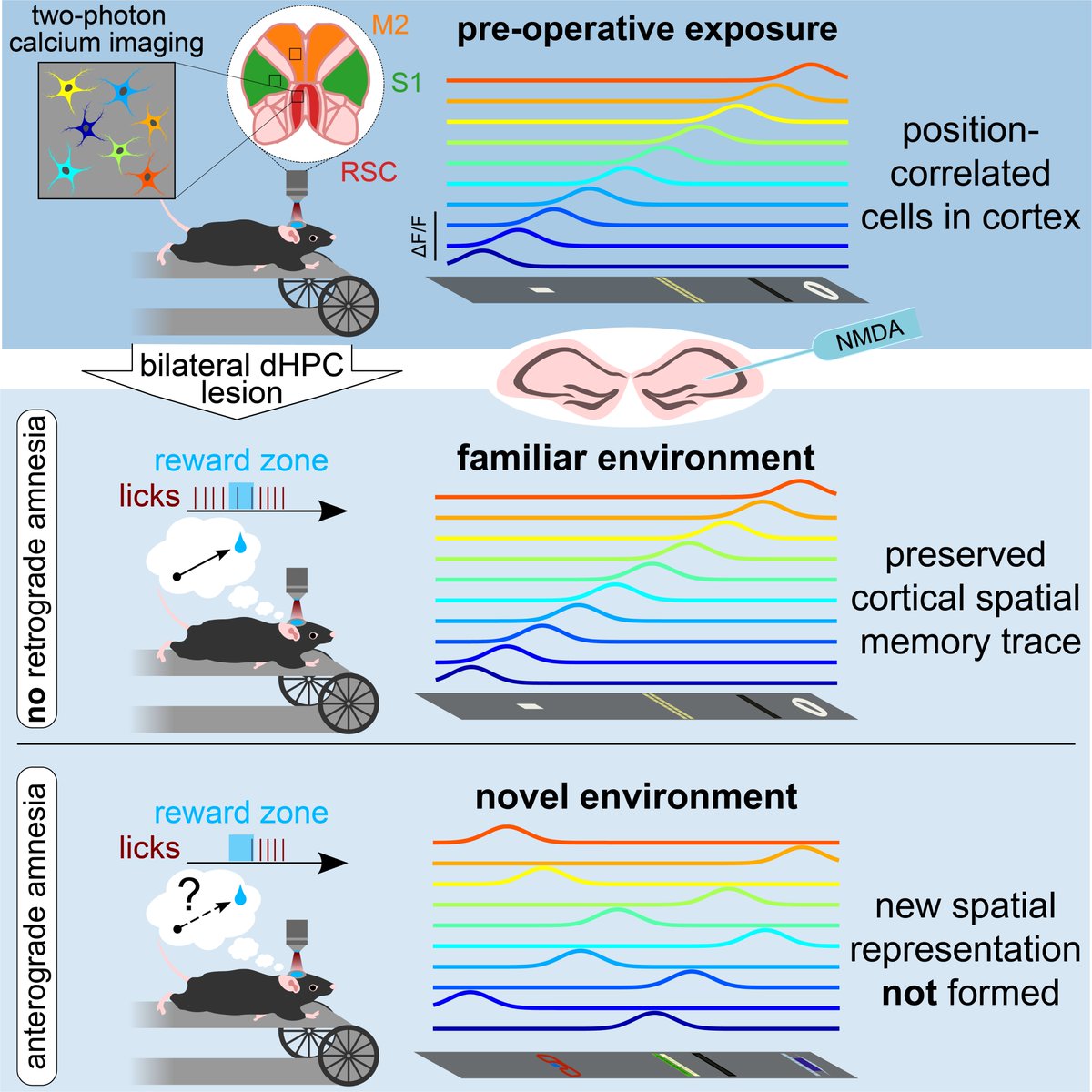
Are spatial memories ever consolidated into cortex? Lesion studies have shown us the answer is “no”. Surprisingly, our findings under 2-photon suggest otherwise. Summary below:
@andrewtanyongyi There seem to be many disparities between human and rodent literature concerning spatial memory.
Check out review from @robsutherland1 and Lehmann:
https://t.co/8Ozhg6z5iG
Also see newer paper from Ocampo, Squire & Clark:
https://t.co/4Gp6V8KNQA
For human:
https://t.co/KeUH0fh7g6
5/ The presence of anterograde amnesia, in concert with the lack of retrograde amnesia, corroborates the standard theory of systems consolidation, as demonstrated here both functionally and behaviourally.
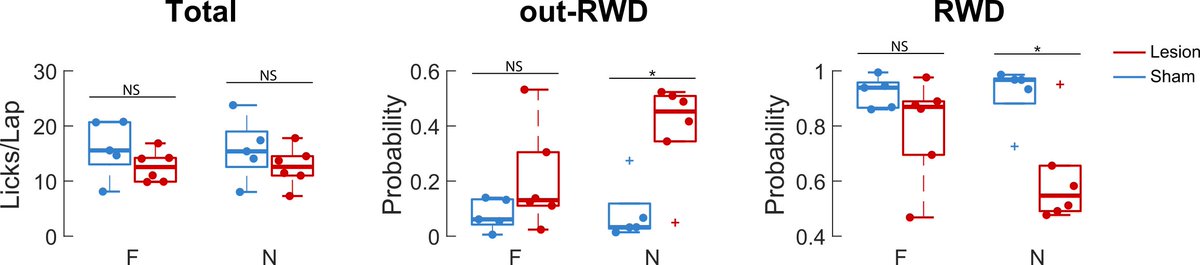
4/ However, the ability to form a new representation for a post-operatively exposed environment is severely impaired. Behaviourally, animals showed pre-emptive licking on approach to the reward location in the familiar, but not the novel environment.