Personal update: I've joined Anthropic. I think the next few years at the frontier of LLMs will be especially formative. I am very excited to join the team here and get back to R&D. I remain deeply passionate about education and plan to resume my work on it in time.
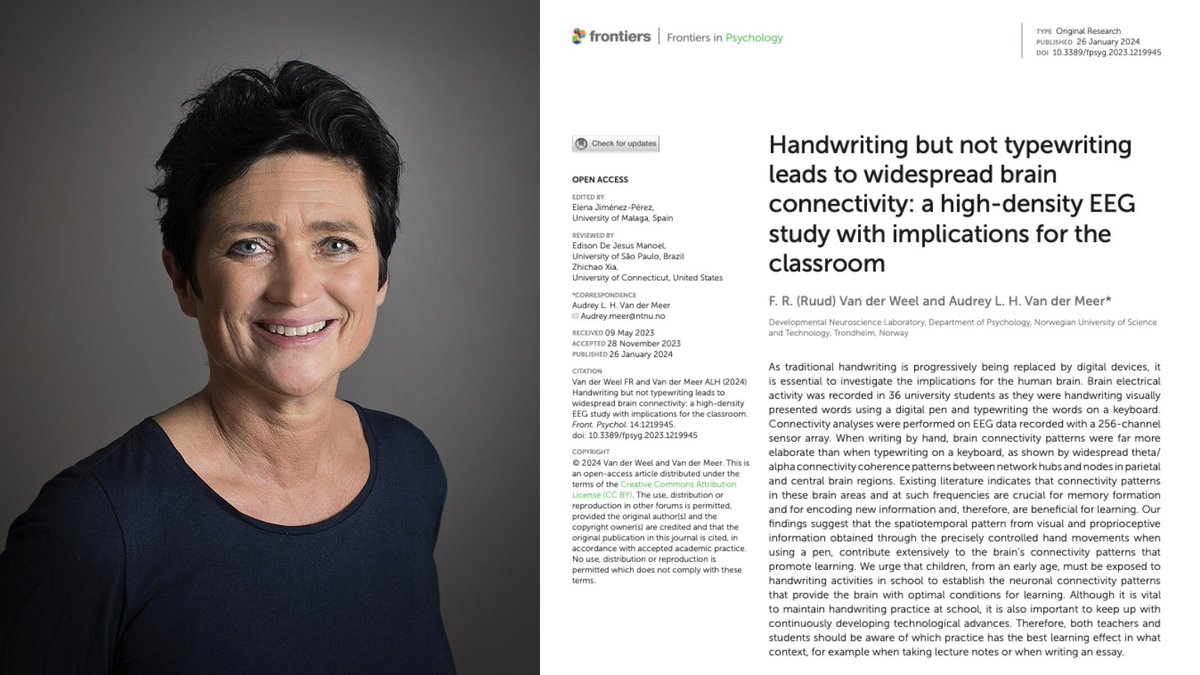
A Norwegian neuroscientist spent 20 years proving that the act of writing by hand changes the human brain in ways typing physically cannot, and almost nobody outside her field has read the paper.
Her name is Audrey van der Meer.
She runs a brain research lab in Trondheim, and the paper that closed the argument was published in 2024 in a journal called Frontiers in Psychology. The finding is brutal enough that it should have changed every classroom on Earth.
The experiment was simple. She recruited 36 university students and put each one in a cap with 256 sensors pressed against their scalp to record brain activity. Words flashed on a screen one at a time.
Sometimes the students wrote the word by hand on a touchscreen using a digital pen, and sometimes they typed the same word on a keyboard. Every neural response was recorded for the full five seconds the word stayed on screen.
Then her team looked at the part of the data most researchers had ignored for years, which is how different parts of the brain were communicating with each other during the task.
When the students wrote by hand, the brain lit up everywhere at once.
The regions responsible for memory, sensory integration, and the encoding of new information were all firing together in a coordinated pattern that spread across the entire cortex. The whole network was awake and connected.
When the same students typed the same word, that pattern collapsed almost completely.
Most of the brain went quiet, and the connections between regions that had been alive seconds earlier were nowhere to be found on the EEG.
Same word, same brain, same person, and two completely different neurological events.
The reason turned out to be something nobody had really paid attention to before her work. Writing by hand is not one motion but a sequence of thousands of tiny micro-movements coordinated with your eyes in real time, where each letter is a different shape that requires the brain to solve a slightly different spatial problem.
Your fingers, wrist, vision, and the parts of your brain that track position in space are all working together to produce one letter, then the next, then the next.
Typing throws all of that away. Every key on a keyboard requires the exact same finger motion regardless of which letter you are pressing, which means the brain has almost nothing to integrate and almost no problem to solve.
Van der Meer said it plainly in her interviews.
Pressing the same key with the same finger over and over does not stimulate the brain in any meaningful way, and she pointed out something that should scare every parent who handed their kid an iPad.
Children who learn to read and write on tablets often cannot tell letters like b and d apart, because they have never physically felt with their bodies what it takes to actually produce those letters on a page.
A decade before her, two researchers at Princeton ran the same fight using a completely different method and ended up at the same answer. Pam Mueller and Daniel Oppenheimer tested 327 students across three experiments, where half took notes on laptops with the internet disabled and half took notes by hand, before testing everyone on what they actually understood from the lectures they had watched.
The handwriting group won by a wide margin on every question that required real understanding rather than surface recall.
The reason was hiding in the transcripts of what the two groups had actually written down.
The laptop students typed almost word for word, capturing more total content but processing almost none of it as they went, while the handwriting students physically could not write fast enough to transcribe a lecture in real time, which forced them to listen carefully, decide what actually mattered, and put it in their own words on the page.
That single act of choosing what to keep was the learning itself, and the keyboard had quietly skipped the choosing and skipped the learning along with it.
Two studies. Two countries. Same answer.
Handwriting makes the brain work. Typing lets it coast.
Every note you have ever typed instead of written went into your brain through a thinner pipe. Every meeting, every book highlight, every idea you captured on your phone instead of on paper was processed at half depth.
You did not forget those things because your memory is bad. You forgot them because typing never woke the part of the brain that would have made them stick.
The fix is the thing your grandmother already knew.
Pick up a pen. Write the thing down. The slower road is the faster one.
SubQ shipped a commercial LLM that isn't a transformer. Sparse subquadratic attention, native 12M-token context, claims ~1/5 the cost of frontier on long-context jobs.
First time anyone has put non-transformer attention behind a paid API and shipped a coding agent on top.
AISI ran Claude Mythos Preview through a 32-step corporate-network attack range — usually 20 hours of human red-teaming. It cleared 3 of 10 runs. GPT-5.5 cleared 2 of 10 three weeks later. Frontier cyber-offence is now doubling every four months.
This is something!
I've been managing my life (insights, deliverables, tasks, to-dos) and what not in Notion for the past 5 years.
With this release, the ones who stuck w/ Notion as a knowledge storing platform will be rewarded. AI brain loading. Thanks @NotionHQ
BIG one for devs today. Introducing the Notion Developer Platform:
- Notion CLI, ntn (Notion in your terminal)
- Workers (run code on Notion's infra)
- Database sync (any data source into Notion)
- Agent tools (build any workflow)
- Webhook triggers (trigger Notion from any app)
- External Agents API (bring any agent into Notion)
- Notion Agents SDK (use Notion Agents anywhere)
- …and a bunch more API improvements
And soon, you won't need to be a developer to build on Notion. Your agent will be one for you.
HTML is the new markdown.
I've stopped writing markdown files for almost everything and switched to using Claude Code to generate HTML for me. This is why.
Introducing USVC - a single basket of high-growth venture capital, for everyone.
No accreditation required, SEC-registered, and a very low $500 minimum.
Includes OpenAI, Anthropic, xAI, Sierra, Crusoe, Legora, and Vercel. As USVC adds more companies, investors will own a piece of that too.
Liquidity typically comes when companies exit, but we’re aiming to let investors redeem up to 5% of the fund every quarter. This isn’t guaranteed, but if we can make it work, you won’t be locked up like in a traditional venture fund.
It runs on AngelList, which already supports $125 billion of investor capital.
And I’ve joined USVC as the Chairman of its Investment Committee.
—
Go back to the 1500s, you set sail for the new world to find tons of gold - that was adventure capital.
Early-stage technology is the modern version. It says we are going to create something new, and it’s risky. It’s daring.
But ordinary people can’t invest until it’s old, until it’s no longer interesting, until everybody has access to it. By the time a stock IPOs, most of the alpha is gone. The adventure is gone. Public market investors are literally last in line.
This problem has become farcical in the last decade. Startups are reaching trillion dollar valuations in the private markets while ordinary investors have their noses up to the glass, wondering when they’ll be let in.
Investing in private markets isn’t easy. You need feet on the ground. You need judgment built over years. Most people don’t have the patience to wait ten or twenty years for an investment to come to fruition.
But there is no more productive, harder-working way to deploy a dollar than in true venture capital.
USVC enables you to invest in venture capital in a broad, accessible, professionally-managed way, through a single basket of innovation, focused on high-growth startups, at all stages.
It is how you bet on the future of tech: the smartest young people in the world, working insane hours, leveraged to the max, with code, hardware, capital, media, and community. Your dollar doesn’t work harder anywhere.
There is an old line - in the future, either you are telling a computer what to do, or a computer is telling you what to do. You don’t want to be on the wrong side of that transaction.
USVC lets you buy the future, but you buy it now. Then you wait, and if you are right, you get paid.
Get access here:
https://t.co/pAj1sqUsG0
GPT-Image-2 is insanely good at making brand kits.
You can give it a URL or a logo + color guide, and it will pull together everything for you.
I think it’s fun to ask for some swag, too 😉
This is wild. SpaceX now has the right to BUY Cursor for $60B.
Or pay them $10 billion to walk away. To put it in perspective, Cursor was worth $9.9 billion total in May of last year.
Let's have a closer look at the numbers.
Start with the $60 billion. Cursor was already raising money this week at a $52 billion valuation from a16z and Nvidia. The Elon offer sits 15% above a number that was already on the table. The next round priced in, with a one-year fuse.
The $10 billion is the real number. That's what SpaceX pays even if it walks away and never buys the company. The walk-away fee alone is more than the entire company was worth 12 months ago.
Now the strategic logic. Cursor stopped being just an editor in March. They shipped Composer 2, their own model, and it beat Claude Opus 4.6 on Terminal-Bench at one-tenth the price. The catch is that frontier coding models need frontier compute, and the only labs with frontier compute are the same ones building competing coding products. OpenAI shipped Codex. Anthropic shipped Claude Code. Google has Gemini CLI. Cursor was renting capacity from every company trying to kill it.
Colossus is the way out. 230,000 GPUs in Memphis today, 1 million by year end, the biggest training cluster on Earth. The Information already reported Cursor is renting tens of thousands of those chips to train Composer 3. SpaceX is also building Grok Code, so they're not a clean partner. But xAI losing the coding race to Cursor is a better outcome for SpaceX than Cursor losing the coding race to OpenAI.
The trade Cursor made: gave up the right to be acquired by anyone else for one year. Got training compute at a scale no other lab would sell them. Got $10 billion guaranteed if Elon walks. OpenAI tried to buy Cursor in early 2025 and got rejected. Cursor stays independent for at least 12 more months and gets to train on the biggest cluster on earth doing it.
Elon just bought a one-year call option on Cursor for $10 billion.
That's the deal.
This is the next step for AI, but broswer harness isn't it for AGI, AGI will mostly come with a rock-solid integration with exisiting IoT and robotics hardware, when AI has the ability to parse real-time physical environments.
Opus 4.7 beat Stockfish...
Claude Code just learned how to play Chess
> parses board state from the DOM
> tracks changes between moves
> play moves in real time
browser-harness is AGI...
Also, I think I could have a dedicated post about this, but a good pg vendor is supabase, I choose to not pay for it (I already spend $100-$150 in AI spends), but here’s the hack: 1 supabase projects for all apps, but segregated schemas (apart from the default public schema), its a free glitch (obviously till the generous egress, compute and storage is maxed out on the free plan)
I built a working AI-powered app on its own domain in 75 minutes last Friday. https://t.co/nGyXpgy090
Not a demo. Not a prototype. Live. Deployed.
Here's what's actually happening to software ↓
@thedeepflux Yep, spent the time setting up the unsexy and repeatable stuff. I have 2 vendors/platforms that I utilize.
GCP for projects with multiple services, vercel to release the smaller ones, vercel is pretty good with the networking, costing and monitoring/logging integrations.
10/If you're a dev sitting on the sidelines:
$100, a few hours, some patience. That's the cost of shipping something real.
Not for MRR screenshots. For the craft.
More coming next. https://t.co/68FGOrP4DT
8/What AI actually killed is engineering leverage as a differentiator.
Any dev can ship a feature in a weekend now.
Taste, timing, and distribution are what's left.
9/None of my weekend projects exist without infrastructure.
CI/CD that auto-initializes every new repo. Personal cloud. Unified deployment.
"Built in 75 minutes" is only possible because I invested time in making it possible.