No matter what one's approach is to active trading, being charts or numerics or macro or fundamentals of all kinds, realize that any approach will be in sync with markets sometimes and out of sync other times.
This is the reality.
I do not trust the trader that says he/she constantly knows what kind of markets they are in and switches up accordingly. Nor should you trust them.
Some traders try to force their trading upon markets when their approach is out of sync.
Then there are times when a trader is out of sync with his/her own trading approach and forces trades that are out of their sweet spot.
Then there are times when an approach is out of sync with markets AND the trader is out of sync with the approach. Most accounts get rekt when this happens.
Mature traders develop an instinct about the compatibility of their approach and price discovery. During these times they stick with their approach, but emphasize risk control even more than normal.
Of course, mature traders think more in terms of risk management than trade selection. I know that anyone who emphasizes trade selection to me is someone I do not want to listen to.
I do not change up my approach when it is out of sync with price action. These periods will pass if I stay with my basis approach, which has not materially changed in decades.
Recently someone sent me a speech I gave before the MTA (predecessor of CMT) some 35 years ago. I could give the same speech today as representing my approach to market speculation.
My recommendation to aspiring novices or those who cannot gain traction is to develop an approach based on common sense (not smoke and mirrors), bet small, and improve it incrementally.
Only after several hundred trades using the same basic approach can you start running Monte Carlo simulations to determine if you have an edge.
Trading is a marathon, not a sprint.
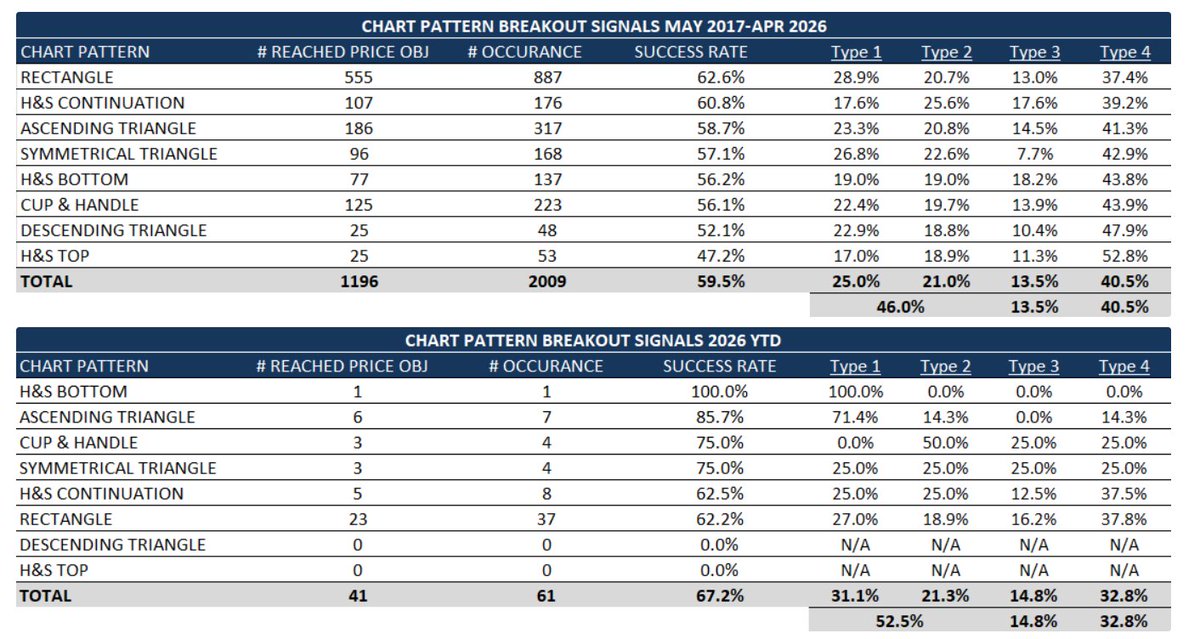
Past 9 years, I focused on "old school" classical chart patterns. 8 classical chart pattern.
These can easily be reduced to 2-3 favorite setups and successfully traded across different assets and time frames.
I work with hedge funds. My colleagues were fund managers. I sat down with large asset managers.
Out of 10
3 were actually understanding technical analysis
1 were actively applying it in their decision making.
We are minority.
Nobody that can move the markets care about that wedge pattern on $BTCUSD or the H&S top on S&P.
Trading frequency - a commentary from a five decade veteran
I follow about 40 global futures markets
I enter each year figuring that I might three good signals in a given market over the course of 12 months -- maybe four. That's it. For a given market there will only be three or four price bars that I will consider suitable for taking a risk position. If I trade a market more than five times in a year I consider that I over-traded -- that my nose was too close to the chart. Then it is time to be conscious about pulling back from daily charts and re-focusing on weekly charts. As a rule, if I cannot see a pattern on weekly chart then it is 80% certain there is no trade for me.
That's it -- three or four price bars that are important. The rest are noise.
If you are not seeing your sweet spot chart pattern in the first 6-7 seconds of reviewing the chart, then there is no pattern.
Don't force your analysis.
Move to the next chart.
You might go through 100 chart and not find your sweet spot setup. That is fine. There is always another day.
Back when I traded Soybeans and Corn at the CBOT we would not look at someone on the opposite side of a trade and think to ourselves, "What an idiot!"
Now the new hot shots do this openly on social media
There has been a degradation of trader maturity
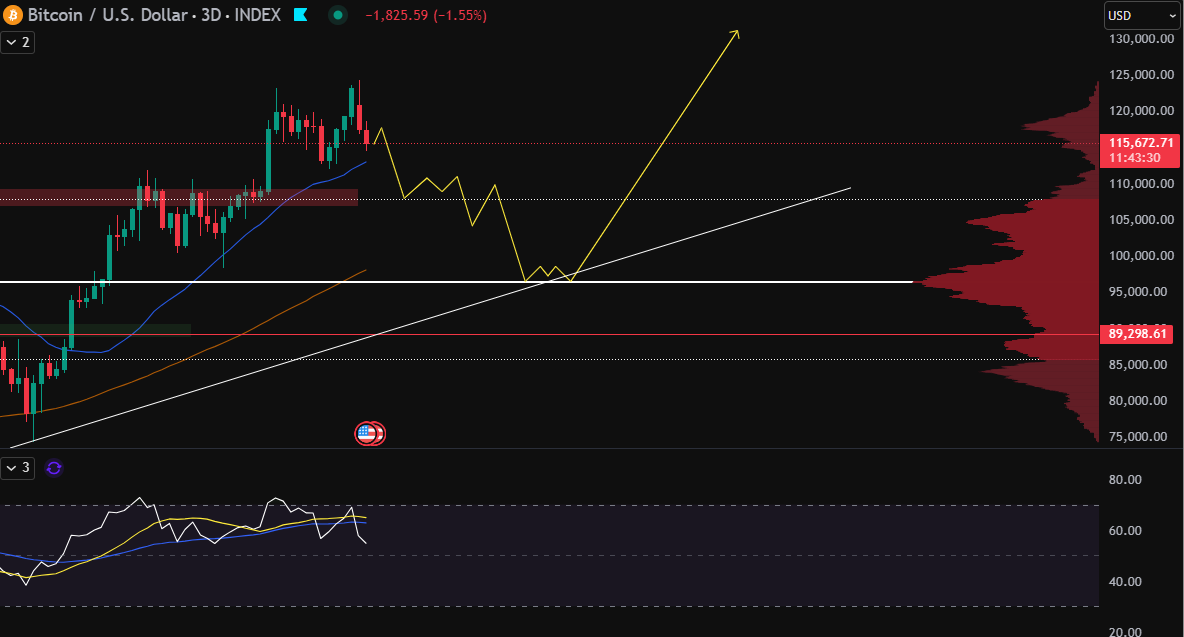
#BTC view
bitcoin's movements in the last couple of weeks are quite obvious to me.
Check the $BTC short setup my low-key public tele: https://t.co/VekDG5sBZJ
#BTC view
bitcoin's movements in the last couple of weeks are quite obvious to me.
Check the $BTC short setup my low-key public tele: https://t.co/VekDG5sBZJ