Experience gives perspective. Programming is not dead, and never will be.
It's late September 2026. Sometime in September 1976, just after I entered college, I wrote and ran my first serious program. I have now been a programmer for literally 50 years.
And man, I have seen it *all*. Punched cards to glass ttys on minicomputers to workstations to the earliest micros. I've written business software, communication programs, development tools, games, language implementations, kernel device drivers, graphics libraries, a few critical pieces of infrastructure, and all manner of odd programs for which there is no taxonomy. Coded in a score of languages some of which are now forgotten. I've run over 70 open-source projects and contributed to at least as many more.
Along the way I noticed a few things, and wrote about them, and that made me famous. But I'm not here to write about that today. I'm here to write about what it means to be a programmer and a technologist with the Singularity upon us.
I have lost count of the number of times I have been told "programming is over". You kids may think this is a new claim that came into the world with LLMs. Hah! There's been that kind of talk at every step function in the quality of our programming tools. I first heard it when compilers were replacing hand-hacked assembler in the early 1980s, and I wouldn't be a bit surprised if somebody said it earlier when in-memory code replaced plugboards.
One constant amidst all this change is that the intentions in a user's head do not magically turn into executable instructions that a computer can run. Another constant is the mindset of the people who specialize in bridging the gap between wish and algorithm. A programmer is a programmer is a programmer - the tools are secondary.
"But it's different this time!" some people will say, "AIs are superhuman now!" So? What did you think the optimization stage of a compiler was, chopped liver? We've been relying on tools that exceeded human capabilities all along - we built them precisely because our meatbrains could not otherwise keep up with the demands of the job.
It's been a hell of a ride, that 50 years. I've succeeded and failed and succeeded again. Done a lot of work I'm proud of. Built at least a few things that look like they're going to last. None of that goes away because, hypothetically, an AI might have made me faster.
The work is never done, even if the tools can talk to us now. Because intentions still have to be communicated; people who specialize in that and develop right mindset to do it still have a major advantage over people who don't.
If you're feeling depressed because you spent years or decades developing hand-coding skills that are obsolete now? Buck up. You still have the most important asset - a mind that knows how to think that way.
I'm facing the winds of the Singularity with a smile. Because 50 years and I'm still standing - still shipping code that people can use, still learning, still refusing to be paralyzed by the pace of change.
The best therapy for your uncertainty? Get to work on something.
Students sometimes tell me they’re applying to PhD programs as a backup in case they don’t get a job as a software engineer or whatever. I get that the job market is rough but this is like saying you’ll start a company if you don’t find a job. Like starting a company, a PhD is the far *more* risky path and requires incredible grit over a long period. It isn’t just that you might realize after a couple of years that a PhD isn’t for you. The bigger risk is that you complete a PhD but end up overqualified on a niche topic after having spent 5-7 years on it. The research world, like acting, sports, music, or book publishing, is set up as a tournament, with lots of extremely competent people competing for a small number of highly desirable slots. We can talk about whether that’s fair and whether it’s inherent or can be changed, but as a professor I feel the least I can do is loudly and repeatedly warn people about what they’re getting into.
This week I had the honor of speaking to Princeton’s entire incoming undergraduate class to address their AI anxieties. I had three messages for them — good news, bad news, and a note of optimism. Here’s a condensed version.
The good news
We have enough evidence now to conclude that the shrill predictions of rapid, massive job loss were misplaced. Even in a field like software engineering where AI has been rapidly adopted, its effect has been to shift, not replace the role of the human (see the “decide-execute-deliver” framework https://t.co/8ZofeCz8yS)
Similarly, the panic about what to major in is also misplaced. There will be enduring demand for computer science, philosophy, and just about everything else. (In fact, AI companies hiring philosophers has been a big recent trend.)
The bad news
AI seems to help senior people much more than juniors. I can use AI for coding because I spent 25 years learning how to code, which lets me supervise coding agents effectively. (See my post on the “growth cycle” vs the “dependence spiral” https://t.co/79icF9hSKY)
You are in a bind — you can’t offload your skill-building to AI, but you’ll graduate into a market where employers will expect you to get work done with AI. We never faced this dilemma. As a result we haven’t figured out how to revamp our classes to help you do both. You’ll have to help us figure it out. And you’ll need to somehow resist the constant temptation to turn to the shortcut machine.
The hope
My point is not that AI is bad for learning. It’s an incredibly flexible tool. Is the internet good or bad for learning? Depends — are you using it to find research papers or waste time scrolling? I use AI every day for learning. The key is to use it to increase, not decrease your cognitive load. To learn deeper, not faster. There is no learning without the cognitive sweat. I try to make sure I’m mentally exhausted at the end of the day. I do feel that AI lets me push myself harder than I ever could before, and I have a vision that as AI continues to advance it will enable human-AI “co-superintelligence“. (I talked about this at the end of my ICML keynote. https://t.co/ZA5TBDypfl)
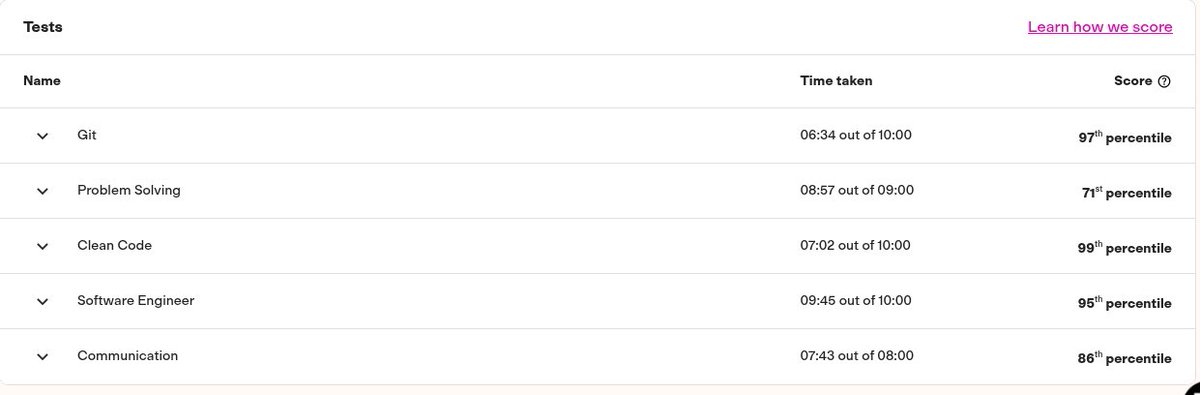
For those curious of the upskill programme by @cardtonic, unfortunately I didn't pass the screening stage. Got a score of 72/80. But the things that came out include identifying MST, opting for UDP vs TCP based on the requirements of your software and git internal representation.
@OgbeborAisosa3 Nah. Just that you'll be proctored while doing the test but I learnt 2.0 did videos in real time and sent em while doing the test! But seems there'd be a big change with 4.0 cos I received an email saying they're trying to make it better.
I dey always look things less and find it so difficult to believe stuff and especially in this era where AI has degraded stuff
Anyone could easily come up and make a proposal of them having done so so especially the "missy smart" guys yet they're shining on the glory of AI lmao.
antonyms and general test of grammatical usage I suppose. Then section B is on comprehension, summary, essay/letter writing then section C deals with speech sounds.
All these revolves around understanding the basic rules and foundations that govern and determine fluency
Do y'all agree that waec requires memorisation?
Nah I don't think so and blatantly disagree
There's really nothing demanding of you to memorize. I'm trynna recall the sections. I think there's section A B and C. A includes things like lexis and structures, register , synonyms,
"I don't want to say one is easier, but IGCSE is a little bit easier to understand." — Akota-Chika Serena.
The Nigerian teenager, who achieved the highest score globally in Cambridge IGCSE English, explains how the exam structure compares to WAEC, noting that WAEC requires more memorisation of outside knowledge.
#CTVMorningBrief
@jbarbier Hi Julien, thanks for grooming us at ALX. I'm curious about something though. Is AI also leveraged in the systems programming domain at Silicon Valley. Cos I think that's a niche AI is yet to bloom and the risk of writing secure code particularly with C and maybe some assembly.
Finally, I was able to reproduce a bug locally on my machine. After a week of steady grinding!
Now it's all about understanding the reproducer, bug and debugging and fixing the bug
Some key takeaways include compiling the specific commit where syzbot reported the bug
Shey nah only me abi some of us just dey live in oblivion?
Like we're fully unaware of all these Israel, Iran, USA, Claude, Chatgpt conundrums. Like I go jus come online dey see posts wey no dey make sense at all 😭😭. Like I don't understand relating to the war and the AI frenzy
Coming online to see that what you tweeted is not as you painted it is so disappointing and disgusting. I believed this guy, even retweeted and bookmarked it. WTF.
I innocently believed him, wished him well, and moved on only to return hours later and see it’s all hype. You guys!!!
The key takeaway "brainwashed to focus on just mobile apps and websites".
CS and tech is way beyond that but sadly most Nigerians don't see beyond mobile dev or web dev.
And for those that don't know. He's into deep learning systems not any training of DL or ML model but systems.
@jino_rohit Is it just me or this looks like writing C in C++. Not actually leveraging the best and modern features of C++ that distinguishes it from C.
I've decided to major in systems programming. Hence the need to refubish some of my old C projects. Extending the simple_shell project assigned at #ALX_SE by @jbarbier .Implemented a nearly posix compliant shell tokenizer in C. https://t.co/uqSnh7mzDr