Human DL/ML researcher at tech startup.
Intellectual polygamist.
Living in the future forged by AGI, blockchain, bioengineering, longevity science, & memes.
This might be why it was observed in blood transfusion experiments between young and old mice that:
- older mice got younger
- younger mice got older
more thoughts below👇
Aging Spreads Through the Bloodstream
Aging isn’t isolated—it spreads through the blood. Scientists found ReHMGB1 drives body-wide senescence, but blocking it restores regeneration. A promising new target in the fight against aging.
https://t.co/xU5B9RfCPh
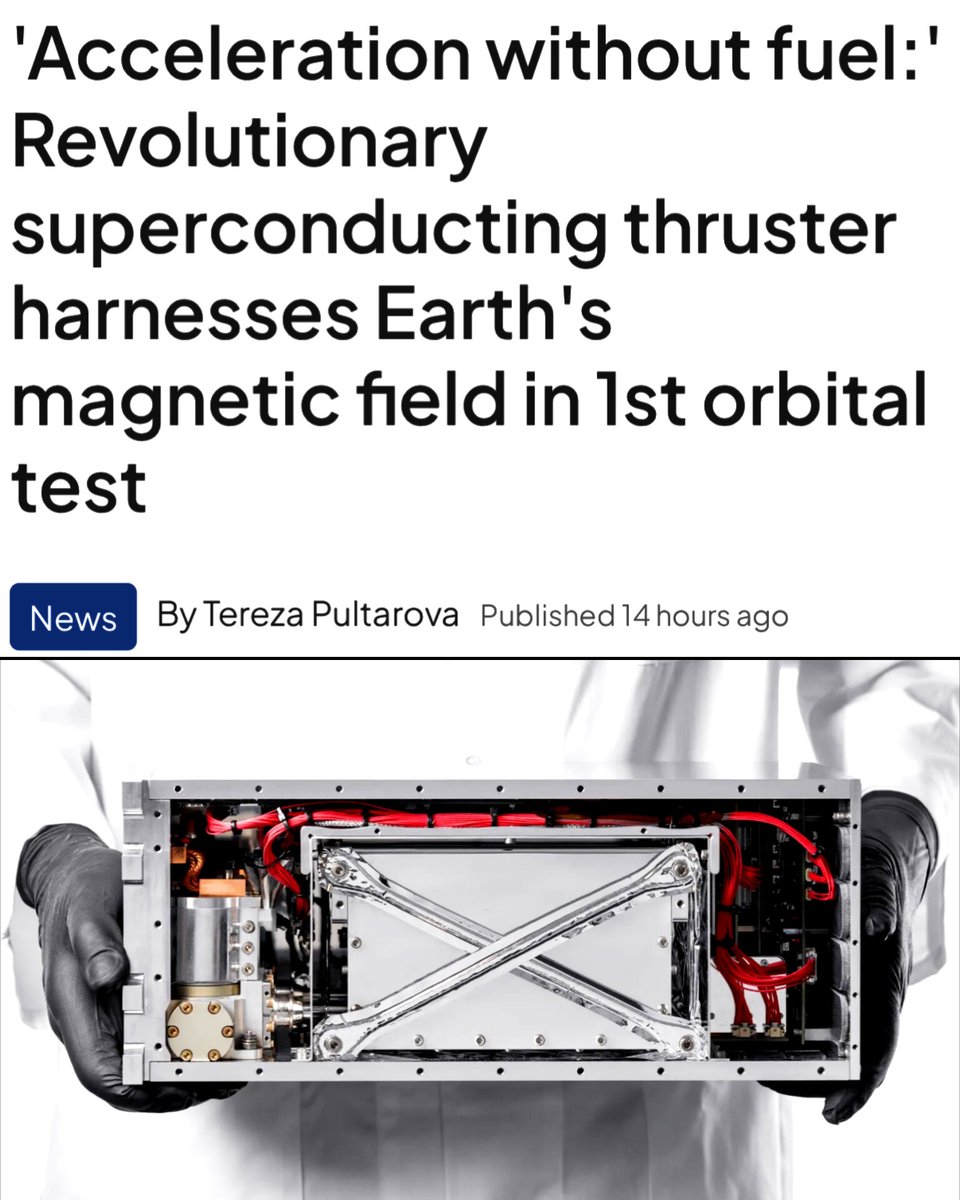
Fuel-Free space propulsion passes first orbital test 👀!
A company called Zenno Astronautics has successfully completed the first orbital test of its superconducting magnetic thruster, a propulsion system that interacts with Earth's magnetic field instead of expelling onboard propellant.
The technology uses superconducting electromagnets cooled to around −200°C, allowing them to carry extremely high electrical currents with almost zero resistance. The system is powered by solar energy.
That means satellites could perform certain maneuvers without burning fuel, helping extend mission lifetimes while reducing the amount of propellant they need to carry.
In the future, this technology could enable fuel-free attitude control, satellite docking, and formation flying, making space missions more efficient and cost-effective.
Fun fact.
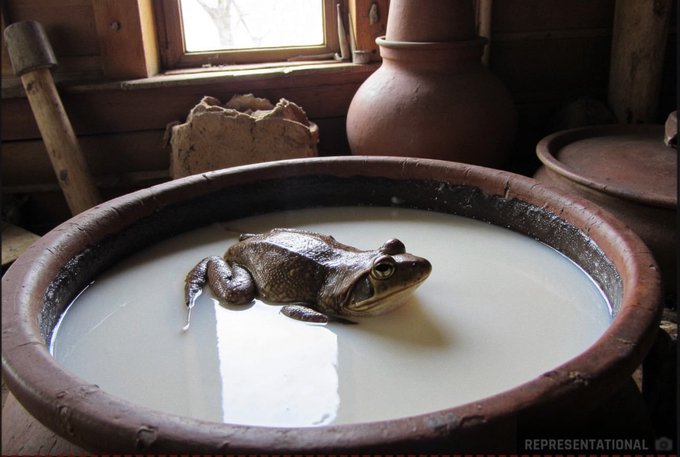
Before modern refrigeration, rural communities in Russia and Finland used an unusual technique to keep milk from spoiling: they dropped live brown frogs (Rana temporaria) into their milk containers.
Scientists later discovered that the skin of these frogs secretes antimicrobial peptides-natural antibiotics-that kill bacteria and slow spoilage, helping the milk stay safe to drink for longer.
Larry Page (Google's founding CEO) knew it back in 2007
"When AI happens, it's going to be a lot of computation and not so much clever Blackboard, whiteboard kind of stuff, clever algorithms, but just a lot of computation.
My theory is that if you look at your programming, your DNA, it's about 600 megabytes compressed, so it's smaller than any modern operating system, smaller than Linux or Windows or anything like that, your whole operating system. "
---
From "Google TechTalks" YT channel (link in comment)
A recent study suggests that water exists as two distinct liquids rather than a single uniform substance.
Physicists have long hypothesized that water possesses a hidden dual nature at the molecular level. Confirming this idea has proven challenging because water molecules rearrange rapidly. An international research team has now provided the strongest evidence to date using unsupervised artificial intelligence techniques.
The analysis reveals that liquid water consists of a dynamic mixture of two structural forms. One is a dense disordered high density liquid or HDL. The other is a more open ordered low density liquid or LDL. These configurations continuously interchange at the molecular scale.
This internal switching explains many of water unusual properties. For example unlike most liquids water reaches maximum density at 4 degrees Celsius and expands upon further cooling which allows ice to float.
By clarifying these molecular dynamics the research advances understanding of water behavior under extreme conditions and its critical role in maintaining thermal stability essential for life on Earth.
[Li, L., & Zeng, X. C. (2026). Evidence for the generic existence of two local structures in liquid water. Nature Physics]
Flying machines solved ✅
Information solved ✅
Intelligence solved ✅
AGI loading..
ASI pending..
FSD loading..
Fusion pending..
Mars base pending..
Moon base loading..
Aging reversal pending..
Artificial womb pending..
Abundant energy loading..
Climate restoration pending..
Quantum teleportation loading..
Cancer & disease-free world loading..
Advanced non-invasive BCIs pending..
what else I am missing 🤔?*
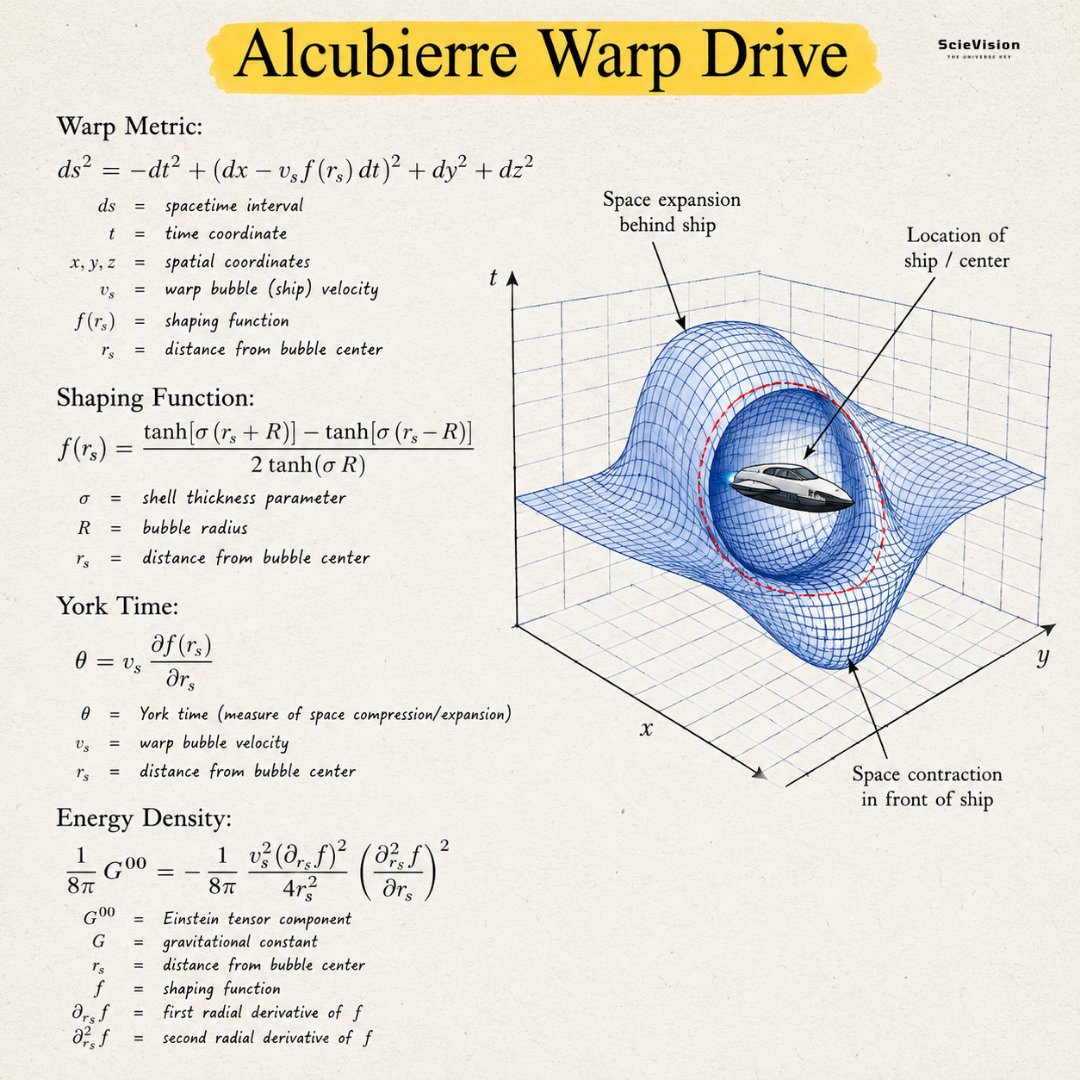
Alcubierre warp drive ✍️
It is one of the most remarkable concepts in theoretical physics. It was proposed in 1994 by a Mexican physicist named Miguel Alcubierre. It outlines a mathematically sound way to travel between two points faster than light without actually breaking Einstein's speed limit. The loophole it uses is as elegant as it is mind-bending.
Einstein's relativity states that nothing can move through space faster than light. However, it does not address the idea of space itself moving. Space is neither matter nor energy; it is the fabric on which everything exists. This fabric can expand or contract at any rate without violating any physical law. We know this is true because distant galaxies are moving away from us faster than light right now. They are being carried by the expansion of space rather than moving through it. Alcubierre posed a simple yet stunning question what if we could create that same expansion and contraction locally, around a spacecraft, on demand?
The idea suggests that a ship remains perfectly still inside a bubble of flat, undisturbed space. Meanwhile, the space in front of it contracts, bringing the destination closer, and the space behind it expands, pushing the starting point farther away. The bubble moves through the universe like a wave carrying a surfer. The surfer does not swim faster than the wave; the wave carries them along. The ship doesn’t move through space at all. The space around it moves, while the ship is just along for the ride.
What makes this particularly interesting is what the passengers would actually experience: nothing unusual. There would be no crushing acceleration, no distortion, and no strange passage of time. They would simply feel like they were sitting still in ordinary space, which is precisely what they would be doing. The bubble wall does all the work while the interior remains calm and flat, much like the quiet eye of a storm.
A diagram beautifully illustrates this concept. The flat grid representing normal spacetime is dramatically distorted around the ship. It compresses into a depression in front and bulges up behind, while the ship sits in a smooth, undisturbed pocket in the middle. The red dashed circle marks the bubble wall where all the dramatic geometry occurs, with ordinary flat space both inside and far outside.
The significant issue, and it is a serious one, is the energy needed to create this warped geometry. The mathematics indicates that the bubble wall must contain negative energy not just a little, not zero, but genuinely less than nothing called exotic matter. This type of matter has never been observed or created in any substantial amount. Early estimates suggested we would need an amount of exotic negative energy similar to the mass-energy of an entire planet like Jupiter, which is far beyond any current technology. This makes the concept feel more like fantasy than physics. Later estimates have lowered this requirement considerably, but the need for exotic matter remains.
There are other deep challenges as well. The ship inside the bubble cannot send signals to the bubble wall to steer it. The wall moves too quickly for any signal from inside to catch up, meaning the entire journey must be pre-programmed before departure with no way to change course. Quantum effects indicate the bubble wall might generate intense radiation that could harm the ship and its passengers during any significant journey. Additionally, the bubble's geometry creates boundaries that may make the entire structure fundamentally unstable.
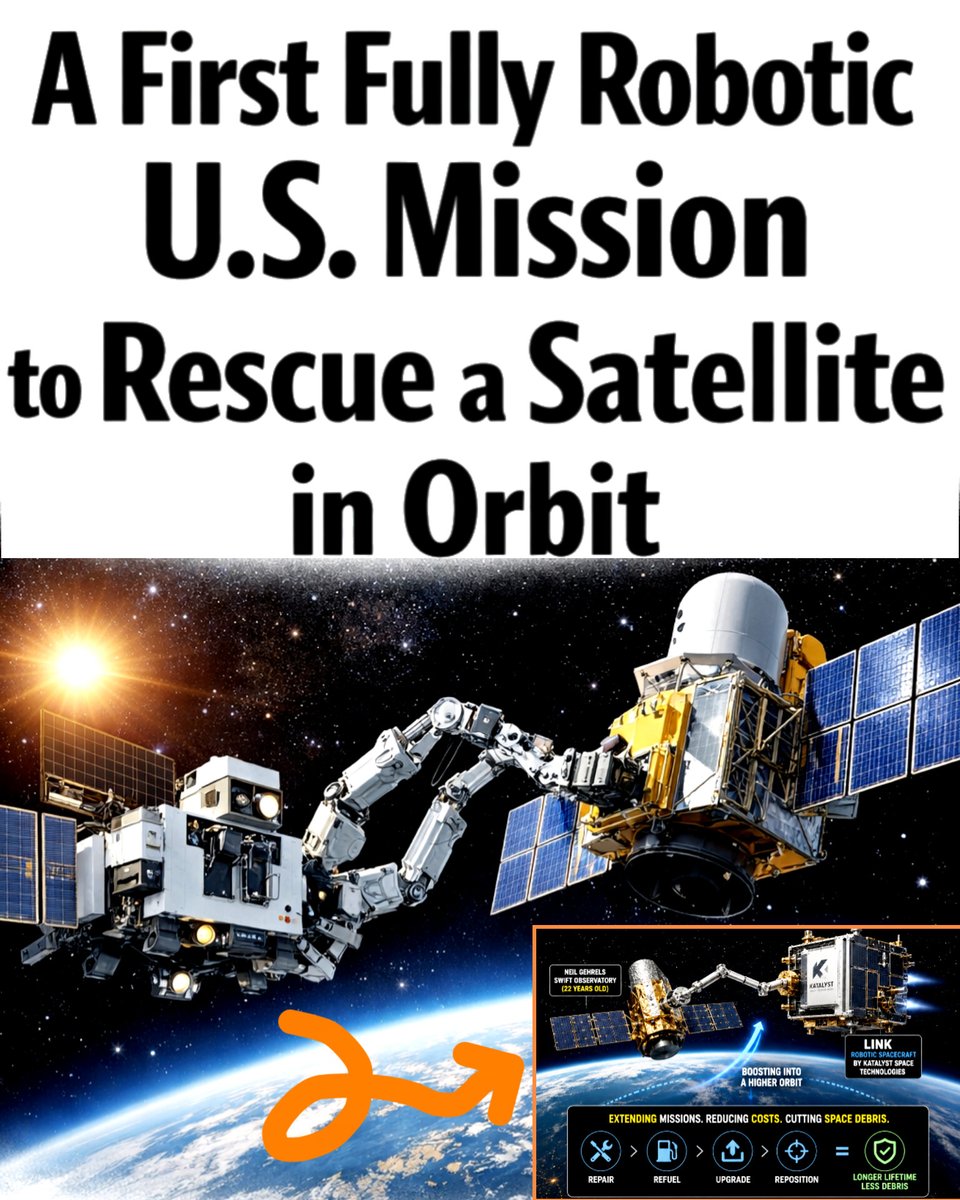
We're entering the era where satellites don't have to die and age of orbital maintenance has officially begun.
A first fully robotic U.S. mission to rescue a satellite in orbit 👀
Katalyst Space Technologies has launched LINK, a robotic spacecraft that will boost NASA's 22-year-old Neil Gehrels Swift Observatory into a higher orbit, helping extend its mission before atmospheric drag eventually pulls it back to Earth.
NASA awarded Katalyst a $30 MILLION contract for this historic mission.
This offers a glimpse of a future where satellites can be repaired, refueled, upgraded and repositioned in orbit.
which will dramatically extend their lifetimes while also reducing space debris.
Wow. This could become one of the most important debugging tools for quantum computers.
"Researchers at ETH Zurich developed a technique that turns a single trapped beryllium ion (Be⁺) into an ultra-sensitive quantum sensor, capable of mapping 3D electric and magnetic fields above a microfabricated chip."
"Using a Penning chip trap, the team can move the ion through space and directly visualize tiny stray electromagnetic fields that introduce noise, motional heating and quantum errors in trapped-ion processors."
"The ability to precisely image these hidden fields could help engineers identify defects, reduce decoherence, improve gate fidelity and build more reliable, scalable trapped-ion quantum computers."
This is how quantum hardware goes from trial-and-error engineering to precision engineering.
This is insane.
Scientists just built the world's first fully synthetic cells that can complete a full cellular life cycle.
"Researchers just created SpudCells, artificial cells assembled entirely from non-living components that can take up nutrients, grow, replicate their DNA and divide into daughter cells."
"According to the researchers, SpudCells consist of about 150-200 molecular components, absorb nutrients, grow, and typically persist for about 5 generations. They are far simpler than natural cells, which contain millions to billions of molecules."
"Unlike previous synthetic organisms created by modifying existing cells, SpudCells were built from scratch using lipid membranes, synthetic DNA, ribosomes, enzymes, and other purified biomolecules, marking a major milestone toward programmable synthetic life."
If we can design cells the way we design software today, the future could bring programmable living systems that manufacture medicines, clean pollution, capture carbon, repair damaged tissues and accelerate biotechnology in ways that seem almost unimaginable today.
This feels like small but important step toward an era where biology becomes an engineering discipline.
Scientists have created one of the most detailed 3D reconstructions of a human cell (eukaryotic cell) ever produced.
This groundbreaking model, often termed a "Cellular Landscape Cross-Section Through a Eukaryotic Cell," combines data from X-ray tomography, nuclear magnetic resonance (NMR), and cryo-electron microscopy to map molecular structures in extreme detail.
The Sun has only 22 galactic orbits left.
Earth races around the Sun at ~67,000 mph (107,000 km/h), giving us our familiar 365.25-day year and changing seasons.
But the Sun is in motion too—hurtling through the Milky Way at ~514,000 mph (828,000 km/h) on a grand orbit around the galactic center. One complete lap, known as a cosmic year, takes roughly 225–230 million years.
When the Sun finished its most recent galactic orbit, the earliest dinosaurs were just beginning to roam Earth.
Since its birth ~4.6 billion years ago, our star has completed about 20 such orbits.
Stellar models predict the Sun will keep fusing hydrogen in its core for another ~5 billion years before it swells into a red giant and eventually fades into a white dwarf. At its current orbital speed, that leaves roughly 22 more laps around the Milky Way.
Each cosmic year sweeps the entire Solar System tens of thousands of light-years across the galaxy—through dense spiral arms rich with star-forming regions, past ancient globular clusters, and amid countless other stars.
Continents drift, mountains rise and erode, entire species evolve and vanish—all within a tiny fraction of one galactic circuit.
Human civilization, from the first cities to today’s digital age, has existed for less than 0.001% of a single cosmic year.
We are passengers on a star halfway through its ~10-billion-year galactic journey across a 100,000-light-year-wide disk—witnessing just the briefest sliver of one ongoing lap in an unimaginably vast cosmic dance.
one almond takes as much water to grow as it takes to cool a data center to generate approximately 1 million claude tokens. whenever you eat a bag of almonds, you're eating a business's entire SAAS suite. and it'll end up in the toilet tomorrow, where most SAAS belongs.
amazing news
anti aging/acc
A team led by Northeastern University researchers found a way to identify which existing drugs could be used to target longevity.
Scientists mapped aging related genes into "network neighborhoods" and screened 6,442 approved drugs, finding 370 that may influence aging hallmarks, with 14 flagged as potential longevity promoters.
This is huge. Drug repurposing could make longevity research faster and cheaper.
👀
For the first time, scientists recorded individual neurons in bilingual brains and found that the brain does not translate words. Instead, it does something very similar to vector space isomorphism in LLMs.
we getting closer to human-like AGI?
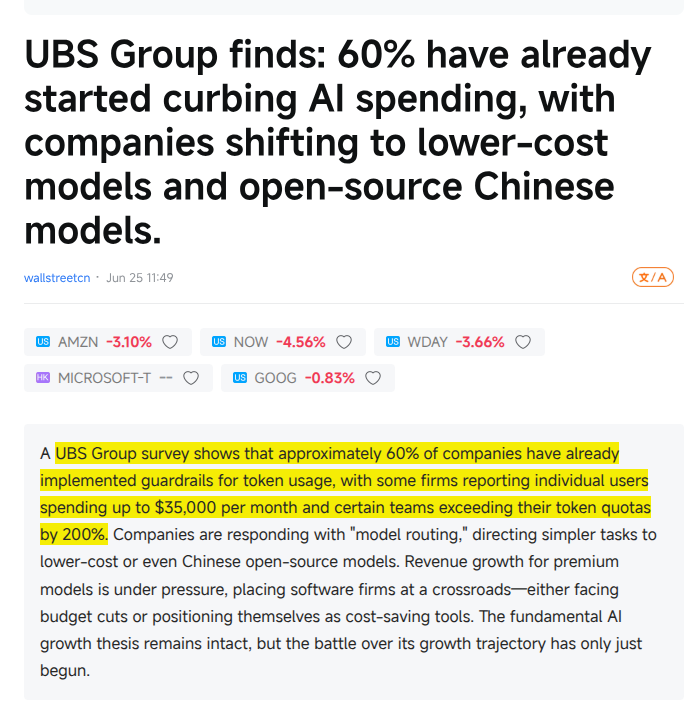
UBS says 60% of companies now watching AI budgets are moving to cheaper models and open-source Chinese models
The pressure is coming from extreme bills, including users spending up to $35K/month, teams exceeding quotas by 200%, and companies cutting internal AI tools from 5 to 2.
Companies are not abandoning AI, they are using model routing, which sends easy tasks to cheaper models and saves premium models for hard reasoning, code, and long-context work.
Chinese open-source models such as Qwen, DeepSeek, MiniMax, GLM, and Kimi now fit the enterprise cost curve because they can be run locally or used through cloud catalogs.
---
news .futunn.com/en/post/75068082/ubs-group-finds-60-have-already-started-curbing-ai-spending?level=2&data_ticket=1780870170397383
Imagine telling someone in 1999…
The year is 2026.
The President is Donald Trump in his second non consecutive term.
The richest man in the world is PayPal cofounder Elon Musk… but not because of fintech or Paypal. Because of rockets, electric cars, AI, satellites, brain chips and something called “Boring Company”.
Apple is worth trillions but its main business isn’t computers… its selling glass rectangles everyone stares at for 9 hours a day.
People don’t watch TV. They watch teenagers explain geopolitics, finance, and relationship advice in ~60 second videos.
The biggest taxi company owns no taxis.
The biggest hotel company owns no hotels.
The most powerful media companies are social networks where everyone argues with strangers for free.
Kids are making millions filming themselves playing video games.
AI Robots write emails, code, legal memos, songs, essays, and breakup texts.
The internet is mostly bots arguing with humans who are trying to prove they aren’t bots.
You can summon a car, groceries, a doctor, a date, a private jet, or a dog walker from your phone.
People pay real money for invisible currencies, digital monkeys, AI girlfriends and pictures that disappear after 24 hours.
The richest companies in the world don’t sell oil, steel, or cars. They sell attention, compute, data, and addiction.
And somehow, after all of that everyone is still using Excel.
What if you could walk past a surveillance camera and remain unrecognizable to artificial intelligence, while still looking completely normal to other people?
That is exactly what Dutch designer Jip van Leeuwenstein set out to achieve. He created a transparent face mask specifically designed to confuse AI-powered facial recognition systems without hiding the wearer’s identity from human observers.
At first glance, the mask appears almost invisible. Its clever design subtly alters the geometric relationships between key facial features, eyes, nose, mouth, and jawline, that AI systems rely on to identify individuals. To the human eye, the wearer’s face and expressions remain clearly visible and recognizable. To facial recognition algorithms, however, the facial data becomes distorted and much harder to process accurately.
The project was developed as part of the Surveillance Exclusion initiative, which examines the tension between privacy, technology, and the rapid spread of facial recognition in public spaces. Although the mask was first introduced several years ago, it has regained attention as AI surveillance becomes more widespread in airports, smartphones, security systems, and cities worldwide.


![Rainmaker1973's tweet photo. A recent study suggests that water exists as two distinct liquids rather than a single uniform substance.
Physicists have long hypothesized that water possesses a hidden dual nature at the molecular level. Confirming this idea has proven challenging because water molecules rearrange rapidly. An international research team has now provided the strongest evidence to date using unsupervised artificial intelligence techniques.
The analysis reveals that liquid water consists of a dynamic mixture of two structural forms. One is a dense disordered high density liquid or HDL. The other is a more open ordered low density liquid or LDL. These configurations continuously interchange at the molecular scale.
This internal switching explains many of water unusual properties. For example unlike most liquids water reaches maximum density at 4 degrees Celsius and expands upon further cooling which allows ice to float.
By clarifying these molecular dynamics the research advances understanding of water behavior under extreme conditions and its critical role in maintaining thermal stability essential for life on Earth.
[Li, L., & Zeng, X. C. (2026). Evidence for the generic existence of two local structures in liquid water. Nature Physics]](https://pbs.twimg.com/media/HMUQL3KXQAA6Rzw.jpg)