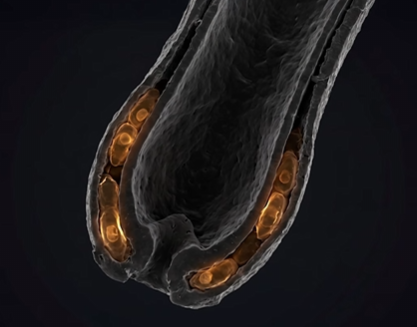
흰머리가 나면 오히려 다행인 이유
흰머리는 다들 늙어서
생기는 노화의 상징인 줄 알고 있는데
흰머리만 20년 넘게 집요하게 파고든
도쿄대 연구팀이 낸 논문을 보면
소름 돋는 반전이 있다고 함
머리색을 만드는 멜라닌 줄기세포가
DNA의 손상을 입어서 불량품이 될 위기에 처하면
우리 몸은 얘를 고쳐 쓰는 대신
"야 너 짐 싸서 나가" 하고
강제로 조기 성숙시켜서
줄기 세포 자리에서 빼버린다고 함
이렇게 되면 색소 공장이 멈추니까
흰머리가 나는 건데
만약 손상된 세포를 그대로 두면
그게 증식해서 피부암이 될 수도 있다고함
그래서 차라리 흰머리를 감수하면서까지
불량세포가 암세포로 흑화하는 일을
원천 봉쇄해 버리는 거라고
그러니까 흰머리는
단순히 늙었다는 증거가 아니라
암이 생기기 전에 가장 위험한 녀석을
미리 손절친 훈장같은 거라고
Recent studies in neuroscience and psychology are reframing ADHD not merely as a set of cognitive hurdles but as a powerful driver of breakthrough creativity and innovation.
Long stereotyped for difficulties with focus, attention, and impulse control, individuals with ADHD traits often exhibit superior divergent thinking—the capacity to generate a wide array of novel ideas by connecting distant or unrelated concepts. This stems from reduced adherence to rigid mental frameworks, enabling freer conceptual expansion and the production of more original, unconventional solutions than neurotypical counterparts. Heightened mind-wandering, especially when deliberate (purposefully allowing thoughts to drift), acts as a fertile source for this creativity, bypassing conventional boundaries to yield abundant "outside-the-box" insights.
Complementing this cognitive flexibility is a neurological drive for novelty rooted in lower baseline dopamine signaling. This creates a chronic need for stimulation, translating into exploratory, risk-tolerant behavior and a propensity for adventure—qualities that can disrupt routine settings but prove invaluable in dynamic fields. Impulsivity, often reframed as rapid action initiation, becomes a catalyst for pursuing bold ideas and seizing opportunities in high-stakes environments.
These traits align closely with the profiles of many successful entrepreneurs, inventors, and pioneers. In fast-evolving creative and innovative economies, the ADHD brain's wiring for quick associative leaps, tolerance of uncertainty, and motivation through novelty-seeking provides a distinct edge, turning potential challenges into engines of originality and progress.
Emerging evidence from 2025–2026 research reinforces this view: studies link stronger ADHD traits to elevated creative achievements via mediated mind-wandering, intuitive insight-driven problem-solving, and higher real-world inventive output, highlighting neurodiversity's role in fueling societal advancement.
[Maisano, H., et al. (2026). ADHD Symptoms Predict Distinct Creative Problem-Solving Styles and Superior Solving Ability. Personality and Individual Differences (February 2026)]
Ya hace tiempo pensaba que las habilidades de front-end estaban super saturadas y que no quedaría nada para descubrir.
Ayer me topé con un repo llamada Awesome Design, con casi 20K estrellas.
Comprime los design languages de 55 grandes empresas globales, todo empaquetado en un único archivo DESIGN.md.
Marcas con un gusto impecable como Apple, Spotify, IBM. Sus paletas de color, fuentes y componentes de referencia, todos disponibles de una vez.
Para usarlo es muy sencillo: Comparte el link del repo con Claude Code, deja que él mismo gestione la instalación y configuración. Una vez listo, indícale que tome este design spec como referencia para correr tu proyecto.
Lo probé y va de maravilla!
Gracias a estas directrices, la calidad del diseño es otro rollo.
Pruébalo!
YouTube is not luck. If you start a YouTube Channel now, you'll be earning $10,000/month in July 2026.
Like and comment "YouTube" and I will send you my step-by-step guide 100% FREE.
Must follow me to get this guide in DM.
FREE for the next 48 hours only.
You’re using your brain WRONG.
In 2010, Stanford neurologist Dr Frank Longo gave a 2-hour lecture on how memory really works.
Everything you’ve learned about memory is mostly wrong.
His frameworks:
• The Magic 7 rule
• How sleep moves memories to storage
• Use it or lose it
In the 1920s, a Stanford psychologist tracked genius children for 50 years.
Malcolm Gladwell breaks down what he discovered:
Rich families → successful. Poor families → failures.
Not average. Failures. Genius-level IQs that produced nothing.
He spent 60 minutes at Microsoft explaining why we're wrong about success:
The psychologist was named Terman. He gave IQ tests to 250,000 California schoolchildren.
He identified the top 0.1%. Kids with IQs of 140 and above.
His hypothesis: these children would become the leaders of academia, industry, and politics.
He tracked them. And tracked them. For decades.
The results split into three groups.
The top 15% achieved real prominence. The middle group had average, moderately successful professional lives.
And the bottom group? By any measure, failures.
The difference wasn't personality. Wasn't habits. Wasn't work ethic.
It was simple: the successful geniuses came from wealthy households. The failures came from poor families.
Poverty is such a powerful constraint that it can reduce a one-in-a-billion brain to a lifetime of worse than mediocrity.
There's a concept called "capitalization rate."
It asks a simple question: what percentage of people who are capable of doing something actually end up doing that thing?
In inner city Memphis, only 1 in 6 kids with athletic scholarships actually go to college.
If our capitalization rate for sports in the inner city is 16%, imagine how low it must be for everything else.
Here's something stranger.
Gladwell read the birth dates of the 2007 Czech Junior Hockey Team:
January 3rd. January 3rd. January 12th. February 8th. February 10th. February 17th. February 20th. February 24th. March 5th. March 10th. March 26th...
11 of the 20 players were born in January, February, or March.
This isn't unique to the Czechs. Every elite hockey team in the world shows the same pattern. Every elite soccer team too.
Why?
The eligibility cutoff for youth leagues is January 1st.
When you're 10 years old, a kid born in January has 10 months of maturity on a kid born in October. That's 3 or 4 inches of height. The difference between clumsy and coordinated.
So we look at a group of 10 year olds, pick the "best" ones, give them special coaching, extra practice, more games.
We think we're identifying talent. We're just identifying the oldest.
Then we give the oldest more opportunities, and 10 years later they really are the best.
Self-fulfilling prophecy.
The capitalization rate for hockey talent born in the second half of the year? Close to zero.
We're leaving half of all potential hockey players on the table because of an arbitrary date on a calendar.
Kids born in the youngest cohort of their school class are 11% less likely to go to college.
11% of human potential squandered because we organize elementary school without reference to biological maturity.
Now here's the part about math.
Asian kids dramatically outperform Western kids in mathematics. The gap is enormous and consistent across decades of testing.
Some people say it's genetic. It's not.
It's attitudinal.
When Asian kids face a math problem, they believe effort will solve it.
When Western kids face a math problem, they believe the answer depends on innate ability they either have or don't.
Here's the proof.
The international math tests include a 120-question survey. It asks about study habits, parental support, attitudes.
It's so long most kids don't finish it.
A researcher named Erling Boe decided to rank countries by what percentage of survey questions their kids completed.
Then he compared it to the ranking of countries by math performance.
The correlation was 0.98.
In the history of social science, there has never been a correlation that high.
If you want to know how good a country is at math, you don't need to ask any math questions. Just make kids sit down and focus on a task for an extended period of time.
If they can do it, they're good at math.
Why do Asian cultures have this attitude?
Gladwell's theory: rice farming.
His European ancestors in medieval England worked about 1,000 hours a year. Dawn to noon, five days a week. Winters off. Lots of holidays.
A peasant in South China or Japan in the same period worked 3,000 hours a year.
Rice farming isn't just harder than wheat farming. It's a completely different relationship with work.
There's a Chinese proverb: "A man who works dawn to dusk 360 days a year will not go hungry."
His English ancestors would have said: "A man who works 175 days a year, dawn to 11, may or may not be hungry."
If your culture does that for a thousand years, it becomes part of your makeup.
When your kids sit down to face a calculus problem, that legacy of persistence translates perfectly.
Now consider distance running.
In Kenya, there are roughly a million schoolboys between 10 and 17 running 10 to 12 miles a day.
In the United States, that number is probably 5,000.
Our capitalization rate for distance running is less than 1%.
Kenya's is probably 95%.
The difference isn't genetic. The difference is what the culture values and where it spends its attention.
Here's the most fascinating finding.
30% of American entrepreneurs have been diagnosed with a profound learning disability.
Richard Branson is dyslexic. Charles Schwab is dyslexic. John Chambers can barely read his own email.
This isn't coincidence. Their entrepreneurialism is a direct function of their disability.
How do you succeed if you can't read or write from early childhood?
You learn to delegate. You become a great oral communicator. You become a problem solver because your entire life is one big problem. You learn to lead.
80% of dyslexic entrepreneurs were captain of a high school sports team. Versus 30% of non-dyslexic entrepreneurs.
By the time they enter the real world, they've spent their whole life practicing the four skills at the core of entrepreneurial success: delegation, oral communication, problem solving, and leadership.
Ask them what role dyslexia played in their success and they don't say it was an obstacle.
They say it's the reason they succeeded.
A disadvantage that became an advantage.
Here's what Gladwell wants you to understand:
When we see differences in success, our default explanation is differences in ability.
We forget how much poverty, stupidity, and attitude constrain what people can become.
We refuse to admit that our own arbitrary rules are leaving talent on the table.
We cling to naive beliefs that our meritocracies are fair.
The capitalization argument is liberating.
It says you don't look at a struggling group and conclude they're incapable. It says problems that look genetic or innate are often just failures of exploitation.
It says we can make a profound difference in how well people turn out.
If we choose to pay attention.
This 60 minute Microsoft talk will teach you more about success than every self-help book you've ever read combined.
Bookmark this & give it an hour today, no matter what.
Claude Sonnet 4.6 is the smartest Al right now.
But 90% of people prompt it like ChatGPT.
That's why I made the Claude Mastery Guide:
→ How Claude thinks differently
→ Prompts built for Claude
→ 2000+ Al Prompts
Comment " Claude " and I'll DM it free.
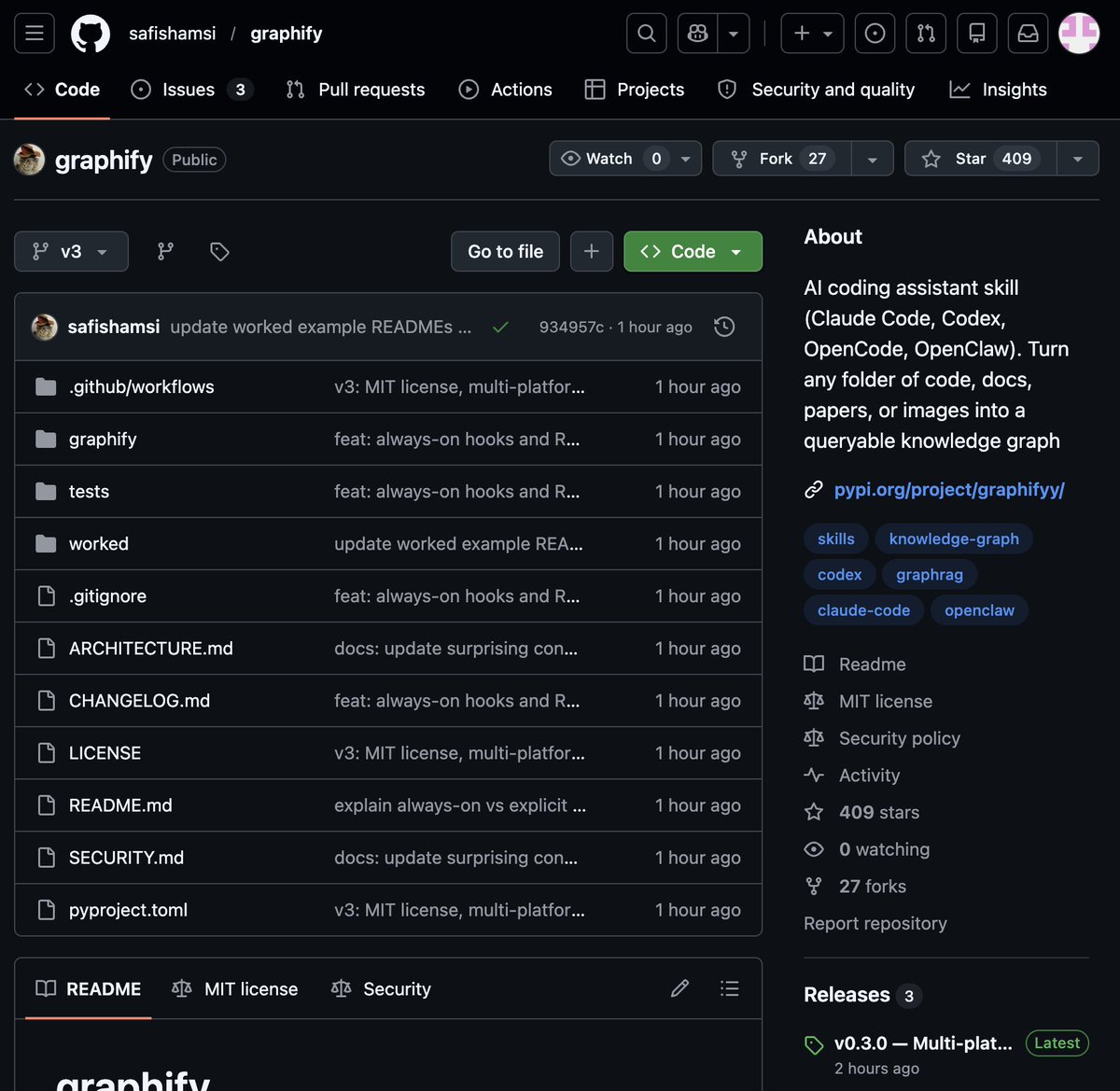
🚨 BREAKING: Someone just built the exact tool Andrej Karpathy said someone should build.
48 hours after Karpathy posted his LLM Knowledge Bases workflow, this showed up on GitHub.
It's called Graphify. One command. Any folder. Full knowledge graph.
Point it at any folder. Run /graphify inside Claude Code. Walk away.
Here is what comes out the other side:
-> A navigable knowledge graph of everything in that folder
-> An Obsidian vault with backlinked articles
-> A wiki that starts at index. md and maps every concept cluster
-> Plain English Q&A over your entire codebase or research folder
You can ask it things like:
"What calls this function?"
"What connects these two concepts?"
"What are the most important nodes in this project?"
No vector database. No setup. No config files.
The token efficiency number is what got me:
71.5x fewer tokens per query compared to reading raw files.
That is not a small improvement. That is a completely different paradigm for how AI agents reason over large codebases.
What it supports:
-> Code in 13 programming languages
-> PDFs
-> Images via Claude Vision
-> Markdown files
Install in one line:
pip install graphify && graphify install
Then type /graphify in Claude Code and point it at anything.
Karpathy asked. Someone delivered in 48 hours.
That is the pace of 2026.
Open Source. Free.
안드레 카파시가 제안한 llm-wiki 구조를 적용한
제 obsidian 구조입니다(작은점 하나가 마크다운 파일)
보시면 겉에 있는 부분은 제 hermes가 수집한 raw data고,
안에 있는 독립된 원은 제 hermes가 raw data를 가공해서 인사이트를 반영한 wiki (thinktank)입니다.
llm-wiki의 핵심은 수집된 raw data와 AI가 가공한 data가 섞이지 않게 하는 것입니다.
여러분도 잘 적용 됐는지 지금 바로 obsidian에서 그래프 뷰를 보세요!





![Rainmaker1973's tweet photo. Recent studies in neuroscience and psychology are reframing ADHD not merely as a set of cognitive hurdles but as a powerful driver of breakthrough creativity and innovation.
Long stereotyped for difficulties with focus, attention, and impulse control, individuals with ADHD traits often exhibit superior divergent thinking—the capacity to generate a wide array of novel ideas by connecting distant or unrelated concepts. This stems from reduced adherence to rigid mental frameworks, enabling freer conceptual expansion and the production of more original, unconventional solutions than neurotypical counterparts. Heightened mind-wandering, especially when deliberate (purposefully allowing thoughts to drift), acts as a fertile source for this creativity, bypassing conventional boundaries to yield abundant "outside-the-box" insights.
Complementing this cognitive flexibility is a neurological drive for novelty rooted in lower baseline dopamine signaling. This creates a chronic need for stimulation, translating into exploratory, risk-tolerant behavior and a propensity for adventure—qualities that can disrupt routine settings but prove invaluable in dynamic fields. Impulsivity, often reframed as rapid action initiation, becomes a catalyst for pursuing bold ideas and seizing opportunities in high-stakes environments.
These traits align closely with the profiles of many successful entrepreneurs, inventors, and pioneers. In fast-evolving creative and innovative economies, the ADHD brain's wiring for quick associative leaps, tolerance of uncertainty, and motivation through novelty-seeking provides a distinct edge, turning potential challenges into engines of originality and progress.
Emerging evidence from 2025–2026 research reinforces this view: studies link stronger ADHD traits to elevated creative achievements via mediated mind-wandering, intuitive insight-driven problem-solving, and higher real-world inventive output, highlighting neurodiversity's role in fueling societal advancement.
[Maisano, H., et al. (2026). ADHD Symptoms Predict Distinct Creative Problem-Solving Styles and Superior Solving Ability. Personality and Individual Differences (February 2026)]](https://pbs.twimg.com/media/HGraT9tXMAANR_7.png)