Sunday Vibes 🚕💨
Kaspa just hit another real-world milestone: the first $KAS-accepting taxi driver in Peru (and likely the world) is now officially on the road.
Meet David @david_kas_peru — now proudly listed on https://t.co/pV37MVr6sm — making $KAS real payments possible!
Courtesy of Kaptain Kaspa 🫶🤝
This is exactly what adoption looks like — one practical use case at a time.
If you're bullish on real-world Kaspa usage, join the $KPTKAS mission!
Let’s bring #Kaspa adoption together!
#KAS #RealWorldAdoption #KaptainKaspa
https://t.co/MzOLFJSd60
⚡️95.42% of $KAS already in circulation
🔥1.986 billion network transactions
☀️538,675 wallet addresses
🎉This is a glory that belongs exclusively to #Kaspa enthusiasts
🎁#HumPool is grateful to have been alongside everyone all along the way
@kaspaunchained@KaspaReport#POW
OVER 95% OF KASPA $KAS HAS ALREADY BEEN MINED
A glance at @kaspaunchained's explorer dashboard highlights that some 95.42% of all the $KAS coins that will ever exist are already in circulation.
It also showcases that the cumulative transaction count for the network is not far off the 2 billion mark, currently standing at around 1.986 billion.
The network has also broken past the 0.5 million wallet address milestone, now sitting at 538,675.
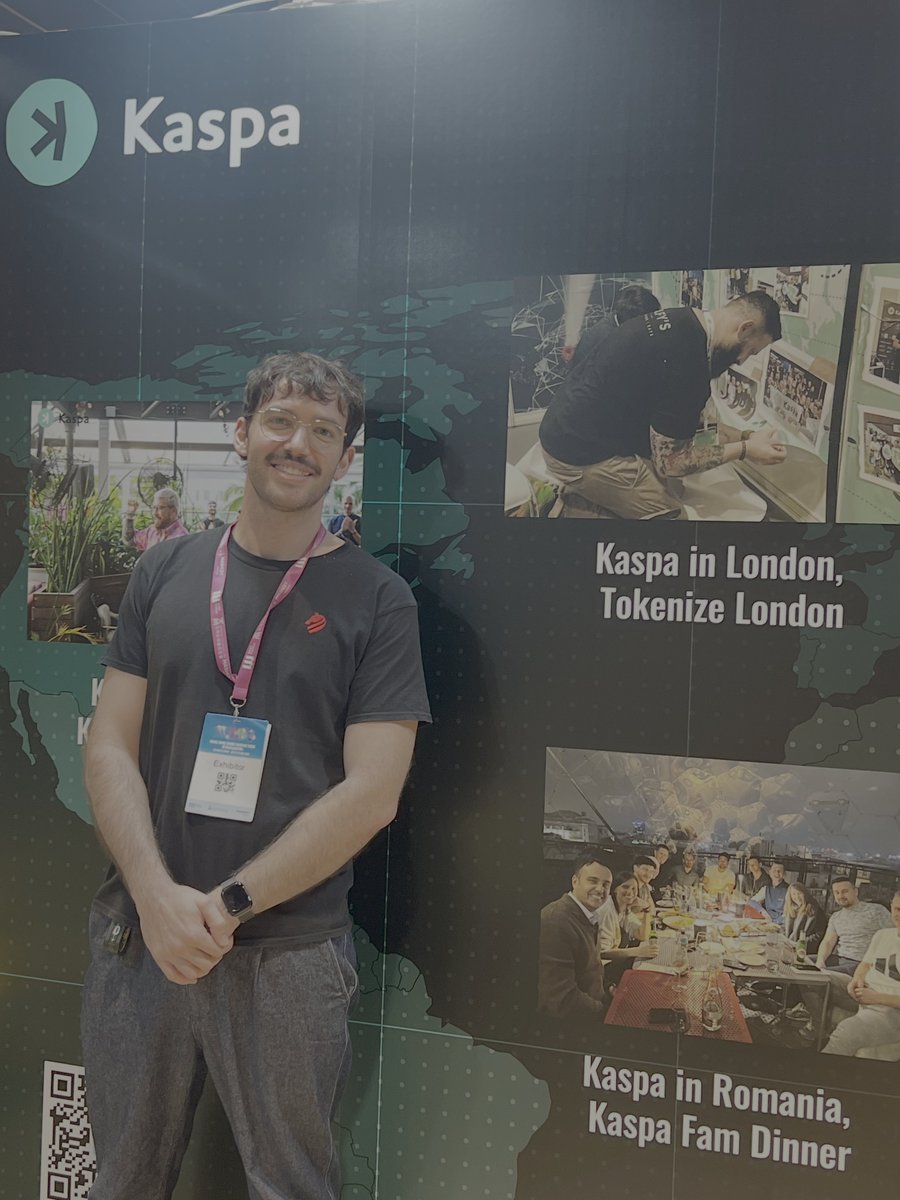
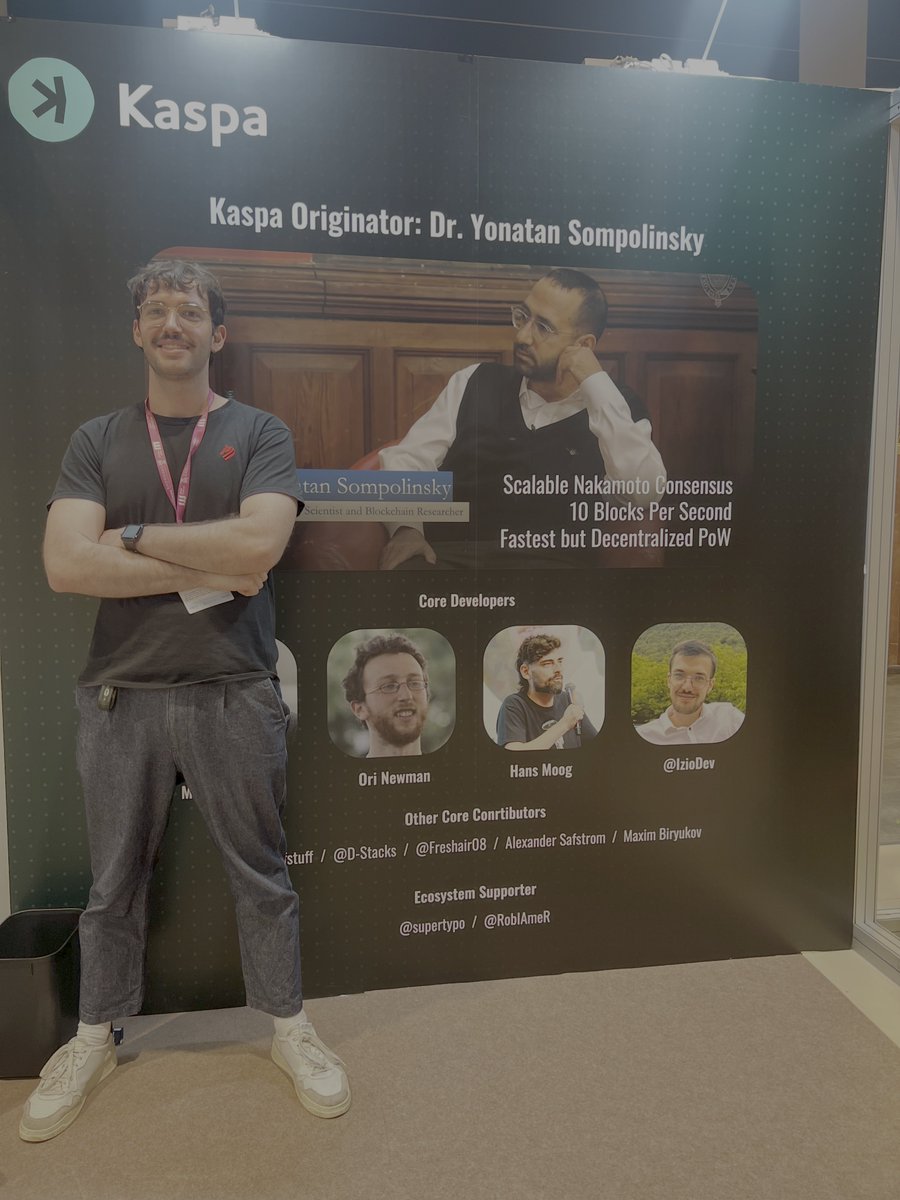
Thank you @Kaspa_KEF for hosting us in the VIP Lounge at @festival_web3 to share what we're building at @KastleWallet — an app that brings the entire Kaspa ecosystem together in one place — and where we're all headed next. 🏰
Personal shoutout to @oneforonehaha — great to finally meet IRL and align on the bigger picture (thanks for the pics too!).
Builders in the same room. Plans outlined. Executing together.
From London to Hong Kong — Kaspa builders are coming together.
Bullish on every team building in this ecosystem. 🛡️
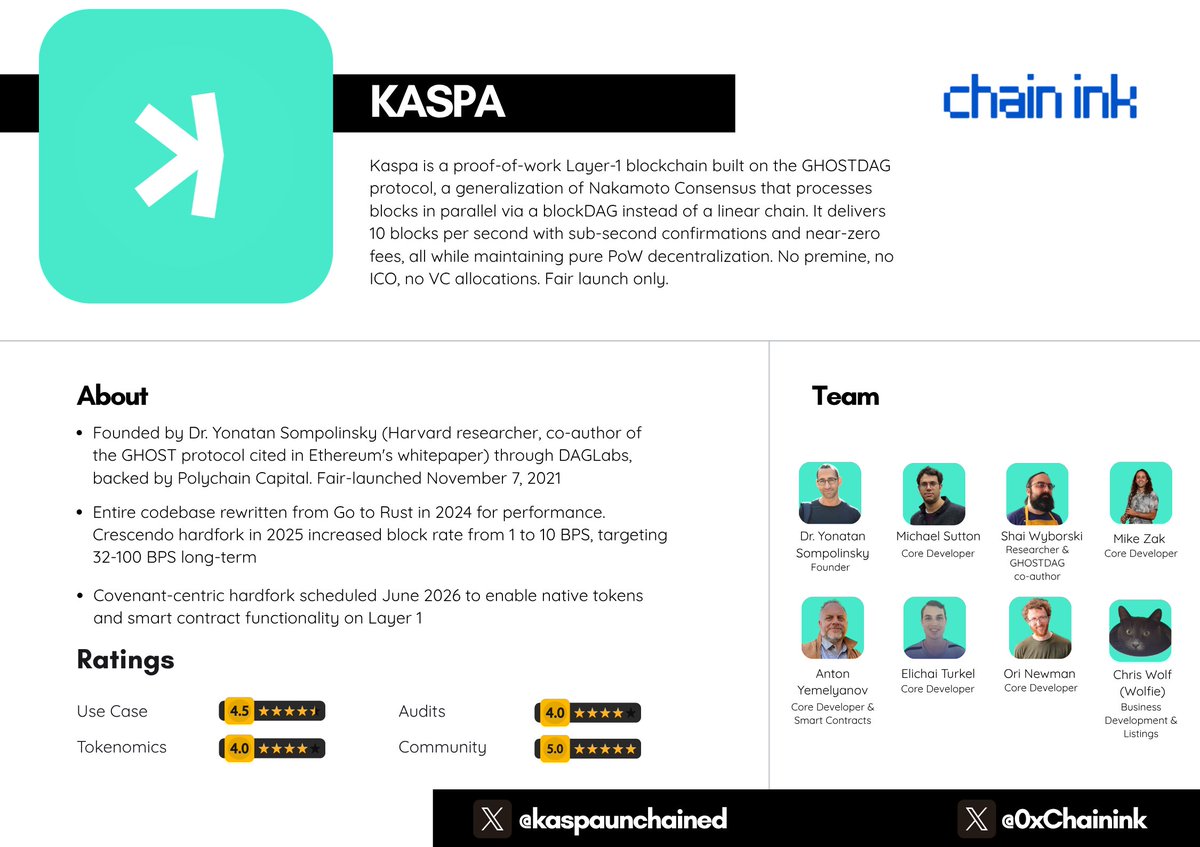
$KAS : Review 📜
What if you could take Bitcoin's security model, make it 600x faster, and then add ZK-powered smart contracts without sacrificing a single atom of decentralization?
Meet Kaspa - a fair-launched, proof-of-work Layer-1 blockchain that replaces the traditional single-chain structure with a blockDAG, processing 10 blocks per second with sub-second confirmations, designed by the Harvard researcher whose GHOST protocol is cited in Ethereum's whitepaper. And with the Toccata hard fork weeks away, it's about to become programmable.
Let's explore how Kaspa is rewriting the rules of proof-of-work. 👇
⚪ Kaspa at a Glance
Kaspa is a decentralized, scalable Layer-1 cryptocurrency built on proof-of-work and powered by the GHOSTDAG protocol, a novel consensus mechanism that extends Nakamoto's original design.
Unlike traditional blockchains that discard competing blocks, GHOSTDAG allows parallel blocks to coexist and orders them within a Directed Acyclic Graph (blockDAG).
The $KAS token is the native currency, distributed entirely through mining with no premine, presale, or founder allocations. The name "Kaspa" means "silver" or "money" in Aramaic.
As of April 2026, $KAS trades around $0.03 with a market cap of approximately $800M. The max supply is ~28.7 billion KAS, with over 95% already emitted through mining. The network currently processes 10 blocks per second following the Crescendo upgrade.
Marketplace Insight: The Toccata hard fork (June 5-20, 2026) is about to transform Kaspa from the fastest PoW payment network into a fully programmable platform with native tokens, covenants, ZK verification, and based ZK apps. Proving costs scale with app activity rather than the entire network, unlocking canonical bridging, stateful multi-contract flows, and DeFi on pure proof-of-work.
⚪ Mission
Kaspa's mission is to create a PoW that operates with internet speed, combining the reliability of proof-of-work with the responsiveness demanded by modern applications.
The project aims to realize Satoshi Nakamoto's original peer-to-peer electronic cash vision but with the throughput, speed, and now programmability that Bitcoin's single-chain design structurally cannot achieve.
🟢 A Brief History
DAGLabs was founded by Dr. Yonatan Sompolinsky with the purpose of implementing the GHOSTDAG protocol, invented by Yonatan with his then PhD advisor Professor Aviv Zohar.
Sompolinsky gained recognition in the blockchain academic world in 2013 when he and Zohar conceived the GHOST protocol, famously cited in Ethereum's whitepaper as a design goal.
Together with a small team including Michael Sutton, Shai Wyborski, and others, Sompolinsky founded Kaspa under DAGLabs, with backing from Polychain Capital. Kaspa's November 7, 2021 launch had no premine, no ICO, and no early allocations. Anyone could start mining from day one.
DAGLabs was dissolved around the time of Kaspa's fair launch, transitioning the project to a decentralized, community-led model. Since then, Kaspa has been developed by a global group of open-source contributors with no central governance or business model.
In 2024, the team completed a full rewrite of the codebase from Go to Rust, dramatically improving performance. The Crescendo hardfork in 2025 increased the block rate to 10 BPS while maintaining network stability.
Now, the Toccata hard fork (originally scheduled May 5, moved to June 5-20, 2026 to finalize the sequencing architecture) is set to introduce extended covenant opcodes, ZK proof verification via Groth16 and RISC Zero, native token issuance, SilverScript programming language, and the Computational DAG (CDAG) for resource management. Feature freeze hit April 15, followed by testnet validation and mainnet node upgrades.
Yonatan currently holds a post-doctoral position at Harvard researching transaction ordering protocols and MEV, while continuing to lead Kaspa's research direction.
🟢 Ecosystem Narrative
Kaspa's ecosystem is built on a simple but powerful premise: you can have proof-of-work security at proof-of-stake speeds if you change the underlying data structure from a chain to a DAG. With Toccata, you can now add programmability without compromising any of it.
Key dynamics include:
➛ BlockDAG architecture allows multiple blocks to be created and confirmed in parallel, eliminating the bottleneck that forces traditional blockchains to be slow. Blocks reference multiple predecessors, forming a graph instead of a single linked list.
➛ GHOSTDAG consensus orders parallel blocks using a greedy algorithm that favors well-connected, honest blocks. The upcoming DAGKnight protocol will further improve ordering with adaptive, parameterless consensus.
➛ Toccata hard fork (June 2026) adds powerful covenants via extended opcodes, enabling native L1 programmability. Introduces a Computational DAG (CDAG) to manage resource usage and sets the stage for sovereign programs (vProgs).
➛ ZK verification at Layer 1 with support for Groth16 and RISC Zero verifiers, enabling based ZK apps where proving costs scale directly with app activity instead of the entire network. This unlocks canonical bridging, stateful multi-contract flows, and privacy-preserving applications.
➛ Partitioned sequencing allows L1 to serve all three roles for based ZK rollups: sequencing, data availability, and settlement. No external dependencies.
➛ SilverScript is a new high-level programming language built specifically for Kaspa covenants, lowering the barrier for developers to build programmable transaction logic, smart wallets, vaults, and DeFi applications.
➛ Native token issuance (KRC-20) directly on Layer 1, with atomic transfers built into the Kaspa transaction model. No external smart contract systems needed.
➛ Kaspa Industrial Initiative (KII) is testing the network in enterprise environments including supply chain tracking, industrial automation, smart grid coordination, and settlement infrastructure.
⚪ Token Utilities
$KAS is a pure proof-of-work currency evolving into a programmable asset:
➛ Peer-to-Peer Payments - Fast, feeless transactions with sub-second first confirmations and ~10 second probabilistic finality. Designed for everyday digital cash use.
➛ Mining Rewards - All KAS enters circulation through PoW mining using the kHeavyHash algorithm. No premine, no allocations, no insider supply.
➛ Transaction Fees - Minimal fees for on-chain transactions, designed to remain low even at high throughput levels.
➛ Smart Contract Fuel (Post-Toccata) - $KAS will power covenant execution, native token operations, ZK verification, and vProg settlement on Layer 1.
➛ Governance via KIPs - Kaspa Improvement Proposals allow the community to propose and adopt protocol changes based on technical merit and consensus.
⚪ Key Features
➛ BlockDAG + GHOSTDAG - Processes blocks in parallel via a Directed Acyclic Graph, ordering them through a greedy consensus algorithm. The core innovation that makes high-speed PoW possible.
➛ 10 BPS (Targeting 100) - Currently processes 10 blocks per second following the Crescendo hardfork, with a roadmap to 32, then 100 blocks per second. Sub-second first confirmations.
➛ Toccata Hard Fork (June 2026) - Adds extended covenant opcodes, ZK proof verification (Groth16, RISC Zero), native tokens (KRC-20), CDAG for resource management, partitioned sequencing for based ZK apps, and SilverScript programming language. The single biggest upgrade in Kaspa's history.
➛ Fair Launch - No premine, no ICO, no presale, no VC allocations, no founder tokens. 100% of supply distributed through open mining since day one.
➛ Rust Rewrite - Entire codebase migrated from Go to Rust in 2024, achieving significant performance improvements and enabling the 10x block rate increase.
➛ DAGKnight (Upcoming) - Adaptive, parameterless consensus protocol that will replace GHOSTDAG, providing optimal confirmation times without manual parameter tuning.
➛ Full Node on Standard PC - Efficient pruning and multithreaded CPU use mean anyone can run a full node on modest hardware, preserving true decentralization.
🟢 Meet the Kaspa Team
Kaspa is built by academic researchers, applied cryptographers, and open-source contributors with no corporate structure, no central entity, and no executive hierarchy. Development is funded entirely by voluntary community donations via a multi-sig wallet.
▶️ Core Members:
➛ Dr. Yonatan Sompolinsky - Founder & Lead Researcher | Co-inventor of the GHOST and GHOSTDAG protocols. PhD under Professor Aviv Zohar at Hebrew University. Currently holds a post-doctoral position at Harvard researching transaction ordering and MEV. His GHOST protocol is cited in Ethereum's whitepaper.
➛ Michael Sutton (msutton) - Core Developer | Distributed Systems Researcher with an https://t.co/m1x1uKVUTt from Hebrew University, where he researched parallel algorithms. Led the Rust rewrite and Crescendo implementation. Serves as one of four community-elected treasurers managing the dev fund.
➛ Shai Wyborski (deshe) - Researcher | Co-author of the GHOSTDAG paper. PhD candidate at Hebrew University and Ben-Gurion University researching classical and quantum cryptography.
➛ Mike Zak (svarog) - Core Developer | Cryptocurrency and Distributed Systems Developer contributing to core protocol implementation and network stability.
➛ Elichai Turkel (elichai2) - Core Developer | Applied Cryptographer and High-Performance Developer. Bitcoin Core contributor bringing deep cryptographic expertise to Kaspa's architecture.
➛ Ori Newman (someone235) - Core Developer | Cryptocurrency and Distributed Systems Developer. Key contributor to SilverScript development.
➛ Anton Yemelyanov (aspect76) - Core Developer, Advisor & Smart Contracts | 30 years systems engineering, 12+ years in cryptocurrency. Co-founder of the Scaling Bitcoin academic conference. Leading smart contract development efforts.
➛ Chris Wolf (Wolfie) - Business Development & Listings | Driving exchange listings, partnerships, and ecosystem business development.
➛ Chad Ballantyne (Rhubarbarian) - Marketing, Branding, PR, Web Development & Creative Content.
➛ Community-Governed - No CEO, no board, no foundation with allocated tokens. Dev fund is a multi-sig wallet managed by 4 community-elected treasurers requiring 2/4 signatures. All spending is publicly documented.
🟢 Ratings
➛ Use Case: ★★★★✦ (4.5/5) - Kaspa solves a problem that every other PoW chain has accepted as unsolvable: high throughput without centralization. The blockDAG architecture is a structural rethinking of how proof-of-work operates. 10 BPS with sub-second confirmations is already remarkable; 100 BPS would be historic.
The Toccata hard fork transforms the equation entirely: covenants, native tokens, ZK verification with Groth16 and RISC Zero, SilverScript, and based ZK apps with partitioned sequencing. This isn't an incremental update, it's Kaspa evolving from digital cash into a programmable settlement platform while keeping PoW security.
The 0.5 deduction is because Toccata hasn't shipped yet and the developer ecosystem around smart contracts is still pre-launch.
➛ Tokenomics: ★★★★ (4/5) - This is what fair-launch tokenomics should look like. Zero premine, zero VC allocation, zero founder tokens. Every single KAS in existence was mined.
The max supply of ~28.7 billion is fixed and predictable. By design, ~87% of the supply was mined in the first 3.5 years, meaning inflation is now rapidly declining toward Bitcoin-like low levels. By July 2026, over 95% will be emitted.
The emission follows a smooth chromatic curve (not halving steps), creating predictable monetary policy. Post-Toccata, smart contract execution will introduce burn mechanics through covenant commissions, adding deflationary pressure.
➛ Audits: ★★★★ (4/5) - Kaspa holds a 4.2 star rating on CertiK via CoinMarketCap, validating the project's security posture. The GHOSTDAG protocol has been peer-reviewed and published in academic literature. The codebase is fully open-source with 188 commits in the trailing 12 months versus an industry average of ~65, nearly 3x the activity.
The network has never been exploited or suffered a consensus failure. The pure PoW model and academic foundations provide inherent security strength. The 1-point deduction is because smart contracts aren't live yet, and as Toccata ships and programmability launches, deeper protocol-level auditing will become increasingly critical.
➛ Community: ★★★★★ (5/5) - Kaspa has one of the most genuine, grassroots communities in all of crypto. Built entirely through mining and organic discovery, with no airdrop, no marketing budget, and no influencer campaigns. The fair launch created a community of true believers who chose to mine and hold from day one. Developer activity is nearly 3x the industry average with dozens of independent contributors.
The KEF (Kaspa Ecosystem Fund) is funded entirely by voluntary community mining donations, not corporate treasury. Kaspa ambassadors are active globally, from Dubai energy summits to Oxford Union speaking events. The dev fund is a multi-sig wallet managed by 4 community-elected treasurers with all spending publicly documented. This is Bitcoin-era community energy applied to next-gen technology.
🟢 Conclusion
Kaspa is what happens when a world-class academic researcher takes the best parts of Bitcoin's philosophy and asks "what if we made this actually fast, and then actually programmable?" The blockDAG architecture isn't a marketing gimmick.
It's a peer-reviewed, mathematically rigorous generalization of Nakamoto Consensus that allows proof-of-work to operate at speeds previously reserved for proof-of-stake chains.
The Toccata hard fork changes everything about Kaspa's positioning. Covenants, native tokens, ZK verification with Groth16 and RISC Zero, SilverScript, partitioned sequencing for based ZK apps, proving costs that scale with app activity instead of the entire network.
This is Kaspa's Ethereum-moment: the transition from "fast digital cash" to "programmable settlement layer." And it's doing it without touching the PoW security model.
The fair launch ethos remains unmatched. No premine, no VC, no founder allocations, no corporate entity. Just open-source code, academic rigor, and a community that funds development through voluntary mining donations.
The risks are clear: Toccata hasn't shipped yet (moved to June 5-20 from the original May 5 date), the developer ecosystem around smart contracts is pre-launch, and the price sits well below previous highs. But the trajectory speaks for itself.
A full Rust rewrite, a successful 10x block rate increase, ZK verification coming to Layer 1, and a community that builds in the open with zero corporate backing. If Toccata delivers, Kaspa won't just be the fastest proof-of-work chain. It'll be one of the most important L1s in crypto, period.
Rusty Kaspa v1.1.0 is out.
Faster syncing, less storage, and exchanges/wallets building on Kaspa just got a much easier time of it.
The big one for integrators is a new API call that returns chain updates and transaction data together in one go, instead of having to juggle multiple parallel requests. If you've ever tried to integrate Kaspa and cursed at the DAG complexity, this is the fix.
Node operators get up to 3x faster sync in the early header stage on some machines, plus lower disk usage.
The stratum bridge also shipped as beta if you're running mining infrastructure.
One heads-up - DB version bumped to 6. Upgrade is automatic, but you can't roll back to an older version without wiping the DB.
https://t.co/fJkvYX0eOS
📢📢 We’re excited to announce our official partnership with @uex_us, a U.S.-based exchange with Money Services Business (“MSB”) registration, now fully supporting the Kasplex Layer 2 ecosystem.
You can now seamlessly deposit and withdraw #Kaspa directly on @Kasplex EVM Layer 2, making transactions faster and more efficient than ever.
This collaboration also opens the door for projects building on @Kasplex. If you're developing within our ecosystem, you can connect with https://t.co/2EVvRWpPXV to explore potential token listings and exchange integrations.
Together, we’re expanding the @Kasplex ecosystem and bringing more accessibility, scalability, and opportunity to our community.🔥
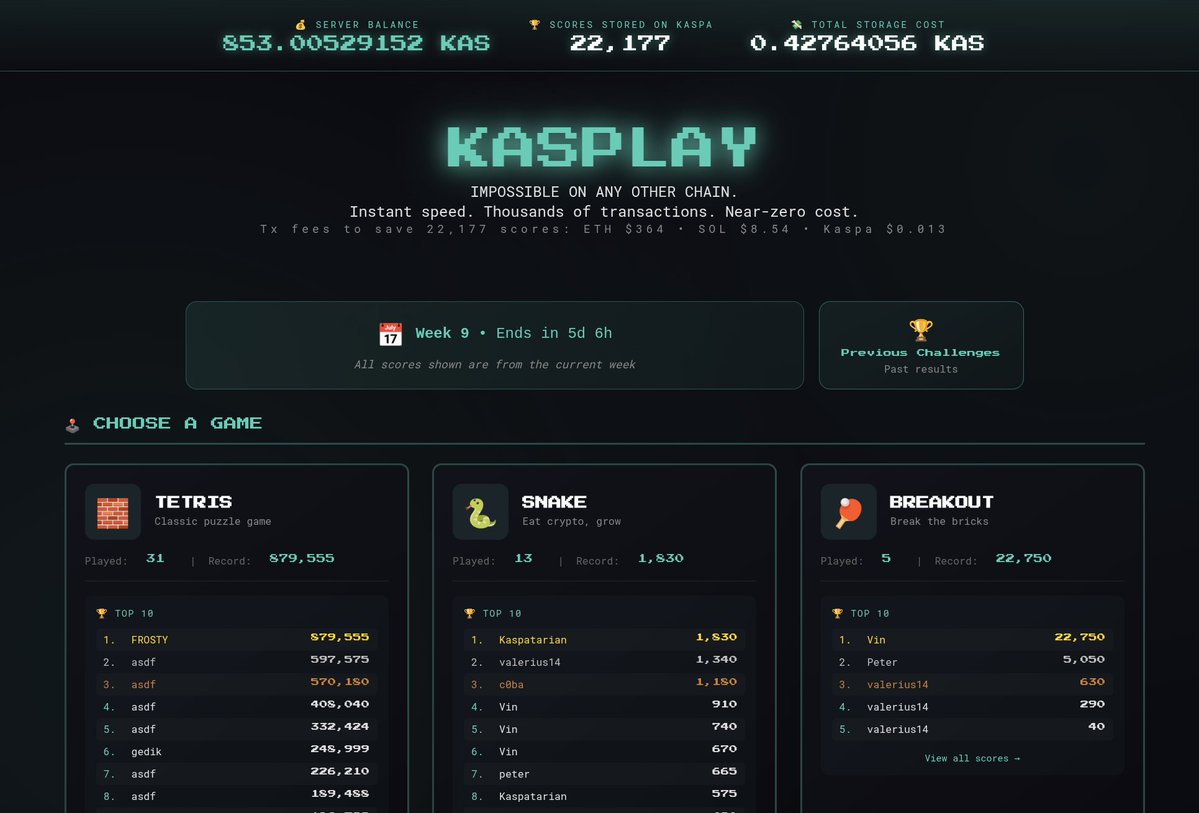
Kasplay provides mini games where scores are kept on the Kaspa network. Try to be the best within the Kaspa community!
Play on mobile or PC here - https://t.co/LQjd8Y0TD2
Bitcoin is too slow! And they used Lightning Network. That’s not a flex.
This is a flex: In August 2025, 5 $KAS travelled across 7 countries; Ireland to USA, Brazil, Nigeria, Romania, Malaysia, Australia, and back to Ireland.
Fast, cheap, secure, decentralised, all on Layer 1 POW. Kaspa is endgame.
Have you ever looked at different DLT projects and realized they're all converging on the same ideas, just with different terminology?
And have you ever wondered what would happen if you forced all DLT projects to have a baby, where each could only contribute their most powerful ideas?
You'd be surprised by the overlap - how non-unique many projects actually are - and how few genuinely good ideas exist. Often they sound almost trivial once you strip away the noise.
The problem is that fundamental breakthroughs get buried under layers of unnecessary complexity - the inevitable result of gradually expanding a protocol's capabilities as research progresses.
With Kaspa, we have the benefit of being late. In fact, we're so late that we arrive at the party when almost all the research has already been done. We can skip the archaeology and just make that perfect baby - making the final breakthrough on our quest for perfection.
Today we are open-sourcing our vprogs framework: https://t.co/eCvvSAyt1n
A post-Amdahl execution engine that enables inter-block parallelism and linear scaling beyond boundaries traditionally assumed to be possible in the context of DLT execution.
By deeply understanding causal actors and domains, we eliminate almost all logic and instead encode behavior in dependencies and relational properties of a generic type framework.
This allows us to transparently map hardware resources to workload - achieving linear scalability.
The design principles:
- No fsync / WAL flush boundaries
- No mutexes / locks
- Versioned append-only data with efficient rollbacks
- Maximal parallelism - even inter-block - breaking through Amdahl's law
- No wasted CPU cycles on speculative execution
This repo is still heavily WIP with rough edges (we don't even prune state yet). But the goal of this repository is to create a concrete instantiation of all existing research directions condensed into a singular, maximally performant type framework that gets away with almost no logic.
There's still room for improvements (zero-copy deserialization, NUMA affinity, etc.) but we're converging toward a system that can eventually no longer be optimized or simplified.
The holy grail of blockchain execution isn't more complex but orders of magnitude less complex than anything that exists today!
I am really looking forward to tell you more about this in the coming weeks (I just ordered a new microphone pre-amp to be able to host regular hangouts where we can discuss and explain how everything works under the hood - let's pray for a fast delivery 😅).
Kaspa Testnet 12 has successfully integrated covenants introduced in KIP-17 and while it’s not a flashy update, it’s an important one.
Covenants allow transaction outputs to include rules about how they can be spent in the future. Instead of funds being freely movable with a signature, the protocol itself can enforce conditions like where funds must go next, when they can move, or what kind of transaction must follow.
This doesn’t turn Kaspa into a full smart-contract chain and that’s the point.
It makes the UTXO model more expressive without adding uncontrolled complexity. Logic stays bounded, predictable, and enforced at the protocol level, while preserving PoW security and decentralization.
Why this matters:
• Stronger base-layer programmability
• Better control and security over assets
• Foundational building blocks for future Layer-2s, DeFi primitives, and advanced transaction flows
This is the kind of progress that doesn’t create hype today, but quietly expands what’s possible tomorrow.
Builders notice these upgrades long before the market does.
🔥Thank you for the trust and perseverance of all #Kaspa miners.
⚡️#HumPool is committed to providing you with higher quality services, contributing to the security, stability, and prosperity of the $Kaspa ecosystem.
@kaspaunchained@Kaspa_KEF@DailyKaspa@FundingKaspa#POW
HumPool and ViaBTC were the two largest Kaspa miners over the past 7 days, each responsible for around 23% of blocks mined.
During the recent negative price action, Kaspa’s network hash rate dropped below 500 PH/s as some hash power went offline.
This kind of pullback usually reflects short-term miner economics rather than any issue with the network. Hash rate tends to follow price, and it often recovers once conditions stabilize.
Understanding Kaspa’s Mass System (v1)
#Kaspa doesn’t rely on simple transaction size. Video little long.. pl excuse ☺️
What you can learn from this..
1. The Speed Dilemma (0:43)
2. Measuring weight/ Mass in Kaspa (1:22)
3. Three Faces of Mass: It measures true network cost using Mass — Compute Mass (verification effort) — Transient Mass (temp storage) — Storage Mass (UTXO impact)
4. Mass in Action/ fees (3:46)
5. Why it Matters (5:36)
This keeps the network fast, secure & spam-resistant..
Learn more at https://t.co/NL4zVIhtF2 💠
Big thanks to the #Kaspa community for building clarity every day 🙏💚
#KASPANetwork #BlockDAG