President Trump just reposted a pretty extraordinary warning from @JamesGRickards on Truth Social.
Rickards says gold could hit $10,000 before the end of 2026, and even $20,000 is “not out of the question.”
He says he has more than $1 million of his own money in physical gold, is still buying, and believes gold is already pricing in the instability he sees coming.
Rickards warns that the run-up to the November midterms could bring an extraordinary convergence of political and financial turmoil: criminal prosecutions of powerful political figures, escalating clashes between the federal government and sanctuary states over immigration enforcement, civil unrest, geopolitical conflict and a potential constitutional showdown over presidential power.
And all of that is colliding with an already vulnerable financial backdrop.
When Rickards recorded the presentation in June, he pointed to $39 trillion in U.S. national debt, pressure on the dollar, record consumer debt and highly valued stock markets.
The national debt has since crossed $40 trillion.
Rickards’ gold thesis ultimately comes down to confidence. He argues that when confidence in government, currencies and the financial system begins to crack, money moves to gold.
And he thinks the potentially bigger opportunity is gold miners, where higher gold prices can translate into dramatically higher margins.
But the most interesting part of all of this is that President Trump chose to share it on Truth Social and amplify this message….
Voyager hit a 90,000°F wall at the solar system’s edge.
NASA’s Voyager 1 spacecraft crossed one of the most dramatic frontiers in the cosmos: the heliopause, the tenuous boundary where the Sun’s influence finally gives way to interstellar space. What the probe discovered there was astonishing, a turbulent zone of superheated plasma with temperatures soaring between 30,000 and 90,000 °F (roughly 17,000–50,000 °C).
This wasn’t a physical wall or barrier, but a dynamic transition region where the outward-flowing solar wind abruptly slows, compresses, and piles up against the incoming pressure of interstellar material. That compression converts kinetic energy into thermal energy, driving the plasma to extreme heat levels far beyond anything found inside the heliosphere.
Remarkably, despite the blistering temperatures, this “wall of fire” would pose no danger to a hypothetical astronaut. The plasma is extraordinarily diffuse, far less dense than the best vacuums achievable in Earth laboratories, so there are simply too few particles to transfer meaningful heat. The region is hot in temperature but cold in practical effect.
Voyager’s instruments captured clear signatures of the crossing: a sudden plunge in solar wind particles, a sharp rise in galactic cosmic rays, and faint plasma oscillations that revealed the density and temperature of this exotic boundary layer for the first time. These vibrations, analogous to ripples on an unseen sea, provided direct measurements of conditions in a realm previously known only through theory.
The heliopause itself serves as a vital shield. The entire heliosphere, the vast bubble carved by the Sun, deflects most of the galaxy’s high-energy cosmic radiation, helping protect life on Earth from constant bombardment. Beyond this protective envelope lies the harsher, unfiltered radiation environment of the interstellar medium.
Today, more than 15 billion miles (24 billion kilometers) from home, Voyager 1 remains the farthest human-made object ever sent into space. Still operational and transmitting precious data, it continues to reveal the secrets of this distant frontier.
At the outer limit of our solar system, space is neither empty nor serene. It is a violent, glowing threshold: and humanity has only begun to map its mysteries.
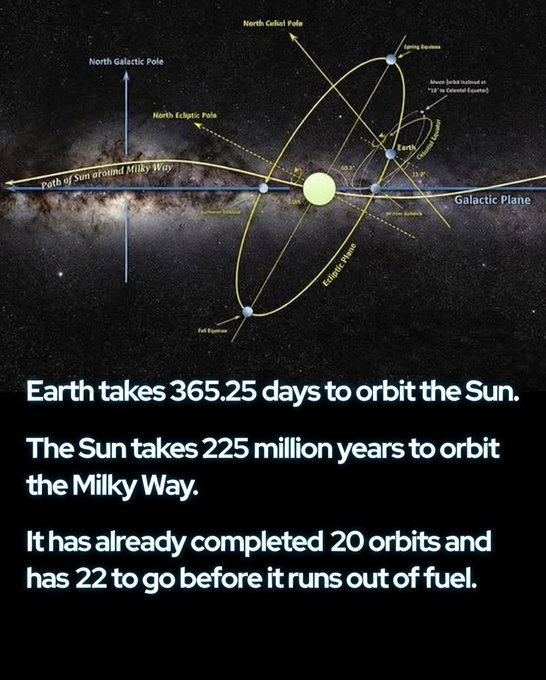
The Sun has only 22 galactic orbits left.
Earth races around the Sun at ~67,000 mph (107,000 km/h), giving us our familiar 365.25-day year and changing seasons.
But the Sun is in motion too, hurtling through the Milky Way at ~514,000 mph (828,000 km/h) on a grand orbit around the galactic center. One complete lap, known as a cosmic year, takes roughly 225–230 million years.
When the Sun finished its most recent galactic orbit, the earliest dinosaurs were just beginning to roam Earth.
Since its birth ~4.6 billion years ago, our star has completed about 20 such orbits.
Stellar models predict the Sun will keep fusing hydrogen in its core for another ~5 billion years before it swells into a red giant and eventually fades into a white dwarf. At its current orbital speed, that leaves roughly 22 more laps around the Milky Way.
Each cosmic year sweeps the entire Solar System tens of thousands of light-years across the galaxy, through dense spiral arms rich with star-forming regions, past ancient globular clusters, and amid countless other stars.
Continents drift, mountains rise and erode, entire species evolve and vanish, all within a tiny fraction of one galactic circuit.
Human civilization, from the first cities to today’s digital age, has existed for less than 0.001% of a single cosmic year.
We are passengers on a star halfway through its ~10-billion-year galactic journey across a 100,000-light-year-wide disk, witnessing just the briefest sliver of one ongoing lap in an unimaginably vast cosmic dance.
@pickover Unfortunately this is crap as it does not mention Sumerian civilisation! Even the time you posted this on Twitter is Sumerian! How not to mention! Enuma Elish, the aathra hasis all depict them in detail! They knew Pythagoras theorem in base 60, 2000 yrs before the greek salad!
This highly unusual #book is the first one I’ve read on the philosophy of technology.
It sketches key principles behind how technology arises, develops and evolves. Plus its link with economy and human needs.
The best part of the book was historical anecdotes on different technologies (jet engines, computers, recombinant DNA, etc).
The prose was dry, and I think you’ll only enjoy it if you genuinely care about high-level principles behind technology’s evolution (which many of them would be obvious once you read).
So it’s a breezy read, a bit simple but historical examples of how different technologies came to be was super interesting.
An essay I've just written for @nytimes on why Big Tech is the 21st Century’s equivalent of the East India Company:
"What It Would Take to Dismantle the Most Powerful Companies in the World" https://t.co/E8mFY9tJkW
A Japanese mathematician published a result in 1944 that nobody understood for twenty years. Today it runs inside every options desk on Wall Street. Goldman pays $400K to quants who can derive it from scratch and explain why classical calculus gives the wrong answer without it.
His name is Choongbum Lee. MIT, 18.S096, Topics in Mathematics with Applications in Finance. The course that Wall Street watches.
This is lecture 17. It derives Ito's Lemma from scratch.
He opens with the problem nobody in classical calculus can solve.
Then the foundation. Brownian motion is the limit of a random walk taken to infinity. Each trade pushes a price up or down by a tiny amount. A million trades a day. The limit of that process is Brownian motion. Einstein proved this for pollen particles in 1905. The finance world borrowed the math fifty years later.
Then three properties that make no sense until you see them derived. Brownian motion crosses zero infinitely often. It never escapes to infinity. And it is nowhere differentiable - with probability one, every path is continuous but has no slope at any point. That last property is why classical calculus breaks completely.
Then quadratic variation. For any smooth function, chop an interval into n pieces, square the increments, sum them - the result goes to zero. For Brownian motion it goes to T. The increments are too wild to vanish. That single fact is why Ito's Lemma has a second term that classical calculus does not.
Watch the moment he derives it. Taylor expansion applied to a function of Brownian motion. The first term is what you expect. The second term appears precisely because the squared increment does not vanish. Without it, options pricing gives wrong answers. With it, you have Black-Scholes.
A quant I know sends this lecture to junior analysts who cannot explain why their pricing model drifts. Says it fixes in ninety minutes what two years of finance courses left open.
Free on YouTube, MIT OpenCourseWare, 18.S096.
bookmark this and watch later - the math behind every options desk on Wall Street fits on one blackboard, and this is the lecture that shows you why
Schweber’s book somehow achieves something truly unique that I’m not sure I’ve seen anyone else do except Pais in his Einstein bio: It is simultaneously a rich, deep biographical history and a rich, deep scientific biography replete with equations. It can be read profitably by both serious historians and serious physicists. There are other contenders, scientific biographies like Kragh's Dirac bio and Enz's Pauli bio, but none is as richly detailed and engaging as Schweber's. A remarkable contribution.
Somewhere around 1930, on a sandy village road in Alappuzha, a woman rode a British motorcycle alone, sari hitched at her waist, while a crowd gathered on the roadside just to jeer. They called her Bullet Narayani. For almost a century afterward, everyone forgot her. 1/16
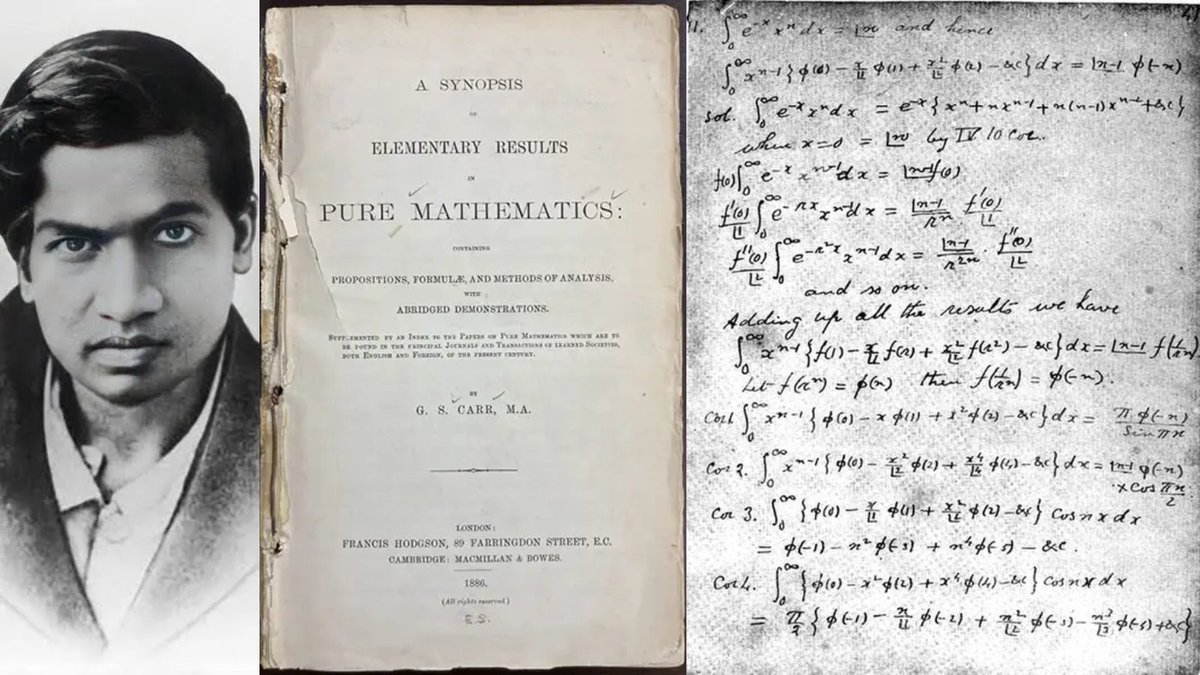
When he was 15 years old, he obtained a copy of George Shoobridge Carr’s Synopsis of Elementary Results in Pure and Applied Mathematics, 2 vol. (1880–86).
This collection of thousands of theorems, many presented with only the briefest of proofs and with no material newer than 1860, aroused his genius. Having verified the results in Carr’s book, Ramanujan went beyond it, developing his own theorems and ideas.
A fresh quantum cosmological framework indicates that existence may unfold in perpetual exact cycles.
For many years researchers in cosmology have confronted the troubling Boltzmann brain paradox. In an unbounded, cooling cosmos random quantum fluctuations would far more readily generate isolated conscious minds complete with illusory histories than produce genuine universes populated by evolved beings.
Consequently every recollection you hold could have crystallized mere moments earlier through pure statistical chance.
Quantum cosmologist Sean Carroll together with collaborators, has advanced a contrasting picture. Rather than transient accidental entities within a lifeless expanse, observers may inhabit a precisely periodic quantum cosmos that recurs without end.
In their mid-2026 study Carroll, Nadiia Diachenko and Saakshi Dulani identified a mathematical pathway within quantum theory that permits a stable repeating universe. Through precise alignment of energy eigenvalues the model sidesteps the predominance of random Boltzmann brains, moving smoothly from low-entropy expansions resembling the Big Bang through contractions and back again. Should the proposal prove correct, each dialogue, choice and cherished recollection has already occurred infinitely often and will continue to do so indefinitely.
Although the notion of endless recurrence may appear imposing, it supplies an orderly scaffolding for existence and affirms that consciousness constitutes a durable aspect of the cosmos.
[Carroll, S. M., Diachenko, N., & Dulani, S. (2026). Toward a phenomenologically acceptable quantum cyclic universe. arXiv. DOI: 10.48550/arXiv.2605.30405]
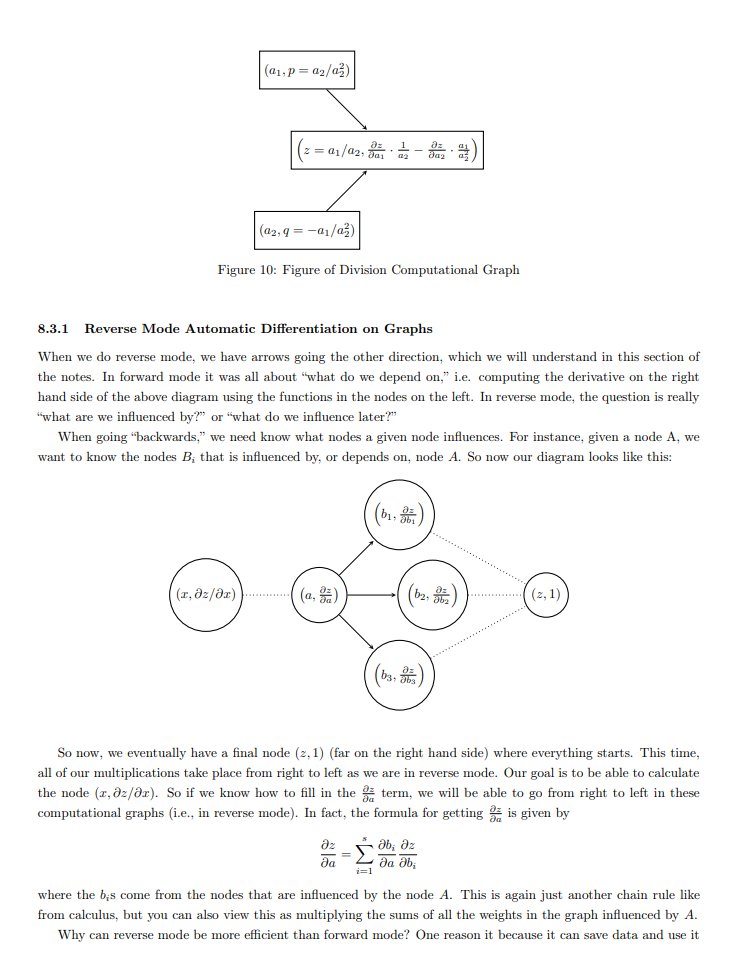
Matrix Calculus (for Machine Learning and Beyond) — Free PDF
📘 Matrix Calculus (for Machine Learning and Beyond)
📄 101 pages
🆓 Free PDF
This MIT course material covers matrix derivatives, Jacobians, gradients, Hessians, matrix factorizations, optimization, automatic differentiation, and applications in machine learning. MIT provides the complete lecture notes openly through OpenCourseWare.
👉 Read & access the free PDF: https://t.co/cknb3Chnk8
The youngest mathematician to win the Fields Medal in 40 years walked into UCLA and explained an unsolved problem that sits at the foundation of number theory. The companies that understand this mathematics hire at $400,000 a year and almost never post the jobs publicly.
His name is Manjul Bhargava. Fields Medal 2014. Princeton professor at 28. He reinvented the study of number fields and broke open problems that had been untouched for 200 years. His students go on to cryptography teams at Google, Jane Street, and the NSA before most mathematicians finish their PhDs.
This is UCLA, Distinguished Lecture Series, 2015. It covers square-free values of polynomials - a problem so deep that even the simplest version, x to the fourth plus 1, remains unsolved.
He starts with a question anyone can understand. If you pick a random integer, what is the probability it has no perfect square as a factor? The answer involves pi. It is 6 over pi squared - roughly 60 percent.
Then why. Each prime contributes independently. The probability of avoiding a squared factor at prime p is 1 minus 1 over p squared. Multiply over all primes and you get the Euler product for the Riemann zeta function. A question about integers connects directly to the deepest object in mathematics.
Then the hard part. For polynomials of degree four or higher in one variable not a single irreducible example is known where the conjecture is proven. Does x to the fourth plus 1 take infinitely many square-free values? Nobody knows.
Then the breakthrough. Bhargava shows how symmetry groups - algebraic structures acting on spaces of polynomials - can be used to transfer hard cases to easier ones. The technique works on a polynomial with degree 40 in 40 variables and resolves questions about quintic number fields that had been open for decades.
Watch the moment he describes a problem that the ABC conjecture would instantly solve - and notes that a proof of ABC has been sitting on the internet for years, unverified.
A cryptographer I know watched this series before joining a post-quantum security team. Said it was the first time algebraic number theory felt like engineering rather than pure abstraction.
Free on YouTube, UCLA Mathematics, full lecture series available.









![Rainmaker1973's tweet photo. A fresh quantum cosmological framework indicates that existence may unfold in perpetual exact cycles.
For many years researchers in cosmology have confronted the troubling Boltzmann brain paradox. In an unbounded, cooling cosmos random quantum fluctuations would far more readily generate isolated conscious minds complete with illusory histories than produce genuine universes populated by evolved beings.
Consequently every recollection you hold could have crystallized mere moments earlier through pure statistical chance.
Quantum cosmologist Sean Carroll together with collaborators, has advanced a contrasting picture. Rather than transient accidental entities within a lifeless expanse, observers may inhabit a precisely periodic quantum cosmos that recurs without end.
In their mid-2026 study Carroll, Nadiia Diachenko and Saakshi Dulani identified a mathematical pathway within quantum theory that permits a stable repeating universe. Through precise alignment of energy eigenvalues the model sidesteps the predominance of random Boltzmann brains, moving smoothly from low-entropy expansions resembling the Big Bang through contractions and back again. Should the proposal prove correct, each dialogue, choice and cherished recollection has already occurred infinitely often and will continue to do so indefinitely.
Although the notion of endless recurrence may appear imposing, it supplies an orderly scaffolding for existence and affirms that consciousness constitutes a durable aspect of the cosmos.
[Carroll, S. M., Diachenko, N., & Dulani, S. (2026). Toward a phenomenologically acceptable quantum cyclic universe. arXiv. DOI: 10.48550/arXiv.2605.30405]](https://pbs.twimg.com/media/HQlTq5cXQAEeIz1.png)