Wat mij verbaasd is dat deze nuttige analyse nu pas gedaan is en niet voorafgaand aan de stikstofbrief gevraagd lijkt. 👇 Nieuwe normen vergeleken met praktijkresultaten 37 deelnemers Netwerk Praktijkbedrijven https://t.co/0iHv593NLR
Jij: “Vanaf €91.400 stijgen mijn beleggingen weer. Ik verdien eindelijk weer geld terug.”
Overheid: “Goed nieuws. Over die waardestijging betaalt u 36% belasting, na een vrijstelling van €1.600.”
Jij: “Maar ik ben nog steeds niet terug bij mijn beginvermogen van €100.000. Ik probeer alleen het gat te dichten dat ontstond doordat ik belasting moest betalen over winst die later verdampte.”
Overheid: “Een stijging is een stijging.”
Jij: “Dus als mijn beleggingen van €91.400 met 9,4% terug stijgen naar €100.000, verdien ik €8.600 terug. Na de vrijstelling blijft €7.000 over. Daarover betaal ik €2.520 belasting.”
Overheid: “Correct.
”Jij: “Dan houd ik na belasting €97.480 over. Ik ben dus nog steeds €2.520 armer dan toen ik begon, ondanks dat mijn beleggingen weer op €100.000 staan.”
Overheid: “Maar u had dit jaar wel rendement.”
Jij: “Alleen omdat u eerst een deel van mijn vermogen hebt weggehaald. Om puur weer op mijn oorspronkelijke €100.000 uit te komen, moet mijn portefeuille vanaf €91.400 eerst €12.538 stijgen: bijna 13,7%. Na de vrijstelling betaal ik daar opnieuw belasting over.”
De Duitse politie gaat uit van een aanslag met terroristisch motief, NLe media noemen het ‘een aanrijding’. Dit is een aanval op een Pride. Het is geen ‘bestuurder’ of ‘bestelbus’ die dit deed maar een terrorist. Woorden doen er toe.
Prepare yourself for a proposition from $GME to increase the total authorized share count. I know that might make some of you uncomfortable, but hear me out because there's a very logical reason this is coming, and it's actually bullish. If you disagree or hate this idea, please give me the courtesy of reading my logic before you have a mid-life crisis in the comments.
Right now, GameStop has ~448m shares outstanding against 1bn authorized. That's a 44.8% issued-to-authorized ratio. Sounds like plenty of headroom, right? Not when you factor in what's already committed:
- 171.5m shares tied to RC's performance options
- ~43.5m shares from the $1.3Bbn convertible notes ($29.85 strike)
- ~77.8m shares from the $2.25bn convertible notes ($28.91 strike)
That alone brings the fully diluted count to ~741m, or 74% of the authorized ceiling. And that's before a single acquisition dollar gets raised.
So why would RC want to increase the limit now, while there's still room? Because good capital allocators do not wait until they are maxed out. They plan ahead, and there is clear precedent for this.
RC has shown you exactly how he thinks about this.
In January 2023, RC built a stake worth several hundred million dollars in Alibaba and personally pushed management to increase their buyback program from $40bn to $60bn. He told them they could hit double-digit sales growth and ~20% FCF growth over five years, but the shares were undervalued and the buyback was not aggressive enough. Alibaba listened and expanded the program.
He also invested the vast majority of his personal wealth into Apple after selling Chewy, becoming one of Apple's largest individual shareholders (roughly $800m plus at peak). When sources close to RC described his Alibaba thesis to Reuters and the Wall Street Journal, they specifically pointed to Apple's capital return program as the blueprint RC wanted Alibaba to follow. RC called Apple “the strongest business in the world” and cited “disciplined capital allocation” as a core investment principle he learned from Buffett. He bought his first Apple share at age 15.
The through-line here is pretty clear to me: RC is acutely aware of shareholder value mechanics, issued-to-authorized ratios, and capital discipline. He does not want to be forced into raises when his back is against the wall. He would rather have optionality.
Buffett operated the exact same way, and there is direct precedent here. Berkshire Hathaway has 1.65m Class A shares authorized but only roughly 523,000 outstanding. That is a 31.7% utilization rate, and Buffett has maintained that kind of headroom for decades. He did not do that because he planned to flood the market with stock, but because he wanted the flexibility to act when opportunity appeared without going back to shareholders for emergency approvals.
At the 1995 Berkshire annual meeting, when shareholders questioned whether authorizing preferred stock would dilute them, Buffett said: “There is no downside to this proposal. It is an authorization. It is not a command to issue shares.” He also explained that shareholders are only diluted if Berkshire receives less in value than it gives, and he repeated that principle in multiple letters and Q&A sessions over the years. In later commentary he went so far as to say he would “rather prep for a colonoscopy than issue Berkshire shares,” underscoring how seriously he treats actual issuance versus simple authorization. The lesson is simple: Buffett authorized far more shares than he ever used, kept massive headroom at all times, but was extremely disciplined about when and why he actually issued stock. That is the model RC appears to be following.
Now let's do the math on what $100bn plus actually requires.
RC has told us the plan: acquire a publicly traded consumer company “significantly larger” than GameStop. He has described it as “transformational” and said this has “never been done before in the history of capital markets.”
GameStop currently sits at roughly $11bn market cap with roughly $8.8bn in cash. To get to $100bn by 2036 (the 10 year horizon of his compensation plan), he is going to need significantly more capital than what is on the balance sheet today. My estimate: at least another $20bn in equity and debt capital over the next 3 to 5 years. And honestly, that might be conservative if the vision is $100bn to $500bn.
Think about it through the lens of how the Mag 7 plan their growth. Meta, Google, Microsoft, Amazon, they are each telling shareholders and the market they are spending $60bn to $80bn per year for the next 3 years on AI infrastructure. They are planning capex 2 to 4 years out and asking for patience. The market rewards that kind of forward planning.
Now apply that same thinking to GameStop. This is not capex, but the principle is the same: how much capital does RC need to build a $100bn to $500bn conglomerate? The answer is: a lot. And it needs to come from a combination of cash flowing acquired businesses that can generate $4bn to $5bn per year, plus accretive equity raises and creative debt instruments (like those 0% converts).
If you assume $20bn in additional equity raises at an average price of roughly $25 per share, that is roughly 800m new shares. Add that to the 741m fully diluted count and you are at roughly 1.54bn shares, well past the current 1B authorized limit.
If RC wants to hover around a 60 percent issued-to-authorized ratio (which, based on his Alibaba and Apple track record, seems like a reasonable mental ceiling), he would need authorization for roughly 2.5bn to 3bn shares. My guess is we will see a proposal for 2bn to 3bn, likely the latter.
Here is the key point most people miss: increasing the authorized share count is not dilution. It is giving the board the legal runway to execute over a multi year period. Dilution happens when shares are actually issued, and RC has shown through his $35bn all or nothing compensation plan that he only wins if the stock goes up. His 171.5m options are worthless unless GameStop hits $100bn in market cap and $10bn in cumulative EBITDA. Every share he issues needs to be accretive to that goal or he is lighting his own paycheck on fire.
It takes money to buy whiskey. You do not build $100bn plus companies without capital. And it is far better to ask for authorization now, while utilization is at roughly 45%, than to come back begging when you are at 90% and the market reads it as desperation.
This is forward planning. This is the Berkshire playbook. Do not let it scare you.
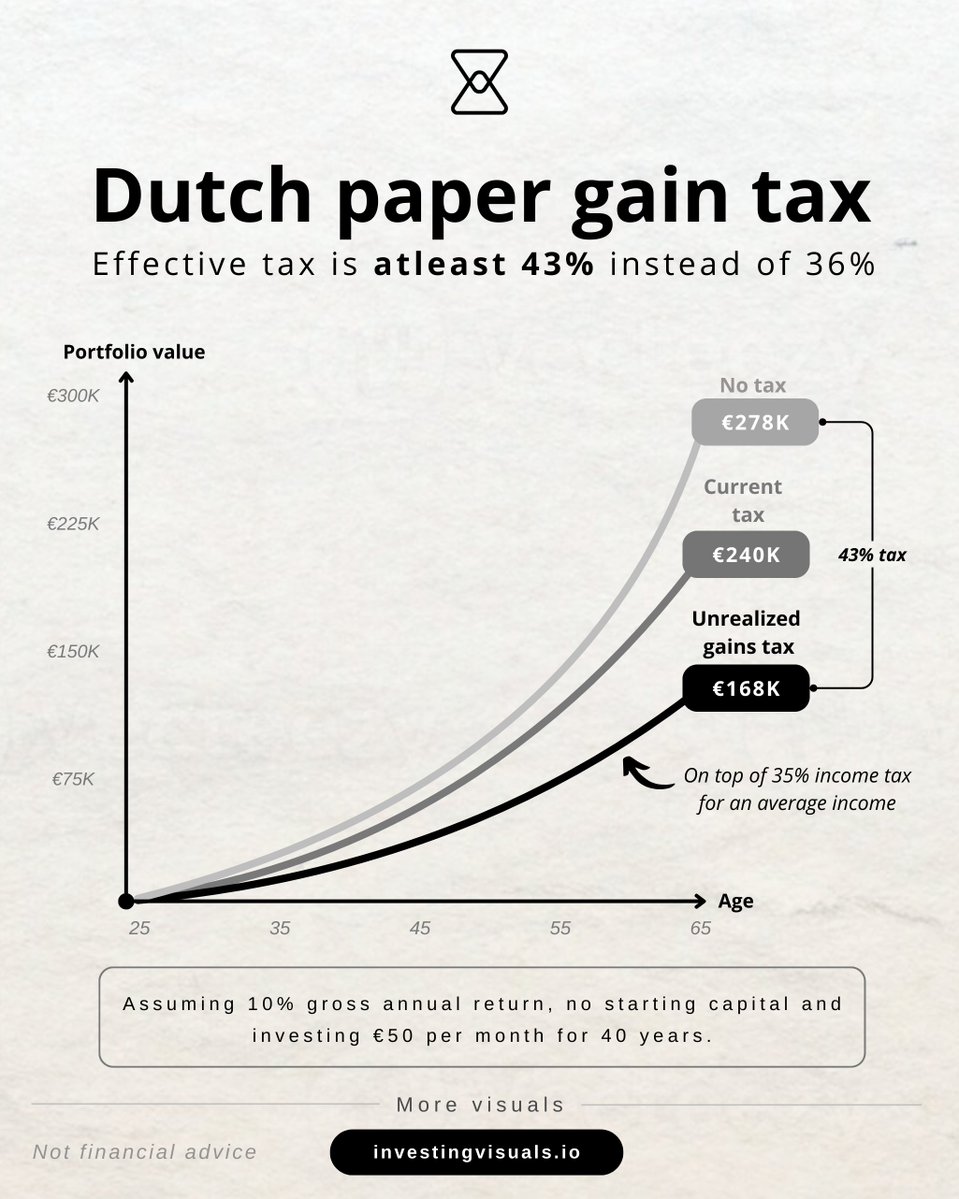
The effective Dutch paper gain tax is at least 43%, not 36%.
• You start at €0
• You invest €50 per month
• You do so for 40 years
• Your annual return is 10%
Part 1: Unrealized gains tax
What you actually pay the government is 36%.
Part 2: Missed compounding effect
What politicians seem to forget is that taxes paid can no longer compound, creating another 7% indirect tax effect.
In short
In reality, this tax is even worse than it looks on paper, and the indirect hit grows as monthly or yearly contributions increase.
#StopBox3
When Trumps dad got Alzheimer's (which is hereditary) they put him in a pretend office and let him sign pretend papers and make pretend decisions for his companies.
I feel like that information is relevant right now.
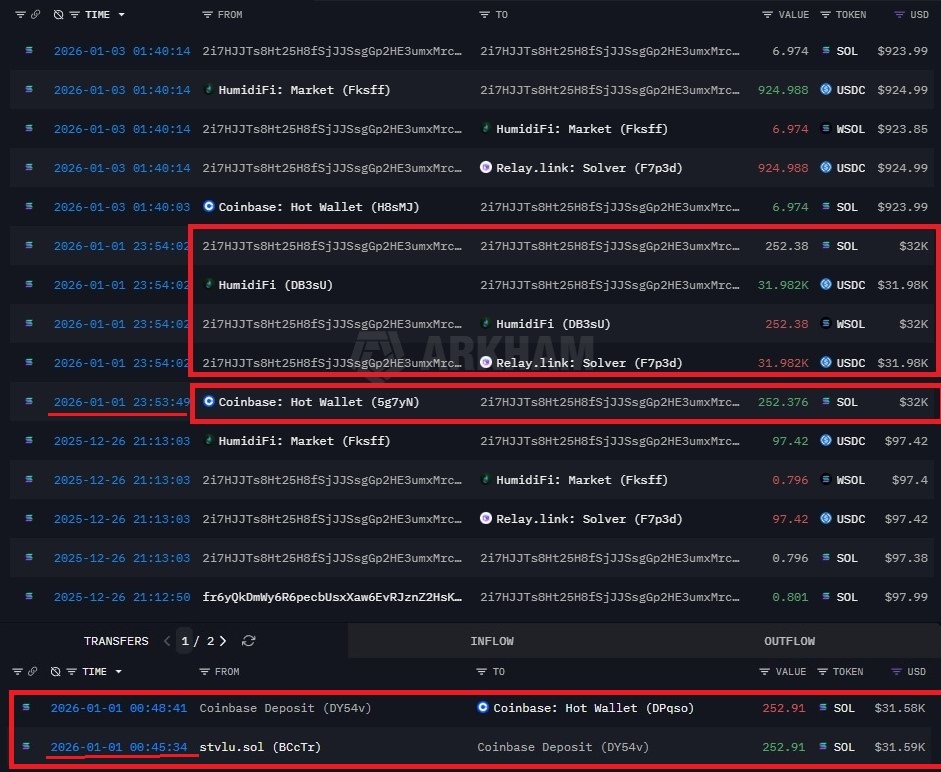
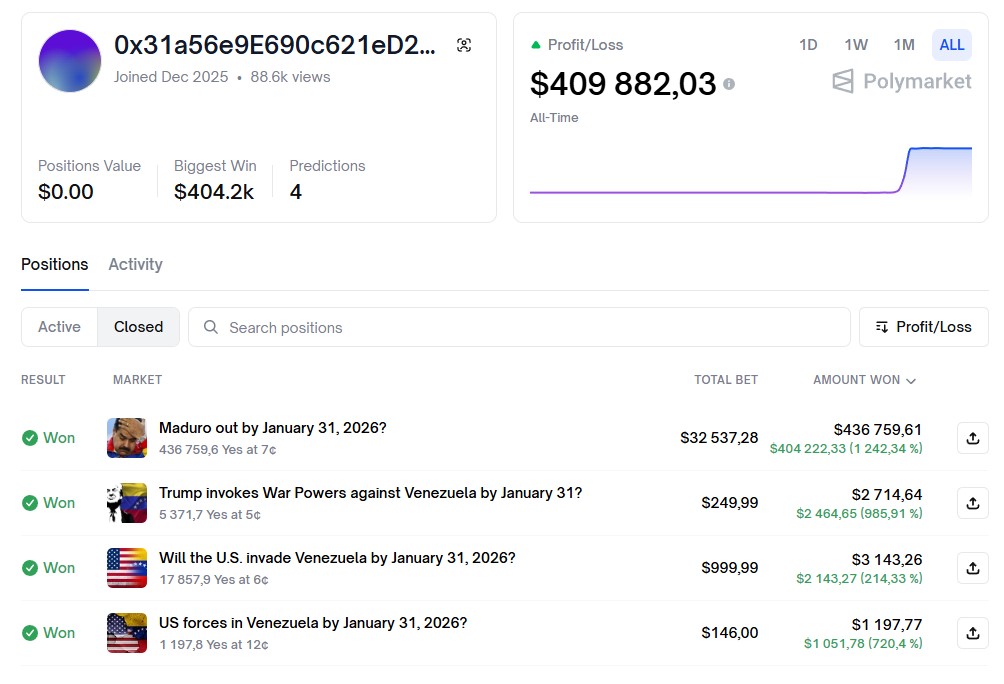
Insider who made $400,000 on Maduro's capture at Polymarket – could turn out to be someone connected to Steven Charles Witkoff (WLFI Co-Founder)
The entire CT was talking yesterday about an insider who placed around $32k just a few hours before the well–known events in Venezuela, earning a total of $400,000.
Insider's account:
https://t.co/WAG6JeRZ3X
The market where he won the $400k:
https://t.co/s70PNUejJA
I decided to dig into the chain in search of any clues.
Found 2 wallets that were funding the @Polymarket account:
- 0x9c7fca7d24162f0dd09d853e999c3f954ed0f8d1 (https://t.co/CujwkcSqEN)
- 2i7HJJTs8Ht25H8fSjJJSsgGp2HE3umxMrcEa1Cq6hV3 (https://t.co/C7lT419DKz)
Both accounts have no transactions other than funding from the Coinbase exchange and the subsequent deposit to Polymarket.
I noticed that the second wallet (2i7HJJ) was funded from Coinbase with 252.39 SOL on January 1st at 11:53 PM UTC.
I decided to check all deposits to Coinbase within a day before the insider's wallet withdrawal and found one match with 99% accuracy.
BCcTrxcowNeUqhr4yPtAMy5PhhQ5eD8hsjHYmMS8FaV8 (STVLU.SOL) – from this wallet there was a deposit to Coinbase through a deposit address of 252.91 SOL on January 1st at 00:48 AM UTC, meaning approximately 23 hours before the withdrawal to the insider's wallet.
I noticed that this wallet had several registered ENS domains: STVLU.SOL and StCharles.SOL
And the first funder – ES6SiK66UZcsPevTgfVtKtay4o1vWUepeVvb5kfWnJXF with ENS Solhundred.sol
Moving to the latter, we see transactions of $11 million with someone with ENS Stevencharles.sol (22Tqm7fBbrGb5XmT9UkcZhSPjT1Q1DMBatacpmsJGkUz)
Steven Charles – or Steven Charles Witkoff(?), one of the co–founders of World Liberty Finance (WLFI), meaning a person who potentially had access to insider information.
All 3 wallets (STVLU.sol, Solhundred.sol, StevenCharles.sol) – are connected by the same deposit addresses on the Coinbase exchange.
From the insider account on Polymarket, the winnings of approximately $440k were withdrawn to Coinbase 18 hours ago.
14 hours ago, Fartcoin tokens worth $170k were withdrawn from Coinbase to the STVLU.sol (stcharles.sol) wallet.
Another coincidence? Or was part of the profits from insider trading on Polymarket used to buy Fartcoin?
In total, we have several interesting coincidences:
- The amount of the deposit to Coinbase and the amount withdrawn to the insider's wallet for the deposit to Polymarket match with 99% accuracy with a 23–hour difference.
- The ENS(SNS) StevenCharles.sol and StCharles.sol on these wallets match with Steven Charles Witkoff. (Together with the first point, such a coincidence looks strange, doesn't it?)
- The time interval between the withdrawal of winnings from Polymarket to Coinbase and the receipt of Fartcoin to the stvlu.sol wallet is 3–4 hours.
Your take?
Are these just coincidences, or is it really someone connected to Steven Witkoff using insider information to trade on Polymarket?
Les 1 economie: maak energie duurder en bedrijven verliezen marges, klanten en hun concurrentiepositie.
Gevolgen? Minder starters, meer faillissementen, meer vertrekkende bedrijven.
Gevolgen? Economische rem, minder banen, minder winst, minder belastinginkomsten, minder welvaart.
Overigens is NL ook de grootste netto-bijdrager aan de EU, en daarmee geven we landen die wel slim met energie, industrie, economie en welvaart omgaan geld. Dubbelop dom?
Een ochtendcolumn
De overheid beloont goed gedrag met een aanslag
Jarenlang moedigde de overheid mensen aan hun hypotheek af te lossen. Niet alleen via Nibud-adviezen en bankgesprekken, maar via complete voorlichtingscampagnes. “Aflossen is het nieuwe sparen.” “Houd uw financiële toekomst gezond.” Het was de toon van spotjes, folders en rekentools die allemaal hetzelfde suggereerden, minder schuld was verstandig, zekerder, bijna een morele plicht. Burgers luisterden en handelden ernaar. Extra aflossen werd normaal en Nederland kreeg een grote groep huishoudens met een kleine of geen hypotheek.
In het nieuwe belastingplan wordt juist deze groep zwaarder belast. Niet wie zijn schuld liet staan, maar wie hem afbouwde. De hypotheekrenteaftrek werkt compenserend; wie geen hypotheek meer heeft, mist die aftrek en betaalt het volle eigenwoningforfait. Het resultaat is een systeem dat schuld beloont en aflossing straft. Dat schuurt, zeker voor wie zich jarenlang naar de overheid richtte.
De draai van deze week maakt dat alleen maar duidelijker. De Kamer schrapte de geplande verhoging van de belasting op vermogen niet omdat het draagvlak ontbrak, maar omdat de rechter inmiddels heeft bepaald dat het fictief belasten van rendement onrechtmatig is. Daar ligt de grens. En dus kijkt de overheid waar zij nog wél terecht kan. Dat blijkt niet de belegger te zijn, maar de aflosser met een eigen huis.
Het wringt omdat deze draai geen incident is, maar het sluitstuk van een langere beweging. In de jaren negentig gold overwaarde nog als vrij beschikbaar vermogen. Opeethypotheken en krediethypotheken maakten het mogelijk waardestijgingen van woningen te benutten, geld stroomde de economie in. Na de kredietcrisis veranderde dat. Schulden golden als risico’s, aflossen werd deugd, overwaarde moest worden vastgezet. Miljoenen huishoudens deden precies dat. Nu verschuift de lijn opnieuw, het vermogen dat eerst vrij mocht zijn en daarna veilig moest worden opgeborgen, wordt fiscaal aangeslagen. Wie zich aanpaste, staat achteraan.
Intussen staat er meer dan duizend miljard euro aan vermogen stil: ruim zeshonderd miljard op rekeningen, honderden miljarden in stenen. Vermogen dat nauwelijks circuleert en waarvan de reële waarde deels wordt weggevreten door inflatie die hoger is dan de rente. Economen wijzen er al jaren op dat vermogen dat niet beweegt geen waarde creëert. DNB en de OECD spreken van idle capital, slapend vermogen, non-productive assets, underutilised household wealth. Andere woorden voor hetzelfde verschijnsel, kapitaal dat aanwezig is, maar niets doet.
In plaats van maatregelen die vermogen de economie in laten vloeien en waarvan alle burgers direct zouden profiteren, kiest de overheid voor een greep in de kassa. Niet om richting te geven, maar om gaten te vullen. Het zegt veel over hoe beleid tegenwoordig werkt, niet vanuit een visie op economische beweging, maar vanuit de vraag waar nog iets te halen valt.
En dan is de conclusie even simpel als ongemakkelijk. Niet de aflossers zijn het probleem, maar de overheid die hen jarenlang vertelde hoe het moest. Een overheid die van koers verandert zodra het uitkomt, hoeft zich niet af te vragen waarom burgers niet meer met haar meebewegen. In een stelsel dat zo werkt, wordt gehoorzaamheid geen deugd maar een risico.
Volgens de NOS 'wemelt' het op de COP30 klimaatconferentie in Brazilië van de 'fossiele lobbyisten'. Een artikel dat vooral laat zien hoe makkelijk het voor een actiegroep is om de NOS aan z'n kant te krijgen. Lees onderstaand draadje even mee... 1/14 https://t.co/KfWZvDZJ6T
Ondernemertje pesten ziet er zo uit.
Stel je hebt 1 medewerker en die rijdt 1 auto van de zaak. Jouw zaak. Hij rijdt er privé in en betaalt daar bijtelling over.
Per 2027 betaal jij als ondernemer daarbovenop 12% van de nieuwwaarde. Dit mag je niet aan je medewerker doorrekenen.
Oftewel per medewerker met leaseauto betaal je €5000 per jaar extra.
Tenzij je medewerker verplicht elektrisch gaat rijden.
Dwang en geld harken zien er zo uit.
Dit helpt alleen de BOVAG en de RAI met het pushen van elektrische auto’s maar dwingt ondernemers tot het versneld afschrijven van hun vloot: kapitaalvernietiging.
Overgangsregeling of niet, haal deze maar snel uit de begroting en uit de plannen…
Benieuwd hoe @DilanYesilgoz en @vincentkar @MinisterEZ @RobJetten@HenriBontenbal hiernaar kijken.
https://t.co/nURvC1i48O