What Polymarket got Right that the Experts Got Wrong
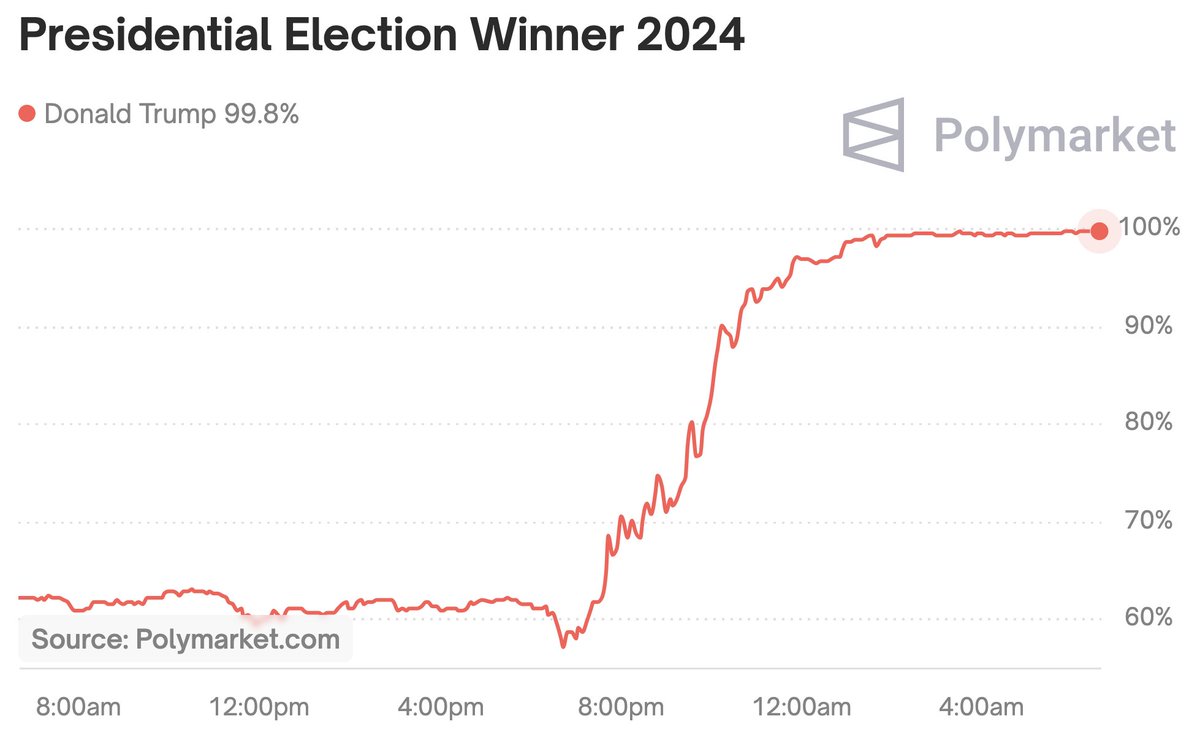
As the dust settles on the election, there’s a story that the WSJ and NYT didn’t tell you. While the mainstream news was busy with their TV pageantry and hedging on calling key swing states, Polymarket, the world’s biggest prediction market, had already delivered its verdict by midnight EST, declaring Trump was 97% likely to win. This was before the media called even a single swing state.
All throughout this election, Polymarket was always one step ahead. I want to explain why this is, because judging from the Twitter responses I was getting last night, most people deeply misunderstand this.
There are two fundamental things that Polymarket did better than the media.
1. Polymarket was more accurate on the forecast going into the election.
Let’s take the pollsters and analysts. Election poll-based models claimed the race was a dead-even 50/50. Polymarket meanwhile was priced Trump with a distinct edge—going into the election, he was priced around 62% to win.
If you remember, the mainstream media derided Polymarket for this difference. Polymarket should be the same as the modelers, they said! Obviously it means you can’t trust Polymarket. It’s priced differently because it’s a bunch of Trump-loving crypto bros. It’s invested by Peter Thiel. Only foreigners trade on it. It's unregulated, so it must be being manipulated. There's a whale pushing up the price of Trump. And on and on.
Implicit in this dismissal is a deep distrust of markets. As though markets cannot be trusted unless affirmatively proven otherwise. And of course, if you actually trusted the markets, you might not trust the media anymore. And their whole business model is predicated on you distrusting anyone but them—why else would you continue to click on their never-ending stream of clickbait?
But anyone with experience with markets knows: it doesn’t fucking matter if a market is composed of Republicans, or Democrats, or foreigners, or whatever. In reality, we know that JP Morgan was using Polymarket, as were some of the largest hedge funds in the world (most have non-US subsidiaries). It was integrated into Bloomberg Terminal, it was being quoted on CNN. And yet the media spoke of Polymarket as though it was 4chan.
Understand, Polymarket traded $3.6 BILLION dollars on the presidential election. This was the largest election betting market by volume IN HISTORY and AN ORDER OF MAGNITUDE more than any other election market ever. There was more riding on this than any single modelers’ career prospects. Understand—markets work because of how much is riding on getting the answer right.
These supposed biases—being Trump-aligned crypto-pilled non-Americans—didn’t skew the market’s accuracy. (It seems obvious in retrospect that being non-American might improve your ability to dispassionately predict an election.)
But the identities of the bettors didn't matter. Prediction markets distill input from many diverse actors to produce prices that transcend biases. Markets don't care about ideology, they only care about being right.
And as it turns out, Polymarket was more right than any pollster or modeler.
Now, I want to be clear what I’m not saying: the difference between 60/40 and 50/50 sounds big, but it’s not. Elections are noisy. High school statistics will tell you that if you want to tell if a coin is rigged to be 60/40 rather than 50/50, you would need over 100 coin flips to have 90% certainty. The outcome of “Trump won this election” does not tell you whether the coin was 60/40 or 50/50.
My point is not that Polymarket was right and the models were wrong. They actually didn't disagree with each other by much. I'm making a more subtle point: the market was consistently pricing Trump’s odds higher than the polls. Remember, the market knows what the polls and analysts are saying. Markets incorporate all existing information—but Polymarket disagreed with with the pollsters. The only explanation that analysts could come up with for this was: Polymarket is biased.
They didn’t have the humility to imagine, maybe, just maybe, Polymarket knew something that was not being captured by the polls.
Polling sucks. This is all well established now. In the pre-Internet era, polling was much more accurate. Landline poll response rates were often above 60%. Today, poll response rates are around 5%. This means pollsters are getting massive sampling biases, and there is no possible way to correct these biases without baking in clumsy statistical corrections. (Plus pollsters—who are ultimately selling a product and have reputations to keep up—frequently herd their estimates together to avoid being an outlier, which fucks up poll aggregation.)
Plus, Trump is special. He is uniquely divisive in American politics. So for three elections in a row, we have seen massive polling errors that underestimated his support—the so called “Shy Trump Voter” effect.
Polymarket presumably believed that the polls were missing this. The pollsters said, no: we’ve updated our models and corrected for it. Polymarket said: I don't buy it. Polymarket was right.
Now, again! Polymarket did not say the election was 90% for Trump to win. 62% is not a sure thing, and elections are genuinely uncertain. But what irks me is that there was not even a tinge of curiosity from the media about the delta. Maybe Polymarket knows something we don’t? Maybe there’s information we’re missing that’s not being captured in the polls?
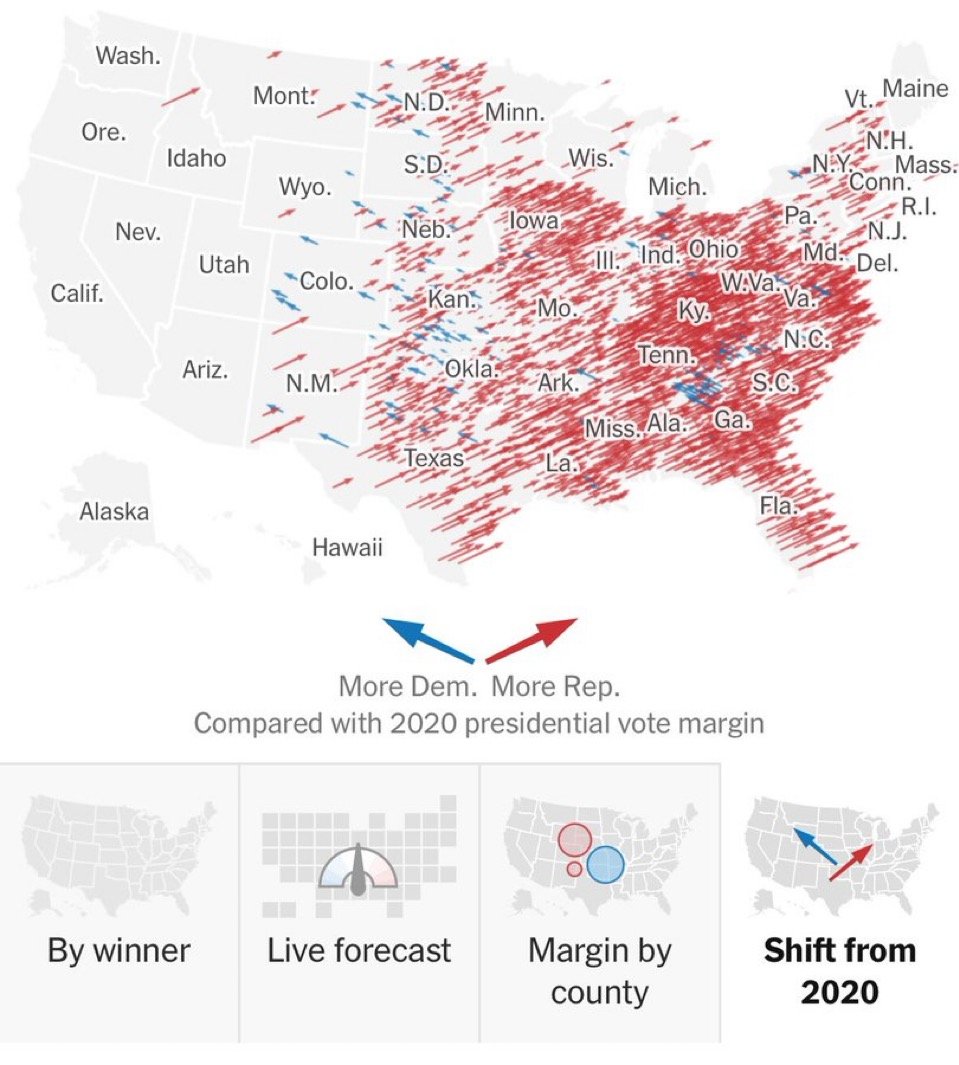
Remember, Trump massively outperformed his polls all across the country, in both red states and blue ones. He sweeped every single swing state, and even won the popular vote—something most people thought impossible.
Are you really so confident that there was no way to detect this—the sentiment of tens of millions of Americans—that didn’t involve the same old pollsters running the same old Internet surveys?
This is what being a student of the markets teaches you. Markets are smart. But they don’t explain themselves—they just show you the outcome.
That brings us to the second way that Polymarket outperformed the media.
2. Polymarket called the election in real-time, way before the media did.
The inscrutability of markets came in full force on election night. Polymarket moved quickly and violently before a single swing state was ever called. According to Polymarket, the election was over by midnight, while the mainstream media was milking the drama until the election was officially called at 6AM the next morning. Why was this?
First, Polymarket saw an important correlation that the mainstream media was not willing to explain to their viewers. You see, polling errors are seldom random; they are usually correlated across states. So when traders saw that Trump was massively outperforming his polls in states that were not themselves competitive—picking up huge vote share in NYC (cleanly blue) or Florida (cleanly red), this meant that there must be a massive polling miss across the country.
Polymarket immediately picked up on this and realized that the swing states could not possibly be competitive anymore. Polymarket priced Trump to win Pennsylvania at 90% by 11:30PM, when only a small portion of the Pennsylvania vote had been counted.
Prediction markets don’t wait for pageantry or pundits. It doesn’t care if it invalidates the sacred ritual of waiting for the votes to be counted. Remember in 2020 when Fox News called Arizona early (which turned out to be correct), viewers were outraged. Trump vowed to boycott the network over it. This reinforced the lesson—the networks must sit there and dutifully count up the votes. Don’t be too clever.
But markets don’t care about drama. They only care about outcomes. Obviously, it would be incredibly difficult to explain to a CNN viewer that the election is over, the polling error in non-competitive states is too big, Kamala is doomed and you should go to sleep and not bother to wait for swing states. It goes against the narrative that the media has been reinforcing for months. The public wants simple, explainable stories, and everyone knows how the narrative is supposed to go—you wait for the swing states and until one of the little colored bars crosses the 270 line.
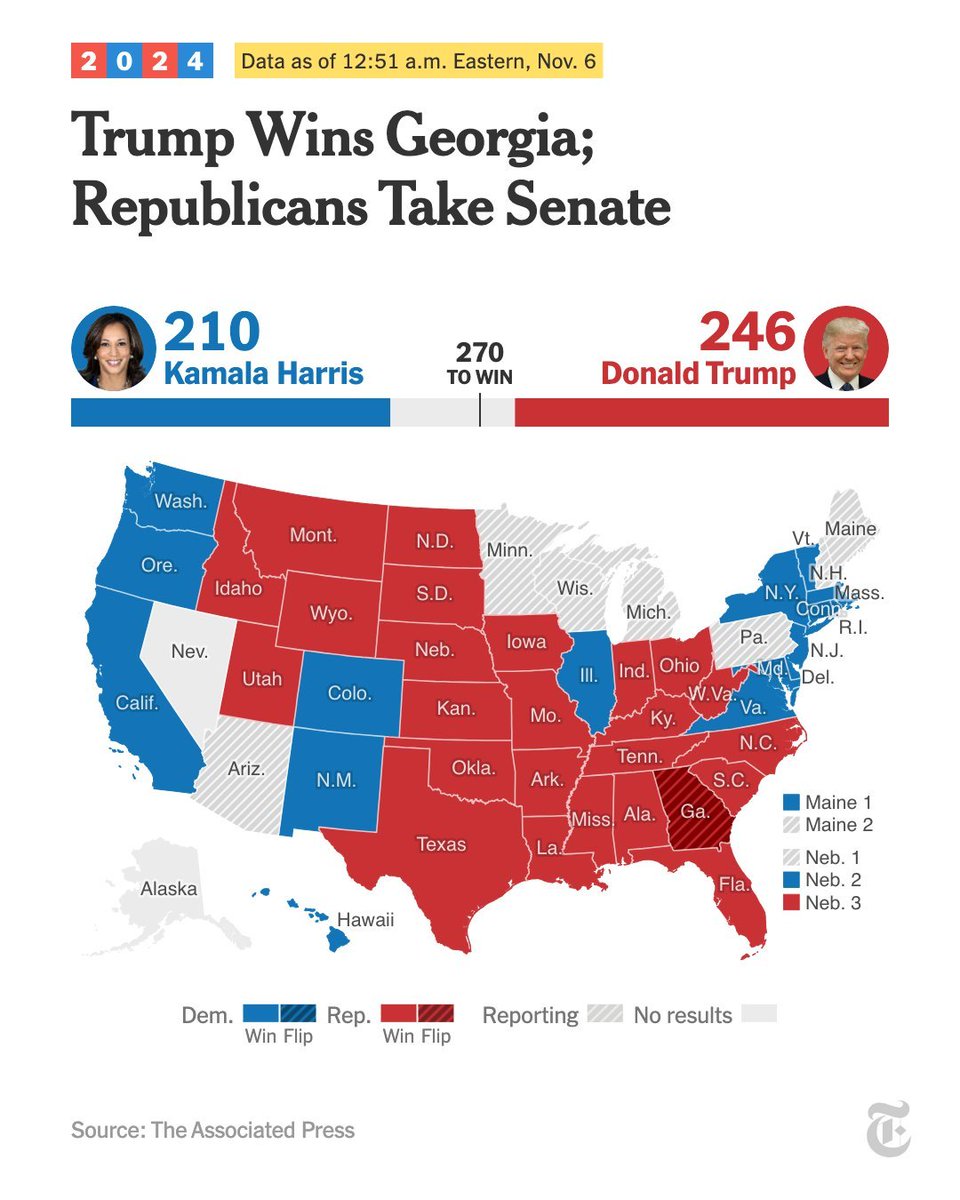
At 12:51AM, the NYT was still showing this dramatic chart and headline. By then Polymarket already had Trump priced at 98% to win.
So election watchers dutifully stayed up through the night so the media could complete its empty ritual of filling up the bars.
Polymarket’s traders have no loyalty to narrative and no incentive to play up the drama for ratings—they just call it straight. @shayne_coplan, Polymarket’s founder, said that Trump’s campaign team was reading Polymarket to try to understand how to actually interpret the odds. The media even had the gall to complain that Trump was declaring victory when his electoral count was at 267—at that point, the Polymarket odds were so low that they registered as 100%.
The beauty of markets is they respond instantly to new information. The fastest trader who incorporates the information gets a prize—profit. This is something traditional media fundamentally is not set up to do. They have to filter events through layers of interpretation, narrative making, and internal politics (recall Murdoch’s intercession into the 2020 Arizona call).
The decentralized nature of Polymarket bypasses all this bullshit. It lets information flow without any interference.
There is a lot to reflect on from last night. This election was a resounding reprimand of the Democratic party, a rejection of the expert class, and an immune response against an arrogant media.
But for Polymarket, it was a night of pure vindication.
For me, the lesson is this: the next time something important is going on in the world, skip the op eds and check the Polymarket odds.
JUST IN: 🇭🇰Hong Kong to allow #Bitcoin ETFs to be In-Kind - Bloomberg
Are you watching @SECGov 👀
This "could spark AUM and volume in the fast-growing region" says Bloomberg's @EricBalchunas
This means customers can buy into and redeem out of the fund with Bitcoin, instead of just cash in/out.
This is a HUGE improvement to US-based ETFs which are "cash creates" only.
It's in these moments, where the market is feeling heavy that your mind will be racing into what lies in store.
The Defensive mindset:
You're overleveraged.
You haven't taken profit on higher price point entries.
You'd rather leave the positions untouched because "what if."
You've added too aggressively to spot positions.
You'll be nervous, worried about the potential for downside, unsure how deep it will be and your positions are under threat.
The outcome here is you're likely to lose money, potentially panic close spot positions and usually freeze up during more aggressive selling as you're just hoping it stops.
Your focus becomes watching red candles thinking "oh shit oh shit they all said we were going higher!"
Your unrealised PnL plummets and your impulses close your positions down.
The Attacking mindset:
You're aware a larger sell off may be brewing in the market.
You've cleared some risk on leveraged positions, especially from very recent entries.
You know that even if you're wrong there's still opportunity if the market doesn't sell off aggressively to reposition long.
You are psychologically prepared that your unrealised PnL may take a hit and your portfolio won't be at the same level it was 24 hours ago but this is all short-term.
You have ammunition ready to strengthen your positions and holdings if the market gives a sell off.
You welcome a sell off as opportunity.
You are prepared, anticipatory and can action opportunity the market provides.
Be attacking. Make the necessary changes to ensure sell offs don't leave you panicking and freezing up.
Switch the mindset to realise opportunity and the ability to secure some great entries and additions to your bags.
Understand the psychological aspect to a sell off, not just the visual one.
A very important concept to learn and comprehend.
ATTACK THE MARKET.
A few common mistakes in these conditions:
1. Excessive leverage. Specifically, introducing liquidation risk in assets that are regularly moving 10%-20%+ in a day. Let the volatility do the heavy lifting, not the leverage (or specifically, massively inflated position sizes facilitated by leverage that force you to use very tight stops or liquidate you on small moves against you).
2. Excessively tight stops. Same consideration. If you're targeting larger rotations in a higher volatility asset, being overly tight with stop placement can work against you. You don't want to create a loop where your idea is broadly correct, you get wicked out because you were LARPing as some 50R tick sniper, and then the market moves straight to your target without you.
3. Excessive rotation. If you're trying to make the most of a multi-week and multi-month trending period, you shouldn't be overly concerned with any specific 24H window of returns. It is a form of overtrading. It is also a form of FOMO. This also introduces the risk of creating a loop whereby you sell your bags to chase the strong stuff --> strong stuff consolidates --> the bags you sold moon --> repeat ad infinitum. Find some setups or ideas that you like and give them some room to breathe.
4. Mistaking consolidation for weakness. This is another version of time-based FOMO. Participants will infer that just because their bags haven't turbo mooned in a short period of time, the market is weak or they've allocated poorly. Instead, your rebuttable presumption should be that consolidations are a form of pullback and present an opportunity to buy stuff that eluded you when it was breaking out. Boredom and impatience do not necessarily signal weakness.
5. Excessive trade management. The degree to which you intervene in your trade ideas should somewhat mirror the time frames of those ideas. For example, if your trade is predicated on a breakout from a multi-week range, your targets and trade management time frames should be derived from (or resemble) the weekly time frame. That makes more sense than, for example, buying a large weekly breakout and setting a target at 15M resistance that's 5% higher and panicking over every red 5M candle.
6. Overtrading your core holdings. There are countless stories of traders getting very good swing and/or HTF positional entries but gradually fumbling them through trying to time every single dip and rotation that takes place on the way to their target. An unfortunately common version of this is selling 100% of exposure at some level in order to 'buy back lower'. This is particularly a strange choice when a trader's target is materially higher than the pullback they're hoping to rebuy. For example, if your ultimate target is 50% higher, is it worth selling all of your exposure in an attempt to time a 5%-10% dip? This can result in the market not offering the pullback that was hoped for, and now the trader is sidelined - this usually comes with a mental block, as buying back higher than you sold can be psychologically tricky/feels like you're chasing. In short, this is a form of overoptimisation. If you're bored and feel like gambling in between, use a sub account or @breakoutprop (disclaimer: I have a financial interest in its success) so you can scratch the trading itch without sabotaging yourself. Or go to the casino, get a hobby, whatever.
7. Excessive number of open positions. With every added position, your capacity to effectively manage any single position decreases. The altcoin market is still pretty tightly positively correlated, so you're more likely just spreading yourself thin rather than 'diversifying'. Focusing on a smaller number of higher conviction trade ideas and managing them patiently and judiciously is probably better than trying to catch everything at once and drowning in noise. If you want to spread yourself thin, go buy some Solana shitter lottery tickets i.e. X amount of $ across [large number] of memecoins/new coins that will either go to 0 or appear on your feed when you're up multiples. At least that doesn't take up your trade management RAM.
8. Allowing social media to materially impact your perception. It's PnL + leaderboard season. It may feel like absolutely everyone is winning massively all the time. Granted, the market has been very good unless you've been stubbornly short, but social media is still a highlight reel boosted by selection bias and survivorship bias. You don't see the fumbled entries, the break evens, the times traders got stopped at the bottom, undersizing great ideas and oversizing bad ideas, not pulling the trigger, and so on. As long as you're trading well and improving, don't try to speed run some arbitrary returns or net worth goal.
TL;DR
I ain't reading all that. I'm happy for u tho. Or sorry that happened.
stop writing essays nerd give me a ticker
NEWS: in an interview with Yahoo Finance @saylor says “#Bitcoin is going to appreciate in value faster than the S&P Index. It’s going to appreciate in value faster than commercial real estate.”
#Bitcoin isn’t just the best asset, it is THE asset 🚀
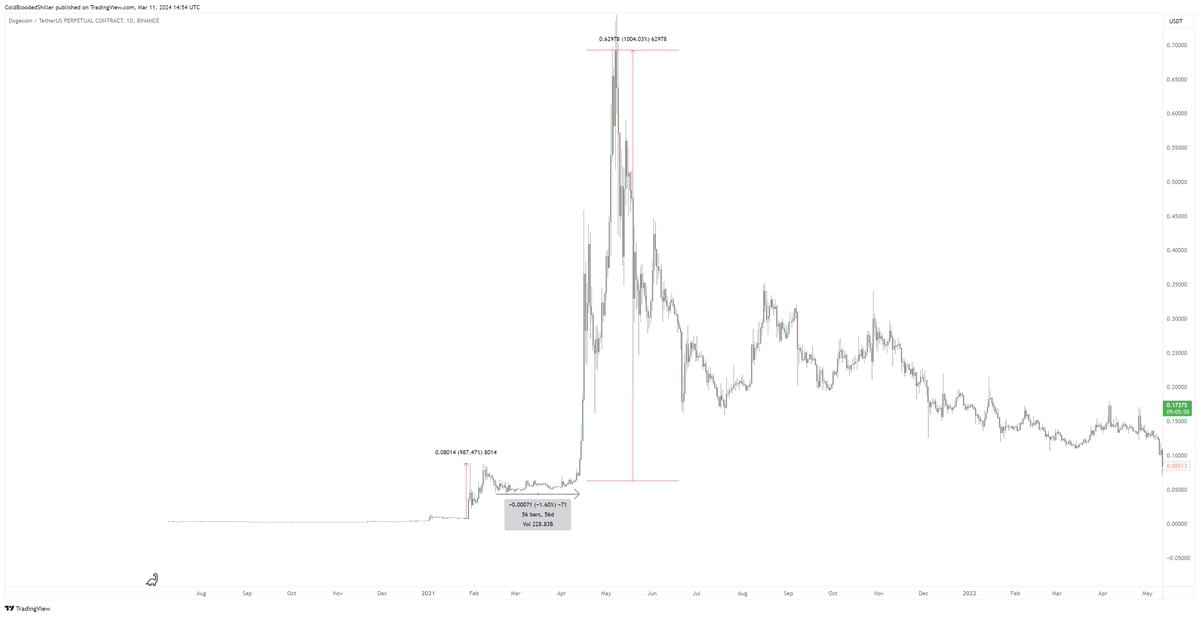
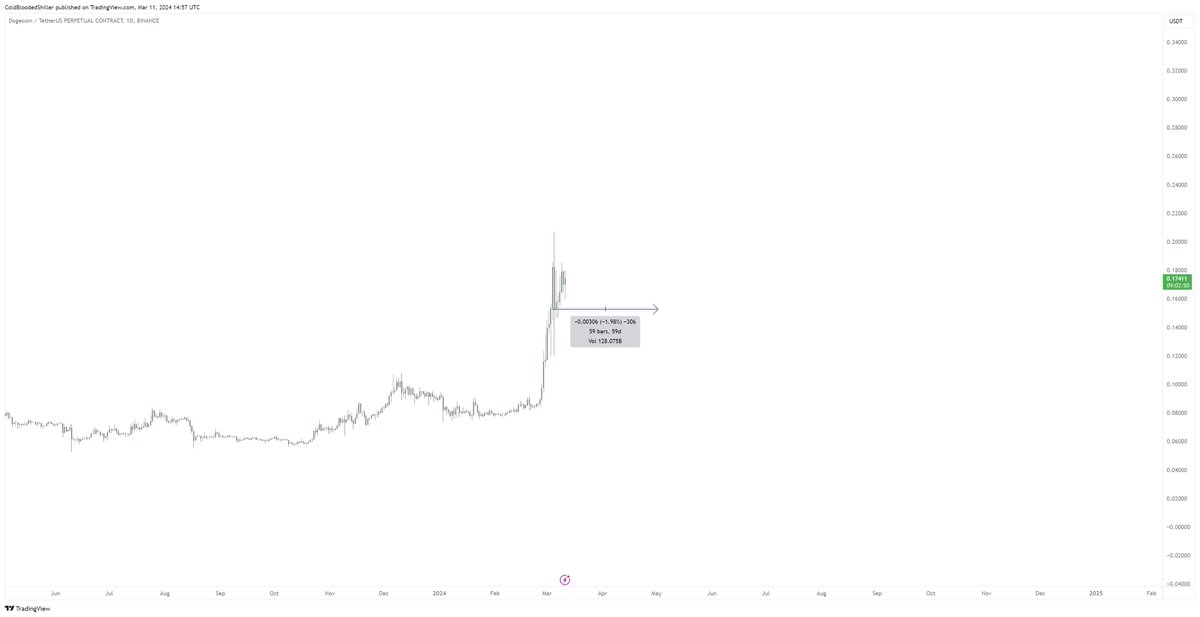
I'll use the example of $DOGE and some reference from @TheHavenCrypto.
In 2021 DOGE did a 10x, then just went sideways for 2 months before doing another 10x.
I read stuff like "man we're struggling to break out" - "hmmm idk this looking weak now" daily in Discord across various markets.
This is usually an indication your time horizons aren't correct and you're too engaged with the LTF.
Of course, the market has been 100mph and so I expect people to be more anticipatory to the breakout potentials.
But just because your market is sideways doesn't mean anything is WRONG with it, it's actually probably your psychology that's WRONG.
Some patience goes a long way to reaping rewards. Stop thinking you can conduct perfect rotations to appropriately take advantage of different sectors, usually this results in underperformance vs conviction in a market.
JUST IN: #Bitcoin ETFs are catching up to Gold ETFs for total assets, with more than 50% as much AUM as Gold.
$54b for $BTC
$96b for Gold
💥After just 8 weeks!
Because I am raising concerns about the flood of unvetted illegal immigrants overwhelming American cities, the press will often characterize me as “anti-immigrant”.
As an immigrant myself, nothing could be further from the truth.
I am very much in favor of increased and expedited legal immigration for anyone who is talented, hard-working and honest.
It is bizarrely difficult and agonizingly slow to immigrate to the USA legally, but trivial and fast to enter illegally! This obviously makes no sense.
This is big news for #Bitcoin.
If Middle Eastern Oil Nations decide to add $50m a trading session to #Bitcoin demand flow per country.
That’s $12.6bn a year - per country.
That would involve an addition to equilibrium price of #Bitcoin after halving of $85,470.
That would mean roughly 10% of Qatar (for example) daily Oil Export.
Great work @nayibbukele.
The beautiful thing about #Bitcoin is - it incentivises you to share its magic - even with your “competitors”. It inspires co-operation.
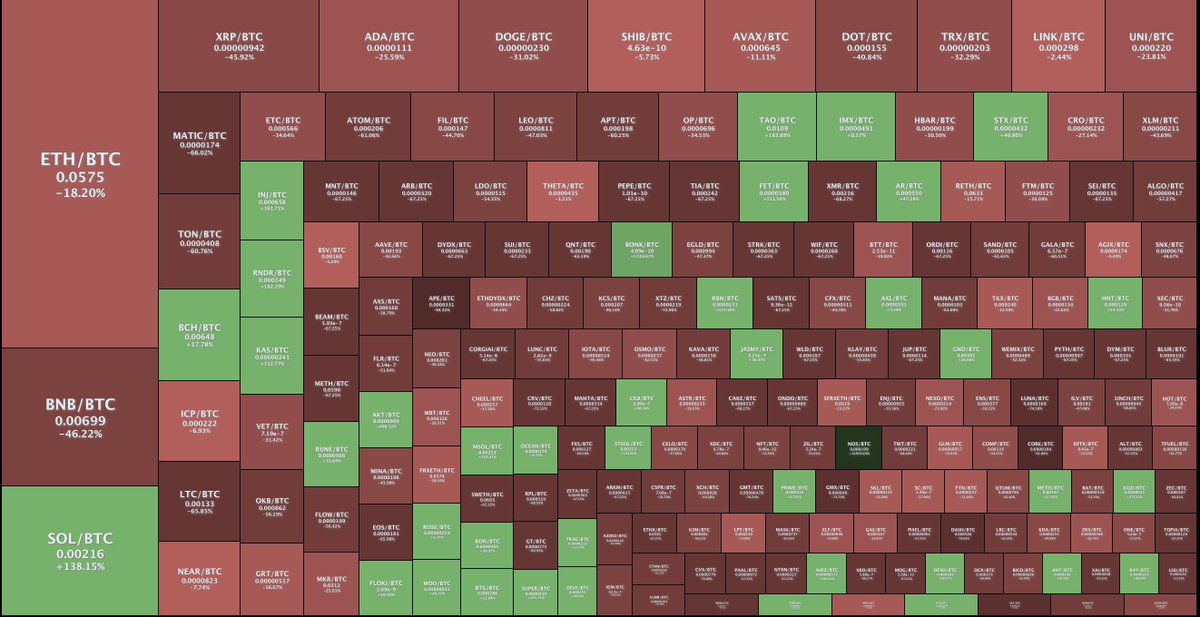
This is a heat map of #ALT / #BTC pairs over the last 1 year.
Out of the top 200 coins, only 39 have outperformed BTC.
Congrats if you picked one that outperformed, but you can see that most have bled back to the king.