AI-designed proteins can now carry an invisible watermark.
I used to think of AI watermarking as a problem for images, video, and text. A new Nature paper from Google DeepMind raises a more unusual question: what happens when the AI output is a protein sequence that can actually be synthesized and tested?
SynthID Bio embeds a detectable signal into AI-generated protein sequences or predicted 3D structures. The challenge is not adding the signature—it is preserving function.
For sequences, the team integrated watermarking into ProteinMPNN and experimentally tested designed binders against SARS-CoV-2 RBD, VEGF-A, and PD-L1. Watermarked and unwatermarked designs had comparable binding hit rates and affinity distributions.
For structures, they fine-tuned AlphaFold 3's diffusion module so that predicted coordinates carry a detectable signal with little effect on global structural accuracy.
The technology is clever. But the boundary of the claim matters:
A watermark can provide provenance. It cannot prove that a protein is safe, functional in every context, or scientifically trustworthy. And no watermark does not mean “natural.”
I think of it as a batch number, not a quality certificate.
As AI-designed sequences move into papers, databases, and DNA-synthesis workflows, that batch number could still be valuable. It may help trace outputs from a model with a newly discovered failure mode, label computational designs in public databases, and give biosecurity screening another signal.
The harder questions are organizational: Who controls the detector and keys? Will developers use interoperable standards? How do open models participate? What happens when someone deliberately edits the design to erase its origin?
I want AI-designed biology to leave traceable footprints. But footprints only tell us where something came from. Trust still has to come from evidence—and experiments.
Paper: https://t.co/zw1zMaiiNl
Code: https://t.co/HiIsYopnOW
#AIinBiology #Bioinformatics #ProteinDesign
arXiv has introduced a limit of two submissions per calendar month for each submitter.
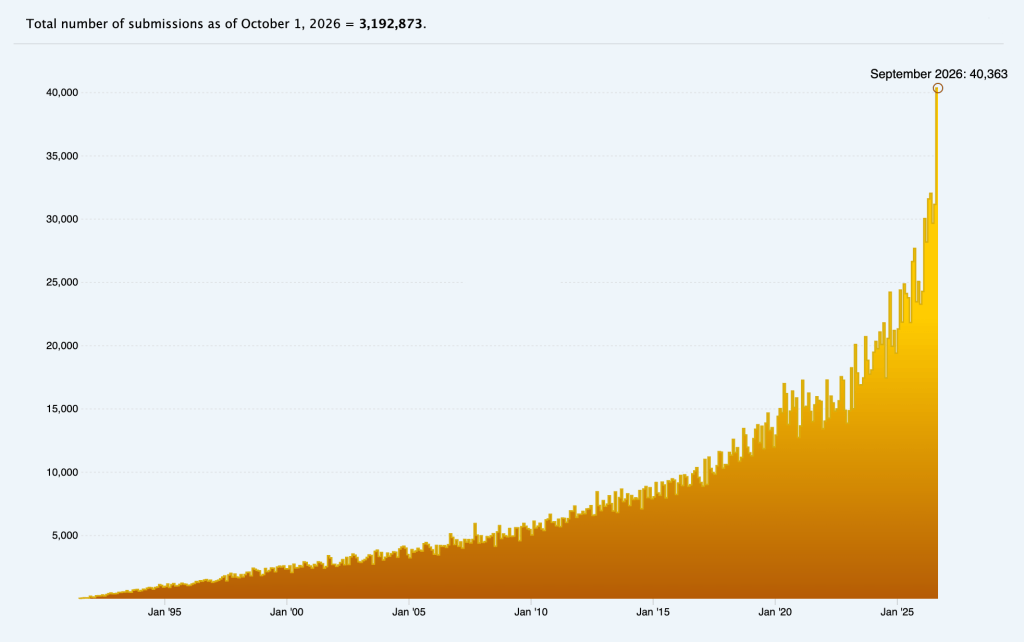
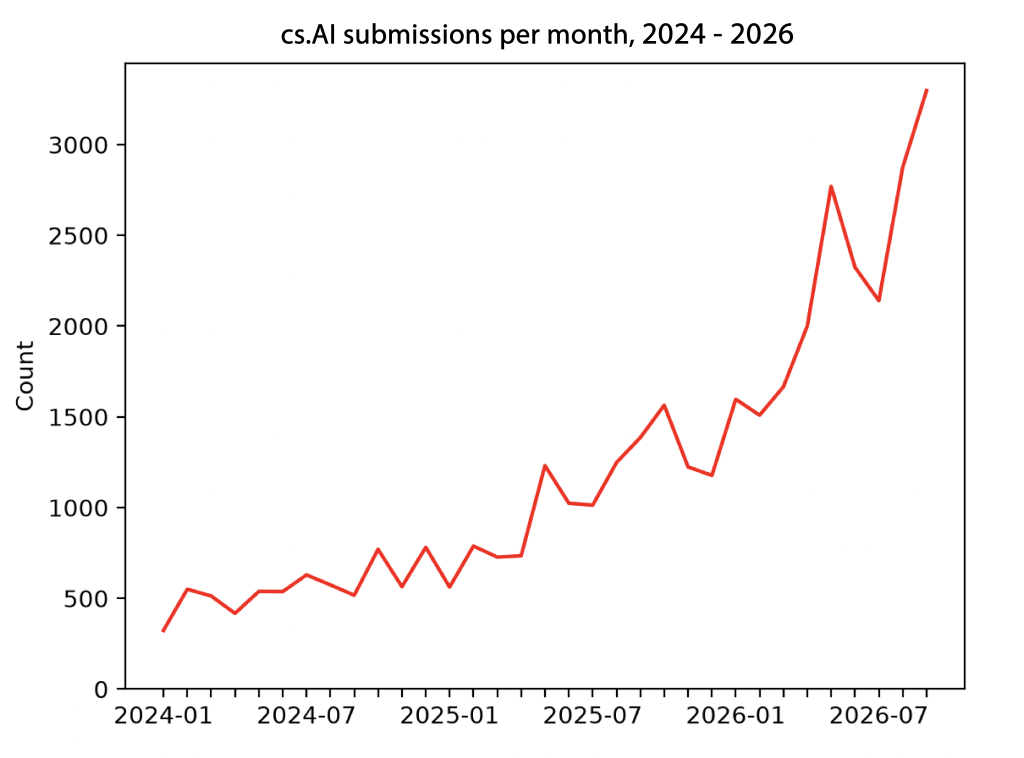
Two sounds surprisingly low. But arXiv received 40,363 submissions in September 2026; submissions doubled in two years, while https://t.co/kUPa5ezWd5 grew more than sixfold.
The interesting question is not whether two is the perfect number. It is what this tells us about research in the AI era.
AI can speed up literature searches, coding, analysis and writing. In bioinformatics, that is genuinely useful. But a polished manuscript can now appear before we have spent enough time checking data leakage, batch effects, weak validation or whether the result will survive outside a benchmark dataset.
The bottleneck is moving—from producing an analysis to choosing worthwhile questions, validating evidence and taking responsibility for a conclusion.
arXiv is not banning AI. It still allows responsible, disclosed AI use. The new limit looks more like a temporary brake while moderation catches up with the scale of AI-assisted scientific production.
If I had only two submission slots each month, I would ask:
Is this one of the two pieces of work I am most willing to put my name on, explain clearly, and remain responsible for?
AI can help science move faster. The harder skill may be knowing where we should refuse to save time.
Source: https://t.co/hl62wfX6zg
#AI #Bioinformatics #arXiv #ResearchIntegrity
Gene-editing techniques could soon allow researchers to replace entire genes and engineer complex cellular circuits — if the systems can be delivered safely into cells
https://t.co/YwrzIUViSB
Claude has discovered a previously unknown enzyme system hidden in the DNA of bacteriophages. Beside the enzyme’s gene sits a long array of repeating DNA—a structure that looks somewhat similar to CRISPR.
We don’t yet understand what this system does, but only a handful of known systems share its features, and all of them are able to cut, copy, and paste DNA. Historically, the discovery of such programmable systems has helped revolutionize medicine. CRISPR, for instance, is now the foundation of genetic medicines. But it will take much more work to learn what this system does, and whether it can be put to similar use.
Read more: https://t.co/RuEosScSMb
Check out my latest article: AI in Bioinformatics | Single-Cell AI EP03: What Does Masked Learning Teach a Model? https://t.co/DPtV6SxkWp via @LinkedIn
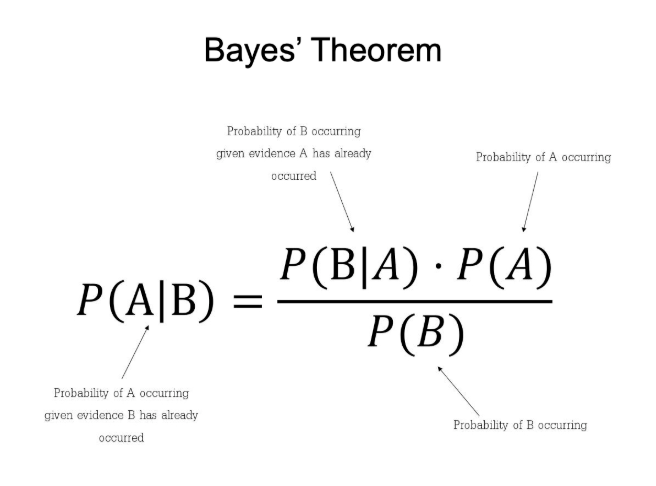
Bayes' Theorem is a fundamental concept in data science.
But it took me 2 years to understand its importance.
In 2 minutes, I'll share my best findings over the last 2 years exploring Bayesian Statistics. Let's go.
Today we’re opening applications for the Life Sciences Verification Program.
Through the LSVP, life science professionals can use our models—including, for the first time, Mythos—with a new set of safeguards designed to enable the full range of biology-related work. We designed these new safeguards to provide a better experience for biologists and more protection from risk of misuse.
The program is launching in beta for teams of all kinds—from academic labs to startups, pharma companies, and more. We will continue to improve the program and expand access to individual Pro and Max plans over time.
Learn more about these access grants and apply: https://t.co/uALS2lZuN4
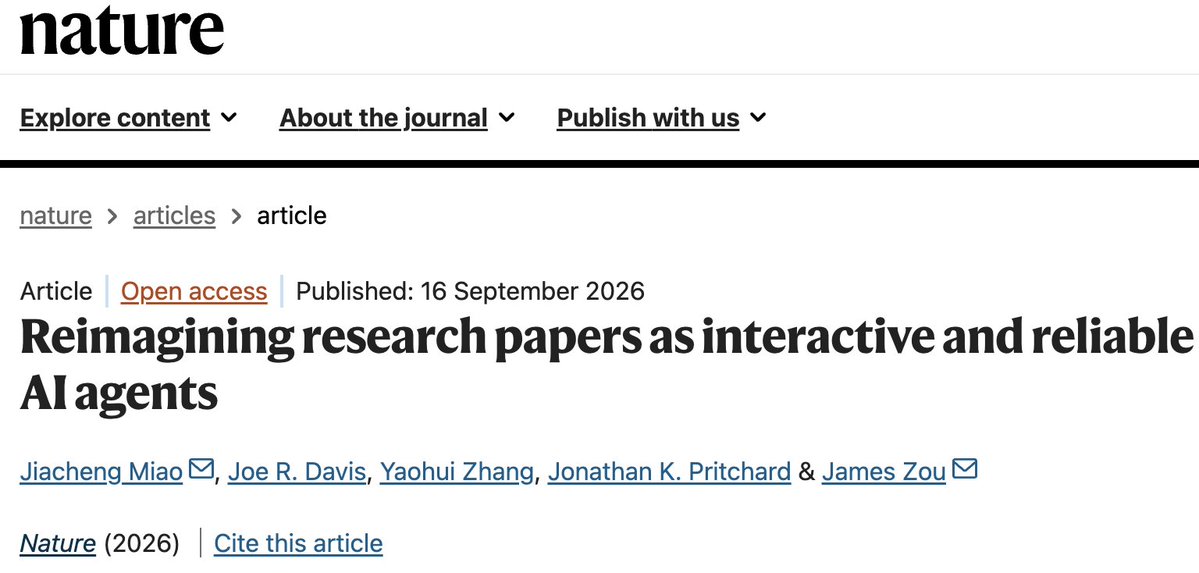
🔥 Excited to share that #paper2agent is published in @Nature today!
Papers have long been the primary format for communicating scientific knowledge, but they remain static. Putting that knowledge to work requires connecting findings to data, navigating supplementary materials, and adapting methods to new questions - effort repeated by each new reader.
We introduce Paper2Agent, a multi-agent framework that automatically turns research papers into virtual authors. Paper2Agent turns a paper’s manuscript, code, data, and supplements into an MCP server that any AI agent can access, with automated testing and iterative refinement in an agentic loop. The paper then becomes a virtual author you can talk to: trace claims to evidence, analyze your own data, and collaborate with other papers’ virtual authors
Agentifying a paper turns it from something people read into something people and AI agents can discover and build on - providing the context needed to interpret its findings and reuse its methods reliably. We tested how reliably these agents put papers to use. Across multiple benchmarks, agents created by Paper2Agent outperformed baselines such as Claude Code working directly with papers' PDFs and code repositories.
Once papers become virtual authors, they can collaborate - much like human researchers do. In one case study, agents built from AlphaGenome and two large-scale genetic perturbation studies worked together to propose a new computational approach for integrating evidence across different perturbation datasets. By connecting predictions from one paper with experimental data from others, they helped pinpoint a likely causal gene for psoriasis.
We hope Paper2Agent makes scientific knowledge easier to access, reuse, and build on - a first step toward a future where millions of paper agents proactively collaborate with human researchers and one another to advance discovery.
🤖Talk to the virtual author for Paper2Agent itself: https://t.co/wCzxUS4alX
📎Paper: https://t.co/2EGOPUgirB
💻Code: https://t.co/290bZWDmRt
VERY grateful to work with this incredible team: @james_y_zou, @jkpritch, Yaohui, and Joe!
For those who heard AI agent everyday but don't know what it really do, let's dive into it today. hashtag#AIinBioinformatic hashtag#AI agent hashtag#Bioinformatics https://t.co/0EH0oIgMaY