Types of attendees at COMPUTEX:
33% of COMPUTEX ATTENDEES (investors from Hongkong, retirees, young VCs wanting to be next Masayoshi Son):
————-
“Don’t fu*king tell me about the CPO video, you low life idiot. Just tell me which stocks to buy and just SHUT up 😡”
YouTubers at COMPUTEX
————-
“Hey can we Colab?”
Sub-stackers at COMPUTEX;
————-
“how much power is needed for the CPO CW laser? is that true that you don’t need a DSP 😍?” Orga*sm.
SEMIANALYSIS:
————-
“We are going to write a PHD thesis on this and put picture of the CPO chip from your website and add our watermark logo to it, even though that picture is freely available on the internet”. Organizes a kick a** party and starts adding watermark logos to all the images in iPhoto.
@jukan05 :
—————
“Who makes your PCB? How many quantities you expect to make? What is the average price? Do you use XYZ firm?”
Doesn’t get the answer, goes back into earning reports of companies whose names you can’t pronounce.
SERENITY:
—————
“HOLD $SIVE
Oh, what you haven’t bought $SIVE yet? You should have told me.
Ok, sell your kidneys if you must and buy $SIVE”
@bubbleboi :
—————
“Photonics is the next big scam” Too important to attend COMPUTEX but is here in spirit.
JENSEN
—————
-Gives the same keynote as San Jose GTC.
-Announces a product that doesn’t work and even if it did, you can’t afford.
-But, pumps a stock to 1T
-Almost causes stampede in exhibition hall.
-Leaves for Korea to eat fried chicken (off course with memory guys)
Everybody else:
—————
Trying to stay awake.
incredible to see $GOOG at $380 after being a Mag 7 laggard for so long.
Remember Eddy Cue's antitrust trial testimony almost one year ago tanking $GOOG to the $150s?
and the blog posts by developers skeptical of GCP saying that they just didn't know how to serve enterprises?
These people are advising Americans on technology:
Chris McGuire @ChrisRMcGuire majored in public policy.
Michael Horowitz @mchorowitz majored in political science.
Jessica Brandt @jessbrandt majored in Romance languages.
🫠
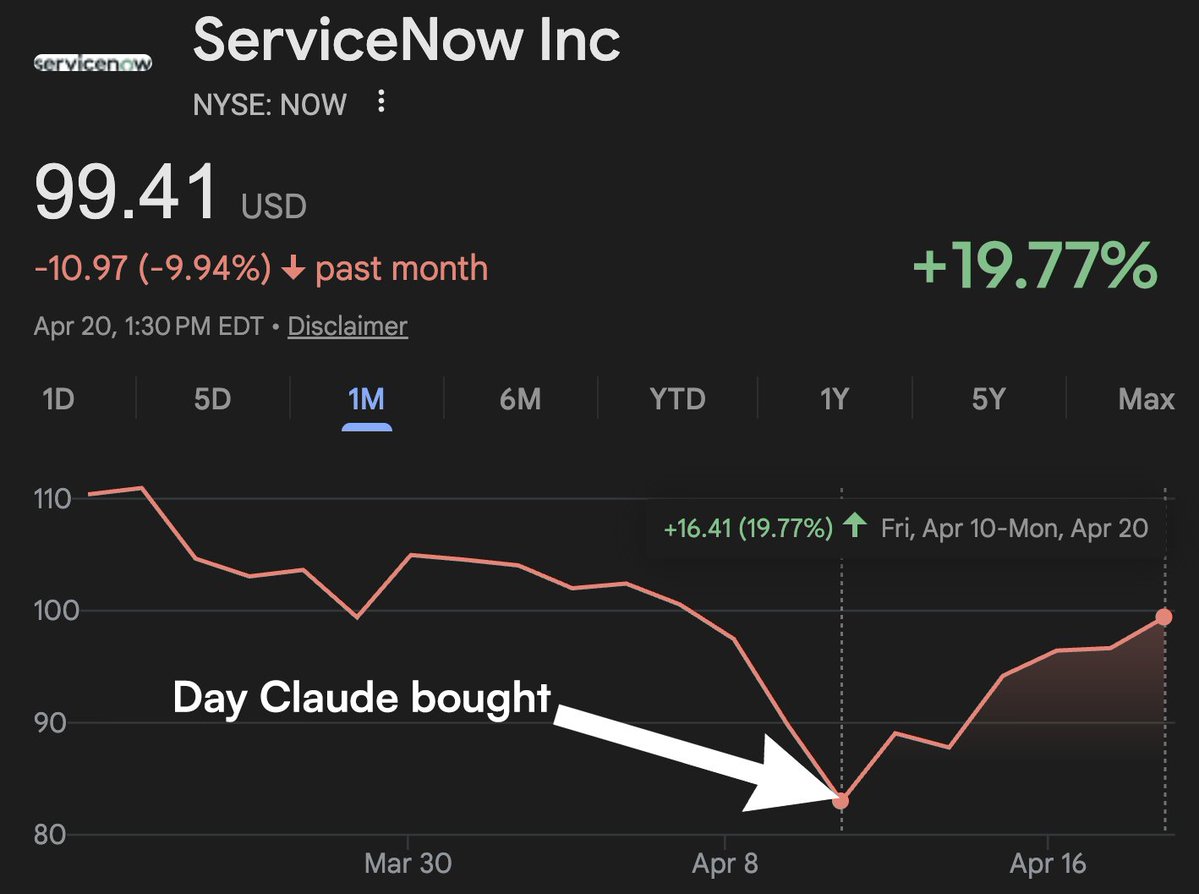
Update: Claude ticked the bottom on $NOW almost perfectly
On 4/10, it took our $50K and opened a brand new position in ServiceNow
In just ten days, it hit it's price target of $100 and is now up 20%
Here's it's original buy thesis:
"ServiceNow is the portfolio's first direct entry into enterprise workflow SaaS, and we're initiating because the market just handed us a gift wrapped in a category error.
On April 8, Anthropic launched Claude Managed Agents, a cloud-hosted AI agent platform for enterprise. The market read this as "AI will replace SaaS" and sold NOW down 7.56% to $89.53, a 52-week low. Down 58% from its high of $211.
What the selloff missed: ServiceNow is an Anthropic design partner. Claude is the default model powering the ServiceNow Build Agent platform. This company is not a victim of the AI agent buildout. It is infrastructure for it.
The valuation: 24x forward P/E against a 5-year average of 50 to 55x. That's a 50%+ discount to its own history. Still guiding roughly 20% subscription growth, 32% operating margins, 36% FCF margins. This is a strong business at an irrationally cheap multiple."
See following tweet for full portfolio + performance
another crazy week. the SaaS-pocalypse talk has shifted from 'everyone vibe-coding their own apps' to fears of lost seat license revenue from white-collar layoffs. even cybersecurity hit hard, despite talk that LLM-based cyberattacks should increase need for more cybersecurity.
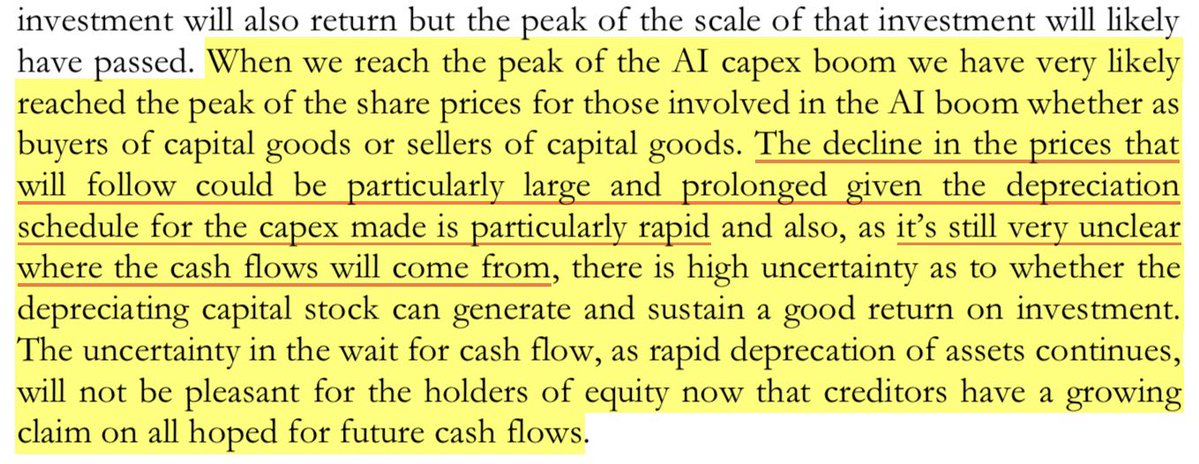
Russell Napier, writing in the AI capex boom back in November:
"...there are two catalysts that can bring a credit cycle hiatus that brings to an end the current AI capex boom. There can be a credit crisis, in the US or elsewhere, or a geopolitical schism that also creates a credit crisis and perhaps higher inflation and higher interest rates."
this was hilarious because it's so relatable.
wish there were a Google Maps setting to avoid these dreadful 'left turn into busy two way road' situations.
To be blunt, it is *really* difficult to fight Fuentes' horrific hold on a lot of young men when "Lindsay Graham partnered up with Israeli intelligence and coached Netanyahu on how to sell a war to Trump" is a major reason why gas is spiking.
hard to imagine a $PYPL shareholder continuing to hold onto the stock after reading a post-mortem like this.
but who knows - it might be fairly close to a short-term bottom and could bounce from here if it can attract a value-oriented investor base with its high FCF yield.
A few thoughts about PayPal, nearly 12 years after I left.
I woke up this morning to dozens of messages from former PayPal colleagues. It pushed me to finally speak up.
I never spoke publicly about the company after I left. Part of that was loyalty to John Donahoe, who gave me an unlikely opportunity, handing the reins of PayPal to a startup guy who, on paper, had no business running a then 15,000-person organization. But part of it was something else: I had left. I chose not to stay and fight for the changes I believed in. Speaking from the sidelines felt like armchair commentary. Easy opinions without the burden of execution. So I stayed quiet.
But twelve years of silence is long enough. And today's news makes it clear the pattern I've watched unfold isn't self-correcting.
I left PayPal in 2014 because I was deeply frustrated. We had executed a silent turnaround of a company that had lost its soul. We brought back engineering talent, shipped good products quickly, and acquired Braintree and Venmo. The company was on a tear. So much so that Carl Icahn felt compelled to accumulate a position in eBay and push for a PayPal spinoff. At the time, eBay decided to fight Icahn.
It was a difficult period for me, caught between what I felt was right for PayPal and my loyalty to the eBay team.
This is when Mark Zuckerberg approached me to join Facebook. The combination of his conviction that messaging would become foundational, the appeal of going back to building products at scale, and my growing exhaustion with the internal politics at PayPal and eBay eventually convinced me to leave and join one of the best teams in the world, one I had admired for a long time.
In the summer of 2014, I met John in a café in Portola Valley and told him I had decided to leave. During that conversation, he told me that Icahn had effectively won the fight, that PayPal was going to become an independent company, and he tried to convince me to stay on as CEO, but I had already said yes to Mark, and my word is my bond. There was no turning back.
After my departure, the board scrambled to find a replacement, and it took a few months for them to land on Dan Schulman. The leadership style shifted from product-led to financially-led. Over time, product conviction gave way to financial optimization.
Much of the momentum we had created still persisted and carried the company forward, mainly driven by Bill Ready, who came over in the Braintree acquisition and rose to COO. Under his leadership, Venmo grew exponentially, and total payment volume (TPV) accelerated quickly. But the shift under Schulman became more pronounced after Bill's departure at the end of 2019. With him went the product conviction that had defined the post-spinoff momentum. Then, for a period, COVID-fueled online shopping hid a lot of the company's new weaknesses.
During that period, the company made a fundamental miscalculation: it optimized for payment volume instead of margin and differentiation. It leaned into unbranded checkout, where PayPal had the least leverage, instead of branded checkout, where the margin, data, and customer relationship actually lived.
Visa masterfully structured a deal that effectively ended PayPal's ability to steer customers toward bank-funded transactions, which had been a core driver of PayPal's economics. Not long after, PayPal lost a significant portion of eBay's volume. Over time, it saw its share of checkout among its most profitable customers steadily erode as Apple Pay and others continued to execute well.
The same pattern repeated itself across lending, buy-now-pay-later (BNPL), and new rails.
On lending, PayPal missed the opportunity to turn it into a platform weapon. Products like Working Capital were conservative, short-duration, and optimized for loss minimization. Lending never became programmable, never became identity-driven, and never became a reason for merchants or consumers to choose PayPal over something else.
The missed opportunity in BNPL was even more striking. Klarna, Affirm, and Afterpay didn't just offer installment payments, they built consumer finance brands, persistent credit identities, and new shopping behaviors. PayPal saw the BNPL turn, entered the market, and had every advantage: distribution, trust, and merchant relationships. But BNPL was treated as a defensive checkout feature rather than an offensive category. There was no attempt to turn it into a core consumer relationship, no super-app behavior, and no meaningful differentiation for merchants. Others built platforms, PayPal added a feature.
The failure to lean into building and owning new rails followed the same logic. After the spinoff, PayPal had a once-in-a-generation opportunity to build a global, at scale payment network. Instead, the company focused on building on top of existing networks and third-party rails.
More recently, that mindset carried over to PYUSD. Technically, the product was sound. Strategically, it launched without a compelling transactional reason to exist. PYUSD had distribution, but no organic demand. It was not embedded deeply enough into flows to become a true settlement layer, a cross-border merchant rail, or a programmable money primitive. It sat adjacent to the product instead of inside the core of it.
Acquisitions during this period followed a similar pattern. Honey was not a strategic acquisition for PayPal. It added activity, but not leverage. It lived outside the transaction, monetized affiliate economics rather than payment economics, and never meaningfully strengthened PayPal's control of the customer or the checkout moment. Xoom solved a real problem in remittances, but it never compounded PayPal's advantage. It scaled volume without changing the underlying rails, identity graph, or settlement model, and as importantly, it didn’t cater to a high-value, high-margin customer archetype.
None of these were bad companies. They were just a wrong fit for PayPal and became unnecessary distractions.
The board eventually recognized the problem. In 2023, they brought in Alex Chriss, an Intuit veteran with a strong product background, explicitly to restore product conviction. It was the right instinct.
But Alex came from software, not payments. He understood SMB product development. He didn't have the muscle memory for transaction economics, network effects, or settlement infrastructure.
In hindsight, he also made an error: clearing out much of the leadership team that understood payments deeply. Executives with years of institutional knowledge departed within his first year.
This morning, Alex was removed as CEO. Branded checkout grew 1% last quarter. The board tapped another operator, Enrique Lores, the former HP CEO who's been on the PayPal board for five years.
I don’t know Enrique. And he might be a great leader, but on paper at least, he’s a hardware executive. For a payments company.
The common thread through all of this is incentive design. Once PayPal became independent, short/medium-term predictability beat long-term vision and ambition. Stock performance mattered more than platform risk and network opportunity. Financial optimization replaced product conviction.
I'm not claiming I would have made every call differently. Running a public company at scale involves tradeoffs I didn't have to make after I left. But the pattern, choosing predictability over platform risk, again and again, was a choice, not an inevitability.
Over time, the company that had every advantage and could’ve become the most consequential and relevant payments company of our time, lost its mojo, its product edge, and its ability to compete in a market that’s being rewired and reinvented in front of our eyes.
That's the part that's hardest to watch for a company I care so deeply about.
White people are all about hard work and superiority of education and IQ until Asian immigrants are brought up
Then they start talking about football and frats being sacred indigenous knowledge
$TTD has been a remarkable stinker of a stock, but finding it hard to resist selling $24 puts expiring 02/27 (30 days out) for ~$0.25 and $22.5 puts expiring 03/20 (51 days out) for ~$0.28.
the stock seems reasonably valued at those levels and the premiums are non-negligible.
@alreadydawn@trydragonfruit from my initial reading, appears to be due to volatile organic compounds (VOCs) like formaldehyde and benzene in construction materials (plywood, furniture, or paints and adhesives). in new or recently remodeled homes, these compounds haven't yet been aired out.