The first influence economy on @RobinhoodApp. Early access is open.
500 Genesis Passes. Top 500 on the leaderboard at snapshot mint free.
Points decide your rank and your airdrop share.
Your influence has value. Prove it.
https://t.co/tBqjnXJ9Wd
Rarelist is live!
Curated projects. Creator campaigns. Launches. Priority access.
Familiar ways to earn, built around a new approach.
The first 500 to join get OG: https://t.co/hlGjkOzX7r
What I find interesting about @axisrobotics is that the learning loop doesn't have to stop with human demonstrations
A trained robot can generate new attempts, learn from the outcomes, and turn those experiences into data for the next generation of models
The bigger piece is the combination of simulation + real-world experience
Simulation gives robots room to explore thousands of scenarios cheaply, while real-world interactions ground those skills in actual physics
Over time, this creates a compounding loop:
train → act → collect experience → improve → repeat
Instead of rebuilding robot intelligence from scratch, each cycle can become the foundation for the next
That's the direction I find most interesting about Axis: robots that don't just learn once, but keep getting better through experience
GM CT fan
One thing that stands out about @axisrobotics is that scaling a robotics network isn't simply about collecting more trajectories
The harder the task, the more important it becomes to route it to the right contributor
The current Challenger zone makes this visible. Anyone can inspect it, but submitting requires the Seek the Unseen badge. There are currently 478 badge holders, while difficult tasks can pay 2–3× the Axis Points of comparable regular tasks
But the more interesting part isn't the higher reward
It's how contributors are selected
Axis appears to factor in contributor history, including consistency, quality and experience across both pre-training and post-training work. In other words, reputation becomes part of the data pipeline.
That matters because difficult manipulation tasks are more likely to produce noisy or failed demonstrations when assigned to someone unfamiliar with the interface or task dynamics
Routing those tasks toward proven contributors could reduce that mismatch before verification even starts
There is a clear trade-off: tighter access means less openness for some contributors, while completely open access can create more low-quality data that has to be filtered later
So the scaling question for Axis isn't just:
How many contributors can join?
It's also:
Can the network learn which contributor is best suited for each data problem?
For Physical AI, contributor to task matching could become nearly as important as contributor count
$AXIS token soon
GM CT
The latest update from @axisrobotics made me look at the project a bit differently.
At first, the numbers stand out
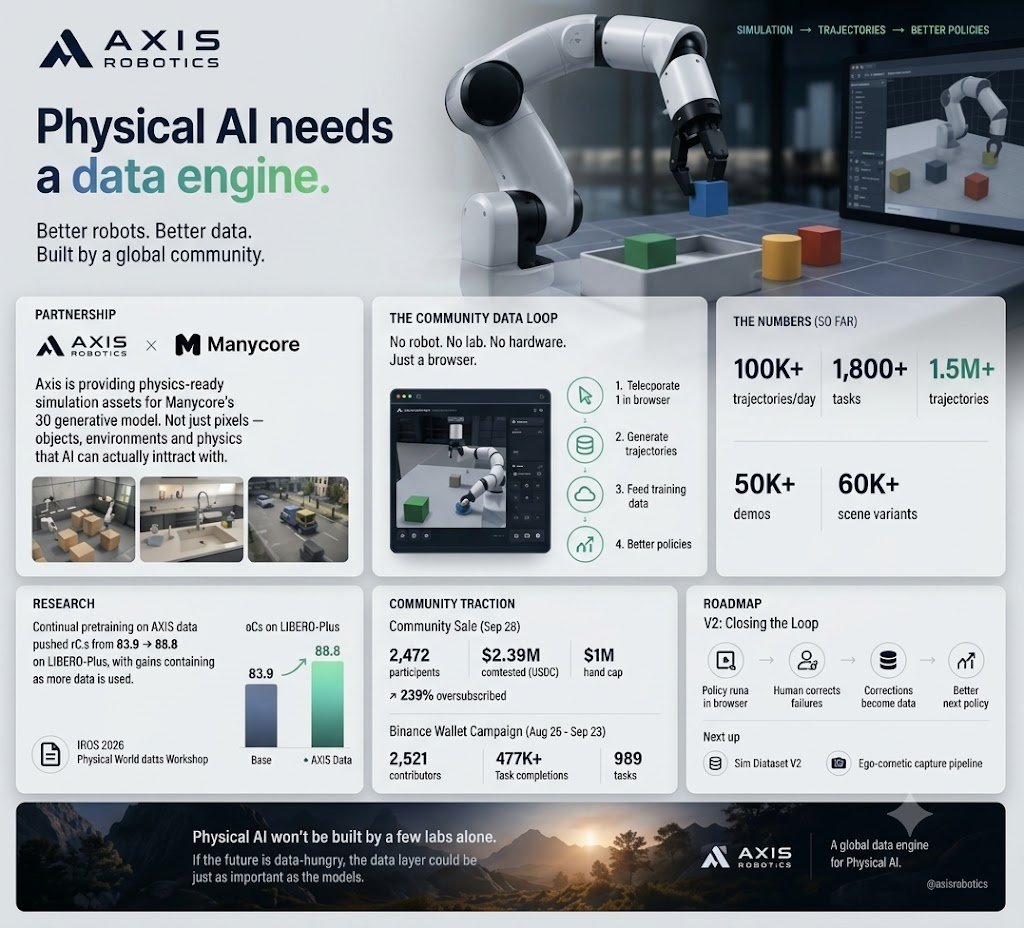
50k+ human-teleoperated simulation trajectories
207 manipulation task
60k+ scene variants
160k+ dataset download
But the bigger idea isn't just scale
Axis open- ourced Sim Dataset V1, and what I find interesting is the philosophy behind the data
Robotics data doesn't necessarily need to be perfectly curated from the start
Give enough people different environments, interactions, edge cases and failures, and that diversity itself becomes valuable training signal
That's very different from relying on a small pool of highly controlled demonstrations
And this is where the loop gets interesting
If failures expose gaps in the model, those gaps can tell you what data needs to be generated next
So instead of seeing Axis as simply a platform for producing trajectories, I'm starting to see it as a system that can continuously discover what kind of data robotics models are missing.
More data → more failures revealed → better targeted data → better training
The real question is how far that compounding loop can go
Bullish @axisrobotics
Axis finally showed the cards @axisrobotics
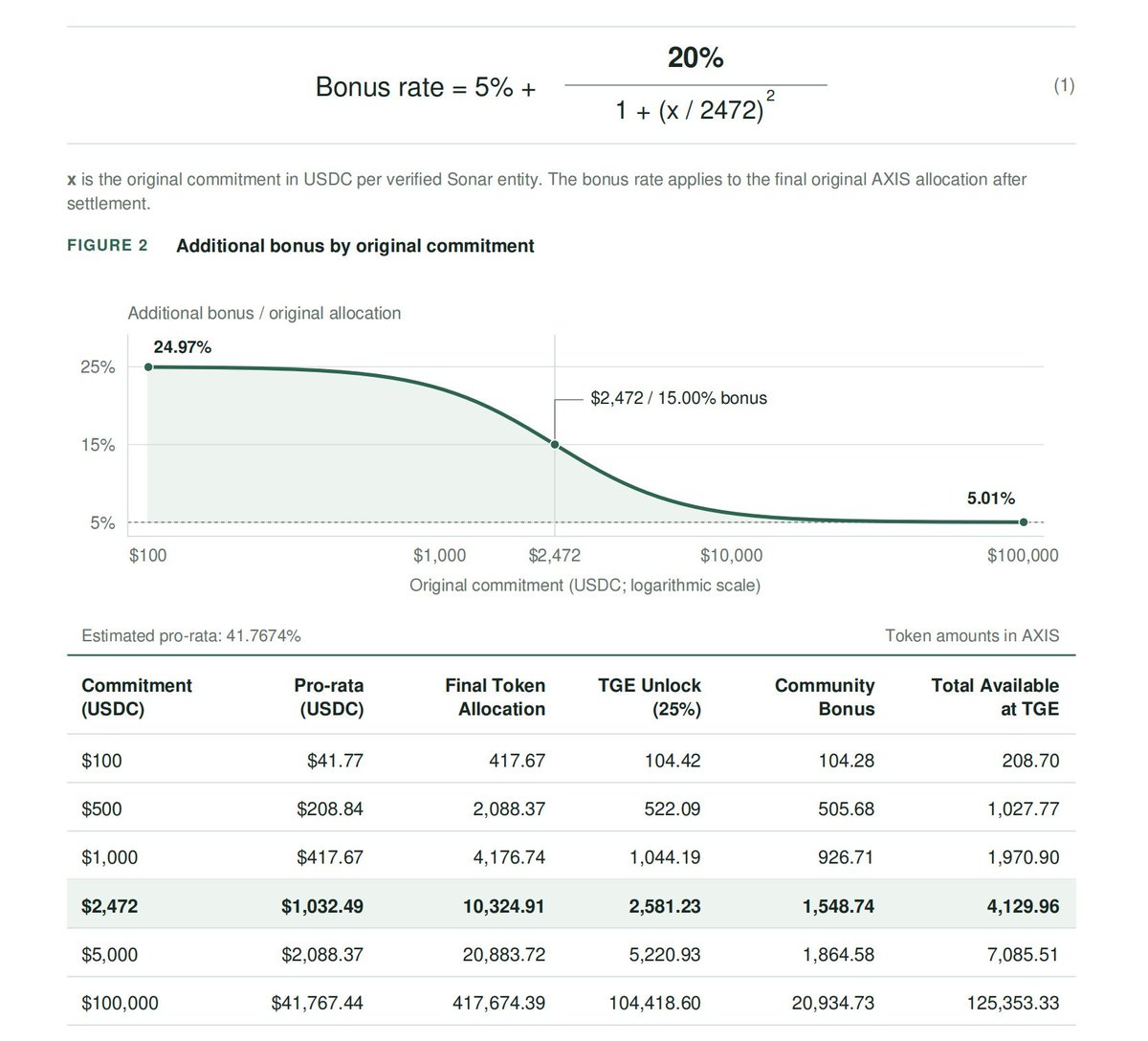
After the Presale closed, the bonus mechanism is officially out, and there are a few interesting changes from the original terms
The headline: everyone gets 25% unlocked at TGE
But the more interesting part is the bonus
Participants will receive additional bonus tokens, and 100% of those bonus tokens unlock at TGE
What makes it more interesting is that the bonus isn't calculated from the amount you actually receive after pro rata dilution. It is based on your original committed amount before dilution
So the people who committed early, despite the strict unlock conditions, get an additional reward for that commitment
There were 2,472 Axis believers who decided to participate under those original terms
Now we finally know what that commitment comes with
Whether that means everyone is immediately back in the green at TGE is another question
That will ultimately depend on the token price, available liquidity, and actual selling pressure
But at least one thing is clear:
The bonus mechanism is now on the table
Continuing to contribute to the project
What’s been catching my attention with @axisrobotics isn’t another trajectory milestone
It’s the shift in what Axis is actually trying to scale
Not just more data
More reusable capability
The interesting piece is the Expert architecture
An Expert can learn a specific task, reach strong success with relatively little compute, then become a building block for another behavior
So instead of the usual:
more tasks → more trajectories → more data → bigger model
Axis is pushing toward:
task → Expert → reusable skill → composition → longer-horizon behavior
That changes the economics of Physical AI
A single trajectory teaches a model what happened
A reusable skill can become something a robot can actually execute, combine and build on
The Sim2Real loop makes this even more interesting
Deployed policies generate real-world experience, that experience feeds back into training, and stronger successors get pushed back into the loop
One recent experiment reportedly moved real-robot success from ~22% to ~52%.
That’s the part I keep coming back to
Axis isn’t just building a bigger data warehouse
It’s trying to build a capability engine
If individual skills can continuously improve, compose into longer behaviors, and eventually be distilled into more general models, then maybe trajectories aren’t the real scaling unit of Physical AI
Capabilities are.
And that’s a much more interesting direction for @axisrobotics
I think the market is slightly overreading the whole “AXIS 2026 acceptance” headline @axisrobotics
Yes, the paper is being presented today at the PWMS workshop
Yes, it sounds fancy
And yes, the timeline has already started treating it like AXIS just walked into IROS, dropped a 200 page thesis on the table and received a Nobel Prize on the way out
Small detail though:
The workshop is non archival, and the paper will not appear in the official IROS proceedings
That doesn’t make the work meaningless
It just means we should probably label it correctly
A workshop presentation is a useful research signal. It is not the final boss of scientific validation
And honestly, the part I find much more interesting isn’t the conference badge
It’s the experiment
AXIS data reportedly pushed π0.5 from 83.9% to 88.8% on LIBERO Plus.
That’s a meaningful jump
More importantly, the team says the improvement persists even when controlling for dataset volume
That changes the conversation
Because the easy narrative in robotics is:
Just collect more trajectories
More robots
More humans
More hours
More data
More GPU bills
Problem solved, right?
If only robotics worked like buying RAM
The more interesting AXIS thesis is that how the data is generated, structured and processed may matter as much as how much data you throw into the model
And if that holds up, the game becomes less about building the biggest pile of trajectories and more about building better training signals
That’s the part I want to see tested harder
Because one benchmark result can get everyone excited for a week
Independent reproduction is where things get uncomfortable
Can other labs reproduce the gains?
Do they survive across different robot embodiments?
Different environments?
Different datasets?
Different training setups?
If the answer keeps being yes, then the story gets much more interesting
If the gains disappear the moment the setup changes, then we probably learned something too
Either way, that’s how this should move forward
A conference poster gets attention
A benchmark number gets engagement
A good thread gets 50 replie
But reproducibility gets customer
That’s the milestone I’ll be watching next for AXIS
I just joined the shhhhhcat whitelist — the first free silent NFT collection on BRC-20
Inspired by $shhhhh, the first BRC-20 deployed with Bitcoin Silent Payments (BIP352), verified with a BIP374 DLEQ proof. Quiet by design, verifiable on-chain
Shhhhh-3P2SK
$shhhhhcat $shhhhh