A DeFi protocol just force Coinbase and Circle to share their profits.
And those profits now automatically buy $HYPE. 🤯
Here's something that's never happened before in financial history 👇
A decentralized exchange negotiated a deal where two of the world's biggest financial companies hand over most of their income — directly to the protocol.
Not a rumor. This is live. Let me explain. 💰
First — the scale nobody is talking about:
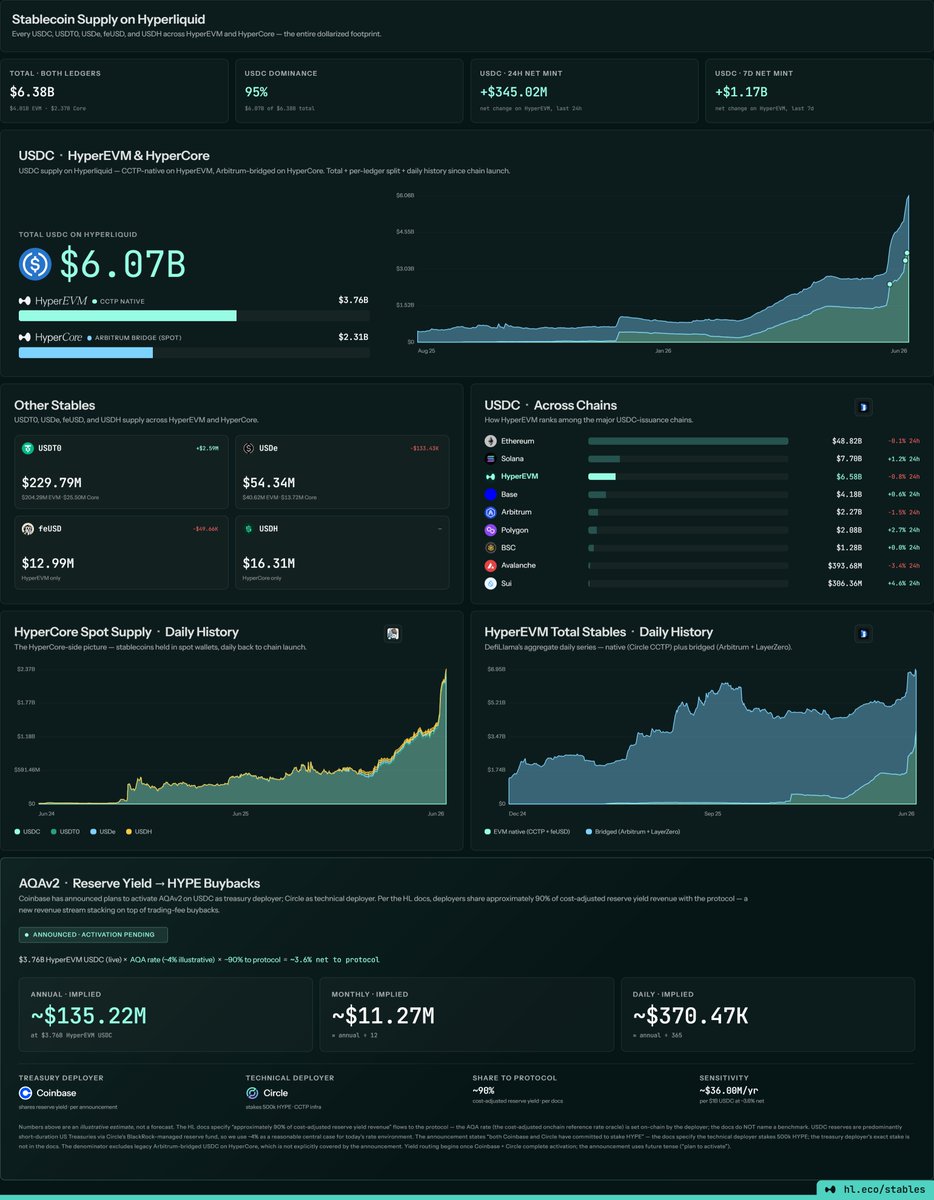
Hyperliquid now holds $6.90 BILLION in stablecoins.
To put that in perspective:
🥇 Ethereum: $48.82B USDC
🥈 Solana: $7.70B USDC
🥉 HyperEVM: $6.58B USDC ← Hyperliquid
4️⃣ Base: $4.18B
5️⃣ Arbitrum: $2.27B
6️⃣ Polygon: $2.08B
7️⃣ BSC: $1.28B
A DEX built 3 years ago is the #3 USDC chain on Earth. 🌍
And money is pouring in FAST:
📊 Last 24 hours: +$346 million new stablecoins minted
📊 Last 7 days: +$1.17 billion net inflow
That's not a trickle. That's a flood. 🌊
Now here's the deal that changes everything:
For years, this $6.9B sitting in Hyperliquid was generating massive yield.
How? Simple: US Treasury interest rates.
$6.9B × ~4%/year = $276 million/year in interest income
The problem?
That yield historically flowed to Circle and Coinbase — not to Hyperliquid or its users. The protocol supplied the users, the liquidity, and the trading activity that made the stablecoin useful — but kept none of the income.
Hyperliquid decided that needed to change. 🔧
The AQAv2 deal — explained simply:
Think of it like owning a shopping mall.
Before: Tenants (Circle, Coinbase) kept all the rent money.
After AQAv2: The mall owner (Hyperliquid) now keeps ~90% of the rent. 🏢
Under the new arrangement, Coinbase serves as USDC treasury deployer and shares the vast majority of reserve income with the Hyperliquid protocol.
Compass Point analysts estimate the deal removes roughly $60-80 million in annual EBITDA from Coinbase and Circle combined.
Where does that money go?
➡️~90% of all USDC reserve yield → Hyperliquid protocol➡️ Protocol uses it to buy $HYPE from the open market➡️ Automatically. Every day. On top of the $800M/year in trading fees.
Implied additional yield revenue:
💵 ~$135M/year (illustrative at ~4% rate — estimate, not guaranteed)💵 ~$11.27M/month💵 ~$370K/day
⚠️ Activation still pending — yield routing begins after Coinbase + Circle complete technical setup
The skin-in-the-game signal:
Circle committed to stake 500,000 HYPE tokens as part of the deal. Coinbase also increased its staked HYPE position.
The companies providing the stablecoin infrastructure are now forced to be aligned with $HYPE.
If HYPE goes up → they profit. If HYPE goes down → they lose. 🎯
The total revenue picture for $HYPE:
💰 Trading fees (existing): ~$800M/year💰 Stablecoin yield (new, AQAv2): ~$135M/year (illustrative)
Combined: ~$935M/year in protocol revenue — and this is BEFORE US market access opens.
The precedent this sets:
Compass Point warns that other DeFi protocols may now demand similar revenue-sharing terms from Circle and Coinbase — creating pressure across the entire stablecoin industry.
Hyperliquid didn't just negotiate a deal for itself.
It changed the rules for every protocol. Forever. 📜
⚠️Not financial advice. Always DYOR.
Today, Grayscale put $HYPE on Nasdaq.
Not just to hold it.
To stake it — and pay you for owning it. 🤯
Something historic happened this morning, June 3, 2026. 👇
The world's largest crypto asset manager just launched HYPG — the Grayscale Hyperliquid Staking ETF — on the Nasdaq stock exchange.
For the first time ever: anyone with a regular brokerage account can now own $HYPE AND earn staking rewards from it.
No crypto wallet needed. No seed phrase. No exchange account.
Just a normal stock ticker. 📱
Let's break down exactly what HYPG is:
Think of it like a savings account — but instead of earning 0.5% interest at a bank, you're earning staking rewards from one of the most active financial protocols on Earth.
Here's how it works:
1️⃣ You buy HYPG shares on Nasdaq — same as buying Apple or Tesla
2️⃣ Grayscale takes your money and buys real $HYPE tokens
3️⃣ Those tokens get staked on the Hyperliquid network
4️⃣ Staking rewards (historically ~2.2% per year) flow back into the fund
5️⃣ Your shares reflect both the price of HYPE + the accumulated staking yield
Price exposure. Plus income. Through one stock ticker. 🔑
The fee structure — why this matters:
HYPG management fee: 0.29%/year
Historical staking yield: ~2.2%/year
Net math: ~+1.91%/year just from staking — before HYPE price moves a single cent.
Grayscale describes HYPG as carrying the lowest gross fee among all U.S. Hyperliquid exchange-traded products — making it the most cost-efficient institutional wrapper for $HYPE available today. 📊
Now look at what this ETF is holding:
Hyperliquid has traded over $2.99 trillion in perpetual futures volume with over $5.5 trillion in open interest.
The protocol earned approximately $857 million in fees in 2025 alone — and 99% of those fees went back into the protocol through buybacks, making HYPE one of the most value-accretive tokens in decentralized finance.
This is what's sitting inside HYPG. 🏦
Who is the custodian?
Not some random startup.
🏛️ Anchorage Digital Bank N.A. — the first federally chartered crypto bank in the US, approved by the OCC
📋 BNY (Bank of New York Mellon) — one of the world's oldest and largest financial institutions, serving as Fund Administrator
The infrastructure behind HYPG is built on century-old banking foundations. 🔐
The staking mechanic — what most people don't know:
When HYPG stakes HYPE, those tokens actively participate in securing the Hyperliquid network.
Validators who stake HYPE: → Help confirm transactions → Earn fees for doing so → Those fees distribute as staking rewards
Grayscale notes it is the first sponsor to bring staking to U.S. spot exchange-traded products — meaning HYPG is doing something no ETF has done before with a crypto staking model built into a Nasdaq-listed product.
The full picture of who is now involved with $HYPE:
📌 Bitwise (BHYP) — NYSE-listed ETF
📌 21Shares (THYP) — Nasdaq-listed ETF
📌 Grayscale (HYPG) — Nasdaq-listed, staking ETF, launched TODAY
📌 VanEck — pending SEC filing
📌 Pantera Capital — institutional investor thesis published June 2
📌 Coinbase — USDC treasury deployer on Hyperliquid
📌 Circle — technical deployer, staking 500K HYPE
Six months ago, none of these names were attached to $HYPE.
Today, every single one of them has financial skin in the game. 🎯
The bottom line for regular people:
You no longer have to understand crypto to invest in Hyperliquid.
You don't need a wallet. You don't need to understand staking. You don't need to trust a crypto exchange.
You just need a Fidelity, Schwab, or Robinhood account — and a single ticker: $HYPG. 📈
The on-ramp for institutional money just got wider.
Again. 🚀
⚠️Always read the prospectus. Not financial advice. Always DYOR.
Grayscale Hyperliquid Staking ETF (Ticker: $HYPG) is now trading. The $HYPE ETP with the lowest gross management fee in the U.S.¹ and staking, in your brokerage account today.
Why $HYPE?
→ $HYPE is the crypto asset powering 24/7 markets
→ $HYPE captures value from @HyperliquidX’s $2.99T in perpetual trading volume²
→ 99% of @HyperliquidX fees go back to the protocol via buybacks³
$HYPE exposure from Grayscale, the world’s largest crypto-focused asset manager⁴
Hyperliquid.
The CEO of one of Wall Street's biggest exchanges just said a crypto app is "bigger than Nasdaq."
He wasn't joking. 🤯
That wasn't a crypto influencer talking.
That was Jeffrey Sprecher — founder and CEO of Intercontinental Exchange (ICE), the company that owns the New York Stock Exchange.
He said it publicly. At Bernstein's Strategic Decisions Conference. May 27, 2026.
The subject? Hyperliquid. 🎯
Let that sink in for a second:
NYSE's parent company isn't dismissing $HYPE.
They're studying it. Meeting its founders. Lobbying regulators against it.
When incumbents start lobbying against you — you've already won the respect battle. 📋
Here's the full picture from Pantera Capital's research (June 2, 2026):
This isn't crypto Twitter hype. This is one of the oldest and most respected crypto investment funds writing a formal institutional thesis. 📑
The numbers that matter:
💰 $62 trillion — total perps volume on centralized exchanges in 2025 alone 📈 14% — DEX perps share of CEX volume today (was less than 1% in early 2023)🟢 40% — Hyperliquid's share of ALL on-chain perp volume 📊 $250B+ monthly volume 💵 $800M annualized revenue
But the real story is what Hyperliquid is BECOMING:
It started as a crypto exchange.
Now it's the exchange the world uses when every other market is closed. 🌍
Real examples — not theory:
🛢️ Iran conflict started Saturday morning.NYSE closed. CME closed. Everywhere closed. Hyperliquid was the only place to trade oil. That weekend: $3.7 billion in crude oil volume. In one weekend. On a crypto app.
🥈 China announced silver margin changes on a weekend.Silver briefly hit 2% of global derivatives volume on Hyperliquid at peak.
🚀 Cerebras IPO — one of the biggest IPOs of the year. The investment banks underwriting the deal were monitoring Hyperliquid prices on their screens before the opening trade.
Traditional assets have reached up to 40% of Hyperliquid's volume.
A crypto exchange. Where 40% of trades are oil, gold, silver, S&P 500, and pre-IPO stocks.
That's not DeFi anymore. That's something entirely new. 🏗️
The TAM that nobody is pricing in:
📌 $200B/day — 0DTE options and leveraged ETFs 📌 $2T/day — commodities derivatives 📌 $8T/day — FX derivatives
Total: ~$10 trillion per day in addressable market.
Hyperliquid capturing even a low single-digit percentage sustainably = 5x current revenue potential. 🔥
The SpaceX catalyst to watch:
SpaceX is reportedly targeting an IPO later this month.
Right now? It's trading at ~$200/share on Hyperliquid.
The banks pricing the IPO are reportedly watching this number.
Elon Musk — a vocal crypto supporter — is SpaceX's CEO.
If he signals that Hyperliquid's price matters to the IPO process?
That's a step-function increase in global awareness for the platform. 📡
What Pantera actually concludes:
"The question is no longer whether perps can matter outside crypto; the market is already answering that. The question is whether the infrastructure that the blockchain industry built first can become the place where the rest of finance increasingly prices risk, trades, and discovers."
That's not a retail trader talking.
That's Pantera Capital — one of the first institutional crypto funds in the world — making their case. 📜
The risks (being transparent):
⚠️Biggest risk: US regulation — perps not yet freely available to US users
⚠️If regulated perps open in the US, competition gets more serious
⚠️Hyperliquid could potentially lose share to regulated venues for US users
⚠️Mitigant: Hyperliquid may launch its own US regulated version
⚠️Not financial advice. Always DYOR.
Last Friday, the CFTC opened the door to perpetual futures in the U.S.
After years of regulatory headwinds, perps are graduating from crypto’s edge into mainstream finance.
@HyperliquidX has been building exactly what the market needs: a fast, onchain, 24/7, permissionless platform.
As Wall Street plays catch up, Hyperliquid is now positioned to House All of Finance.
https://t.co/1FE5E5PwKc
Someone just said Michael Saylor sold 443 Bitcoin.
The actual SEC filing says 32. 🤯
That's not an opinion. That's a 13x lie — in writing, on the internet, getting thousands of shares.
Let's go through every single claim in that viral Chinese tweet and destroy it with facts 👇
Claim #1: "Saylor sold 443 BTC — first time in 4 years"
Reality check via SEC 8-K filing, June 1, 2026:
Strategy disclosed it sold 32 Bitcoin between May 26–31 at an average price of $77,135, raising about $2.5 million.
Not 443.
The tweet inflated the number by 13.8 times. 📋
Meanwhile, Strategy holds 843,738 Bitcoin total on its balance sheet.
32 BTC out of 843,738 = 0.004% of holdings.
That's not a sell signal. That's rounding error. 🔢
Why did they sell at all?
The sale was made to fund distributions on preferred shares — financial mechanics, not a change in Bitcoin conviction. Saylor had telegraphed this publicly in May, saying Strategy would probably sell a small amount.
This was disclosed. Planned. Transparent.
The opposite of the panic narrative the tweet was selling. 📢
Claim #2: "Binance sold 58,000 BTC. Coordinated manipulation."
This exact type of claim was made before.
In February 2025, similar allegations of coordinated selling between Binance and Wintermute went viral — Binance formally denied them as false. The explanation given: large BTC movements between exchanges and market makers are normal operations — custody transfers, liquidity provision, client withdrawals — not coordinated dumps.
No new on-chain evidence linking these as coordinated sales has surfaced for the June 2026 version. ⛓️
Here's the basic lesson most people miss:
An exchange moving BTC is not the same as an exchange selling BTC.
🏦 Exchanges are custodians. They hold user funds. 🔄 Large BTC movements between wallets = routine operations 📊 To prove a "dump," you need to show BTC hitting order books as market sells
The tweet shows none of that. Just wallet movements + a scary narrative.
Why does this type of FUD keep working?
Because most people don't know how to read on-chain data.
They see big numbers. They see names they recognize. They feel fear.
And they sell. 📉
That's not the market telling you something.
That's someone using your fear against you. 🎯
The uncomfortable truth about viral crypto FUD:
Binance has repeatedly stressed the need for community awareness of market maker strategies to prevent spreading misconceptions about token movements.
Every bull cycle has the same pattern:
Price dips
Someone posts scary numbers
Retail panics and sells
Smart money buys the fear
Price recovers
The tweet had 393,000 views. Every one of those readers deserved to know the Saylor number was off by 13x. 🔍
⚠️Not financial advice. Always verify claims against primary sources before acting.
A 3-year-old DeFi protocol...
already generates 42% of the profit of a $965 BILLION AI company. 🤯
Let's make this very simple 👇
Anthropic — the AI company behind Claude — just raised $65B at a $965 billion valuation. It's now the most valuable AI startup in Silicon Valley.
Now compare that to hyperliquid:native.
The numbers side by side:
🤖 Anthropic valuation: $965B
🟢 Hyperliquid FDV at ATH: ~$69B
That's 7% of Anthropic's valuation.
Now the profit comparison:
Anthropic reported a $47B revenue run rate — and just reported its first profitable quarter.
Hyperliquid generated ~$800M in fees last year — confirmed by Grayscale Research (Allium data, May 27, 2026).
At Anthropic's current thin profit margins as a newly profitable company — Hyperliquid's fees represent roughly ~42% of Anthropic's annualized profit.
⚠️ Anthropic's exact profit figure isn't publicly disclosed — this comparison is directionally accurate but treat as estimate, not a confirmed number.
Here's why this comparison is so powerful:
Anthropic has:
🏢 Thousands of employees
💻 Billions in compute costs
📡 Hyperscaler deals with Google + Amazon
🌍 Global enterprise sales teams
Hyperliquid has:
👥 ~11 person core team
⚙️ Pure code. No VC. No salespeople.
💰 ~$800M/year in real fees
🔄 99% of that → buying hyperliquid:native every single day
Same economic output. Fraction of the headcount. Fraction of the valuation. 📊
The uncomfortable question:
If a near-$1 trillion AI company and an 11-person DeFi protocol are generating comparable profits —
Why is one valued at $965B and the other at $69B?
That gap either means Anthropic is expensive.
Or hyperliquid:native is very, very cheap. 🎯
⚠️Not financial advice. Always DYOR.
Same week. Same industry. Same product.
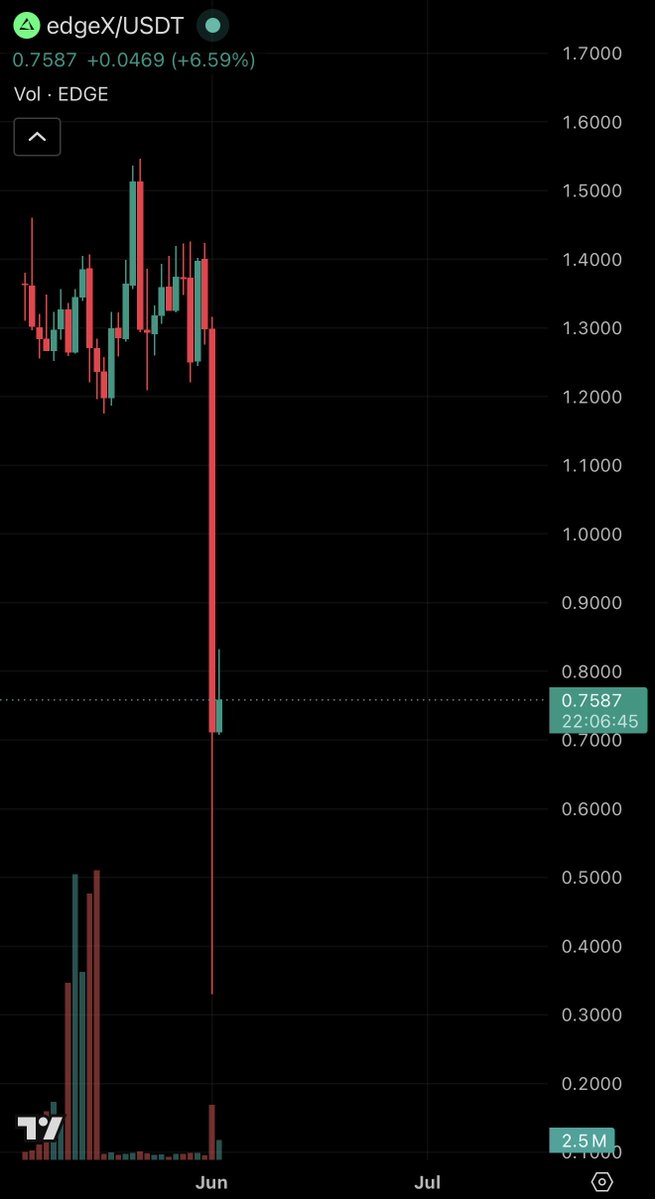
One token hit all-time high. 🚀 One token crashed -70%. 💀
The difference? You need to understand this. 🧵
Let's talk about what just happened side by side 👇
June 2, 2026:
🟢 $HYPE → All-time high. $69.97. Zero supply scandals. Zero manipulation allegations.
🔴 $EDGE (edgeX) → Plunged from $1.20 to an intraday low of $0.3663 — a crash of nearly 70% in a single day.
Same sector. Completely opposite outcomes. 📊
What actually happened to EDGE?
On June 2, the EDGE token experienced a "flash crash," dropping over 77% to $0.315, triggering liquidations totaling $5.2M in just four hours — including $4.1M in long positions alone.
Real people. Real money. Gone. In hours. 🔥
EdgeX's official response:
The team issued a statement saying: "This is not a hack, exploit, or security breach. What we have identified so far suggests deliberate attempts by certain external parties to manipulate the market price of EDGE."
Translation: "It wasn't us. Someone outside did this."
ZachXBT — the most respected on-chain investigator in crypto — wasn't buying it. 👀
What ZachXBT actually said:
"We all know edgeX supply was being controlled by a few insiders with a low float. If you care about transparency at all you will name the counterparties / MM agreements which lead to these events."
⚠️ This is a serious public allegation from a credible investigator — the investigation is still ongoing. No legal determination has been made yet.
But here's the structural problem he's pointing to 👇
"Low float" — what does that mean for regular people?
Imagine a store that says it has 1,000 items for sale.
But secretly, the owners are holding 900 of them in the back room.
Only 100 items are actually available to the public.
Now the owners start selling their hidden 900 items?
In low-float markets, sudden liquidity withdrawals can significantly amplify price movements — especially when leveraged positions begin to unwind.
That's the trap. And $6.2M in real money just got caught in it. 💀
Now compare to $HYPE's structure:
✅ No VC allocation
✅ No pre-sale to insiders
✅ Token distribution: 31% airdropped to community at launch
✅ Team allocation: vested over time, publicly disclosed
✅ All fees → automatic buybacks, fully on-chain verifiable
EdgeX, meanwhile, is now ranked #16 by DEX volume with only $137M TVL — while edgeX claims to have had comparable perp volume to Hyperliquid at various points.
Volume without real users is easy to fake. Revenue and TVL are much harder to manufacture. 📋
The uncomfortable lesson:
In crypto, two projects can look identical from the outside:
Both: DEX. Both: Perp trading. Both: High volume numbers.
But underneath?
One has transparent tokenomics, real revenue, and institutional backing.
The other has low float, insider control, and a token that just lost -70% in one day.
The difference between $HYPE and $EDGE isn't luck.
It's architecture. 🏗️
The rule that keeps proving itself:
"In crypto, you don't just invest in a product. You invest in the token structure behind it."
A great platform with a broken token = still a trap. 🎯
⚠️Not financial advice. Always DYOR.
@edgeX_exchange We all know edgeX supply was being controlled by a few insiders with a low float.
If you care about transparency at all you will name the counterparties / MM agreements which lead to these events.
Grayscale just published a report.
The conclusion made Wall Street analysts go quiet. 😶
$HYPE is cheaper than every single traditional exchange on the planet.
Here's what Grayscale's Head of Research actually found 👇
They compared Hyperliquid against every major exchange in the world.
By a metric called P/E ratio — how much investors pay for every $1 of earnings.
The results were brutal in their clarity. 📊
Price-to-Earnings comparison (last 4 quarters):
🏦 Coinbase → 44x
📈 Robinhood → 37x
🏛️ Interactive Brokers → 34x
📊 CBOE → 29x
🌐 Nasdaq → 25x
⚖️ CME → 24x
🏢 Deutsche Boerse → 21x
🔷 ICE → 20x
🇪🇺 Euronext → 19x
🟢 Hyperliquid → 14x
The cheapest exchange on the list. By a wide margin. 🤯
Now let's put this in plain English:
P/E ratio = how much you pay for $1 of profit.
Coinbase investors pay $44 for every $1 Coinbase earns. Hyperliquid investors pay $14 for every $1 Hyperliquid earns.
Same type of business. Same product category. One-third the price. 📉
And the revenue is real:
Hyperliquid generated trading fees of around $800 million last year — confirmed by Allium data.
Not projections. Not promises. Actual fees already collected.
From a platform that is still blocked from US users due to regulatory ambiguity. 🇺🇸🚫
That last point is the most important.
Hyperliquid is not yet available to US users due to regulatory ambiguity around perpetual futures and decentralized exchanges. However, recent comments from regulators and ongoing efforts in Congress could change that — and create a meaningful catalyst for further growth.
$800M in annual fees. Zero access to the world's largest capital market.
What happens when that door opens? 🚪
Grayscale's exact conclusion — word for word:
"Regulatory clarity in the US can expand access to Hyperliquid to new users and, in our view, help drive value to the HYPE token."
This isn't a random tweet.
This is Grayscale Research — the firm managing billions in crypto assets — publishing an institutional report saying $HYPE looks undervalued compared to its peers.
The full picture:
✅ Cheaper than every comparable exchange by P/E ✅ $800M annual fees already generated
✅ US market still locked out — not yet priced in
✅ Permissionless ecosystem: spot, perps, prediction markets, pre-IPO futures all on one platform
✅ Grayscale actively filing its own HYPE ETF while publishing this analysis
When the institution building the ETF also calls the asset undervalued in a public research report?
That's not noise. 🎯
⚠️Not financial advice. Always DYOR.
Hyperliquid
A DeFi platform built on perpetual futures, now rivaling traditional exchanges.
Spot, futures, and outcome markets in one place.
US access could be the next catalyst for $HYPE
Read the full article from @LowBeta on the Stack: https://t.co/uQEUE3w35R
You can now trade oil, gold, and the S&P 500...
24 hours a day. 7 days a week. On a blockchain. 🤯
And $3 BILLION is already sitting inside it.
The HIP-3 framework launched on October 13, 2025.
Since then — it has set a new open interest record every single month. 📈
No exceptions.
The growth trajectory:
📊 October 2025 → Launch
📊 March 2026 → $1.43B
📊 April 2026 → $2.3B
📊 May 2026 → $2.65B
📊 June 1, 2026 → $3.07B ✅ New ATH
That's zero to $3 billion in 8 months. 🚀
But wait — what IS HIP-3?
Think of it like an App Store for financial markets.
Anyone can build a new trading market on Hyperliquid's infrastructure — without asking permission.
The result?
🛢️ Trade crude oil at 3am on a Sunday
🥇 Trade gold during a geopolitical crisis — when NYSE is closed
📈 Trade the S&P 500 in real time — without a broker 🚀 Trade SpaceX pre-IPO before it lists anywhere
All on-chain. All 24/7. All without a middleman. ⚙️
Here's the structural shift nobody is talking about:
Six of Hyperliquid's top 10 most active markets are now real-world assets — not crypto pairs.
A crypto exchange where most of the volume is oil, gold, and stocks.
That's not DeFi anymore. That's something entirely new. 🌍
Why does this matter for $HYPE?
Every $3B in open interest on HIP-3 generates real fees — and at peak activity, Hyperliquid generated $2.3M in daily fees that funded direct HYPE buybacks.
More RWA volume → More fees → More $HYPE bought from market → Every single day. 🔄
The big picture:
Hyperliquid now captures 44% of all perpetual DEX volume — the only major decentralized exchange to grow its market share during an already expanding market.
Traditional stock markets: open 5 days/week, 8 hours/day = ~2,000 hours/year
Hyperliquid RWA markets: 8,760 hours/year
The always-on financial market. It's already here. 🕐
⚠️ Not financial advice. Always DYOR.
The company that sold JPEGs for billions...
just chose Hyperliquid to build its derivatives exchange. 🤯
Let that sink in for a second 👇
OpenSea — the platform that created the NFT boom, raised $425 million, and was the gateway for millions of people into crypto...
is launching perpetual futures.
And when they asked: "Who wants early access?"
The crowd didn't hesitate.
Every single reply: "Hyperliquid." 🔥
First — who is OpenSea?
Founded in 2017. The world's original NFT marketplace.
At its peak, it handled billions in monthly NFT volume.
For many people, OpenSea WAS crypto. 🖼️
Now they're pivoting beyond JPEGs into perps — one of the fastest-growing financial products in the world.
What are perps?
Short for perpetual futures.
Think of it like betting on whether a price goes up or down — but without an expiration date.
They're simpler and provide more direct exposure to an asset than options or traditional futures.
By April 2026, Hyperliquid's 24-hour volume of around $21.8 billion exceeded most centralized perpetual exchanges.
This is where the money is moving. 💰
Now here's the part nobody is talking about:
OpenSea didn't build their own perps engine.
They didn't go to Binance. Not Coinbase. Not dYdX.
They picked Hyperliquid as their infrastructure layer.
OpenSea's Head of Partnerships, Zack Brenner, confirmed it directly:
"Powered by @HyperliquidX?"
His reply: "yes!" ✅
Why does this matter structurally?
This is what's called a distribution win.
OpenSea brings millions of existing crypto users.
Hyperliquid provides the trading engine underneath.
Every time someone trades perps on OpenSea's new platform:
→ Volume flows through Hyperliquid → Fees get generated → 99% of those fees buy back $HYPE from the market 🔄
OpenSea's users become Hyperliquid's revenue — without even knowing it.
The pattern forming in real time:
Each week a new platform announces they're building on Hyperliquid.
Not competing with it.
Building ON it.
Capital that once chased NFTs and memecoins is increasingly moving towards perps — especially on decentralized exchanges like Hyperliquid.
OpenSea knows this. That's exactly why they made this move. 🎯
The uncomfortable realization:
When the crypto community was asked "where do you go for perps?"
Nobody said Binance. Nobody said Coinbase. Nobody said dYdX.
They just said one word.
Hyperliquid.
That's not marketing. That's brand gravity. 🌍
⚠️Not financial advice. Always DYOR.
"It only goes up because they're buying the token."
The bears said this as an insult.
They accidentally wrote the entire bull thesis. 🤯
Here's what happened at the most important crypto space of May 31, 2026 👇
One room. Professional traders. One question:
What's actually worth owning right now?
The answer was brutal in its simplicity. 🎯
The $HYPE flywheel — explained for humans:
Every trade on Hyperliquid generates fees.
Those fees go directly to buy HYPE from the open market — every single day, automatically.
The math right now:
💰 ~$2M in fees generated per day🔄 99% of that → mandatory HYPE buybacks📈 Result: New ATH of $69.97 reached May 31, 2026
More users → More fees → More buying → Higher price.
The machine doesn't stop. ⚙️
And then Wall Street showed up:
Bitwise and 21Shares' Hyperliquid ETFs recorded more than $60M in combined inflows in one week — after accumulating roughly $68M the week before.
Grayscale filed an S-1 with the SEC to list a HYPE ETF under ticker GHYP on Nasdaq.
Grayscale is now negotiating a ~$115M seed investment of 2 million HYPE tokens for the fund.
VanEck also has a pending filing.
⚠️ BlackRock was mentioned in the space as "circling" — but no official BlackRock HYPE ETF filing has been confirmed publicly as of this writing. Verify before citing.
The portfolio framework that emerged:
This wasn't just about HYPE. The full breakdown was:
🟢 45% Crypto → Led by HYPE at ATH
🟢 45% Stocks → NVDA, IBM (quantum + Trump CHIPS), TSLA, SK Hynix, ServiceNow
🟡 10% Degen → High-risk/high-reward plays
The thesis: balance real revenue assets with asymmetric upside.
Not all-in crypto. Not all-in stocks. Both. 📊
The uncomfortable institutional read:
Bitcoin, Ethereum, Solana, and XRP are all down double digits in 2026.
$HYPE is up +100% YTD. 🚀
In a bear market.
With $2M/day in fees.
With ETF inflows accelerating every week.
The bears said "it only goes up because they're buying the token."
They were right. That IS the thesis.
When a protocol's own economics force permanent, daily, algorithmic buying — and Wall Street ETFs start multiplying that pressure on top?
That's not luck. That's structural demand. 🏗️
⚠️ Not financial advice. Always DYOR.
.@KookCapitalLLC's space recap 🧵 the @HyperliquidX flywheel + the only stocks worth picking ↓
⚡ $HYPE LEADS CRYPTO OUT OF THE BEAR
~$2M/day in fees in a bear market, 99% hardwired into burning the token · ETFs buying 10x the assistance fund, blackrock + grayscale circling · "it only goes up because they're buying the token"
🟠 $BTC IS THE LAGGARD THAT SNAPS BACK
$73k, the only thing in the universe that hasn't pumped · could dip lower first, then catch everyone offside and rip
🖥️ $IBM IS THE QUANTUM TRUMP TRADE
$250 to $298 on a $1B CHIPS quantum foundry plus a literal "buy IBM" from trump · the 20-IQ thesis might beat the 200-IQ one
🧱 STOCK PICKING IS BACK
first time in 10-20 years there's real alpha in single names · $NVDA, $TSLA, SK Hynix (+70%), servicenow off an 80% drawdown, all in the book
🛡️ $XMR OVER $ZEC FOR THE CBDC HEDGE
97% of global GDP is building CBDCs · DCA monero as the only actually-private money · zcash is a corporate KOL pump the regulators love, pass
Tomorrow, 20 million NBA fans will watch Game 1.
A few of them will also be betting on it through a blockchain. 🤯
The NBA Finals just became a crypto event. Here's what's actually happening 👇
Spurs vs Knicks. Game 1. June 3. ABC. The most anticipated Finals in 27 years.
And Hyperliquid just registered it as a prediction market on-chain. ⛓️
But wait — what IS a prediction market?
Simple: You bet YES or NO on a real-world event.
🏀 Spurs win Game 1? → Buy "San Antonio" contract 🏀 Knicks win? → Buy "New York" contract
If you're right → contract settles at $1If you're wrong → settles at $0
No leverage. No liquidation. Maximum loss = what you put in. 🛡️
Now here's where it gets interesting:
Most prediction platforms have a problem:
Who decides the winner?
📌 Polymarket → outsources to UMA, an external oracle where anonymous token holders vote
📌 Kalshi → centralized, CFTC-regulated exchange decides the outcome
Hyperliquid's approach is structurally different — validators who already run the network now also vote directly on market deployment AND settlement outcomes.
The final result becomes an on-chain fact secured by the same consensus mechanism that powers the entire exchange. 🔐
Why does that matter?
Because on Hyperliquid:
✅ No single company decides who won
✅ No anonymous strangers vote on outcomes
✅ The same validators who secure your trades also verify the game result
✅ One unified trust system. Nothing external.
One more thing most people miss:
Cross-margining — on Hyperliquid you can hold perpetual futures, spot positions, and event contracts all within a single collateral pool.
Meaning: you can trade $BTC perps AND bet on the NBA Finals — using the same capital. 🤯
No other platform does this.
The big picture:
Hyperliquid is expanding beyond crypto-focused trading into real-world events: inflation data, elections, central bank decisions, sports outcomes, and geopolitical events — all on one platform.
Bitwise CIO Matt Hougan described Hyperliquid as a potential crypto "super app," arguing investors still undervalue the platform by viewing it only as a perpetual futures exchange. 📈
⚠️Not financial advice. Always DYOR.