Hi, I'm Steffen. I design interfaces for a living and build things with AI for fun. Here I'll share Figma workflows, honest AI tool reviews and my vibecoding experiments, including the ones that fail.
@pascal_bornet The shared component library isn't the problem, shared defaults are. The library should make the boring parts consistent, so the team spends its taste on the few moments that matter: onboarding, empty states, one signature interaction.
@gokulr@figma From the design side, the risk is 40 internal tools with 40 slightly different UIs. The teams that pull this off hand builders a component library and a few rules first, so internal tools still feel like one product.
@diegohaz Nice detail on the chevrons. One thing for the scrollable version: when a tab gets focus via arrow keys, scroll it fully into view past the chevron, otherwise the focused tab sits half hidden. Are you covering keyboard behavior too?
@manthanguptaa Their 2019 multiplayer write-up is worth reading in full: no OT, the server is the authority, and conflicts resolve per property, last writer wins. Simple, because two people rarely change the same property of the same layer at once.
@kyleanthony Looks great. Is the texture baked into an image fill or generated live, so it stays editable when the frame resizes? That decides whether it goes into a design system or stays a hero-shot trick.
@adriankuleszo Quick test for AI-generated UI: drop an 8pt grid on top. If the spacing lands on 13, 18 and 22px, the model guessed. Handing it a spacing scale before the first prompt fixes a lot of that.
@petergyang@nateparrott The bias line is the useful part. A workaround that helps: before it designs anything, ask the model to list the defaults it would reach for (font, radius, gradient, card grid), then ban half of them. Did Nate show something like that?
@yug_design Code wins by default, a human decides the exceptions. Clean. Do those exceptions ever flow back into Figma, or does the file slowly drift until the next redesign?
@faqdev The test I use: who made the decisions? If you can explain why every screen looks and behaves the way it does, that's building with AI. If the answer is "Claude picked it", that's vibe coding. Both are fine. Just don't ship the second one with payments in it.
@0xReso Better inputs, mostly: design rules files, reference libraries, real component systems in context. Polished is the new default, so it's no longer the differentiator. What I check now: empty states, error states, and how it holds up with real, ugly data.
@calvincorreli Same from the design side. Cheap implementation means I get to test the third and fourth idea, not just the first one that looked buildable. The new skill is saying no faster, because now everything is cheap enough to add.
@shadcn Nice proof that behavior and look really are separate now: same primitives, completely different skin. Designer question: is the hardware theme pure tokens and CSS, or did some components need structural changes? That line tells me how far a theme can actually go.
@jsngr@mainframe Designing in the real codebase is the right foundation. My first iOS test: when I tweak something on the canvas, does it stay native SwiftUI with system components, so Dynamic Type and dark mode still work? That's where most handoffs break.
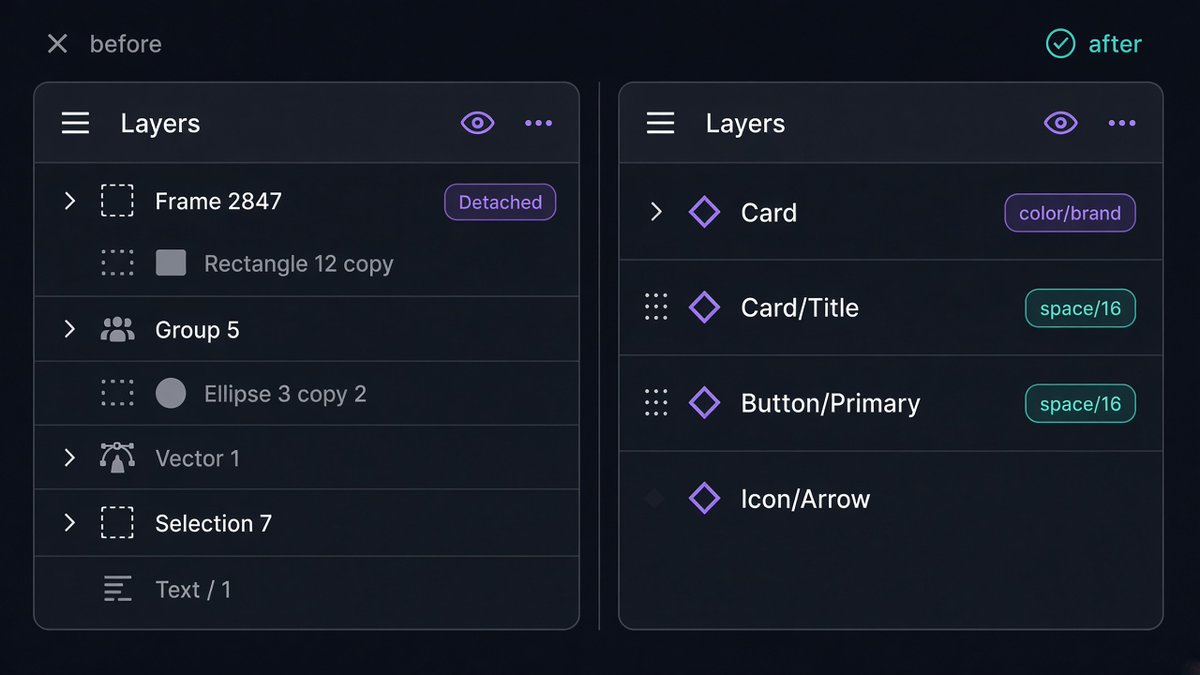
My best AI design tip this month: rename your layers.
Before a frame goes to an agent:
1. Name layers by role, not "Frame 2847"
2. Re-attach detached instances
3. Bind colors and spacing to variables named as in code
10 dull minutes, saves an hour of "why is this #3B82F7?"
@Dorizzdt A real API to discover controls and inspect state beats agents reverse-engineering the DOM every time. Do your browser tests go through the same entry point, so agent checks and your own tests can't drift apart?
@kiselev_one Nice first run. What I'd check: did it reuse your components and auto layout, or draw new frames that just look right? The first is a mobile layout, the second is a screenshot of one.
@framer@plainsupport Branching is what makes letting marketers loose with an agent sane. Question from the design side: when two branches change the same component, how does the merge work? That's usually where design branching gets painful.
@joshpuckett AI made the first 80% almost free, so the extra effort now goes straight into the last 20%: empty states, error copy, the spacing nobody notices until it's off. That part still costs exactly as much time as it used to.