#RethinkingI94 is our chance to make a generational infrastructure investment, one that will impact the Twin Cities for decades to come. So why not think big?
A heavy rail corridor will provide express service between the two downtowns and anchor our future regional network.
@NikoLeMieux Density's an important factor to take into account. Do we have the population metrics to support a transit investment like this?
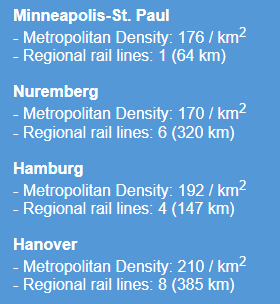
Our metro area's population density is 176 people per square km. That's on par with a lot of German regions which have extensive S-bahn systems.
With the success of Amtrak's Borealis, and with our state's eyes set on new intercity services from Minneapolis, connecting our downtowns by heavy rail will be more important than ever.
What could this "spine" look like, and how will it fit into our growing transit network?
@MaplehoodUnited This corridor will likely be used for Borealis connections to Minneapolis. The issue is it's not publicly-owned, meaning it would be hard to run any kind of frequent regional rail service along it.
@Rex__Churchill Good question! We have some details on the need for a heavy rail corridor in the context of existing and future rapid transit on our site's FAQ.
It essentially boils down to local vs regional demand, and why we can't satisfy both with one mode.
https://t.co/XYuyvOuQJi
🎉Congrats to @MetroTransitMN and everyone who worked on the @GoldLineBRT project!
The festivities were amazing, and the buses were packed! Looking forward to the Minneapolis extension in just a few short years
Have thoughts on the expansion of passenger rail in Minnesota? MnDOT is hosting more public engagement opportunities seeking input on its State Rail Plan!
More info below for Duluth, Rochester, Moorhead, and St. Paul:
https://t.co/jyXadqWMKb
Article: Caltrain's electrification project is paying off big-time
"Although the electric trains still reach the same top speed as diesel ones — 79 mph — they start and stop much faster, saving riders time."
https://t.co/WXk0ar0xyI
The METRO Gold Line is coming to Minneapolis! Opening in 2027, the Gold Line Extension will bring frequent, all-day service to the I-94 corridor between Woodbury and Minneapolis. Learn more about what’s in store here: https://t.co/A9oqLJEeZO
“[Regional rail] also offers Minnesotans a chance to decrease their taxes in the long term. Minnesota spends $4.3 billion a year on road repairs… By investing in rail now, we have a chance to save in the long run through decreased expenditures on roads.”
https://t.co/tDjFCMErFh
@MaryMorseMarti There are a lot of promising station locations along the I-94 corridor, but we don’t want to preemptively earmark several at once. Add too many stations between the downtowns, and the regional spine loses its effectiveness as an express option between them.
@MaryMorseMarti There definitely could be! Depending on what happens with the freeway itself, the land occupied by the Huron interchange could be developed on the future, and a station could be added there to serve the Stadium Village area.
@SteveSubera The benefit of heavy rail is that this I-94 corridor could accommodate regional and intercity trains, meaning the Borealis and NLX (plus future Amtrak routes) could serve both Target Field and Union Depot.
🗺️Map Update!
With our new animated icons, you can visualize how regional trains would utilize the I-94 rail spine to speed up trips within the cities and across the metro.
Check it out on our website!
https://t.co/l70FEjRhQU
The emphasis on regional connectivity is encouraging —and exactly what needs to be considered within the scope of this generational project.
Rethinking I-94 has impacts far beyond the seven-mile corridor.
@stpguy33@i94rail There is a clause supporting studying “options that repurpose the trench for high-speed connections” between MPLS and STP and the broader region
The Minneapolis City Council says MnDOT plans to reconstruct I-94 between the Twin Cities’ downtowns can’t include expanding the interstate, and should consider removing it. https://t.co/PSTJ3mfY3O
Did you know? 🧵
Most electric trains use overhead wire for power. But some models — like Stadler's FLIRT Akku — can run under battery power on non-electrified track.
With an electrified I-94 rail spine, trains like this could charge while running under wire. This means...
And anchoring this network to an electrified, state-owned, purpose-built passenger rail spine will lay the foundation for future electrification projects throughout the Twin Cities metro area and the state of Minnesota.