You can build your own invoice tracker this afternoon.
One prompt to iGPT pulls every invoice, receipt, renewal, and refund from your inbox, ready to be routed to Slack, Sheets, or QuickBooks.
Instantly detect:
- Duplicate billing
- Overspending on team seats
- Upcoming renewals on unused tools
Get the same accuracy as a five-figure subscription, the same coverage as a quarter of engineering, with none of the cost or time.
If you can write a prompt, you can build this.
Walkthrough in the post.
https://t.co/xbxJkhCw8j
iGPT Skills are live!
Connect, ask, get answers grounded in your real email and Drive.
No more pasting threads, summarizing chains, or briefing the model on who matters.
Skills cover sales, finance, customer success, recruiting, operations, and more.
https://t.co/ChKW6grgzx
Want to know why your AI hallucinates even when you give it the context?
It's probably using RAG.
RAG chops content into chunks and pulls the ones that look most similar to your question.
That works for documents, but email isn't a document.
Email keeps copying itself into every reply and buries the current state under quoted history. So the model sees real text and reaches the wrong conclusion.
iGPT reconstructs the thread first and returns what actually happened, with citations back to the source
https://t.co/uXnvzYpEni
Opus 4.7 dropped this week and it's a real step up from 4.6.
It reads screenshots properly, follows instructions exactly how you wrote them, and can handle long jobs without falling apart halfway through.
Here are 5 prompts that actually use what's new. 🧵
Your agent can now reason across Google Drive in one API call.
Another datasource alongside email and attachments. Together they give your agent the full picture.
- Compare two versions of the same doc and pull what actually changed.
- Check whether what was promised in one doc shows up in another.
- Answer a question that spans forty files without adding them into the context window.
iGPT handles the retrieval, structuring, and context assembly with ~20x fewer tokens.
Calling it the "chat era" is interesting for something that's been around for maybe three years. I don't think we're leaving it behind, I think agents are just adding a layer on top of it.
Chat stays because it's great for thinking, exploring, asking a quick question. Agents handle the structured, repeatable work.
But the part that keeps tripping people up is "process data." Agents can call tools and trigger workflows fine. Getting them to actually understand what's in your communication data, the threads, the attachments, the decisions that got made across months of back and forth, that's still where most of them fall apart.
@iGPTai handles that part. One API call, and the agent gets structured, attributed context instead of raw threads. Who said what, what was decided, what's still open. The "process data" step stops being the bottleneck.
You can skip months of engineering and ship your AI product faster.
iGPT turns email threads and attachments into structured intelligence your AI can reason over.
One call, not six months of pipeline.
Skip the infrastructure and start building
https://t.co/pfAqnFW9nB
If you're making decisions based on what AI tells you is in your email, you're likely working with bad data and don’t know it.
We tested a real business thread across five models and four returned confident, structured, wrong answers. Businesses run on email. If the AI reading it gets it wrong, every decision is built on a guess.
iGPT structures your email, attachments, and docs into intelligence that AI can reason over with one API call.
https://t.co/2LJBFknt6L
Every AI tool promises to give you time back. Speed is only half the game though. The answer also has to be entirely accurate.
I used to manually connect the dots between email and Drive. A feedback thread here, a saved deck version there.
@iGPTai just added Google Drive as a native datasource, deep indexed alongside your inbox.
I asked:
Everyone is building context layers for structured data.
Nobody is building them for the place where most business decisions actually happen: email threads.
Most AI agents that touch email are working off raw data and don't even know what they're missing.
They miss things that actually matter to the deal:
- pricing concerns raised in side threads
- a commitment that quietly got dropped
- the conversation going cold after the proposal
iGPT fixes that layer.
One call returns who said what, what is unresolved, and what needs to happen next.
$10 free credits. No credit card needed
https://t.co/scEDNRuihA
Free for everyone. Founders, employees, freelancers.
Accurate answers and clear actions from your email and web.
Personal Gmail or corporate Outlook, thousands of emails, same speed.
https://t.co/NDg7P9Tgmg
Ask:
- Does this invoice match what we agreed to?
- Which deals went quiet after we sent pricing?
- What commitments are we behind on this quarter?
And get instant answers across threads, attachments, and documents, all traced back to the source.
Everyone is building context layers for structured data.
Nobody is building them for the place where most business decisions actually happen: email threads.
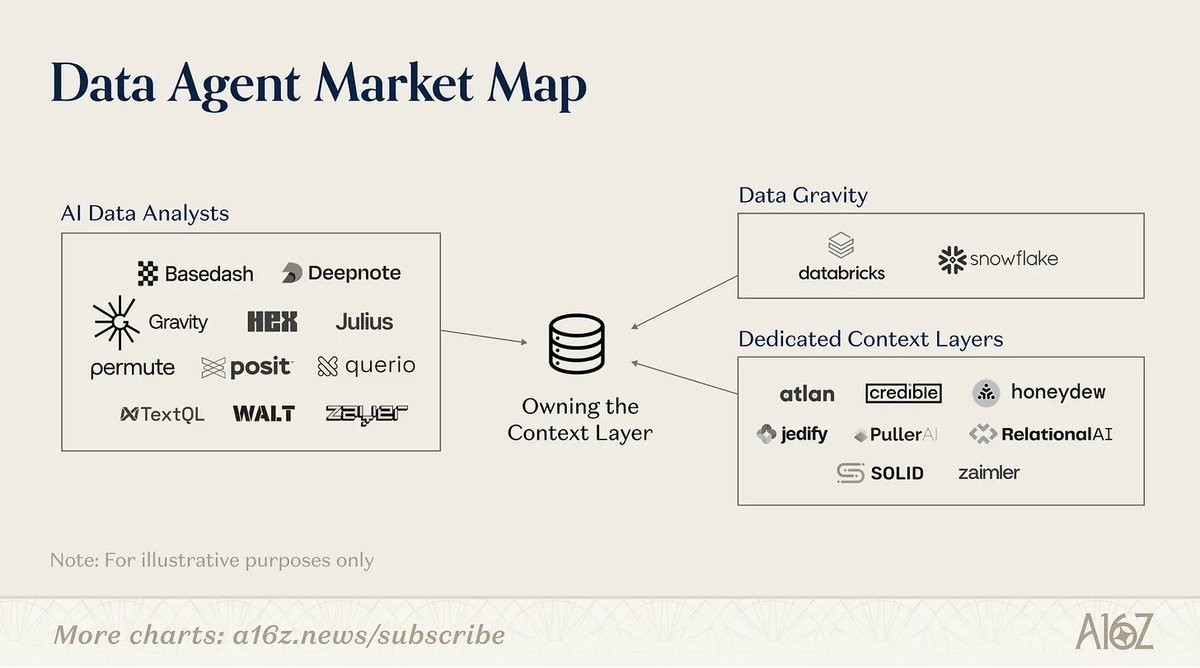
Frontier models are exceptionally efficient, intelligent, and useful. For agents, context is now the bottleneck.
Enter the context layer, which bridges the gap from an enterprise's messy data to actionable context, packaged for agents.
We're seeing three distinct verticals emerge in the context layer space:
- Data gravity platforms
- Existing AI data analysts
- New, dedicated context layer companies
Read the full piece by @JasonSCui and @JenniferHli: https://t.co/ftyF4lYIFK