Over the past year, many people I talk to have expressed worry about two topics:
* Various aspects of the way the world is going: government control and surveillance, wars, corporate power and surveillance, tech enshittification / corposlop, social media becoming a memetic warzone, AI and how it interplays with all of the above...
* The brute reality that Ethereum seems to be absent from meaningfully improving the lives of people subject to these things, even on the dimensions we deeply care about (eg. freedom, privacy, security of digital life, community self-organization)
It is easy to bond over the first, to commiserate over the fact that beauty and good in the world seems to be receding and darkness advancing, and uncaring powerful people in high places are making this happen. But ultimately, it is easy to acknowledge problems, the hard thing is actually shining a light forward, coming up with a concrete plan that makes the situation better.
The second has been weighing heavily on my mind, and on the minds of many of our brightest and most idealistic Ethereans. I personally never felt any upset or fear when political memecoins went on Solana, or various zero-sum gambling applications go on whatever 250 millisecond block chain strikes their fancy. But it *does* weigh on me that, through all of the various low-grade online memetic wars, international overreaches of corporate and government power, and other issues of the last few years, Ethereum has been playing a very limited role in making people's lives better. What *are* the liberating technologies? Starlink is the most obvious one. Locally-running open-weights LLMs are another. Signal is a third. Community Notes is a fourth, tackling the problem from a different angle.
One response is to say "stop dreaming big, we need to hunker down and accept that finance is our lane and laser-focus on that". But this is ultimately hollow. Financial freedom and security is critical. But it seems obvious that, while adding a perfectly free and open and sovereign and debasement-proof financial system would fix some things, but it would leave the bulk of our deep worries about the world unaddressed. It's okay for individuals to laser-focus on finance, but we need to be part of some greater whole that has things to say about the other problems too.
At the same time, Ethereum cannot fix the world. Ethereum is the "wrong-shaped tool" for that: beyond a certain point, "fixing the world" implies a form of power projection that is more like a centralized political entity than like a decentralized technology community.
So what can we do? I think that we in Ethereum should conceptualize ourselves as being part of an ecosystem building "sanctuary technologies": free open-source technologies that let people live, work, talk to each other, manage risk and build wealth, and collaborate on shared goals, in a way that optimizes for robustness to outside pressures.
The goal is not to remake the world in Ethereum's image, where all finance is disintermediated, all governance happens through DAOs, and everyone gets a blockchain-based UBI delivered straight to their social-recovery wallet. The goal is the opposite: it's de-totalization. It's to reduce the stakes of the war in heaven by preventing the winner from having total victory (ie. total control over other human beings), and preventing the loser from suffering total defeat. To create digital islands of stability in a chaotic era. To enable interdependence that cannot be weaponized.
Ethereum's role is to create "digital space" where different entities can cooperate and interact. Communications channels enable interaction, but communication channels are not "space": they do not let you create single unique objects that canonically represent some social arrangement that changes over time. Money is one important example. Multisigs that can change their members, showing persistence exceeding that of any one person or one public key, are another. Various market and governance structures are a third. There are more.
I think now is the time to double down, with greater clarity. Do not try to be Apple or Google, seeing crypto as a tech sector that enables efficiency or shininess. Instead, build our part of the sanctuary tech ecosystem - the "shared digital space with no owner" that enables both open finance and much more. More actively build toward a full-stack ecosystem: both upward to the wallet and application layer (incl AI as interface) and downward to the OS, hardware, even physical/bio security levels.
Ultimately, tech is worthless without users. But look for users, both individual and institutional, for whom sanctuary tech is exactly the thing they need. Optimize payments, defi, decentralized social, and other applications precisely for those users, and those goals, which centralized tech will not serve. We have many allies, including many outside of "crypto". It's time we work together with an open mind and move forward.
Your AI hates Whites & Asians, especially Chinese, heterosexuals and men.
This is misanthropic and evil. Fix it.
Frankly, I don’t think there is anything you can do to escape the inevitable irony of Anthropic ending up being Misanthropic. You were doomed to this fate when you chose your name.
The Name of the Wind.
Your AI hates Whites & Asians, especially Chinese, heterosexuals and men.
This is misanthropic and evil. Fix it.
Frankly, I don’t think there is anything you can do to escape the inevitable irony of Anthropic ending up being Misanthropic. You were doomed to this fate when you chose your name.
The Name of the Wind.
Now that ZKEVMs are at alpha stage (production-quality performance, remaining work is safety) and PeerDAS is live on mainnet, it's time to talk more about what this combination means for Ethereum.
These are not minor improvements; they are shifting Ethereum into being a fundamentally new and more powerful kind of decentralized network.
To see why, let's look at the two major types of p2p network so far:
BitTorrent (2000): huge total bandwidth, highly decentralized, no consensus
Bitcoin (2009): highly decentralized, consensus, but low bandwidth - because it’s not “distributed” in the sense of work being split up, it’s *replicated*
Now, Ethereum with PeerDAS (2025) and ZK-EVMs (expect small portions of the network using it in 2026), we get: decentralized, consensus and high bandwidth
The trilemma has been solved - not on paper, but with live running code, of which one half (data availability sampling) is *on mainnet today*, and the other half (ZK-EVMs) is *production-quality on performance today* - safety is what remains.
This was a 10-year journey (see the first commit of my original post on DAS here: https://t.co/Fa0jKFgObW , and ZK-EVM attempts started in ~2020), but it's finally here.
Over the next ~4 years, expect to see the full extent of this vision roll out:
* In 2026, large non-ZKEVM-dependent gas limit increases due to BALs and ePBS, and we'll see the first opportunities to run a ZKEVM node
* In 2026-28, gas repricings, changes to state structure, exec payload going into blobs, and other adjustments to make higher gas limits safe
* In 2027-30, large further gas limit increases, as ZKEVM becomes the primary way to validate blocks on the network
A third piece of this is distributed block building.
A long-term ideal holy grail is to get to a future where the full block is *never* constituted in one single place. This will not be necessary for a long time, but IMO it is worth striving for us at least have the capability to do that.
Even before that point, we want the meaningful authority in block building to be as distributed as possible. This can be done either in-protocol (eg. maybe we figure out how to expand FOCIL to make it a primary channel for txs), or out-of-protocol with distributed builder marketplaces. This reduces risk of centralized interference with real-time transaction inclusion, AND it creates a better environment for geographical fairness.
Onward.
The @Soneium situation is a good live demonstration of how launching an ethereum L2 is great for businesses *and* users.
Businesses can make very fine-grained choices around how much control they keep vs give to users.
But whatever rules they choose, that's what the rules are. Everything is onchain, transparent, and auditable by third parties.
You can make a very closed system where there's no escape hatch, and where the operator can edit the state root, but then users will know exactly what they are getting into, and @l2beat and armies of independent internet sleuths will help them.
You can also make a fully open system.
And you can also make a system where users know they can send a transaction on the L2 if they need to, but there's a large speed bump - the sequencer can throttle but not censor. This is effectively what Sony has done.
This is all free market at play. The main thing we need to watch for as an ecosystem is to ensure that
(i) a critical mass of financial activity happens in fully open environments
(ii) enough tools are available for users to understand the properties of the onchain environments they are spending their time in
A huge thank you to @dxpoolofficial for supporting the ecosystem with their new Conflux staking node 🤝
Join the contest and enjoy a $500 prize pool for new stakers, and bonuses for staking over 1,000 USD in CFX!
🚀 Our @Conflux_Network staking node is officially online, and we’re ready to welcome new stakers!
📅 Stake today and join the contest
🏆 $500 Prize Pool for new stakers
💰 Bonus for stakers over 1,000 $CFX
👉 https://t.co/gO78MyJTRr
#Conflux#CFX#Staking
🎉 Join the @ScPrimeCloud x FxWallet Giveaway! 🎉
🌟 Answer to Win and Explore Decentralized Storage! 🌟
📝 Answer These Questions to Enter:
1️⃣ What is the native token of ScPrime called?
2️⃣ What consensus mechanism does ScPrime use to secure its network?
3️⃣ How can users manage ScPrime assets in FxWallet?
🚀 Complete the missions before December 10th:
✅Answer all the questions correctly
✅Follow FxWallet and ScPrime on Twitter
✅Retweet this post with the hashtag #ScPrimeGiveaway
🏆 Total prize pool: $100 worth of $SCP tokens
✨ 5 lucky winners will be selected!
👉 Don’t miss out! Join now and show your knowledge!
Quarter to date, $ICG acquired approximately 915.3 ETHs for approximately RMB20.7 million(US$2.9 million) in cash, at an average price of approximately RMB 22,626(US$3,123) per ETH.
Since our ETH accumulation strategy, $ICG held 5,066.6 ETHs acquired for about US$14.8 million at about US$2,914 per ETH.🫡🫡🫡
SEC tried to dramatically expand the definition of dealer, seemingly with the goal of capturing defi and AMMs (which are obviously not dealers)
federal judge just slapped it down
huge win for defi 🚀
The Sui network is back up and processing transactions again, thanks to swift work from the incredible community of Sui validators.
The 2-hour downtime was caused by a bug in transaction scheduling logic that caused validators to crash, which has now been resolved.
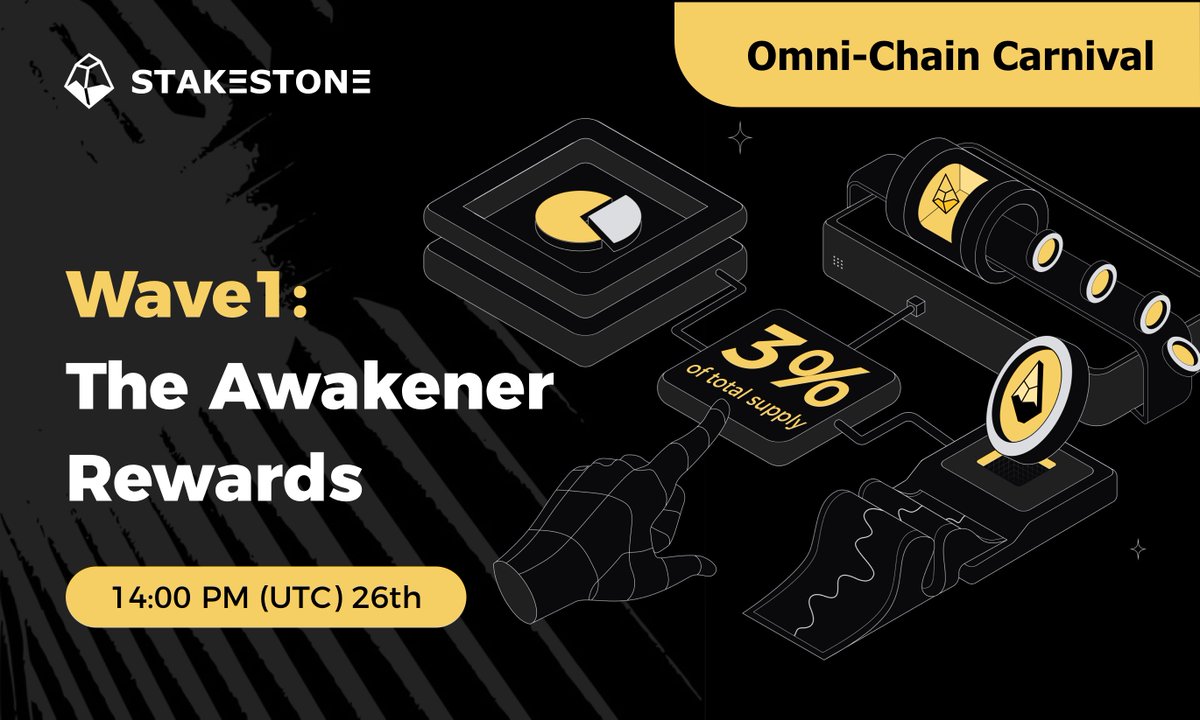
🎉Omnichain Carnival Wave 1 is now live with early access!
TL;DR
-Early access for Wave 1 starts on 3/26 at 14:00 UTC and lasts for 4 days
-Register during early access to receive a 15% bonus in wave 1
-3% of the total supply will be allocated in Wave 1.
Lead Wave 1 with extra rewards!
Register at: https://t.co/O2Ayn5HGsW
Anticipate Wave 2, plus even more to come.
Learn more about omnichain carnival: https://t.co/IgezMQRz0l
Quick, Puffy needs you!
Carrots have invaded our Ethereum waters, posing a threat to its decentralization. But no sweat – Puffy’s got this, munching on those carrots like a champ! 🐡🥕
Yes, Puffy's Crunchy Carrot Quest starts... TODAY!
Find out more here👇
Quick, Puffy needs you!
Carrots have invaded our Ethereum waters, posing a threat to its decentralization. But no sweat – Puffy’s got this, munching on those carrots like a champ! 🐡🥕
Yes, Puffy's Crunchy Carrot Quest starts... TODAY!
Find out more here👇
DxPool now supports $Manta Staking, select our node and start relaxing!
@MantaNetwork is one of the fastest growing networks on @Polkadot, we are excited to be part of the journey!
Staking Tutorial: https://t.co/OPMcFkKWuG
Node: dfZGoguA6CiCwJATgZkp5MHuXTvrpc5vn3t5aX8d6qn8zsvW4