Over 1.7M $PENDLE Buyback 🔥
Since the launch of sPENDLE, the protocol has acquired 1,722,192 $PENDLE from the open market and distributed every token to sPENDLE holders.
On top of it, sPENDLE holders have collected ~$1.4M in airdrops since the start of the year.
ondo generated $318m YTD revenue, $172m from circle alone, just launched perps, won the spacex IPO allocation war, hit $3.7b TVL ATH. token is down 63% over 12 months. the platform is printing. zero buybacks, zero fee share, zero staking yield. $8.3b FDV pricing in dominance while the token captures none of the value the platform creates. compare to HYPE burning $64m in 30 days. ondo the business is executing. ONDO the token has no value accrual mechanism and a 17.1% supply unlock hitting january 2027. until that changes you're holding equity in a company that doesn't pay dividends and keeps issuing new shares
Adam Back believes that even a 2% allocation from Wall Street into Bitcoin could be enough to drive BTC to a $1,000,000 valuation.
The statement reflects a long-term bullish thesis centered on growing institutional adoption and capital inflows—not a guaranteed prediction, but a view shared by one of Bitcoin’s earliest pioneers.
Do you think Wall Street will eventually allocate 2% to Bitcoin, or is that still too ambitious? 👀👇
Bulls have been wrong at every level this year.
Hear me out.
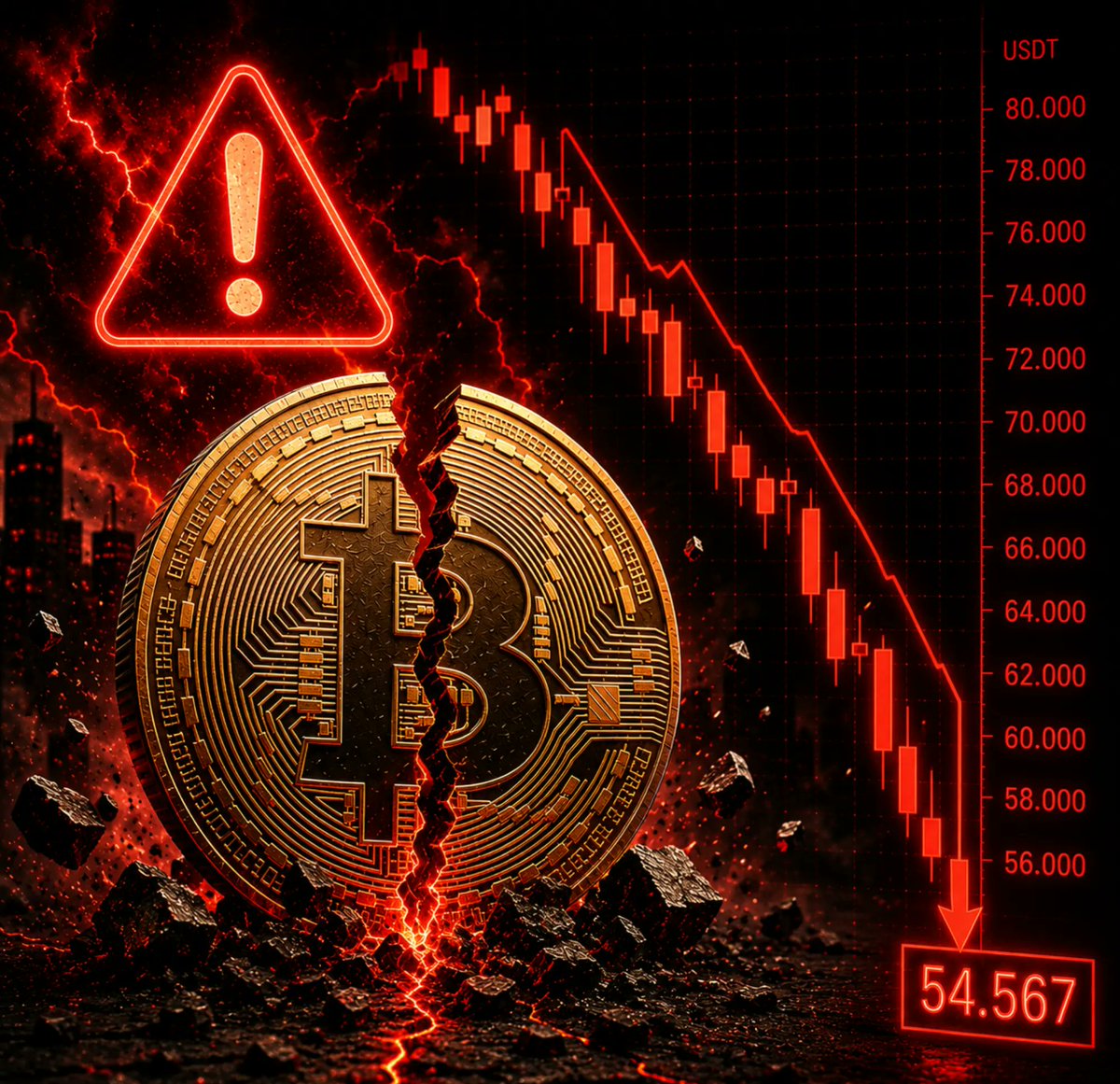
Eight months ago BTC printed 126,200.
Today it's 62,900.
That is -50% in eight months.
Embrace the harsh reality:
⇝ Key support 100,000 broken in November
⇝ Bear market confirmed at 94,000
⇝ May bounce died at 82,800
⇝ Falling 200-day MA rejected every rally so far
⇝ We've just hit new bear market lots
If someone said it's still bull market, they lied to you.
WAKE UP.
The only missing factor separating us now from cycle low is panic phase.
And that's set for sub 40k in next 4 months.
If I'm wrong, enlighten me.
What am I missing?
hyperliquid ZEC perp volume spiked 12-13x on may 26th. zero public catalyst. three days later the orchard vulnerability gets disclosed. ZEC crashes from $680 to $250, $117m in liquidations. one whale on hyperliquid has $100m+ in cumulative profits from shorting ZEC across multiple events. responsible disclosure circles for crypto vulnerabilities run 50-100 people deep across dev teams, ZODL coordinators, exchange partners, and node operators. cake wallet wasn't even told and only found out when their app broke. that's the leak surface. perp volume anomalies on low-float tokens 2-5 days before catalysts is the most reliable insider signal in crypto right now. if you see 10x+ volume on a privacy coin perp with no news attached, someone knows something you don't
Reason why bitcoin had a lousy 2025 bull, decoupled from gold & equities, is in bear now ... is the complete implosion of altcoins IMO. Take ETH for example: -70% from its 2021 top and almost back to its 2017 top 📉IMO shitcoins are done, lesson learned, expensive but worth it.
In volatile markets, price action happens in short bursts, followed by a ton of ranging.
If you didn't catch the moves down already, I wouldn't chase them.
Last cycle, we actually measured this, and something like 90% of price action happens in 5% of the days.
.@maplefinance's loan book is over 10x its market cap.
Fees look soft at the moment, -24% in 30 days.
But Maple lends to institutions.
Revenue is generated on settlement events, not on a daily accrual basis.
The trailing 12 months of fees are $100M, and $SYRUP is trading at 1.7x annual fees.
The people tracking the loan book and the people watching the price chart are looking at different things.
One of them is wrong.
THE DEAD COIN THAT PREDICTS EVERY BITCOIN CRASH JUST WOKE UP.
And history says what comes next.
2018: Zcash pumped. Bitcoin crashed 84%.
2021: Zcash pumped. Bitcoin crashed 77%.
2024: Zcash pumped. Bitcoin crashed 40%.
Not once. Not twice.
Every. Single. Time.
The corpse of Zcash just moved again.
This signal has never been wrong.
Bitcoin bulls you have been warned.
This week could move your portfolio more than any single week this year. Nvidia, Walmart, Home Depot, Target, and a critical home sales report all release in the next five days.
Here is what's going on:
The Biggest Market Week of 2026 Is Here
Starting May 18, 2026, investors get a full-court press of market-moving data. Nvidia, the $2+ trillion AI titan reports earnings mid-week and analysts expect it to either validate or crush the AI spending narrative that has propped up the entire tech sector.
Simultaneously, Walmart, Home Depot, and Target all report, giving us the clearest real-time picture yet of how American consumers are actually holding up under tariff pressure and stubborn inflation.
The existing home sales report rounds it out, a direct signal for mortgage rates, housing inventory, and whether the real estate market is finally cracking.
This is not a normal earnings week. This is a verdict on the entire economy.
What This Means For Your Money:
If Nvidia misses or guides lower, expect tech-heavy portfolios and index funds like QQQ to take an immediate hit, we are talking potential 3-5% single-day swings.
If Walmart and Target signal that consumers are pulling back on spending, that is a recession warning bell ringing in real time, and it will ripple into your 401k faster than any Fed announcement.
The home sales data will directly influence whether mortgage rates drift lower or stay locked above 6.5%, affecting millions of homeowners and buyers sitting on the sidelines right now.
How To Win From This:
If you have been waiting to add to broad index positions, do not go all-in before Wednesday, let Nvidia's report land first, then buy the dip if the market overreacts to any short-term miss.
Watch Walmart's consumer commentary like a hawk; if they flag trade-down behavior, rotate a slice of your portfolio toward discount retail and consumer staples ETFs like XLP.
And if home sales data disappoints, the market may finally be forced to accept that higher rates are doing real damage beneath the surface, especially to housing, regional banks, and consumer confidence.
This week is not just about earnings.
The next five days could shape the direction of stocks, mortgage rates, and investor sentiment for the rest of the summer.
Pay attention.
Because by next weekend, the market narrative for the second half of 2026 may look completely different, so plan accordingly.
TheWealthCode.
Calling $PENDLE a yield farm is like calling the bond market a savings account.
It completely misses the point.
In TradFi, rate markets are some of the largest markets on earth. BIS had global OTC derivatives at ~$846T notional in mid-2025, and interest-rate derivatives made up ~79% of that. Not because everyone is chasing APY, but because every serious institution needs to manage yield, duration, floating-rate exposure and future cash flow.
That is the real Pendle thesis.
Pendle lets onchain capital split, trade, hedge and lock future yield. A DAO treasury, stablecoin protocol, fund, or onchain company earning elevated yield today can effectively put a stamp in time when rates are attractive instead of just hoping next month’s yield holds.
That turns yield from passive APY into a balance sheet tool.
As stablecoins, RWAs, tokenized treasuries, credit markets and yield-bearing assets grow onchain, rate management becomes mandatory infrastructure. Some users will want fixed yield. Some will want leveraged yield. Some will want to hedge. Some will want to speculate on where rates go next.
TradFi already proved this market becomes massive when capital markets mature.
Pendle is building the onchain rate market before most crypto people even understand why it matters.
Why $PENDLE will go up:
FIVE major catalysts are converging at once: fees are accelerating sharply, with 7-day fees up 107.8% week over week to $191.5k and 30-day fees up 28.5% to $730k; tokenomics have improved through sp.endle and aim, with up to 80% of protocol revenue used for open-market pendle buybacks, a 14-day liquid staking withdrawal period replacing the old multi-year vependle lockup, and emissions cut by roughly 30%; boros expands pendle beyond fixed-yield markets into tokenized perpetual funding-rate exposure, giving it access to one of crypto’s largest derivatives markets; institutional integrations are increasing, including global dollar network/usdg, paxos-linked infrastructure, spark protocol, stusds, sky/former makerdao, binance, hyperliquid, and arbitrum-related boros activity; and the protocol is showing resilience, with tvl recovering 7.8% over 7 days, 30-day dex volume up 42.7% to $722.8m, and fees/volume rising even while tvl is far below its november 2025 peak because pendle pool maturities naturally reduce tvl at expiry rather than necessarily indicating user flight. at a $321m market cap, $533m fdv, $26.4m trailing 12-month fees, and a 12.2x trailing p/s ratio, the core case is that pendle is increasingly becoming crypto’s fixed-income and interest-rate market, with improving capital efficiency, accelerating revenue, better supply dynamics, new product expansion, and institutional adoption; the main question is whether the current fee surge is sustainable or only a short-term spike (not even gotten into STRC which would be numero 6 but hey linn has stuff to do, go look at that as well)
dc: linn holds an unholy amount of pendle because it will go up a lot
Bitcoin rebota un poco…
y de repente muchos ya compraron en 60k y creen que nos vamos directos a ATH.
Sinceramente, creo que muchos se van a comer una buena hostia 🩸
Te doy las 5 razones por las que sigo bajista (de mayor a menor peso) ⬇️
BTC is now at $81K, down 35% from its $ 126K ATH.
There's a deep disparity between protocols with strong fundamentals and their token prices.
These protocols are generating more fees right now than at previous cycle highs.
The tokens are 80–95% below ATH.
$SPK: P/F 0.52x | $189M ann. fees | +31.5% fee growth → A $99M mcap token generating nearly 2x itself in annual fees
$AAVE: P/F 1.86x | $759M ann. fees | +38.2% fee growth → Fees growing while the token is -86% from ATH
$FLUID: P/F 2.58x | $50M ann. fees | +29.6% fee growth
$AERO: P/F 4.80x | $87M ann. fees | +34.5% fee growth → P/S = P/F: 100% of fees flow directly to holders.
The average S&P 500 stock trades at ~22x earnings.
These are at 0.52x–4.80x fees, in a recovering BTC market.
Crypto will catch up.
Please read this thread before you ape into the next pump. 🙏
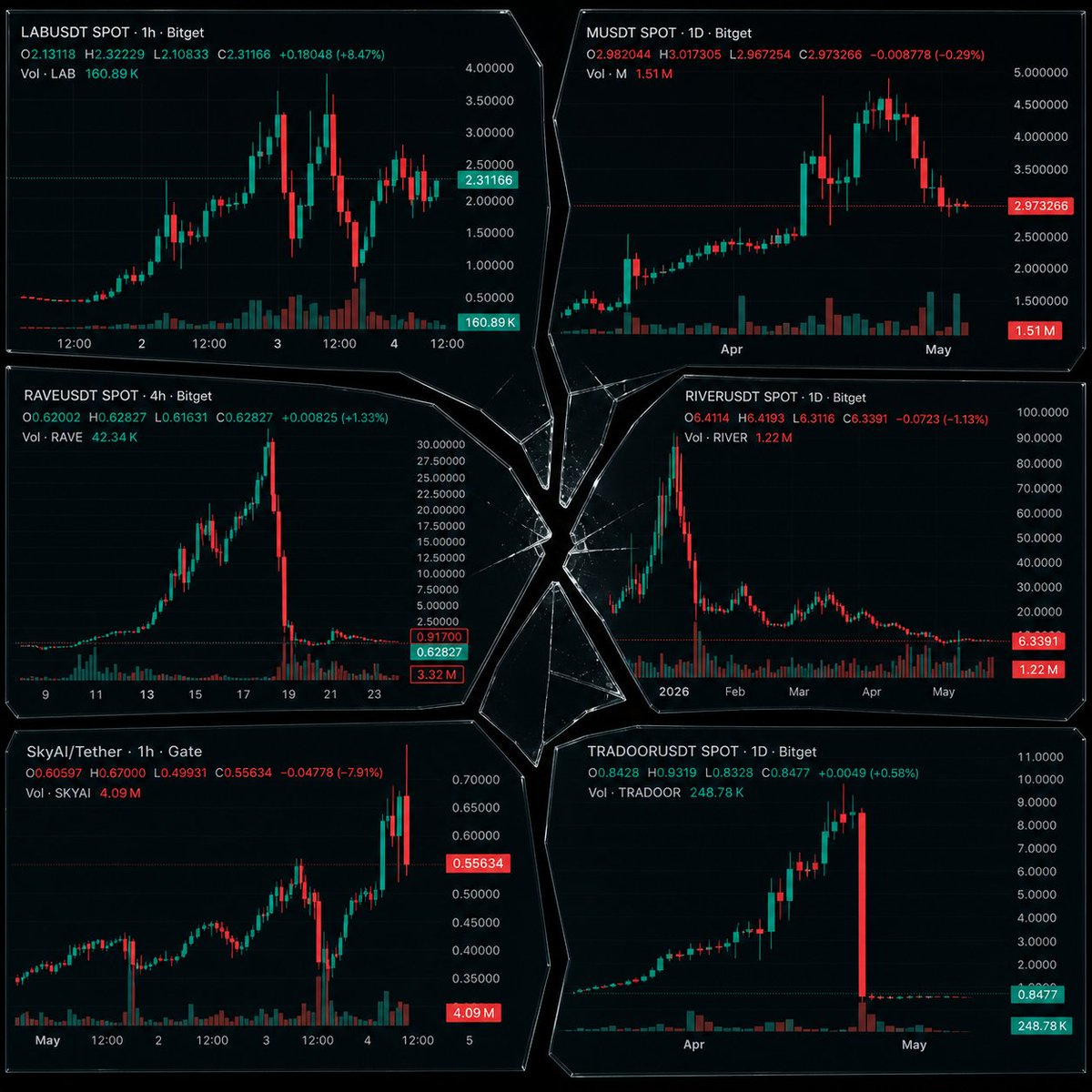
$RAVE, $RIVER, $TRADOOR, $M, $LAB, $SKYAI - all ran the same playbook. All extracted millions from retail.
We broke down exactly how so you never become exit liquidity again. 🧵
If you missed the April 6 bottom at $1.01, read this.
$PENDLE is already up 32% from there and 20% this month.
I'm writing this anyway because I think the market is still wrong about why the TVL dropped.
Here's what actually happened.
Pendle's TVL fell 36% over 45 days. Traders saw this headline and sold the token.
I looked at the dates of the biggest drops (April 10, April 20, April 21)
Every major TVL event was a yield market expiring on schedule; this was TVL that completed its trade and exited. Not capital fleeing a problem.
Meanwhile, vePENDLE holders collected fees throughout it.
You see this in the fee, with fees growing by +41%, and Holder revenue growth of +41.5% last month.
You have a token where:
+ 79% of all protocol fees route to vePENDLE lockers
+ 30-day holder revenue: $604K → $7.25M annualized
+ Fees growing: +41% last 30 days
+ Holder revenue grew +41.5% last 30 days
+ Still −31% below where it traded 90 days ago (~$1.95)
We're already starting to see much of this capital being replaced with new markets, across @boros_fi and new primitives via $STRC PTs ( @apyx_fi).
$PENDLE remains a continuation play.
Everybody wants $TAO to 5x
But I feel like nobody is talking about the fact that if $TAO does a 5x, staking into subnets becomes a LOT less interesting
➤ Subnet market caps are correlated to TAO, so they would 5x too if that happened, which would instantly make them less attractive investments and make them feel less undervalued
➤ Also if $TAO performs that well, most people will start asking themselves: what’s the point of holding subnets, aka the higher-risk assets, if the mother coin is outperforming them?
So if $TAO pumps hard, I think some (or most) subnets could actually end up dumping pretty hard against it
Genuinely curious to hear what the community thinks about this