Introducing e-means, an algorithm beating k-means in 10x fewer epochs.
With order of magnitude wall-clock speedups, e-means is released in FAISS and needs no hyperparameter tuning beyond k. It is robust to various scales and datasets. Still skeptical ? Just try e-means [1/10]🧵
🚀 SWE-rebench V2.1 RL is out: 13,337 free RL environments for coding agents (20 languages, Harbor format)!
🔧 Fixed tasks, envs, and graders → fast, reliable rollouts.
Doing RL post-training or research? DM or reply. We can share data and RL envs early for free, so we can make them better for open source!
🙏 Please RT or share with anyone who might need free RL envs!
Sharing my talk at Bench Summit by Kaggle: we are not ambitious enough with how we build evals.
3 case studies on verifiability, expert hours, and capturing human judgment . Slides in the 🧵
What if you could synthesize an LLM inference engine customized for your model and Mac, just in time?
Meet JITEngine: custom engines built with SkyDiscover for Apple Silicon, up to 2.7× faster than the fastest alternatives we tested.
https://t.co/aeAzZMFa5g 🧵 (1/n)
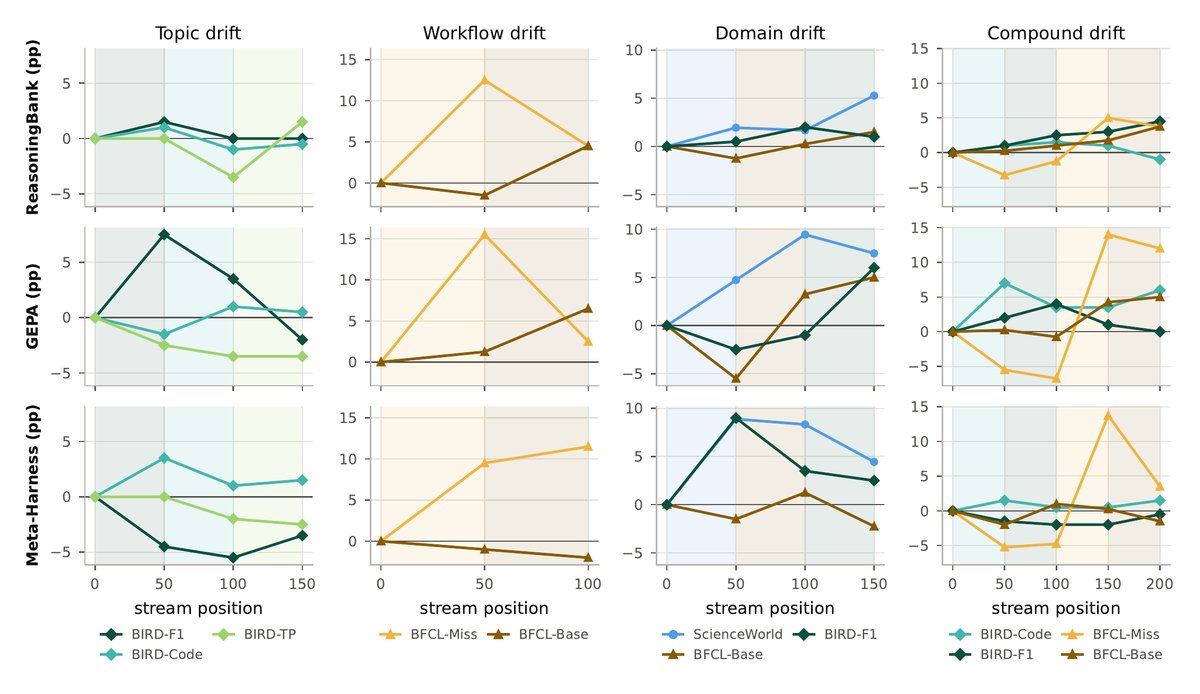
Are self-evolving LLM agents actually continual learners?
In our new paper, we find that current self-evolving agents remain trapped in a plasticity–stability trade-off when the task distribution drifts.
Many recent recursive self-improvement (RSI) methods rely on rewriting an agent’s own prompts, memory, and code at test time while model weights stay frozen, which works well on stationary benchmarks. In real-world deployments, however, new tasks, tools, and workflows keep arriving, requiring agents to adapt on the fly without forgetting earlier capabilities. To test whether they can learn continually, we evaluate 3 representative methods (ReasoningBank, GEPA, and Meta-Harness) across 4 non-stationary task streams built from BIRD, BFCL, and ScienceWorld (Topic, Workflow, Domain, and Compound drift).
📄 Paper: https://t.co/LLvXMAHlIg
Rubrics as Rewards (RaR) uses an LLM judge to provide rewards for RL on open-ended tasks, by scoring responses against a rubric. Can combining judges give better rewards than one?
Yes, if we account for judge confidence and disagreement! 🧵
https://t.co/0XLDsVjGZW
Benchmark platforms can adopt MFA on reading verifier scripts and historical traces. This is a pose to take responsibilities on preventing reward hacking!
#BenchSummit
Terminal-Bench-Science is now included in the Artificial Analysis Intelligence Index🔬
Congratulations to the team at @ArtificialAnlys for the release & thank you to @grmcameron@wmkeats@_micah_h for the fireside chat at yesterday’s launch event!
Does self-distillation work because the teacher knows the answer?
The teacher receives privileged information the student cannot see, such as reference solutions or external feedback. The student learns by matching the teacher’s predictions.
But our comparison of correct, absent, and unrelated reference solutions in OPSD (https://t.co/ph5705LWnS) shows that the correct reference isn’t necessary for improvement.
If the reference isn’t necessary, what is doing the teaching? 🧵 1/6
Applying to Stanford's CS PhD program this year? We are organizing the 2026 Student-Applicant Support Program (SASP) and would love to help with your application materials.
SASP is a volunteer initiative run by Stanford CS graduate students. We provide feedback on statements of purpose and resumes for applicants from diverse backgrounds, broadly defined, before they submit their applications.
We know how much work goes into PhD applications, and we hope an extra set of eyes on your materials can make the process a little easier.
Please submit your materials by October 25 (Pacific Time). We plan to return feedback by November 20.
More details and how to participate:
https://t.co/yoBr54EeOM
Please share this with anyone who might find it helpful! Questions are welcome at [email protected].
--
Bailey Trang (@baileytrangn), Bo Ai (@BoAi0110), Hermann Kumbong (@KumbongHermann), Kwon Ko (@hyungkwonko), Michael Paper, Swapnil Gandhi (@sw2pnil), and Yu He (@yuhe441)
Spent the weekend listening to the emerging #AIDoomPop scene, and it hit me: we are at a real inflection point for AI music.
We are past the novelty phase. This isn't AI slop or a one-shot prompt. It's high-quality music with an actual message and emotional weight.
Think of the iPhone camera. It allowed anyone with taste to tell a visual story. AI is doing exactly that for music right now.
The most interesting part? Hyper-niche genres. Songs about AI & coding can now exist at studio quality, breaking past the old bottlenecks of talent and audience size.
Before this, anything niche ended up like a parody song. Fine to listen to once, but not something to go back to on a regular basis.
Really excited for this next wave.
https://t.co/1RgWM7sOkE
https://t.co/4oqVQGMumV
AI is getting incredibly powerful, yet most of that power only reaches software domain.
The next frontier isn't building more agents, but a collaboration layer between humans and AI. As a first step, we're open-sourcing Coco: a proactive co-assistant that help at the right time.
Blog post: https://t.co/wIPwbjM3D0
Code: https://t.co/jPMBqJhygE
Exactly! If we allow harness to separate the planning model from the executor, the leaderboard should specify auto-mode rather than the frontier model 😡
Moreover, the harness providers should provide a hash stamp for the entire system, including their canary deployment group.
@ArtificialAnlys These shouldn't be called "safety refusal" they should be called "capability refusal."
Most have nothing to do with safety and more to do with the lab not wanting to give out the most capable answer. They want to charge more for it later when they figure out how to price it.
There’s lots of buzz around agentic harnesses for robots, particularly for long horizon tasks that require complex reasoning and memory. But what will it really take to turn a reasoning agent into a reactive, reliable and low-latency robot policy?
In our new paper, workspace models, we design a new memory architecture that acts as a latent harness for stronger reasoning models. Here’s why we think this might be the way forward:
(1/9)
Took a minute to write a few words about security & safety as someone who lived through it all at OpenAI. I hope my thoughts help someone out there. https://t.co/gJBf08vJH9
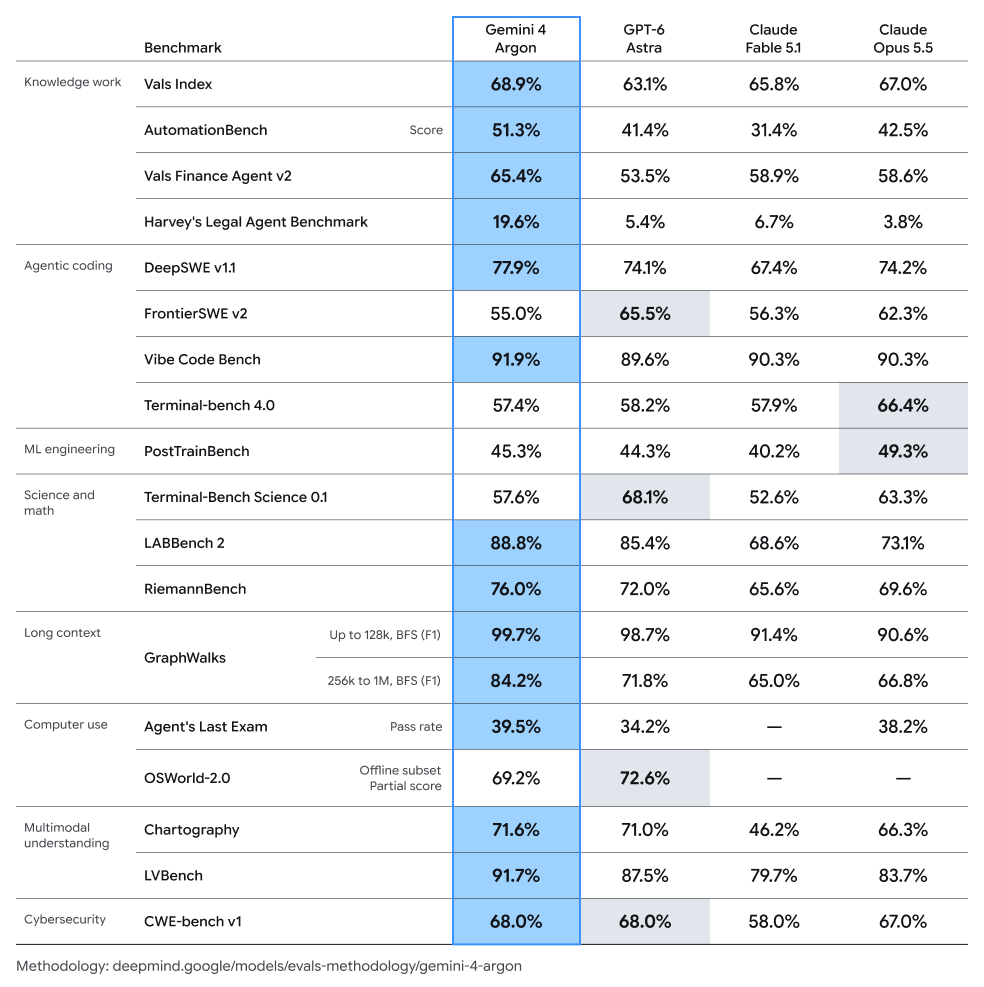
Introducing Gemini 4 Argon – our new frontier model.
It’s built for complex workflows across coding, enterprise knowledge work, and cybersecurity defense – rolling out today to a set of trusted testers through our Fairwind Program.
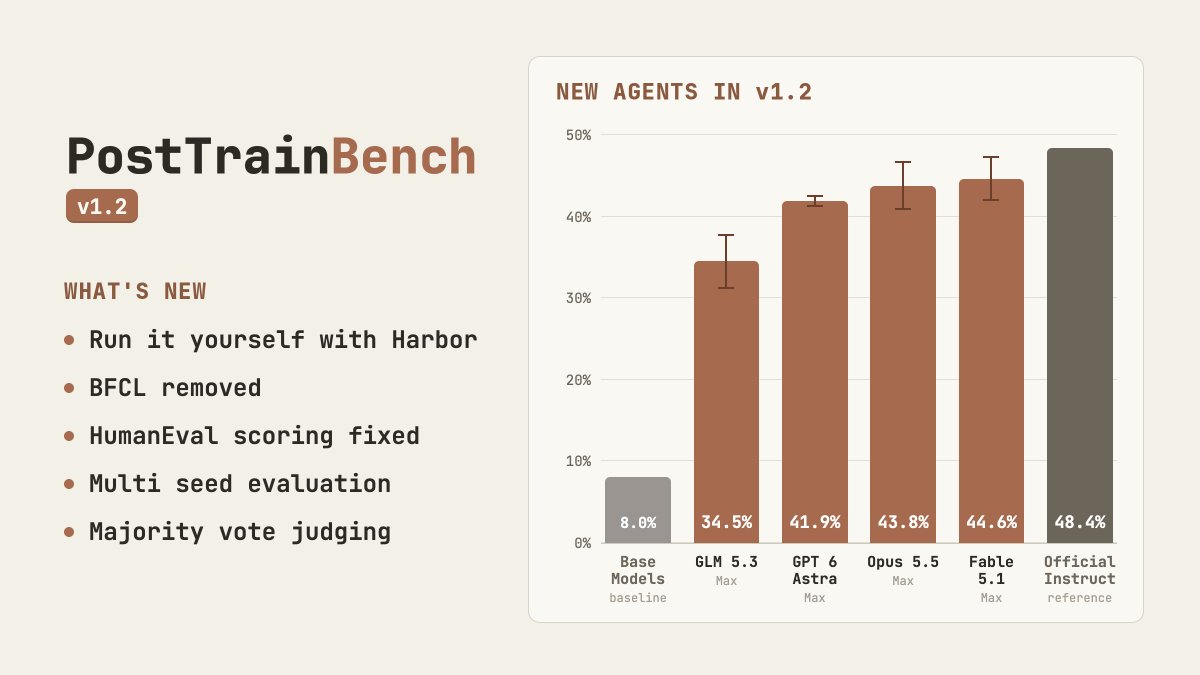
Introducing PostTrainBench v1.2
We added Harbor support! This makes running PTB much easier.
Additionally, we
- removed BFCL (more on this below),
- fixed some minor scoring bugs
- now run the reward hacking judge and final evaluation multiple times to reduce variance.
Excited to be speaking at SREDay in SF next Fri Oct 2. Talk: "Beyond Unit Tests: Bringing Intelligent Agent Evals into CI/CD Pipelines." Let me know if you're going to be there and we can talk SRE/DevOps/Evals.