This is my first ever post on X!
And I’d love to share my first ever preprinted work PIE - Perturbation is Everything!
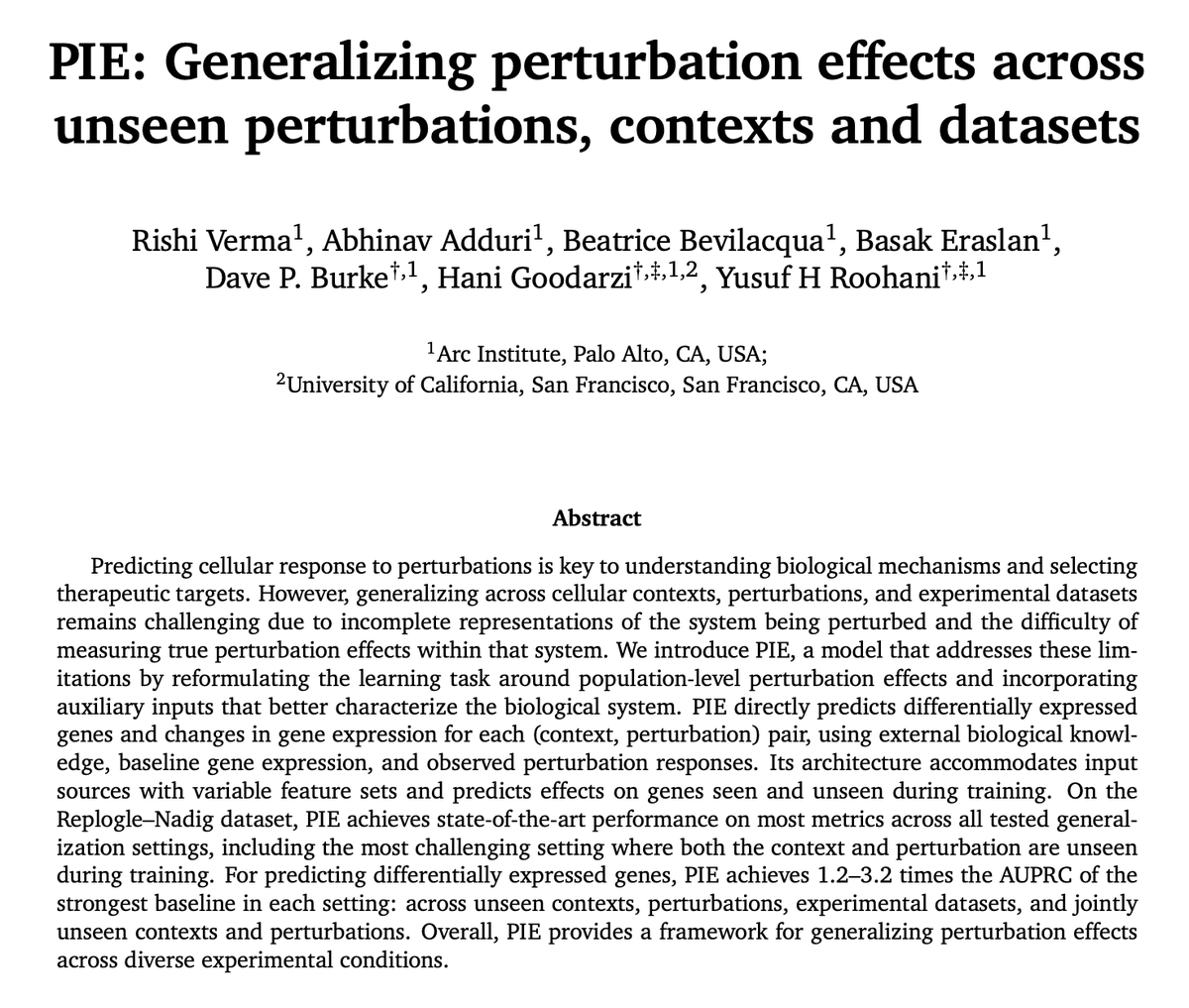
Generalizing across unseen cellular and experimental conditions is challenging but essential to therapeutics discovery. Our latest model PIE addresses this challenge by simplifying the learning objective and leveraging curated biological knowledge from public databases. PIE generalizes across a combinatorial space of perturbation studies, unseen cell lines and unseen perturbations.
Check out the preprint at https://t.co/9oOfpcIZaX
Huge shoutout to the team at @arcinstitute for driving this project:@abhinadduri , @beabevi_ , @basak_ersln , @davey_burke , @genophoria , @yusufroohani .
Most perturbation models learn only from experiments. Our new model, PIE, also draws on decades of curated biological knowledge to predict which genes respond to a perturbation, even in biological contexts and for perturbations it has never seen.
@florian_marty I agree. We’ve barely scratched the surface and there’s a long way to go. More data, both in volume and modalities, would help us build better models.
This is my first ever post on X!
And I’d love to share my first ever preprinted work PIE - Perturbation is Everything!
Generalizing across unseen cellular and experimental conditions is challenging but essential to therapeutics discovery. Our latest model PIE addresses this challenge by simplifying the learning objective and leveraging curated biological knowledge from public databases. PIE generalizes across a combinatorial space of perturbation studies, unseen cell lines and unseen perturbations.
Check out the preprint at https://t.co/9oOfpcIZaX
Huge shoutout to the team at @arcinstitute for driving this project:@abhinadduri , @beabevi_ , @basak_ersln , @davey_burke , @genophoria , @yusufroohani .
Most perturbation models learn only from experiments. Our new model, PIE, also draws on decades of curated biological knowledge to predict which genes respond to a perturbation, even in biological contexts and for perturbations it has never seen.
Most perturbation models learn only from experiments. Our new model, PIE, also draws on decades of curated biological knowledge to predict which genes respond to a perturbation, even in biological contexts and for perturbations it has never seen.
At Arc we have a compounding delivery cycle for our AI/bio models, with model candidates every 6 months. Sometimes we have spinoffs where we explore ideas and cherry pick ideas forward. PIE is one such example. It explores how far we can push using prior biological knowledge sources to make direct differential expression predictions. Useful result as we build towards more general cell simulators. Congrats @i_m_rive, @genophoria, @yusufroohani and team.
@DoctorYev@arcinstitute Please feel free to try the model on the Virtual Cell Challenge. Picking which datasets to train on and how to sample single cell outputs would be interesting.
@k_t_sangster It’s essential I think. Perturbation data is limited in scale and even signal. Prior knowledge augments the representation of the biological system.
Most perturbation models learn only from experiments. Our new model, PIE, also draws on decades of curated biological knowledge to predict which genes respond to a perturbation, even in biological contexts and for perturbations it has never seen.
Check out PIE! Our latest perturbation generalization model from @arcinstitute. Congratulations to everyone, but especially @i_m_rive and @yusufroohani!
The code is on GitHub, with model checkpoints and data on Hugging Face.
Learn more about PIE from co-authors @i_m_rive and @genophoria: https://t.co/znAz30HKeo
Or access the preprint: https://t.co/GD7I44ERhQ