Stanley Druckenmiller, who made extensive use of technical analysis throughout his career, says:
"I can unequivocally tell you that technical analysis is about 20% as effective today as it was 30 years ago, because no one was using it. But when everybody's using it, it doesn't work anymore because you don't have a unique thing to act against."
As Peter Lynch said many times, technical analysis is largely a waste of time. In the long run, stock prices follow the economic results of the business.
"If charts could really predict the future, technical analysts would all be billionaires."
Personally, I combine fundamental analysis with a bit of technical analysis to identify the best moments to buy aggressively and when to sell.
Stocks lose 50% or more of their value all the time "without reason."
That's when I pay the most attention.
Let's take advantage of those moments.
This is the time of year when a lot of investment firms welcome interns. While our work is geared toward institutional investors, a lot of it can be useful for learning about markets and the investment process. Here are a handful of reports and how they can guide interns:
If you can analyse Cash Flow Statements and gather references, you are at a different level when it comes to Fundamental analysis.
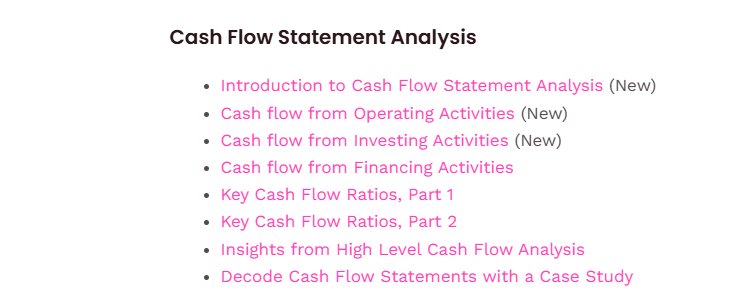
If you did not know... My blog page has 8 blogs on Cash Flow analysis to take you from KNOW NOTHING to an EXPERT.
https://t.co/9Dj54ZtgKk
As global bond yields rise (rapidly), inflation rises, and policy rates must rise in response to oil price driven inflation, here is what will happen: 🧵
Below is my recent presentation I did at @_groww and at @Bharat_Nivesh event.
I talk about business and market cycles. And how these affects stocks. The cyclical ones as well as the non-cylical ones.
Many case studies in the presentation.
There is absolutely no investment advice or recommendation on any stocks mentioned in the presentation. Any stock in the presentation will only be there for the purpose of explaining investing concepts.
Hope this is of help for value investors, primarily.
https://t.co/kXGNlXqB6B
You don't need to read 100s Investor Presentations and annual reports
You need to ingest them with NotebookLM, then research with Claude.
Here are 8 powerful prompts that compress 200 hours of investing research into one weekend break.
Save this thread 🧵
🚨 BREAKING: Google Gemini can now analyze any stock like a Wall Street analyst (for free).
Here are 10 insane Gemini prompts that replace $4,000/month Bloomberg terminals:
(Save this 🔖 you’ll need it later)
Jim Simons agreed to do exactly one long-form interview about his life in math, codebreaking for the NSA, and building Renaissance Technologies. The Simons Foundation filmed it and dumped it on their website behind a Vimeo player nobody could find.
Two hours and 40 minutes. Someone reuploaded it to YouTube on a channel with 483 subscribers. 749 people have watched it.
The deepest Simons interview on the internet. And almost no one knows it exists.
Bookmark it tonight. Then read the article below.
From my personal stock market learnings. Hope it helps. Also do add your learnings too so that those too gets added and we have a great checklist in hand.
A single AI query uses 1,000x more electricity than a Google search.
Data centers now consume 50% of all new electricity demand in the US. India's data center power demand is set to quadruple from 1.4 GW to 9 GW by 2030.
India's overall electricity demand is growing at 6.6% - the fastest among major economies. And cooling alone will add 140 GW to peak demand by 2030.
Everyone talks about "power stocks." But power is not one trade. It is a six-layer value chain. And every layer has a completely different margin profile, bottleneck, and risk.
Here is how the chain actually works:
Layer 1 — Generation
India added a record 52 GW in FY26. Solar alone: 44.6 GW. The target is 500 GW of non-fossil capacity by 2030. Nuclear sits at just 8.78 GW — but new approvals are accelerating.
NTPC is positioning itself as the backbone supplier for industrial-scale AI campuses. Generation is the most capital-heavy layer, but also the lowest-ROCE layer in the chain.
Layer 2 — Transmission
This is where the real capex bomb is. ₹9 lakh crore in transmission investment planned through 2032. Inter-state transmission capex alone will hit ₹1 lakh crore in FY26-27, double the previous two years.
HVDC corridors are the new infrastructure backbone: Bhadla–Fatehpur (6 GW, 950 km), Khavda–South Olpad (2.5 GW), Mumbai HVDC infeed (1,000 MW, just went live). Power Grid, Adani Energy Solutions, Hitachi Energy, GE Vernova, all sitting on multi-year order books.
Layer 3 — Distribution and Smart Grid
The weakest link. India has installed only 5.83 crore smart meters - 25.4% of the 25 crore target. Not a single meter installed in Karnataka. Just 805 in Kerala. But AT&C losses dropped from 21.9% to 15% in four years. Daily meter installations have gone from 15,000 to over 1.12 lakh. This layer is broken, but the fix is underway, and whoever supplies the fix wins big.
Layer 4 — Equipment and Capital Goods
This is the highest-margin layer. ABB India: 29% ROCE. The global transformer market: $65.7 billion in 2026, heading to $96.8 billion by 2033. Lead times for power transformers have stretched from 6 months to 18–24 months. The switchgear market alone will nearly double to $336 billion by 2035.
ABB, Siemens Energy, Hitachi Energy, CG Power — all have multi-year order visibility. BHEL has 190+ gas turbines installed with 13 million+ fired hours.
Layer 5 — Cables and Conductors
India's wire and cable market: $23 billion in 2026, growing at 9% CAGR. Every GW of generation added needs kilometres of cable. Every transmission corridor needs conductors.
Polycab holds ~18% market share. KEI at 9%. KEC International just won fresh orders of ₹1,002 crore. Apar Industries is quietly building an export book. This layer is the silent toll collector of the entire power buildout.
Layer 6 — Energy Storage
India's BESS capacity is about to 10x in 2026 — from 507 MWh to ~5 GWh. There are 92 GWh of battery storage projects in the pipeline. Pumped hydro: 7 GW today, target of 107 GW by 2033. The government just approved ₹5,400 crore in viability gap funding for 30 GWh of standalone BESS. This is the layer that ties the entire renewable buildout together.
The AI power story is not a single stock bet. It's a ₹40 lakh crore value chain. The money doesn't sit in one layer. It flows through all six.