JUST IN: Three thousand ships are anchored in and around the Strait of Hormuz. Twenty thousand seafarers are aboard them. Fresh food ran out two weeks ago. Perishables are rotting in refrigerated holds whose generators are burning through the last reserves of diesel. Water is rationed. Mental health is deteriorating. No mass evacuation plan exists. No humanitarian corridor has been negotiated. No international body has the authority or the means to move twenty thousand people off three thousand ships through a five-nautical-mile channel controlled by the IRGC.
These are the people who move the global economy. Every barrel of oil that reaches a refinery was carried by a seafarer. Every container of goods that stocks a shelf was loaded by one. Every tonne of fertiliser that feeds a field was shipped by one. The war has trapped the invisible workforce that makes globalisation function, and the world has not noticed because the world never notices seafarers until the shelves are empty.
The ships themselves are worth tens of billions. The cargo aboard them is worth more. Crude oil, liquefied natural gas, urea, ammonia, consumer electronics, automotive parts, and 200 cryogenic containers of helium that are boiling off at a rate that no engineer can reverse. The stranded fleet is a floating warehouse of every molecule the global economy needs, and the molecules are degrading while the crews ration drinking water. The cargo is valued higher than the people guarding it, and neither can move.
The IRGC’s Larak corridor clearance system does not only control entry. It controls exit. A vessel that wants to leave the anchorage zone must obtain the same clearance code, submit the same documentation, and receive the same pilot escort as a vessel seeking to transit. The customs border works in both directions. These crews are not stranded by geography alone. They are stranded by bureaucracy, the same bureaucracy Iran wrapped in the language of sovereign maritime governance when the parliamentary committee approved the Hormuz Management Plan. The toll booth charges for passage through. It also charges for passage out.
No centralised evacuation exists because evacuation at this scale would require IRGC approval, and requesting approval would legitimise the system the United States refuses to recognise. So the crews wait. The International Transport Workers Federation issues statements. P&I clubs cover individual medical evacuations by helicopter. Flag states, predominantly Panama, Liberia, and the Marshall Islands, register ships but do not operate navies. The system that made global shipping cheap by divorcing flag from nationality has left twenty thousand people without a government willing to retrieve them.
The seafarers are from the Philippines, India, Bangladesh, Myanmar, Indonesia. Countries whose workers crew the world’s merchant fleet because the monthly pay of $1,500 to $3,000 exceeds anything available at home. They signed contracts to deliver cargo across oceans. They did not sign contracts to become indefinite residents of a war zone, rationing water on a ship whose cargo of ammonia could feed a million people if it could reach a port that is 40 nautical miles and one IRGC clearance code away.
The helium boils off. The fertiliser waits. The crude oil sits. And the people who carry it all drink less water today than yesterday.
The supply chain has a human body at the very bottom of it. The body is thirsty.
https://t.co/dAOBBMsgDS
If we’re forced to choose between Shia Muslims and Sunni Muslims in today’s geopolitical landscape, then as a former Sunni, I can tell you, I wouldn’t hesitate for a second:
I would choose the Shia every single time.
Hezbollah has devastated Lebanon for over 30 years. They’ve hijacked the country’s sovereignty, dragged it into needless wars with Israel, dealt drugs across continents, and trained militias from Syria to Yemen.
Iran’s regime has exported chaos to the entire region.
I am not here to sanitize the destruction caused by Shia Islam.
But there is no comparison, none, between Sunni jihad and Shia jihad when it comes to the barbarity, monstrosity, and nihilism at their core.
Shia wilāya is a political-theological project rooted in eschatological hope, the belief in a coming world of justice, peace, and divine order under the awaited Mahdi.
This doesn’t make their actions justifiable, but it does mean their violence is directed, however twistedly, against what they interpret as tyrannical regimes or ideological threats.
When they target civilians, it’s typically selective, an assassination of a perceived enemy of the movement, not wholesale slaughter for religious cleansing.
This vision stems from their Muʿtazila-influenced theology, which still gives weight to human reason and moral evaluation alongside the sacred text.
Sunni jihad, by contrast, is a black hole.
It recognizes no moral hierarchy, no ethical filter, no gradation of violence.
There is no distinction between soldier and child, between combatant and teacher, between state and street.
Any non-Muslim, or even any “wrong” kind of Muslim, is a legitimate target.
Bombing a wedding, beheading an aid worker, enslaving Yazidi girls, torching churches, shooting up schools, this is not collateral damage. It is the goal.
Sunni Islam’s dominant theological school, Ashʿarism, rejects reason as a tool for understanding good and evil.
Morality, in this view, is whatever Allah commands, even if it contradicts logic, conscience, or compassion.
If the Qur’an says to kill the unbeliever, then killing is not just allowed, it is good. Period.
This is why Sunni jihadis can burn people alive, blow up their own children, or massacre entire villages, because they believe Allah said so, and that’s the end of the story.
Shia Islam, for all its flaws, is still institutional, hierarchical, and clerically mediated.
You don’t see Shia suicide bombers popping up in random countries every week because violence is still (relatively) controlled from above.
But Sunni jihad is chaotic, decentralized, and viral. Sunni theology is deontological, Shia theology is teleological.
Sunni terrorism is a Frankenstein of Wahhabism, Deobandism, Salafism, and Muslim Brotherhood ideology that teaches followers to reject all modernity, all compromise, and all mercy.
@EverythingCar_X@sammyadex62 Shipping and Trucking nko...and a lot of other incidental costs like Rental, security, insurance, taxes. You people should do these businesses first before making assumptions.
Got Deloitte as my PPA but was rooting to be rejected! Everyone (even my parents) thought I was crazy, but I was more than happy that I was.
Back story.
Graduated as the Best Graduating Student in the Faculty of Arts and Social Sciences. Got an assistantship offer from the Dean. I appreciated it, and it still means a lot to me. But I had a larger story to create within the educational space and felt that I didn't have the leverage to balance the job requirements with the impact that I wanted to have.
For context, I lead arguably the largest academic excellence community in Nigeria. We currently have 100,000+ students and have produced several 5.0 GPA and First-Class stories. The student leading your department is probably part of us. But at the time, there was still a lot of growing and experience that needed to be had. A traditional 9-5 would have hampered that, and so, on that count, I turned it down.
A few months later, from Abuja, I was in Lagos for my service. Zero corporate connection. Just my bags (which went missing in Oshodi) and my excellence story. And down to the last day of our Orientation Camp at Iyana-Ipaja, I didn't even know how I would sort my accommodation, not to talk of influencing my PPA location with a request letter. 😂
The game plan was to cold-email the Edtech organization that best aligned with my dream and schedule to death as soon as I got out of camp, but that would mean that I was at the mercy of a rejection letter from wherever I was first posted to.
Weeks before that, I met the Camp Coordinator to relay my concern because I learned that their posting would be strictly based on their reading of our courses of study and class of degree. I knew that I was bound for a financial or accounting institution of some sort, but my heart was within the education sector. I shared that, and he told me that he really could do nothing about it.
Well, on the last day, guess where I was posted? Deloitte, Civic Towers! 🤌🏾
I was flattered, but at the same time I knew that getting a NO was saying YES to the story that was truly mine.
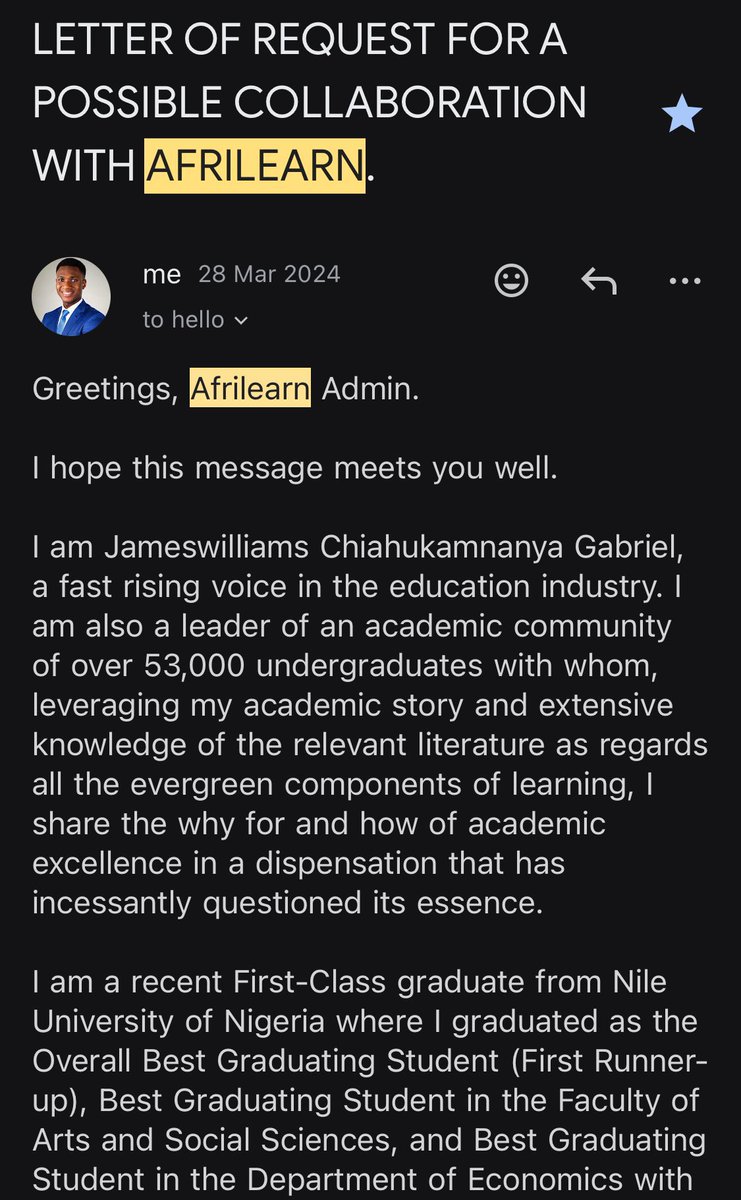
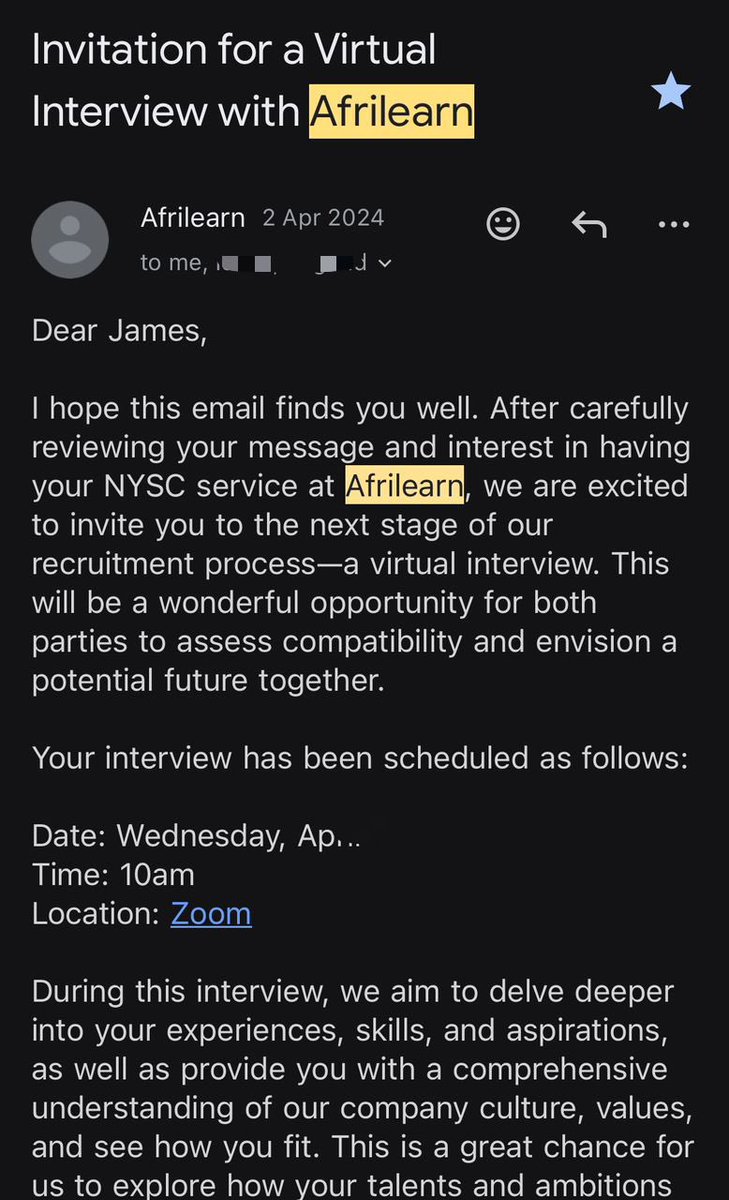
Long story short, I researched and cold-emailed the award-winning, UNICEF-allied Edtech organization named Afrilearn. They were doing work that resonated deeply with my path, democratizing access to education for millions of African kids. I shared my First-Class story, my impact within the education field, my understanding of the market, and just in a few days, I got a reply. We did our interview, and shortly after, they sent a letter to NYSC Headquarters requesting my services. ❤️
I got a job that not only aligned with the direction of my vision but also let me grow my impact within my own field. I hosted conferences, nationwide webinars, and courses during that period, and the organization was willing to sponsor some of these. The relationship was that beautiful.
You do not have to live your life with the common script.
@kamanya_thinks
After NYSC, I started a POS business with just ₦20,000.
Money was finishing fast. I was always running to the bank. I wasn’t making real profit because transport was eating everything. Back then, fintech POS wasn’t common — we were using bank POS.
If I charged ₦100, the bank would take ₦55 and leave me with ₦45 commission days later.
One day, a woman in my estate saw my struggle and said, “You’re suffering running to the bank all the time. I’ll borrow you ₦200,000 to support your business.”
I was shocked. I had never held ₦200k of my own before. But I took the opportunity.
To God be the glory, within 3 months I started making good money — over ₦100k per month.
My principle was simple: punctuality and consistency. Before other POS shops opened by 9am, I was already at my shop by 5:50am. People going to work would withdraw from me first. I could do over 100 transactions before others even opened.
In 6–9 months, I was making over ₦200k monthly.
Then more blessings came. There was a customs barracks in my estate. One officer introduced me to others and I became their trusted POS person. Every weekend they brought big transactions, and they trusted me because I was always reliable and accountable.
There were weekends I handled millions in transactions — all based on trust. And I never broke that trust. Not once.
Even when others opened POS shops out of jealousy, customers stayed with me because of integrity, consistency, and good service.
That POS business didn’t just feed me- It helped me process my travel abroad and achieve many other great things I may not even talk about.
Till the day I left Port Harcourt, I never went late to my shop I never disappointed a customer I never cheated anyone
Lesson: Be faithful with the little you have. Don’t be a thief. Trust and loyalty can take you where capital cannot.
If I were still in university when the EFCC started raiding student rooms, your men would get the same treatment we gave Igbeba police when they tried turning Oru-Ijebu into their office every single time they showed up, until they learned their lesson.
I’m talking about the days when the student union was actually tough, not these hungry boys running around chasing governors.
@abdullahilawal@ephraim3d1@grittyfitty@shehu_mahdi Wait, I don't get your argument? Are you saying their tradition also allow anyone who is not a member of the armed forces to carry AK47? I see how hard you're trying to prove they're not members of any terror group, armed militia or rather bandit, is that logical ?
@1Cyphz@arojinle1 Go to anywhere they sell eran igbe in yoruba land....and ask them you want to buy "Aika".....they get it often. But they keep it mostly for Chinese nationals.
I have eaten it several times 🙈