@Larhny2@jayhemz Same here been applying for visa for 5 years, the people I started with got once some one second attempt, but here I am still thinking how? 🥲
Can you see a proper Omoluwabi? Made sure the reckless driver was caught.
People like him deserves to be celebrated.
From Fadeyi to ikorodu , hopefully police do there work to help the man get justice
“After you win the 2027 election, please come back and listen to us so we can give you our suggestions on how to move the country forward.”
— Nigerians living abroad speak to NDC presidential candidate, Mr Peter Obi, during his visit to Washington, D.C., United States.
Muslim mindset: “I’m fasting. Don’t eat in front of me; you might tempt me.”
Christian mindset: “I’m fasting. Whether people eat around me or not, I must exercise self-control. My discipline should not depend on what others are doing.”
Muslim man: Sees a woman who isn’t fully covered and says, “Cover yourself; you’re tempting me.”
Christian man: Sees the same woman and says, “I am responsible for my eyes, my thoughts and my actions. I must discipline myself.”
Muslim mindset: “Don’t eat pork around me. It is haram.”
Christian mindset: “I may choose not to eat certain things, but I don’t need to control what everyone else eats. My convictions and self-discipline are my responsibility.”
Do you see the difference in the approach?
Christianity teaches us that transformation begins from within. Jesus didn’t come merely to change our external environment, He came to transform the human heart.
The Bible teaches self-control as a fruit of the Spirit (Galatians 5:22–23). We are called to exercise discipline, govern our desires, guard our hearts and take responsibility for our actions.
You cannot keep blaming other people for what you have refused to discipline within yourself.
A woman’s clothing is not an excuse for a man’s lust. Someone else’s meal should not determine your ability to fast. Your environment should not have absolute control over your conduct.
A transformed heart learns to exercise self-control even when the environment offers temptation.
Christianity is not about making everybody around you conform to your weaknesses. It is about allowing Christ to transform you from within.
🇳🇬 DEAR NIGERIANS, PLEASE, LET'S DO SOMETHING TOGETHER!
On the 1st of December 2026, can we all take a moment to participate in a simple online campaign?
Let's flood our WhatsApp statuses, Instagram stories, TikTok, Snapchat and X with one simple message:
VOTE 🗳️ MR. PETER OBI.
You don't need money to participate. You don't need to belong to any political group. All we are asking is for you to use your social media platforms to make your voice heard.
Imagine thousands, even millions of Nigerians posting the same message on the same day.
It may look like a little effort, but collective voices can create conversations and encourage civic participation.
Please, let's make December 1st count.
Let's do this little one together. 🥹🤲🏿🇳🇬
DECEMBER 1ST — ONE MESSAGE, ONE ONLINE CAMPAIGN
NIGERIANS, GO AND VERIFY (4)
Building a Healthy Nation: Our Health Sector Record in Anambra
Peter Obi
In the previous instalment of this series, I discussed our investments in education and explained why we considered human capital development central to the progress of Anambra State. Another sector that received considerable attention under our administration was healthcare. We understood that education gives people the tools to build their future, while good healthcare enables them to live healthy and productive lives.
When we assumed office in 2006, the healthcare system in Anambra faced serious challenges. Our health institutions required rehabilitation, medical equipment was inadequate, many communities lacked accessible primary healthcare facilities, and several medical training institutions had not secured accreditation. We therefore decided to approach healthcare as a comprehensive development priority, rather than concentrate resources on a few prominent hospitals.
Under our Anambra Integrated Development Strategy (ANIDS), we invested simultaneously in primary, secondary, and tertiary healthcare, medical training, maternal and child health, medical equipment, and partnerships with religious and private institutions.
Our approach was simple: healthcare should be accessible to people wherever they live, and the quality of treatment they receive should not depend on their status or whether they live in a city or a rural community.
Building a Teaching Hospital and College of Medicine
One of our most significant achievements was the establishment of the Chukwuemeka Odumegwu Ojukwu University Teaching Hospital at Awka.
We initiated, constructed, equipped, and secured accreditation for the institution, building it virtually from scratch. When I discovered that the state university was admitting medical students without having a teaching hospital through which they could complete their training, possibly with the intention of assigning them elsewhere, I considered the situation unacceptable. We therefore embarked on the construction of a modern teaching hospital to address this deficiency.
We constructed more than 25 buildings and provided facilities for the College of Medicine, laboratories, pathology, accident and emergency services, pediatrics, male and female wards, special wards, consultant clinics, and other essential departments.
We also provided vehicles, including ambulances and staff buses, to support the hospital and the College of Medicine as part of the accreditation requirements.
The objective was not merely to build another hospital but to establish an institution capable of providing specialist healthcare while training the next generation of Nigerian medical doctors.
Rehabilitating General Hospitals
We also recognized that a teaching hospital alone could not meet the healthcare needs of the population. General hospitals had to function effectively because they provide the essential link between primary healthcare and specialist treatment.
We rehabilitated and resuscitated 15 general hospitals across the three senatorial zones of Anambra State. We undertook substantial improvements in their buildings, wards, equipment, and general facilities.
In 2013, we provided ₦400 million for the ongoing renovation of 11 selected general hospitals, alongside other healthcare interventions.
Our intention was to ensure that people did not have to travel unnecessarily long distances to obtain basic secondary medical care.
Taking Primary Healthcare to the Communities
We believed that the best healthcare system is one that prevents illnesses and treats people early, rather than one that waits until minor health problems become emergencies.
That informed our extensive investment in primary healthcare. We built over 120 primary healthcare centers across communities in the 177 autonomous communities of Anambra State and rehabilitated existing facilities.
You are already crying before Nigerians work on you? 🤣
Madam, we are earnestly waiting for you to post that interview with Tinubu
Whether you are working for the Nigeria government under contract is no longer a thing of argument as there are several public documents to back it up
ALL WE ARE SAYINNNNNG! POST THE INTERVIIIIIEEEEWWWWW!
CLARIFICATION: MY MEETING WITH US CONGRESSIONAL LEADERS WAS NOT AN ENDORSEMENT-SEEKING MISSION
I wish to address the inaccurate interpretation presented in certain media reports concerning my recent engagements with members of the United States Congress in Washington, DC.
As I expressly noted in my remarks, my visit to the United States was not intended to secure an endorsement, and I did not characterise my meetings as endorsements of my political aspirations by the US Congress or any of its members.
The primary purpose of the visit was to engage with congressional leaders and other influential American stakeholders, exchange perspectives, and discuss matters related to Nigeria’s development, the welfare of our citizens and, most importantly, the consolidation of our democracy.
I am especially concerned with strengthening democratic institutions, advancing accountability, and ensuring that Nigeria’s electoral process produces elections that are free, fair, transparent and credible. These matters should concern every Nigerian who is committed to our country’s future.
I consider engagements of this kind valuable, and I encourage other Nigerian political leaders, especially those seeking public office, to pursue similar discussions with international stakeholders. Our democracy can be strengthened through constructive dialogue, the exchange of experiences and a shared commitment to credible elections.
Nigeria’s democratic future is far too consequential to be distorted by sensational headlines or inaccurate interpretations. My mission centred on Nigeria, its people and the future of our democracy—not on endorsing any individual. -PO
Endless Human Bloodletting and Failure of Intelligence
I am deeply saddened and troubled by reports that at least nine people were killed in the Zuwagal community, Mangu Local Government Area of Plateau State, in yet another assault on innocent Nigerians. These deaths have occurred amid a deeply concerning pattern of recurring attacks, displacement and the destruction of communities throughout the country.
Data from the past two weeks are alarming. OpenWatch's security incident records show 261 reported deaths across Nigeria between 2 and 15 November 2026, including 24 in Plateau during the first week and 15 during the second. Plateau also reported additional attacks on 16 November.
These victims are not merely numbers. They were fathers, mothers, children and breadwinners whose lives were abruptly ended, leaving families and entire communities to mourn.
Why are communities being threatened without receiving adequate protection? Why are intelligence reports failing to result in preventive action? How many more innocent Nigerians must lose their lives before decisive measures are implemented?
I call on the Government and security agencies to immediately reinforce security operations in vulnerable communities; thoroughly investigate these attacks and ensure that both the perpetrators and those who support them face justice; establish reliable early-warning and rapid-response systems; deliver humanitarian aid and rehabilitation services to displaced families; and release transparent, accurate casualty figures for all affected communities.
We must also confront the root causes of insecurity by strengthening accountable institutions, intelligence gathering, justice, education, economic opportunity and meaningful engagement with communities.
Every Nigerian life is valuable, regardless of ethnicity, religion or political affiliation. The right to life must never be subject to negotiation.
My deepest condolences go to the bereaved families and the people of Plateau State. May God comfort them and bless our country with peace.
Nigeria must do more than mourn those who have died. We must protect those who are still living. -PO
“Fact Doesn't Lie”
A man reacts after spotting an ambulance donated by Mr Peter Obi to a hospital more than 14 years ago while he was Governor of Anambra State. The ambulance was seen still in use today, November 17, 2026.
NIGERIANS, GO AND VERIFY (3)
Building the Future Through Education
Peter Obi
In the first two instalments of this series, I explained how we approached the task of building strong institutions and laying a solid foundation for the development of Anambra State. One of the most important institutions we invested in was education.
For me, education was not a political game or a convenient political promise. Even before I ventured into politics, I had always regarded it as the foundation of meaningful development and the most enduring investment any government can make in its people. I believe that the future of any society depends largely on the quality of its educational institutions, teachers, learning environment, and opportunities available to its young people.
This conviction informed our decision to invest across the entire educational spectrum, from primary schools to universities, technical institutions, and adult education.
Basic and Secondary Education
One of our first major decisions was to return mission and privately owned primary and secondary schools to their original proprietors while retaining government support. We also provided billions of naira to assist in rehabilitating the returned schools, restoring the partnership between government and religious institutions that had historically contributed to educational excellence.
This policy attracted international attention. Professor Paul Collier, the Oxford economist and World Bank consultant, led a World Bank-commissioned study of Anambra’s educational transformation. His team examined our decision to return schools to their original missionary owners while retaining government responsibility for funding teachers’ salaries and supporting infrastructure. The team described the partnership model as a revolution in public service delivery and recommended it as a model that could be replicated by other Nigerian states and developing countries. We believed then, as we do now, that government does not necessarily have to own every institution to discharge its responsibility effectively. What matters is ensuring that every child has access to quality education.
For those who claim that we built no schools, I invite them to verify our records. We constructed five-classroom blocks in virtually all of the 177 communities in Anambra State, one of the most extensive community-based school infrastructure programmes undertaken by any state government. The town union chairmen and community leaders of that period can attest to this.
We also renovated hundreds of dilapidated schools, including some where trees had literally grown through abandoned buildings. Comprehensive Secondary School, Onitsha, and Oraukwu Grammar School are examples.
Beyond infrastructure, we distributed approximately 40,000 computers to schools, including more than 22,500 HP laptops. We equipped secondary schools with Microsoft Academies and connected schools across the state to the internet. We supplied generators, established and stocked libraries, revived school sporting activities, and installed boreholes in over 300 schools, including all girls’ schools. We also provided funding to support sporting activities in all our secondary schools.
These technology investments attracted remarkable international recognition. Mr Fabrice Campoy, Managing Director of the Personal Systems Group at HP Inc., described our procurement and distribution of over 22,500 HP laptops as the biggest project of its kind in the Middle East and Africa. Similarly, Mr Ken Spann, then Country Manager and Head of Microsoft Nigeria, described the establishment of Microsoft Academies in more than 500 Anambra secondary schools as the most extensive deployment of its kind in Africa at the time.
"All we are saying, give us Obi," rents the air as Peter Obi draws supporters on the doorstep of a London think-tank. Maaad moves ...since the year 1900. Obi is coming and Nigeria will be OK.
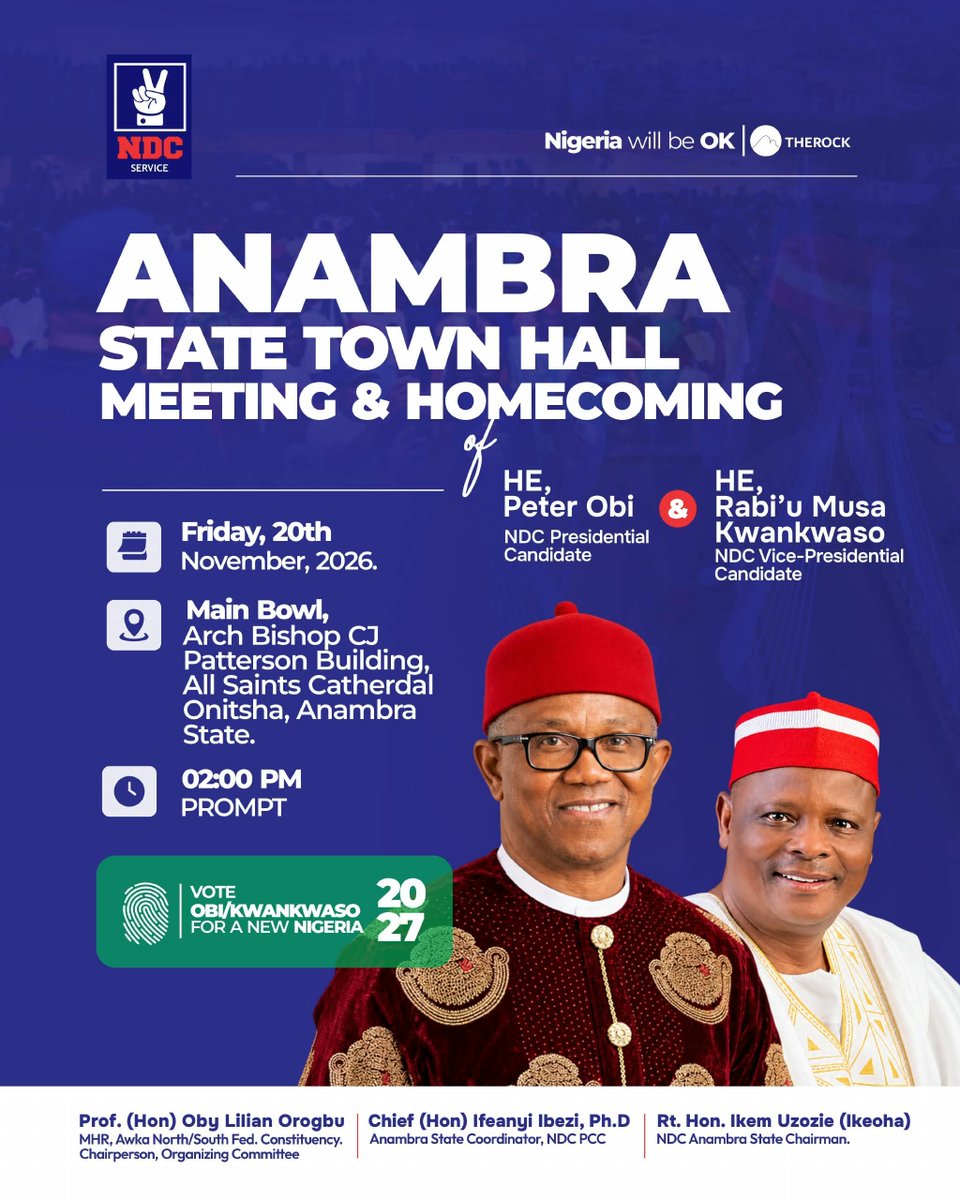
NDỊ ANAMBRA, LET US WELCOME OUR SON HOME
On Friday, November 20, Anambra will welcome His Excellency, Mr. Peter Obi, as he returns home for a special Homecoming and Town Hall Meeting.