Started a blog — The Division of Field Notes — to surface research that regulators, policymakers, and researchers can immediately use. Follow along here: https://t.co/EPgBP35WWq
1. Excited to be launching the Center for Law and the Economy @ColumbiaLaw with @LevMenand. The Center will focus on pressing questions of economic governance and help train the next generation of scholars and policy leaders.
https://t.co/wpc6RwjaJK
I am immensely excited and grateful for the opportunity to speak at @Harvard_Law on March 11. I will be discussing how antitrust is shapes power and democracy. If you are a current HLS student, please come to the event and say hello. https://t.co/np2TFbx3zT
Thrilled that Sam Levine will join @ZohranKMamdani’s administration as Commissioner of the Department of Consumer & Worker Protection.
While leading our consumer protection work @FTC, Sam took on predatory tactics by corporate landlords, fraudsters that squeezed workers and small businesses, and illegal subscription traps and junk fees.
@saalevine is an extraordinary public servant who will enforce the law without fear or favor, ensuring that consumers and workers across NYC get a fair shake.
Loyalty programs promise big savings — but often become a Trojan horse for invasive surveillance, hidden price hikes, and traps to keep us from leaving.
In a new report with @stephtngu, we show how these programs are devolving into a testing ground for surveillance pricing.
@nirajc@nytimes had an article about how United and Delta are capturing most of the airline industry's profits. That this is the case not only makes the airline industry more vulnerable to economic shocks, but also demonstrates the worsening regional inequality in America.
After the industry's turmoil in the 2000s, United and Delta found a pathway to profitability by pursuing wealthy coastal cities, forging exclusive credit card deals, and benefitting from consolidation. But their success comes at the cost of adequately serving the rest of America.
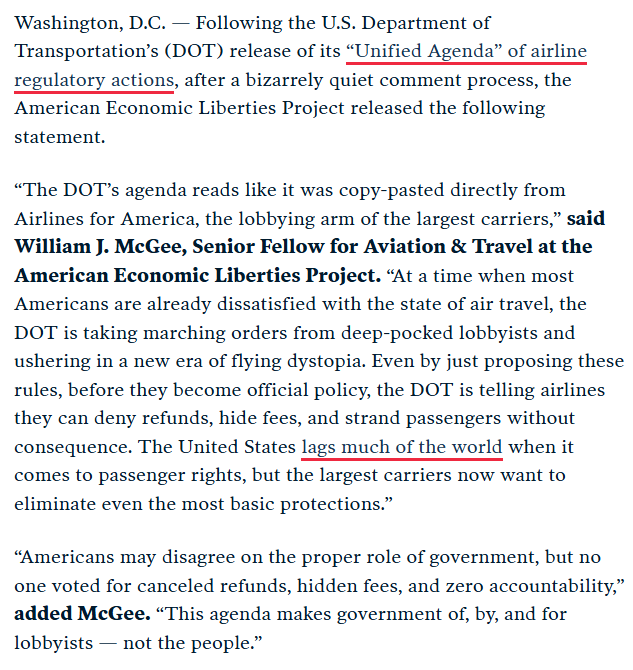
The DOT is now proposing to hand the big airlines their wish list: gutting refund rules, hiding junk fees, and letting carriers strand passengers with no accountability.
As @WilliamJMcGee says, “This agenda makes government of, by, and for lobbyists — not the people.” 👇
Back at my desk, back online, and have already moved to reinstitute the Click to Cancel Rule. Hope a majority of the Commission will join me - all Americans deserve to be protected from abusive subscription traps.
To recap:
Firms have been making people jump through endless hoops just to cancel a subscription, trapping Americans in needless bureaucracy and wasting their time & money.
@FTC began writing a “click-to-cancel” rule promoting efficient cancellation, a rulemaking process that took 3+ years and required reviewing 16k comments & giving industry a chance to present their views at an FTC hearing.
Big business interests sued to block the “click-to-cancel” rule—and Republican-appointed judges tossed it out, concluding that industry needed MORE time and process to explain why they opposed the rule.
This exemplifies big obstacles to effective governance that deserve much more scrutiny than they currently receive.
Ever wonder why clicking “I agree” means giving up your privacy? Two decades ago, FTC leaders argued tech could police itself, and gov’t should focus on disclosures.
That moment helped birth an internet built on unchecked surveillance. And it was no accident. 🧵
In a Feature, @linamkhan, @saalevine, and @stephtngu review the FTC’s changes under their leadership to better rein in data abuses. https://t.co/JpDE68DN9I
In December, FTC started enforcing a long-forgotten law that levels the playing field for the small retailers who serve rural and urban America. The FTC team just won a big victory in that case.
I’m a teacher, union leader, and father, and I'm running for Congress in southern Minnesota.
I grew up poor here, so I know what high prices and gutted public programs mean to working families.
Meanwhile, Brad Finstad is jacking up prices and won't listen to us.