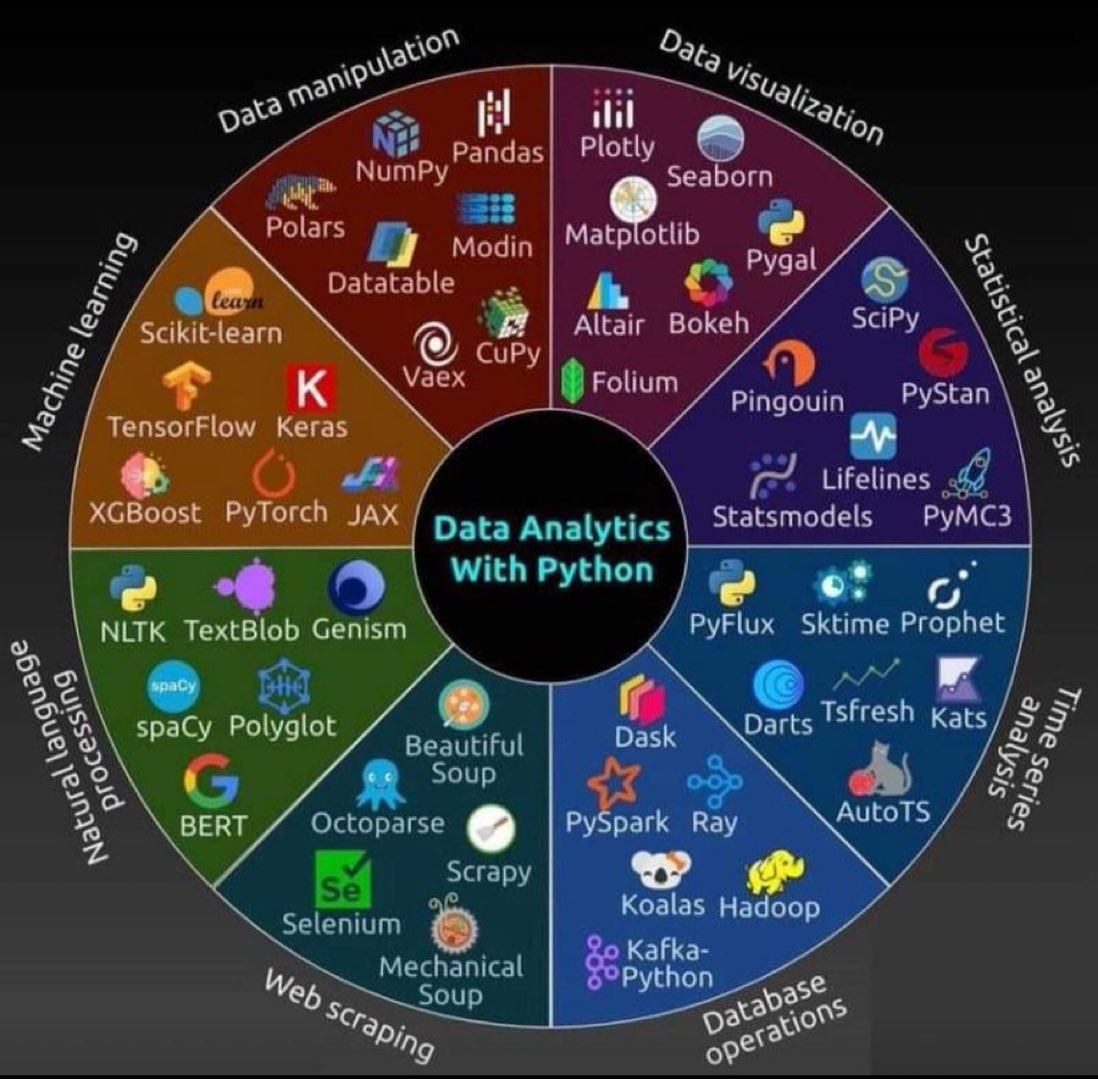
Someone turned Claude into a one person company.
42 skills, organised like a real org chart (links below):
Here is every department, and where to get each one.
Developers:
Superpowers → https://t.co/pPPxKoPEwD
Context7 → https://t.co/3Kk9U8PG1T
Skill Creator → https://t.co/Lanao7tpOh
MCP Builder → https://t.co/Lanao7tpOh
Webapp Testing → https://t.co/Lanao7tpOh
Claude-Mem → https://t.co/yTb8qxqa7S
Designers:
UI UX Pro Max → https://t.co/MQTtS9flwt
Taste → https://t.co/AEq4GZc60x
Frontend Design → https://t.co/AEq4GZc60x
Transitions → https://t.co/Z7JOt7lJb2
Web Artifacts → https://t.co/Lanao7tpOh
Brand Guidelines → https://t.co/Lanao7tpOh
Marketing:
45 skills to run your marketing, from copywriting to SEO to lead magnets.
Access them all here → https://t.co/OWo258NM7L
Social Media:
17 skills to run your social media, from post writing to Reels to thumbnails.
Access them all here → https://t.co/2qawCgAyQF
Finance:
8 skills to run your finances, from statements to reconciliation to audits.
Access them all here → https://t.co/X6dVFcZBIJ
Small Business:
31 skills to run your small business, from cash flow to payroll to invoicing.
Access them all here → https://t.co/7Prb2sXVpI
Legal:
9 skills to handle your legal work, from contract review to NDAs to compliance.
Access them all here → https://t.co/GKaZzGYPOr
---
Every skill on the chart is real and installable from the links above.
Same departments. Same output. No payroll.
Save this.
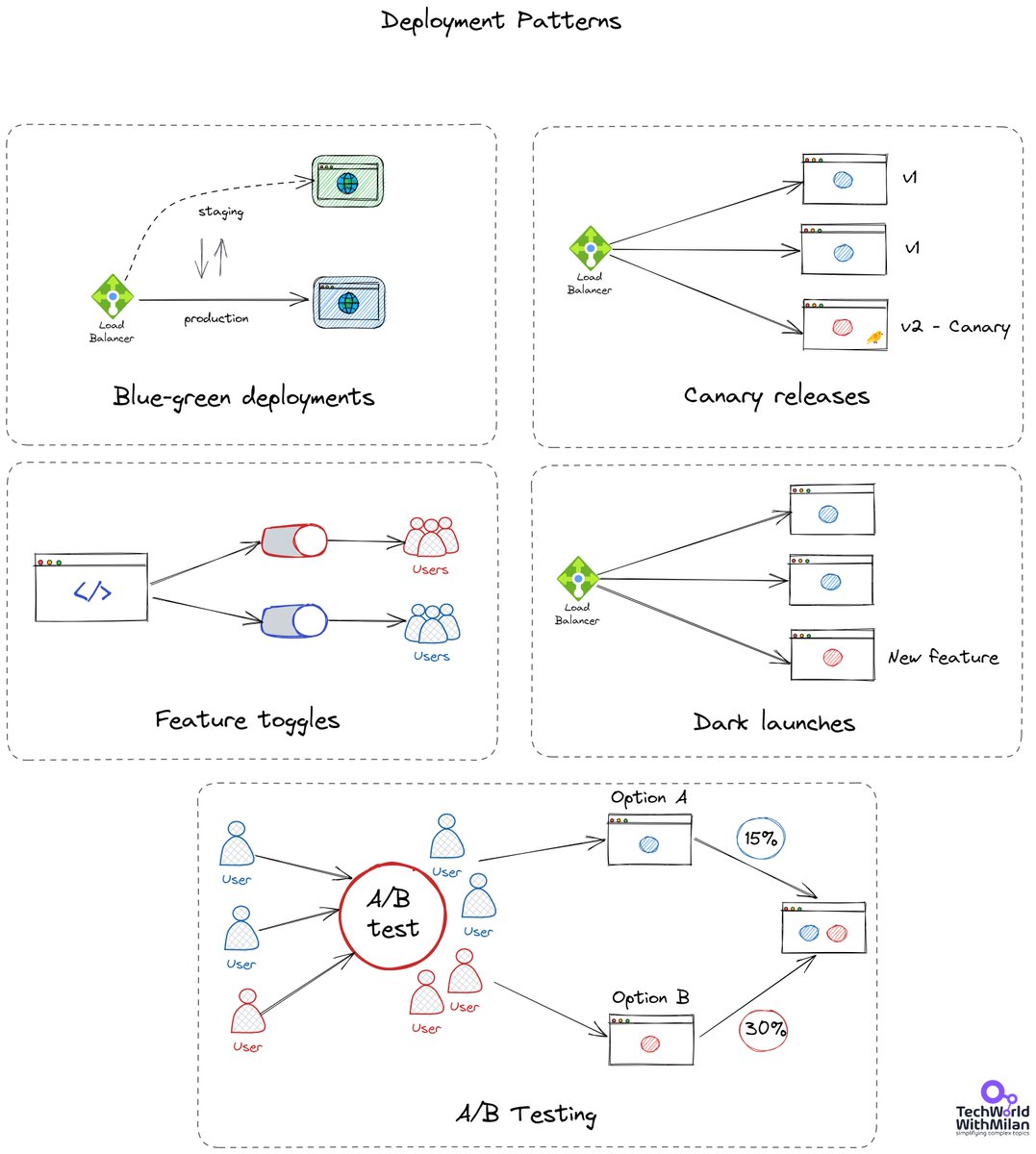
𝗪𝗵𝗮𝘁 𝗮𝗿𝗲 𝗗𝗲𝗽𝗹𝗼𝘆𝗺𝗲𝗻𝘁 𝗣𝗮𝘁𝘁𝗲𝗿𝗻𝘀?
Deployment patterns are automated methods of introducing new application features to your users. Your ability to cut downtime depends on the deployment style you use. Some patterns also let you roll out extra functionality. Doing this allows you to test new features with a small group of users before making them available to everyone.
We have different options for deployment patterns:
𝟭. 𝗖𝗮𝗻𝗮𝗿𝘆 𝗿𝗲𝗹𝗲𝗮𝘀𝗲𝘀
A canary release is a method of spotting possible issues before they affect all consumers. Before making a new feature available to everyone, the plan is to show it only to a select group of users. We monitor what transpires after the feature is made available in a canary release. If there are issues with the release, we fix them. Once its stability has been established, we transfer the canary release to the actual production environment.
𝟮. 𝗕𝗹𝘂𝗲/𝗴𝗿𝗲𝗲𝗻 𝗱𝗲𝗽𝗹𝗼𝘆𝗺𝗲𝗻𝘁𝘀
We have run two similar environments simultaneously, lowering risk and downtime. These surroundings are referred to as blue and green. Only one of the environments is active at any given moment. A router or load balancer that aids in traffic control is used in a blue-green implementation. The blue-green deployment also provides a quick means of performing a rollback. We switch the router back to the blue environment if anything goes wrong in the green environment.
𝟯. 𝗙𝗲𝗮𝘁𝘂𝗿𝗲 𝘁𝗼𝗴𝗴𝗹𝗲𝘀
Here, we can turn a switch on/off with feature toggles at runtime. We may roll out new software without exposing our users to any other brand-new or modified functionality. When we build new functionality, we can use feature toggles to enable continuous deployments by splitting releases from deployments.
𝟰. 𝗔/𝗕 𝘁𝗲𝘀𝘁𝗶𝗻𝗴
Two versions of an app are compared using A/B testing to see which one performs better. An experiment is like A/B testing. In A/B testing, we randomly present users with two or more page versions. Then, we use statistical analysis to determine which variant is more effective in achieving our objectives.
𝟱. 𝗗𝗮𝗿𝗸 𝗹𝗮𝘂𝗻𝗰𝗵𝗲𝘀
In a "dark launch," we introduce a new feature to a select group of users rather than the general public. These users are unaware that they are helping us test the functionality. We don't even point out the new functionality to them. It is nicknamed a "dark launch" for this reason. Users are introduced to the program to get feedback and test its effectiveness.
#technology #softwareengineering #programming #techworldwithmilan #devops
What Does ACID Mean?
Below is a breakdown of the ACID properties, which are critical to the operations of database transactions.
🔹 Atomicity
A transaction is a single unit of operation – either all its data modifications are performed, or none are. If a fault occurs during the transaction, all changes are rolled back as if the transaction never occurred. This "all or nothing" approach guarantees a database transaction is atomic.
🔹 Consistency
Consistency refers to maintaining the database's integrity constraints. Any transaction will only transition the database from one valid state to another, adhering to predefined integrity rules. Unlike consistency in the CAP theorem relating to write visibility, ACID consistency focuses on the validity of transactions.
🔹 Isolation
Isolation ensures concurrently executing transactions cannot view or interfere with each other's intermediate states. While complete "serializability" would run transactions sequentially, practical systems often necessitate weaker isolation levels that still protect integrity at better performance.
🔹 Durability
Once committed, a transaction will persist even after system failures. This means changes are permanent and survive crashes. In distributed databases, durability involves replicating transaction data across nodes to prevent loss.
–
Subscribe to our weekly newsletter to get a Free System Design PDF (158 pages): https://t.co/kNfv0DVDdf
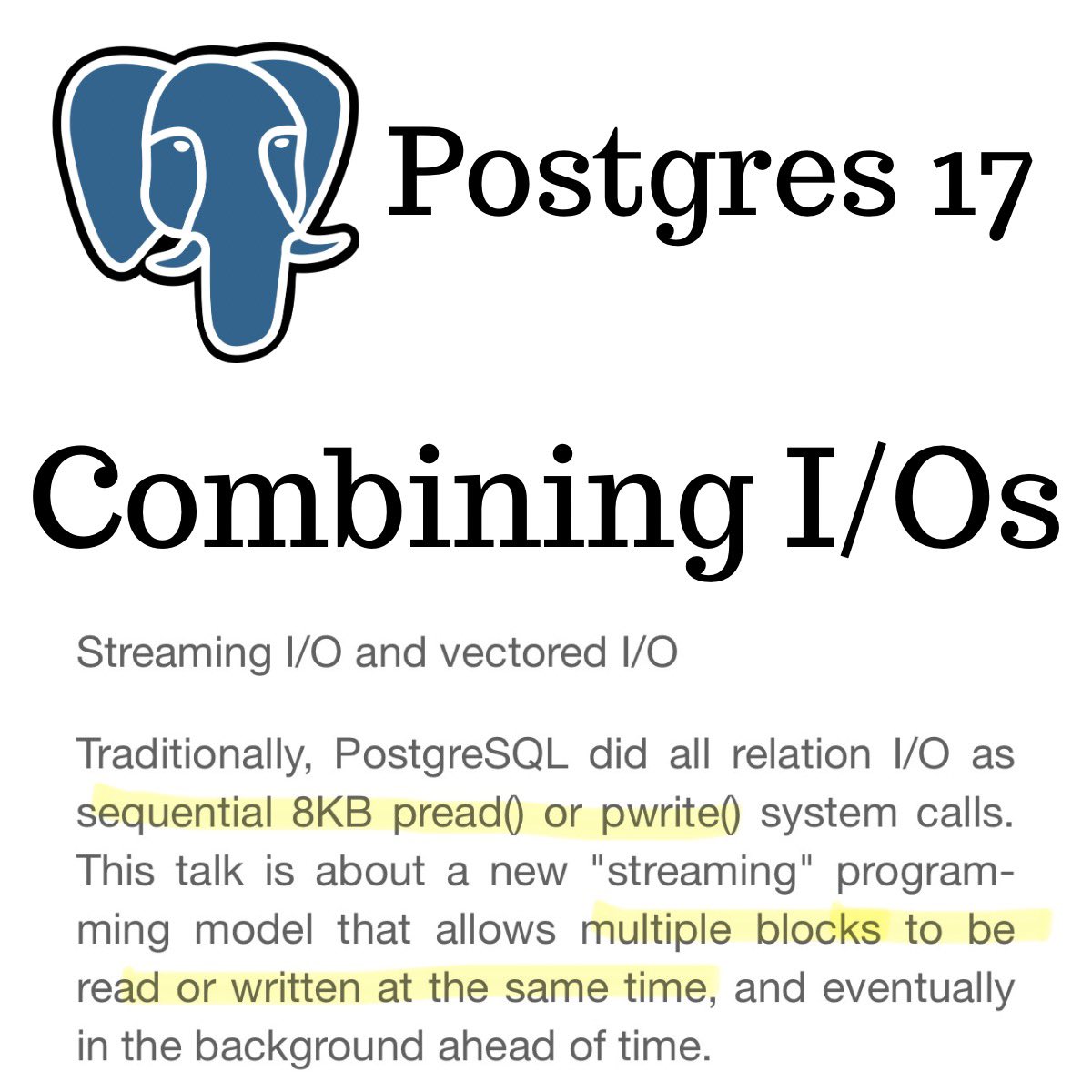
This Postgres 17 feature is amazing
You see, postgres like most databases work with fixed size pages. Pretty much everything is in this format, indexes, table data, etc. Those pages are 8K in size, each page will have the rows, or index tuples and a fixed header. The pages are just bytes in files.
For example, to read page 0 you would call read on offset 0 for 8192 bytes, To read page 1 that is another read system call from offset 8193 for 8192, page 7 is offset 57,345 for 8192 and so on.
If table is 100 pages stored a file, to do a full table scan, we would be making 100 system calls, each system call had an overhead (I talk about all of that in my OS course).
The enhancement in Postgres 17 is to combine I/Os you can specify how much IO to combine, so technically while possible you can scan that entire table in one system call doesn’t mean its always a good idea of course and Ill talk about that.
This also seems to included a vectorized I/O, with preadv system call which takes an array of offsets and lengths for random reads.
The challenge will become how to not read too much, say I’m doing a seq scan to find something, I read page 0 and found it and quit I don’t need to read any more pages. With this feature I might read 10 pages in one I/O and pull all its content, put in shared buffers only to find my result in the first page (essentially wasting disk bandwidth, memory etc)
It is going to be interesting to balance this out.
Good work Pg team! More here
https://t.co/YB6kEdNl6A
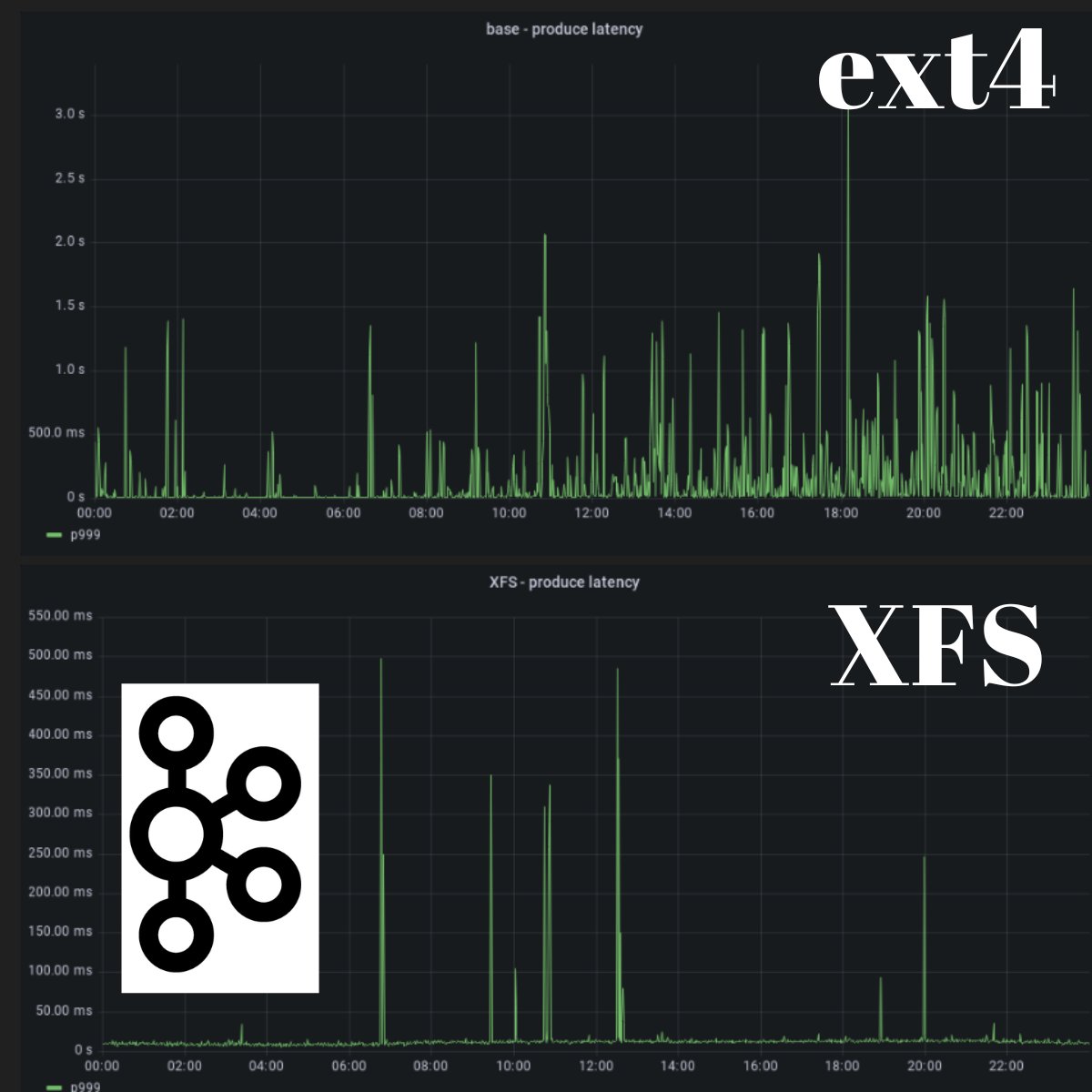
I love reading such detailed technical articles, those guys took Kafka apart and managed to understand the cause of their 3 seconds write latency in Kafka producers. Turns out it was caused by the flush/commit of the ext4 file system journal metadata. Of course doesn't mean ext4 is bad it's just not a fit for Kafka's workload. So they end up switching to XFS and improve the writes by 82%!
The way they discovered this is interesting, all the tooling they wrote for Java/Kernel is just amazing, recommend you guys checking it out.
full article
https://t.co/WxcsWoHPgm
I'll make a video covering this in details once I get a chance, I want to learn more about XFS and ext4, my knowledge there is limited.
I did a brief summary on the article on my second channel for those interested https://t.co/CZFOsrNxL9
launchbadge / sqlx: 🧰 The Rust SQL Toolkit. An async, pure Rust SQL crate featuring compile-time checked queries without a DSL. Supports PostgreSQL, MySQL, and SQLite. ★11123 https://t.co/G6QWcPellN
A new open-source MySQL replicator is now available for Magento 2! ♻️
The Mage-OS Database Changelog Generator module connects to a MySQL database as a replication service& aggregates updates in the database tables.