International media in the last 30 days: "India Hunger strike", "protests in India", "Floods in India."
🇮🇳India in the last 30 days:
July 19, 2026: Indian Gen-Z team wins 4 gold medals (top rank) at International Chemistry Olympiad and medals at the International Biology Olympiad.
July 18, 2026: Young Indians working at Skyroot Aerospace successfully launch Vikram-1, India’s first privately developed orbital-class rocket, from Sriharikota, placing payloads into Low Earth Orbit.
July 17, 2026: PM Modi flags off India’s first indigenous hydrogen-powered passenger train (10-coach set) from Jind station, Haryana, on the Jind-Sonipat route as an inaugural service.
July 14, 2026: DRDO completes successful military field trials of an indigenous scalable fiber-based Quantum Key Distribution (QKD) system for secure strategic communications.
July 13, 2026: Lucknow-Kanpur Expressway (63 km), India’s first barrier-free expressway with satellite-based tolling, opens to traffic.
July 12, 2026: Young Indian team wins 5 gold medals at the 56th International Physics Olympiad (IPhO 2026) in Colombia, securing joint world #1 rank.
July 11, 2026: RM Rajnath commissions INS Mahendragiri, the sixth Project 17A stealth frigate, in Visakhapatnam (~75% indigenous content).
Early–mid July 2026: Vimag Labs (Bengaluru) secures its 5th Indian patent for the Virtual Magnet Synchronous Motor (VMSM), a software-defined rare-earth-free electric motor platform.
Early July 2026: ISRO announces plans for a new Satellite Earth Station campus near Ledo in Assam to strengthen space communication in the Northeast.
Early July 2026: IIT Gandhinagar team wins a grant for developing indigenous liquid cooling plates for AI data centres, EVs, and high-performance electronics.
June 26, 2026: Nuclear heat-based hydrogen production facility (copper-chlorine thermochemical cycle) commissioned at Kalpakkam using Fast Breeder Reactor process heat.
June 24, 2026: ISRO successfully conducts hot test of semi-cryogenic engine power head at 175 tonnes thrust level.
June 24, 2026: RDSO (with ARAI) successfully conducts full-scale crashworthiness testing of LHB coaches for enhanced passenger safety.
June 21, 2026: PM Modi commissions three indigenously built warships in Kolkata: INS Dunagiri (Project 17A stealth frigate), INS Sanshodhak (hydrographic survey vessel), and INS Agray (ASW shallow water craft).
June 15, 2026: DRDO successfully flight-tests the indigenous Long Range Land Attack Cruise Missile (LRLACM) from Odisha; all objectives met.
June 10–11, 2026: DRDO conducts successful Phase-2 Ballistic Missile Defence (BMD) trials and anti-ship missile tests, demonstrating capabilities against long-range ballistic threats including ICBM-class.
Mid-June 2026: India’s defence production reaches a record ₹1.78 lakh crore in FY 2025-26.
Mid-June 2026: Maiden flight of the indigenous C-295 military transport aircraft highlighted as a major self-reliance milestone in aviation (with 40 aircraft under production in India).
June 13, 2026: First batch of women cadets trained at NDA commissioned into the defence forces. Marking the start of an women empowered era in defence.
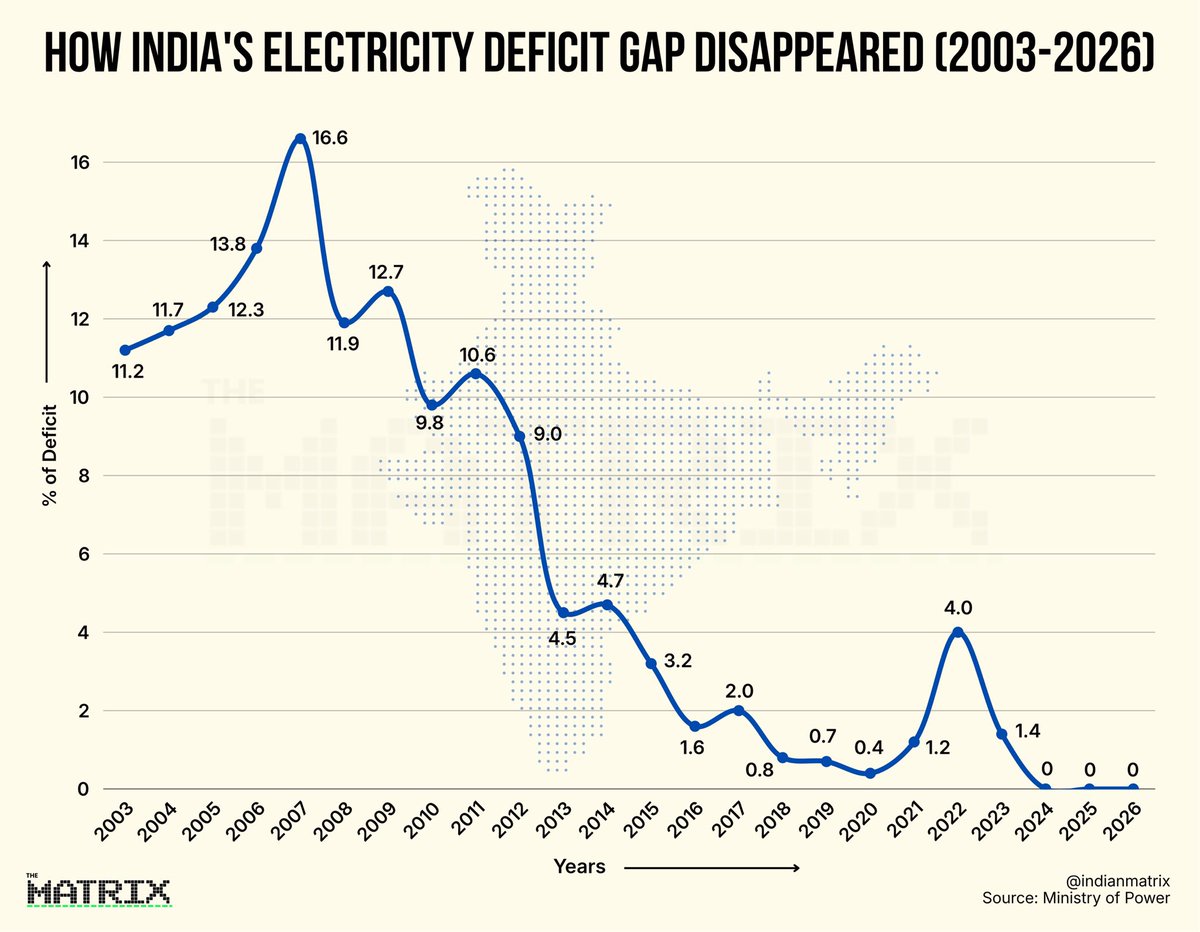
In 2005, India couldn’t meet 12.3% of its own peak demand. By 2007, the shortfall had widened to nearly 16.6%, and close to 18,000 megawatts were unavailable.
The early 2000s were years of genuine electricity poverty. Factories ran on diesel backup generators as a matter of routine. Homes in smaller cities and villages received power for a few hours a day.
Distribution, which is the final link between the grid and the household, was historically the most neglected and most corrupt part of the chain. Electricity theft was widespread, billing was unreliable, and state electricity boards were financially broken.
Reforms here were uneven and politically difficult, but schemes like UDAY, launched in 2015, restructured the debt of state distribution companies and pushed them toward financial viability. The Saubhagya scheme, from 2017, connected the last unelectrified households, around 25 million of them, to the grid by 2019.
India’s solar capacity in 2010 was negligible. Today, it is measured in hundreds of gigawatts. The price of solar panels fell globally by over 90% across this period, and India made a strategic bet to capture that cost decline at scale. Rooftop solar programmes brought electricity generation to homes, factories, and commercial buildings. And the International Solar Alliance, co-founded by India in 2015, helped build global momentum.
The timing proved critical. India’s peak electricity demand now falls in the afternoon, driven by air conditioning in an increasingly hot country. Solar generates hardest in exactly those hours.
On April 25, around 12:30 pm, solar plants and rooftop systems together supplied roughly one-third of all electricity being generated at that moment. Across the full day, solar’s share was around 22%.
India today draws 52% of its electricity from non-fossil sources. More than half of every unit generated comes from sun, water, wind, or nuclear.
The deficit percentage, which once sat stubbornly above 10%, has now collapsed. Since 2024, it has been effectively zero.
Reliable electricity means a small business owner does not budget for a diesel generator as a fixed cost. It means an electric vehicle is practical for someone who cannot afford to be stranded. It means a student in a rural home can study at night without planning around power cuts. It means a hospital runs its equipment on the assumption that the supply will hold.
Electricity reliability is, in the end, a quiet form of equity. When the grid is unreliable, those with money buy backup. Those without simply go without. India's closing of its power deficit means that the gap no longer falls along economic lines.
The country that once rationed darkness now delivers light on demand, at the moment of highest need, to everyone connected to the grid.
That took two decades and thousands of infrastructure decisions. It is not the kind of achievement that fits in a headline. But on an April afternoon, when 256 gigawatts flowed, and nothing broke, it showed.
Imagine Bumrah, Pandya having 1 over to spare and Dube giving 46 in his 2 overs!
Absolute soul-crushing bowling!!!!
God please, why tf is Dube bowling?????
#INDvsZIM
@varun067 Marketing the way it’s done today is highly inefficient and leads to wastage.
Everyone thinks they’re sniping but everyone just carpet bombs ..
Another perspective: we Indians love serving.
Our gods, country, guests .. and our lords, and anyone with fine silver to throw at us.
1.4B great, and all just serving.
Thoughts from DP World India:
-I had a little trepidation before coming to India but I honestly had a great time this week. The golf course was super unique, but played into my strengths and everyone treated us great. I can’t thank DP World enough for inviting me and hosting an awesome tournament.
-Special shoutout to the Oberoi hotel. Easily top 5 hotels I’ve ever stayed, mainly because of the staff. There’s a higher staff to guest ratio than anywhere I’ve been and every one of them treats you like a king.
-Food was great. I never had the Delhi belly and there was lots of spice in the food which I loved.
Mockery of a system.
We are seeing institutional reforms in years — and this is what they do to its messengers.
He’s on the PM EAC. Imagine even he can’t question the “mi lords”.
We live in a system that feeds on itself.
🚨 AG’s consent sought to launch criminal CONTEMPT against PM's EAC member Sanjeev Sanyal for questioning Why judges take LONG VACATIONS while doctors & cops don’t shut services
— Yashwant Varma is enjoying LUXURY, while people are getting THREATS. Wow👏🏼
BIG BREAKING: Maoists announce ceasefire and giving up arms. Statement issued from CPI Maoists Spokesperson Abhay. Home Minister Amit Shah had earlier announced March 2026 as deadline for security forces to completely end Maoists from Indian soil. Big win for security forces.
India has tried building gas turbine engines before. And we’ve come close.
At LAT, we want to get past the finish line. So we’re putting together a propulsion research team in Bangalore, focused solely on building gas turbine engines from scratch. Lightweight. Efficient. Flight-ready. Made in India.
What’s different this time?
We’re giving engineers the freedom to think, build, break, and repeat. Our dedicated research centre — with labs for combustion, turbomachinery, thermal systems, and materials, will give engineers the space and freedom to iterate fast, and get to real outcomes at a speed which is unprecedented in the industry.
Also, this team will be led by engineers. No waiting around for approvals from "business" people. No chasing slides or meetings. Just hands-on problem solving, running bench tests, working with suppliers, building hardware from scratch — and pushing the limits of design and physics every day.
It won’t be easy. But if it works, it changes everything. A full engine stack, built locally. Powering STOL aircraft. UAVs. Remote connectivity. Self-reliance.
If you’ve ever built turbines, rotors, control systems — or anything close — and want to be part of something that could one day, rewrite history, write to us at [email protected]
—
Note: LAT is not a part of Eternal