Some notes on Negotiations
1/ When you finish any complex deal you will feel fatigued and worn out. It sometimes feels hard to celebrate. The best deals feel this way. Complex negotiations require compromises. When both (or all) parties make concessions nobody feels great. Everybody felt like they gave more than they wanted. And all wish the other party would have folded easier. That’s the definition of a good negotiation
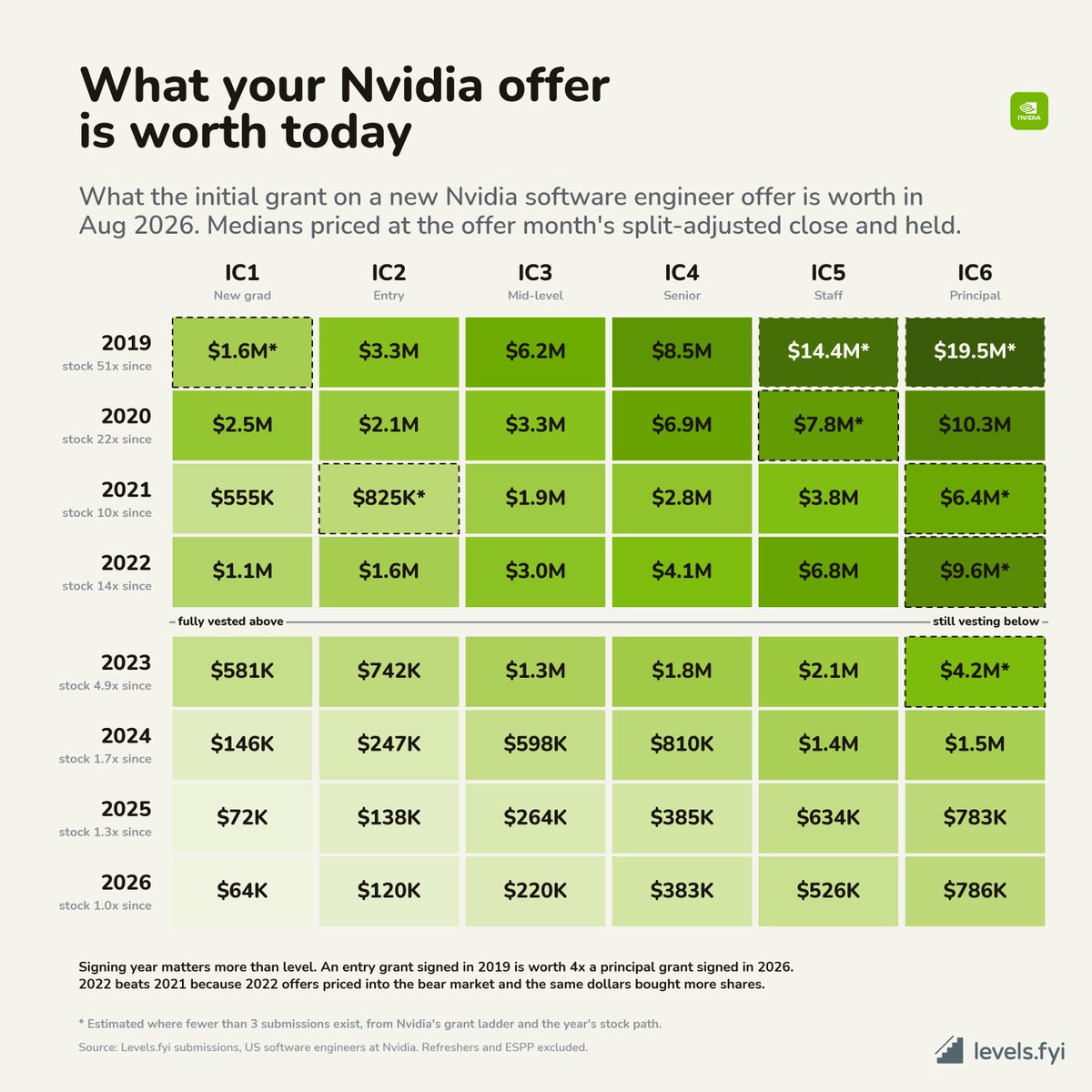
Wow, 50% of employees at @nvidia have a net worth of $25M+ according to recent reports. It prompted me to dig into our data to see what employees made out with in the last few years.
One of my favorite measures of success for a company is how many millionaires are minted through its growth, and how deep: $1M, $10M, $25M
Here's how much your Nvidia stock grant would be worth at each year and level of joining as a software engineer, repriced at today's stock value.
It actually doesn't break $25m as per our analysis here, which leads me to believe that there's a large veteran population at the company from even prior.
Also, keep in mind we aren't counting refreshers or any additional grants on top of your initial one. And we're assuming you held the full amount all the way through.
An interesting tidbit: you'll notice that in 2021, there was a peak in Nvidia stock price, ending up making the stock value lower that year than in 2022.
What a run though, and incredible value creation. The net profit generated per employee at Nvidia is something to behold.
The Myth of “Love Learning”
People often ask me how to get better at chess. My answer is almost the opposite of what people expect.
You don’t have to love learning.
In fact, if you wait until you love the process, you’ll probably never become very good.
We romanticize improvement. We imagine great players waking up excited to study endgames, analyze losses, or memorize opening lines. Sometimes that’s true. Most of the time it isn’t.
Improvement is often boring.
The difference between an amateur and a professional isn’t that the professional enjoys every minute. It’s that they keep going when they don’t.
People say children are fearless learners. I’m not so sure.
Children quit things constantly. Piano. Swimming. Languages. Football. Chess. They usually continue only because someone else insists they do. Parents. Teachers. Coaches.
Discipline often comes before passion, not after.
The same is true for adults.
We tell people to “follow your curiosity.” That’s wonderful advice if curiosity happens to last. Usually it doesn’t.
Every meaningful skill has a point where curiosity runs out and routine takes over.
That’s where improvement actually begins.
Chess certainly did not always feel like play to me.
There were tournaments where the last thing I wanted to do after six hours of defending a miserable endgame was analyze another five hours.
There were openings I studied not because they fascinated me, but because my opponents forced me to.
There were positions I analyzed simply because they were objectively important.
Not because they were fun.
Because they needed to be done.
People often criticize schools for asking the wrong questions.
But there’s another side to that story.
If everyone only studied the questions they found interesting, most people would develop huge blind spots.
Sometimes someone else knows what you need to learn before you do.
Nobody is naturally curious about tax law before becoming an accountant. Or anatomy before becoming a surgeon. Or rook endings before losing enough of them.
External structure isn’t always the enemy of learning.
Often it’s the bridge that gets you to the point where genuine curiosity develops.
The biggest obstacle isn’t fear of looking stupid.
It’s our addiction to doing only what feels rewarding today.
Modern life gives us endless opportunities to switch the moment something becomes difficult.
A new opening.
A new productivity system.
A new app.
A new hobby.
Very few people simply keep doing the same useful thing for years.
That’s the superpower.
So when people ask how to improve at chess, I don’t tell them to fall in love with learning.
Love helps.
Curiosity helps.
Being willing to fail helps.
But none of those are reliable.
Build habits that survive the days when none of those feelings are there.
Because mastery isn’t built on motivation.
It’s built on showing up after motivation has left the room.
One thing I’ve noticed after more than two decades of professional chess is that almost everyone dramatically underestimates how much preparation has changed.
People still imagine opening prep as memorizing a few lines from a book. That world is long gone.
Today it’s databases with millions of games, engines stronger than any human has ever been, neural networks evaluating positions that used to be considered equal, cloud computing, custom scripts, opening trees, novelties hidden 25 moves deep, and increasingly AI helping organize all of it.
But here’s the funny part.
The biggest difference between the very top players isn’t usually who has the strongest engine. We all have access to incredibly strong engines.
It’s knowing what to ask.
You can spend six hours analyzing a position and learn almost nothing, or ask the right questions and discover an idea in twenty minutes that completely changes your understanding.
Over the years I’ve also realized that preparation isn’t really about finding “the best move.”
It’s about finding positions where:
you understand what’s going on,
your opponent probably doesn’t,
and the practical decisions are difficult.
That’s why sometimes you’ll see a super-GM voluntarily enter a position that’s objectively only equal—or even slightly worse. If it’s easier to play for one side, the engine evaluation isn’t the whole story.
Another misconception is that preparation ends once the game starts.
The first novelty is often just the beginning. After that you’re relying on pattern recognition, intuition built from thousands of hours of analysis, psychology, time management, and occasionally just stubbornness.
Chess has become both more scientific and more human at the same time.
The computers keep getting stronger, but understanding which positions fit you is still something no engine can optimize perfectly.
At least not yet.
I’m incredibly excited to share this:
MiniMax has just closed a new $2B funding round. 🚀
At the same time, our CEO, IO, shared three long-term commitments with the team:
• No salary until we achieve AGI.
• Over the next four years, he will dedicate shares equivalent to 4% of the company’s total equity from his personal holdings to reward employees who are building MiniMax for the long term.
• Another 1% will be committed to supporting the open-source community.
The funding is exciting. But what excites me even more is what it represents: a long-term commitment to AGI, to our people, and to the open-source ecosystem.
We’re living through one of the most exciting moments in the history of AI, and we’re just getting started.
If you’re passionate about frontier AI, open source, and building the future, we’d love to build with you.
Intelligence with Everyone. 🚀
I spent 100 hours over the past week researching, writing and editing the piece we just put out.
It’s a scenario, not a prediction like most of our work. But it was rigorously constructed, dismissing it outright requires the kind of intellectual laziness that tends to get expensive.
And we’ve released it for free. Hopefully you enjoy it.
https://t.co/YK8E11GcDU
Google Senior Staff Engineer to me: “Yeah, I have no clue what Claude Code / Codex is but I hear it’s all the rage.
No, I don’t really care, I just need GOOG to hit $400 and keep this job for 2-3 more years so I can retire!”
An updated FDA org chart from @biospace: nearly 90% of senior leaders who were at the FDA a year ago are no longer there. Most FDA employees are usually "career staff" who worked for multiple FDA commissioners & years of training to be knowledgeable incl cell & gene therapies. Pazdur had worked for the Bush, Obama, Trump 1 & Biden administrations. He wasn't a Biden appointee
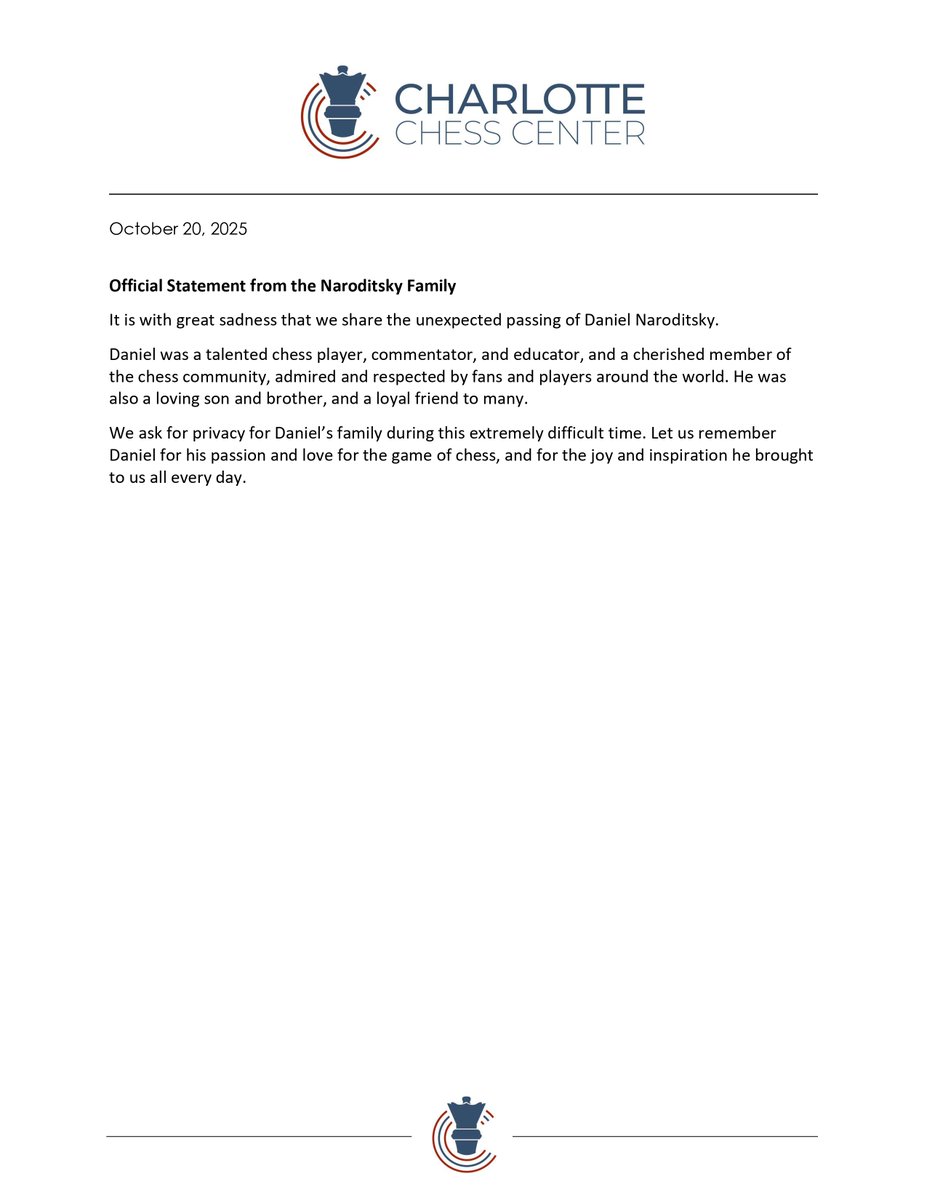
The Naroditsky family shares the sad news of Daniel’s unexpected passing. Daniel was a talented chess player, educator, and beloved member of the chess community. We ask for privacy as the family grieves.
Slide 9⃣: $ABVX Key Points and Summary of Thoughts
The market is extremely skeptical that $ABVX is going to hit in the upcoming P3 readout, and the stock has largely been forgotten or even simply ignored for years.
Most of this pessimism stems from a questionable/uncertain mechanism of action and P2b data that showed an inverse dose response, as well as mediocre outcomes on the most important endpoint: Induction clinical remission delta.
However, as I’ve discussed here, I’m not deterred by an unknown mechanism of action when the clinical data show me that the drug is active, which I strongly believe to be the case for $ABVX. For years, I’ve been bullish on $ABVX’s odds of success due to:
➡️The strength of the P2b results outside of the clinical remission delta (clinical response and endoscopic remission numbers looked more competitive)
➡️The fact that $ABVX’s P2b study had the most severe population of any UC study I have evaluated, explaining why their results might look worse despite having an active drug.
➡️The fact that the P2b maintenance data look as good as, if not better than any other maintenance datasets I can find and make apples-to-apples comparisons against.
➡️The fact that $ABVX’s extra-long-term OLE studies show their severe patients stay on their drug at rates matching or even exceeding what is seen with drugs that are already FDA-approved for UC!
These data have all supported my $ABVX bullishness historically, but when I realized the importance of the maintenance arm enrollment rate data that the company subtly released in June, my enthusiasm for their POS increased significantly.
↪️Knowing that the pooled response rate 87% of the way through the trial is actually higher than the P2b study’s was with its historically high placebo remission rate…I feel even more confident than before that the trial is going to hit, and I even consider it possible that “blue sky” level efficacy capable of generating >10x upside results could be in play. I think that the market has totally missed how bullish this data disclosure is, which is a big part of why I felt this pitch was compelling enough to share.
I strongly believe that $ABVX trading at $9.95 does not reflect how positively skewed the risk:reward setup is going into data, but we also must remember that downside here is steep (90%+) if the readout does fail (which is ALWAYS possible).
I expect data to come in August. In the meantime, I welcome feedback, thoughts, and questions on what I’ve shared here today! I’ll post the link to my >25K word pitch document here again:
https://t.co/10i67JmoZG
This user agreement is absolutely wild. You have to sign away your "knowledge, experience, concepts, ideas, and know-how" that the company "may retain and use". Just remember when something is "free", YOU are the product.