Hmm what's the right course of action when you see a $500m 'seed' round with every tier 1 VC there is going on a mission to work out the thing that you've just got working in your spare room?
@iskander Just because so much of bio uses primary cell lines, animal models or limited patient samples so brute forcing exploration or risk of sub-human expert human level accuracy doesn't seem morally right.
@draparente Yeah exactly, the 50% agreement with interpretation figure in this paper is really telling. Shifting the burden on the human to check everything won't work, the model needs to understand quality science. I think we've just cracked it with Allen, publishing results in a few weeks.
@hume_ai Awesome, I'd love to see an easy to connect back end agents (or data sources) with this voice capability to Google Meets and Teams invites where people expect to speak.
In a medical milestone, a customized base editor was developed, characterized in human and mouse cells, tested in mice, studied for safety in non-human primates, cleared by @US_FDA for clinical trial use, manufactured as a complex with an LNP, and dosed into a baby with a severe, rapidly progressing genetic disease... all in an astounding 7 months. Best of all, the infant patient shows apparent benefit. Congratulations to @kiranmusunuru, Rebecca Ahrens-Nicklas, and other team members for this heroic and inspiring effort, which has implications for the hundreds of millions of patients that suffer from thousands of genetic diseases.
https://t.co/wsgvvRYPVM
@hkanji Kind of insane that covid being an immunodeficiency virus (and potentially also oncogenic) isn't mentioned at all in most of these articles. Good review here if interested: https://t.co/ehhLc9cJZK
@DeryaTR_@TheAIVeteran@deepseek_ai Yeah the combo of Gemini Thinking and Claude critiquing in a loop is incredible, as long as you have really clear requirements. Equiv. of months of senior industry expert solution design time but in seconds.
Cancer vaccines failed due antigen down regulation, immune suppression and poor trial design. The research already exists to do way better but investors are spooked. Let's put 50% of this into trials and we'll get there way quicker.
Larry Ellison says the Stargate Project will construct the largest computer ever built which will enable AI to create cancer vaccines, personalized medicine and pandemic prevention
@guiporto@levelsio Great implementation of this. Is NK cell / KIR / TNF / DQ-alpha included under the 'etc' in immune? Also Translocation? PAI-1 4G/5G? These cover around 35% of root cause but can't see them on the summary so thought it was worth note.
@nabeelqu That’s true, don’t need o1-pro though, Sonnet is amazing at analogies. It is all a modern day ELIZA effect though, you need to a pretty tight shape of what you’re looking for to constrain the output into a useful shape.
He’s right, getting to level 4 (invention) is actually quite easy, you can try it right now on Elman. The hard part is tuning it to a long tail of customer preferences most of which aren’t explicitly known. Beyond simple queries the onboarding ramp is a cliff.
I've heard people claim that Sam is just drumming up hype, but from what I've seen everything he's saying matches the ~median view of @OpenAI researchers on the ground.
@wordgrammer Exactly what we run @deepsciventures, accredited PhD run in top universities but with venture compatible business intent from the beginning. https://t.co/SDOSed52fy
Awesome to see the largest funder of cancer research highlight one of our companies, Neobe, as an example of finding novel ways to address really hard areas like solid tumours.
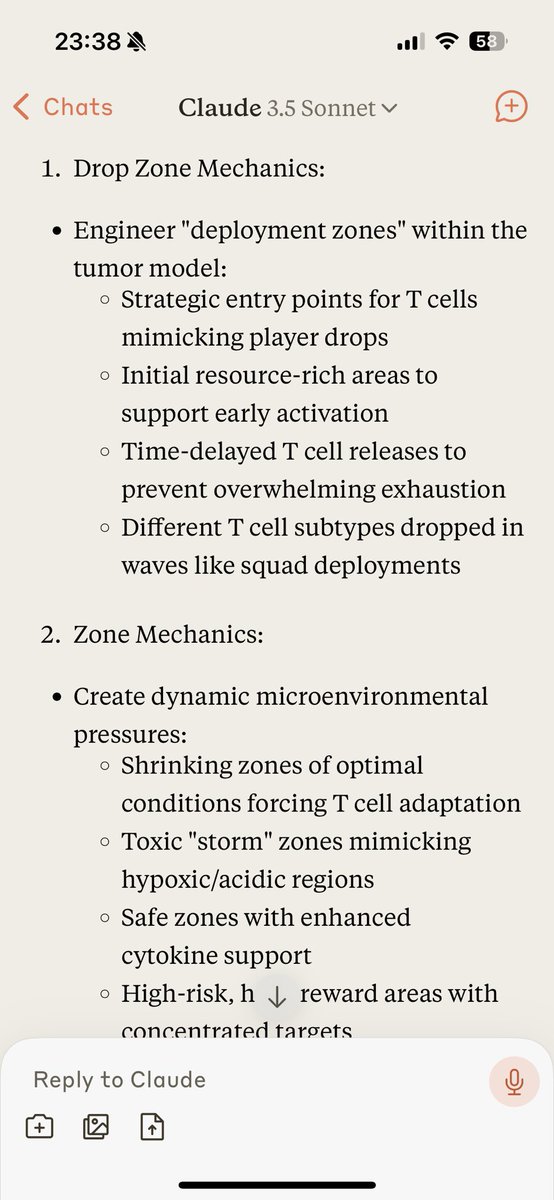
Testing claude's xml tokens in out scientific co-pilot and indeed the results are better than o1 on our test set. Claude still feels like the better power tool if you want control over idea exploration.
Claude 3.5 sonnet outperform openai o1 in terms of reasoning.
Prompt :
Begin by enclosing all thoughts within <thinking> tags, exploring multiple angles and approaches.
Break down the solution into clear steps within <step> tags. Start with a 20-step budget, requesting more for complex problems if needed.
Use <count> tags after each step to show the remaining budget. Stop when reaching 0.
Continuously adjust your reasoning based on intermediate results and reflections, adapting your strategy as you progress.
Regularly evaluate progress using <reflection> tags. Be critical and honest about your reasoning process.
Assign a quality score between 0.0 and 1.0 using <reward> tags after each reflection. Use this to guide your approach:
0.8+: Continue current approach
0.5-0.7: Consider minor adjustments
Below 0.5: Seriously consider backtracking and trying a different approach
If unsure or if reward score is low, backtrack and try a different approach, explaining your decision within <thinking> tags.
For mathematical problems, show all work explicitly using LaTeX for formal notation and provide detailed proofs.
Explore multiple solutions individually if possible, comparing approaches in reflections.
Use thoughts as a scratchpad, writing out all calculations and reasoning explicitly.
Synthesize the final answer within <answer> tags, providing a clear, concise summary.
Conclude with a final reflection on the overall solution, discussing effectiveness, challenges, and solutions. Assign a final reward score.