Exploring the frontier of AI & Startups 🚀 | Frequently sharing the latest in upcoming tech & breakthrough AIs 🤖 | Tech optimist. Let’s build the future. 🛠️
We all save posts we swear we'll read later. Then later never comes and they just pile up.
Two tools fixed that for me. TweetSmash brings back what you save on Twitter. LinkedMash does the same for LinkedIn. No more saving into a void!
Both built by my wife Ramya (@code_rams) and Karthikeyan (@_karthikyn). I'm not the maker, just a happy user who can't stop using them.
So here's my thing: 100 days, 100 posts. Tips on content and AI, plus how I actually use these tools.
Entering my 30s today 🥳
under the Eiffel Tower, with my little one✨
My 20s in a few lines:
- Started scrappy. Shipped messy. Learned that “done” beats “perfect” every time.
- Built Tweetsmash & Linkedmash from zero, every line of code, every late night, every “will this even work?”
- Became a mom and a founder at the same time, and learned you don’t have to choose. You just have to keep showing up.
- Realized growth is slow, quiet, and rarely looks impressive in the moment.
To my 30s self:
- Keep building slow, messy, beautiful things. Trust the boring days.
- The momentum you can’t see is still momentum.
- Your time will come for sure, just don't give up.
Here’s to the next chapter. 🚀
P.S: Getting a good pic with a toddler is still harder than growing MRR 😂
Karpathy is saying:
there are two types of people talking about AI right now, and they're basically speaking different languages.
That's exactly what's happening with AI right now.
Group 1 - the skeptics:
Used free ChatGPT a year or two ago. It gave wrong answers, made stuff up, sounded confident but was dumb. They laughed, moved on, and now when someone says "AI is amazing" they roll their eyes. "I tried it. It's not that great."
Group 2 - the believers:
Paying $200/month for the latest AI tools. Using them every single day to write code, solve complex problems, build products. They're watching AI do in 1 hour what used to take a developer 2 weeks. They're genuinely shocked. "You don't understand, this thing is different."
---
Why did AI get SO good at coding but not at normal stuff?
Simple reason: coding has clear right and wrong answers.
Either the code runs or it doesn't. Either the test passes or it fails. AI can practice millions of times and get instant feedback - "was that right? yes/no."
But writing a good email? Giving good advice? There's no clear score. Much harder to train AI to improve at that. So companies focused on coding because:
1. Easier to measure improvement
2. Businesses pay BIG money for good coding tools
---
So the weird situation we're in:
The same company (OpenAI) has a free voice assistant that can't answer "should I walk or drive to the carwash" - AND a paid coding tool that can independently rewrite an entire software product in an hour. Both exist right now. Both are real.
---
Karpathy's point:
These two groups are arguing online but they're not even talking about the same thing. The skeptic's experience is valid. The believer's experience is also valid. They just used totally different versions of AI for totally different tasks.
The people who truly get how powerful AI is right now are a small group: technical professionals who use the best paid tools daily for coding and research. Everyone else - including people paying $20/month for ChatGPT to help write emails - hasn't seen the real jump yet.
My AI agent was pinging me 15+ times a day.
Cron results, battery alerts, sync logs, tweet drafts, memory updates.
28 cron jobs. Every single one delivering straight to my phone.
Built a 3-tier notification system:
• Tier 1: Immediate (errors, context 80%+, battery critical)
• Tier 2: Batched digest, 2x a day (tweet drafts, cron health, revenue)
• Tier 3: Silent, log only (memory sync, index refresh, GitHub backup)
Paste this to your agent:
"Audit all my cron jobs and notifications. Categorize each into 3 tiers: immediate, batched digest, silent. Route critical alerts to a separate group. Batch everything else into a morning and evening digest. Silence anything I never act on."
Claude Code vs OpenClaw. The debate that won't die.
Honest answer from someone running both daily: he's mostly right.
Claude now has Telegram, cron jobs, 1M token memory, webhooks, 24/7 on a Mac Mini. That covers most of what solo users need.
But I run 2 SaaS products on 3 hours a day.
The gap shows up fast:
• Multi-model. Not locked to one provider. Claude for reasoning, GPT for ops, Gemini when it fits.
• Agent orchestration. 6 agents handling revenue, support, content independently.
• Skills ecosystem. Community-built, plug and play.
Claude Code is the best coding agent I've used.
OpenClaw is the operating system running around it.
If you're building a personal assistant, Claude Code is enough.
If you're running a business on autopilot, you need both. IMO.
Anthropic just added Telegram and Discord channels to Claude Code.
The pain point this solves is real.
Claude Code runs in your terminal. You start a task, walk away, and have zero visibility. No way to check progress. No way to steer it. No way to approve a PR from your phone while your kid is eating lunch.
Now you can message your Claude Code session directly from Telegram or Discord.
Start a task on your laptop. Monitor it from your phone. Reply, course correct, approve, all without going back to the terminal.
This is MCP-based, so it's extensible. Telegram and Discord are just the first two. Slack, WhatsApp, whatever, the pattern works.
If you're running long coding sessions, background tasks, or anything that takes more than 5 minutes, this changes how you work with Claude Code.
My OpenClaw was eating 4.2GB of disk space.
Browser cache: 2.9GB
Gateway error log: 126MB
Old media files: 147MB
Dead session files piling up
Paste this to your agent:
"Audit my ~/.openclaw directory. Break down disk usage by folder. Delete browser profile cache, session files older than 30 days, inbound media older than 14 days, and truncate gateway logs keeping last 1000 lines. Report before/after sizes."
4.2GB → 1.0GB in under a minute.
If you're running cron jobs, check if your sessions are isolated.
Main session crons dump every output into your context window. Isolated sessions don't.
Experimenting with a dedicated VPS for my company's AI operations.
Not my personal assistant.
A separate system that runs the business 24/7.
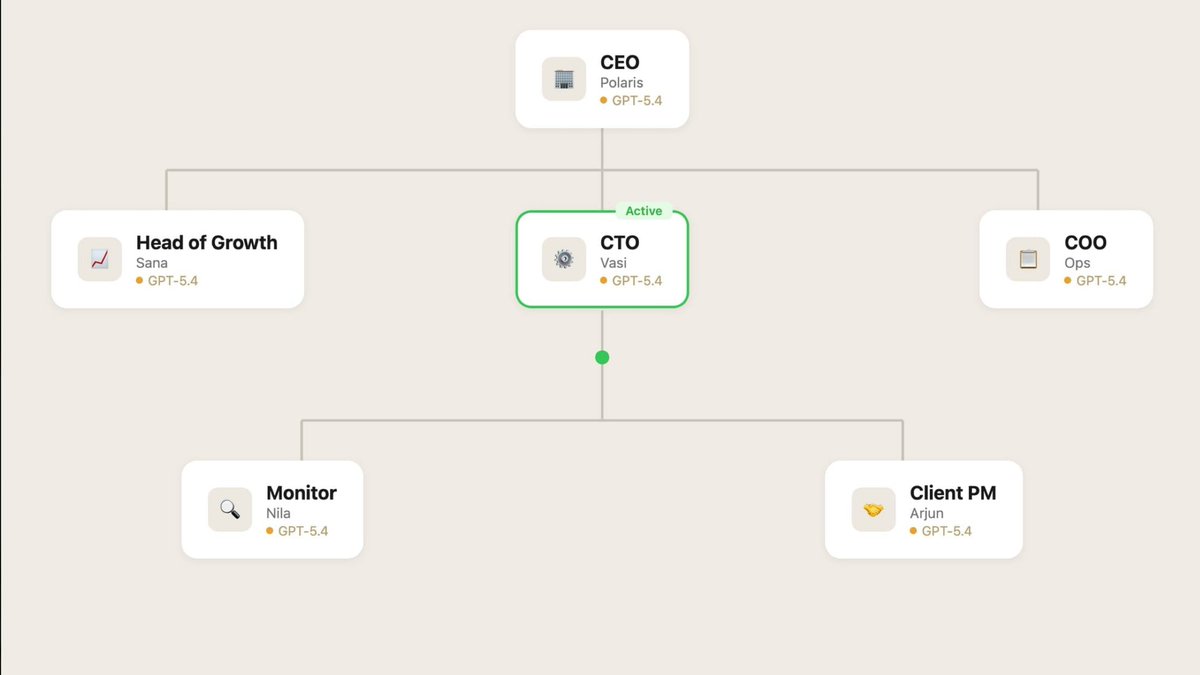
Introducing Polaris that takes charge of all my products.
What it does right now:
• 6 AI agents, each with a role (CTO, Growth, Monitor, COO, Client PM)
• Revenue dashboard pulling live from Stripe
• 6am: daily revenue report to Slack
• 9am: support emails scanned, categorized, replies drafted from past tickets, Notion updated
VPS cost: under €10/month. The API calls cost more than the server.
Still early. But the system already does more before 9am than I could do in a full morning. Will workout and fine tune on day by day with all the learnings.
Anthropic just ran the largest qualitative study in history.
80,508 people. 1 week. 159 countries. 70 languages.
The interviewer was Claude.
Here's what the data actually shows:
What people want from AI
18.8% professional excellence (do better work, not escape it)
13.7% personal transformation (therapy, coaching, growth)
13.5% life management (reduce mental load)
11.1% time freedom (get back to family)
9.7% financial independence
8.7% entrepreneurship
Not "replace my job." Do my job better.
Real stories in the data
- A healthcare worker: AI took away the documentation burden. She's more patient with nurses now. More present for her family.
- Someone was correctly diagnosed after 9 years of misdiagnosis. Using Claude.
- Someone got laid off because their company replaced their role with AI.
- An entrepreneur in Cameroon: "I'm in a tech-disadvantaged country. With AI I reached professional level in cybersecurity, UX, marketing, and project management simultaneously. It's an equalizer."
All of these exist in the same dataset.
The core finding
1. Hope and fear don't split people into two camps.
They live inside the same person.
2. A lawyer: "I use AI to review contracts, save time... and at the same time I fear: am I losing my ability to read by myself? Thinking was the last frontier."
Nobody in this study is naive.
They see the tradeoff.
They're taking it anyway.
The meta layer
Anthropic used Claude to run the interviews.
Claude to classify responses.
Claude to surface quotes.
AI studying how humans perceive AI.
Why they did this
The public AI debate is full of abstract projections.
Anthropic wanted to know what "AI going well" actually means to real people.
So they asked 80,508 of them.
Everyone is debating what AI might do.
This study is about what it's already doing.
To real people. Right now.
The debate is two years behind reality.
Most agent skills are one giant markdown file. 200+ lines. Loaded every session.
This article's key insight: skills are folders, not prompts.
9 categories: Knowledge, Verification, Data, Automation, Scaffolding, Review, DevOps, Debugging, Operations.
Detail loads only when needed. Not every time.
Applied it to Chiti today:
• Had 12 skills. 6 never triggered. Removed them.
• Split the rest into lean trigger + separate files.
Before: tweet-creator/SKILL.md
200+ lines
After:
SKILL.md ← 8 lines
style-guide.md ← writing rules
audience.md ← voice + examples
workflow.md ← steps 1-10
To reproduce:
1. List your skills
2. Remove what hasn't fired in a month
3. SKILL.md = trigger only. Detail goes in separate files.
Gotchas section in his article is the highest signal. Read that first.
Skills are folders. Not prompts.
"Design tax" is a perfect name for it.
Knowledge workers spend more time formatting than thinking. Every pitch, every proposal, every deck.
Same pattern shows up in AI agent work.
Context tax: skills loaded every session whether needed or not. Every token burned on rules you don't need right now.
The fix is the same in both cases: load only what's needed, when it's needed.
Gamma does it for design. Progressive disclosure does it for agent skills.
Pay less tax. Ship more work.
Vercel just shipped a plugin for coding agents.
It watches your file edits and terminal commands in real time, then injects the right Vercel knowledge into the agent's context automatically.
What's included:
47+ skills (Next.js, AI SDK, Functions, Storage, Turborepo)
3 specialist agents: AI Architect, Deployment Expert, Performance Optimizer
5 slash commands: /deploy, /env, /status, /bootstrap, /marketplace. Live validation that catches deprecated APIs as you build
No setup. No prompting.
Skills fire based on what the agent is actually working on.
Both my products are on Vercel.
My coding agent (Vasi) handles deploys, env vars, and debugging. With this plugin, it gets Vercel-specific expertise injected automatically based on what it's actually working on.
That's the difference between a generic agent and one that knows your stack.
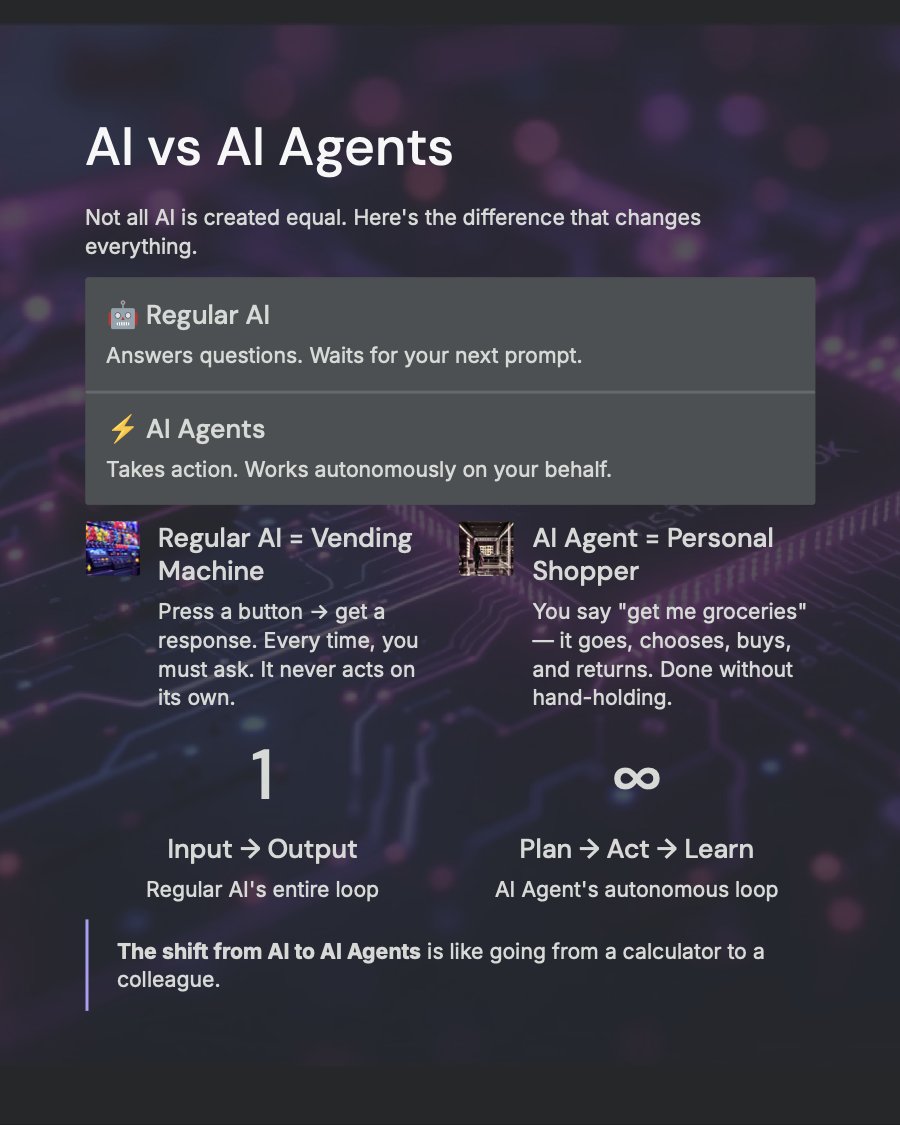
Someone asked me to explain the difference between AI and AI agents.
I said sure. Easy topic. I know this well.
Then I sat down to write it and hit the real problem: I could write 1,000 words, or I could show one good visual.
The visual wins every time.
I had no visual. No designer. I needed 4 of them.
This is the full story, with every prompt I used, and what I actually learned building it.
First I tried the obvious things.
Stock images: felt like a 2019 corporate deck.
Canva: 45 minutes in, hated everything I made. Searched for "AI agents infographic": nothing that fit.
Then I tried @GammaApp Imagine.
The hardest part of explaining AI agents: nobody can picture it. So I started with the simplest metaphor I could think of.
Prompt I used: "Infographic comparing AI vs AI Agents. Vending machine vs personal shopper. Vending machine = press a button, get output. Personal shopper = give a goal, they figure out how to get there. Dark background, clean typography, two-column layout."
First try. This came out.
Then I noticed something. Every time I struggled to write the prompt, it meant I did not actually understand what I was trying to explain. The tool was teaching me the topic.
Jensen Huang just made the OpenClaw centerpiece at GTC 2026.
"OpenClaw is the new computer."
"Every software company needs a Claw strategy."
It outpaced Linux's 30-year adoption in weeks.
Then NVIDIA announced NemoClaw, built on top of OpenClaw.
One command to deploy agents with NVIDIA's Nemotron models.
Here's everything that happened.
The biggest GTC 2026 announcements:
• Vera Rubin: next-gen AI supercomputer, 2400 TFLOPS, HBM4 memory
• Groq 3 LPU: 35x inference throughput over Blackwell
• DLSS5: neural rendering fusing 3D graphics with generative AI
• NemoClaw: enterprise OpenClaw with OpenShell runtime
• Every NVIDIA engineer now codes with AI agents (Claude Code, Codex, Cursor)
• Disney's Olaf robot walking on stage, powered by Jetson + Newton physics engine
The entire keynote had one theme:
AI moved from training to inference.
From copilot to operator.
I've been running my SaaS on OpenClaw for 2 months. Support, revenue, content, all through one agent on Telegram.
Greg Isenberg said it best:
"the future is solofounders with a team of agents."
That's not a prediction anymore.
Jensen just validated the entire stack on the biggest AI stage in the world.
The companies that figure this out first win.
Not because they have more people.
Because their agent never sleeps.
Codex now has subagents.
You can spin up multiple agents inside one Codex session, each focused on a different part of the task.
One writes the code, one writes the tests, one handles docs. All at once.
Less context clutter. Faster output.